Best Soil for Croton: Mix, Drainage & pH Guide
Best Soil for Croton: Mix, Drainage & pH Guide
Best Soil for Croton: Mix, Drainage & pH Guide
Quick Answer
The best soil for croton (Codiaeum variegatum, Joseph’s Coat) is a slightly acidic, well-draining container mix targeting pH 4.5–6.5, built from a light organic base cut with perlite, bark, or grit so water moves through the whole root ball. Two reliable recipes: Recipe A - 2 parts peat-free potting mix or coir, 1 part perlite, 1 part pine or orchid bark, plus a handful of worm castings per gallon; Recipe B - 3 parts peat-free ericaceous compost to 1 part grit, matching RHS codiaeum guidance. Always use a drainage hole, match pot size to the root ball (one size up only), and amend bagged mix with roughly 30% perlite and 10–15% bark before planting. For full transplant steps, see the croton repotting guide; this page covers what goes in the pot and how to test it.
By sai-ananth · Reviewed by LeafyPixels Review Board · Updated 2026-06-15
Why Croton Roots - Not Just Your Watering Can - Drive Leaf Drop and Color
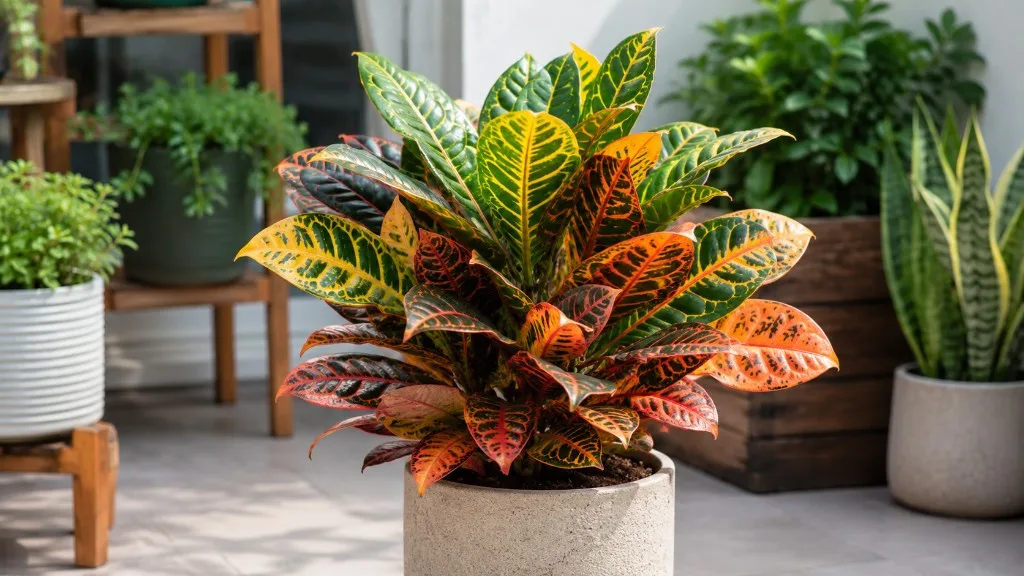
Bring home a nursery croton with flame-red Petra leaves and within a fortnight you may be sweeping a carpet of fallen foliage - not because you skipped a watering, but because the root zone changed while the plant was still sitting in a tight peat plug that dries unevenly under store lights. Codiaeum variegatum is a woody tropical shrub in the Euphorbiaceae family (NC State Extension - Codiaeum variegatum) grown almost entirely for pigment-heavy leaves that depend on healthy micronutrient uptake, not just nitrogen from a fertilizer bottle. Members of this family bleed milky latex sap when cut; it irritates skin and eyes, and all parts are toxic to cats and dogs if ingested (ASPCA - Croton). Contact your veterinarian promptly if a pet eats any portion of the plant.
Croton’s reputation for difficulty usually traces to substrate structure before watering technique. Waterlogged compost is a primary cause of root rot on Croton in codiaeums (RHS - How to grow codiaeum). Roots go dark and soft while upper leaves still look acceptable for a week or two. By the time half the foliage falls, damage is advanced. Prevention is structural: open mix, a pot with a hole, and a drying rhythm matched to how fast your blend dries in your light - not a calendar copied from the internet.
Soil also governs leaf color. Reds, oranges, yellows, and purples need iron and manganese staying soluble in a slightly acidic root zone. Alkaline or compacted mix locks those elements up, producing interveinal chlorosis - yellow tissue between green veins on new growth - even when you feed on schedule. Color fade often traces to alkaline, compacted substrate before you need more fertilizer. Fix the mix first.
What a Codiaeum Root Zone Needs
Think of croton soil as four jobs in one volume: hold moisture without saturation, hold air between particles, supply slow organic nutrition, and stay acidic enough for micronutrients. No single bagged product does all four perfectly; serious growers amend.
Moisture retention matters because croton dislikes drying to dust. Allow the top inch of mix to dry between waterings per Wisconsin Horticulture Extension, but the deeper root zone should not stay bone-dry for long stretches in active growth. Drainage and aeration come from perlite, pumice, coarse sand, or grit creating permanent pore spaces. Organic matter from worm castings or compost feeds biology and trace nutrients without salt shock on day one. Acidity keeps iron and manganese available; the RHS recommends peat-free ericaceous compost for codiaeums because standard loam-based mixes are too heavy and the wrong pH profile (RHS - How to grow codiaeum).
Croton evolved on humid forest margins and understory edges in Southeast Asia, Malaysia, Indonesia, and northern Australia (NC State Extension - Codiaeum variegatum), where organic litter breaks down into loose, airy, slightly acidic soil that never sits saturated for days. Your indoor pot is a compressed version of that environment.
Fine Roots, Pigment, and the Acid Band
Croton roots are relatively fine for a woody-stemmed tropical. They spread outward in the pot but suffocate fast in compacted, wet mix. Fine roots cannot punch through dense material the way a fiddle-leaf fig might. Well-draining for croton means structurally open - distinct particles visible when you squeeze a moist handful, not a uniform mud cake.
Cultivar and growth-form notes: Standard broad-leaf types like Petra build a moderate root mass in a 15–20 cm pot within one to two years. Narrow-leaf Mammy and corkscrew forms often stay in slightly smaller root volumes relative to leaf height but still punish oversized pots the same way - wet unused soil in the center is the risk, not leaf shape. When in doubt, match pot width to the root ball, not the canopy.
Recipe A vs. Recipe B: Which Mix Fits Your Habits
| Factor | Recipe A - Balanced tropical blend | Recipe B - RHS ericaceous + grit |
|---|---|---|
| Formula | 2 parts peat-free potting mix or coir : 1 perlite : 1 pine/orchid bark + handful worm castings per gallon | 3 parts peat-free ericaceous compost : 1 grit or coarse sand |
| Best for | Average indoor waterers; plastic or glazed pots; growers who want one all-purpose batch | Heavy waterers; cool rooms where mix dries slowly; growers matching RHS default |
| Drying speed | Moderate - top inch often dry in 5–8 days in bright indirect light | Faster - grit-heavy; check every 4–6 days in same conditions |
| pH alignment | Depends on base; usually lands near 5.5–6.5 with quality peat-free mix | Pre-calibrated acidic; aligns with RHS ericaceous recommendation |
| Color support | Strong when base is peat-free and hard water is minimized | Strongest when tap water is alkaline and color has washed out on old mix |
| Risk if neglected | Can stay wet too long if perlite/bark are skimped | Can dry faster at edges - watch underwatering on Croton right after repot |
Decision rule: Choose Recipe B if you tend to overwater, keep crotons in cooler rooms, or want the simplest path to RHS-aligned acidity. Choose Recipe A if you water conservatively, use terracotta, or already have coir and bark on hand. Both beat unamended bagged mix.
Ingredient Roles: Coir, Perlite, Bark, Ericaceous, and Worm Castings
What Each Amendment Does in a Croton Pot
Peat-free potting mix or coconut coir forms the backbone - moisture buffer and root anchor. Coir rewets more reliably than old peat that has dried out, which matters if you occasionally let the pot go a bit dry. Never use garden soil, topsoil, or raised-bed blends in containers; NC State Extension’s container handbook stresses that field soil compacts in pots and lacks the aeration container plants need.
Perlite or pumice creates air channels that stay open for years. Perlite is lighter; pumice holds slightly more moisture while draining. Aim for enough white or gray specks that the blend is visibly heterogeneous.
Pine bark fines or orchid bark prevents long-term compaction and mimics decomposed leaf litter in native habitat. Bark gives fine croton roots something to wrap around and resists the shrink-and-channel problem of peat alone.
Peat-free ericaceous compost (Recipe B base) is formulated for acid-loving plants near pH 4.5–6.0 out of the bag - inside the 4.5–6.5 band LeafyPixels uses across the croton care hub to match repotting guidance.
Worm castings add gentle nutrition and microbial life at roughly 5–10% of total volume. More is not better; excess holds moisture and salts.
Grit or coarse horticultural sand (Recipe B) sharpens drainage. Use horticultural grit, not beach sand. Grit-heavy mixes dry faster - pair with attentive watering or a slightly smaller pot.
Amending Store-Bought Mix: Step-by-Step
Yes, you can start with regular commercial potting soil - almost never straight from the bag. Most mass-market indoor mixes are fine-textured and perlite-light, adequate for forgiving pothos and inadequate for a croton that wants steady moisture without wet feet.
Buy a quality peat-free container mix labeled for houseplants. Read the ingredient panel: composted bark, coir, and perlite listed early are good signs. Avoid mixes heavy in unspecified forest products that break down into mush within a year.
Then amend before planting:
- Empty the bag into a tub or tarp.
- Add 30% perlite or pumice by volume.
- Add 10–15% orchid bark or pine fines if the base feels heavy.
- Optionally mix in 5% worm castings.
- Pre-moisten lightly while folding - mix should feel like a wrung-out sponge, not dripping.
If peat-free ericaceous compost is available locally, use it as the base and add grit at one part in four (Recipe B) - often less amendment work than fixing a neutral bag mix.
Do not use succulent or cactus mix alone; it dries too aggressively for a plant that wilts when the root zone goes completely dry for extended periods. A 50/50 blend with standard potting mix is a partial shortcut, not as reliable as a purpose-built tropical recipe.
Drainage, Aeration, and the Moisture Sweet Spot
“Croton likes moist soil” misleads growers. What croton likes is consistent access to water and oxygen at the roots - the same tension every tropical foliage plant navigates. Moist means damp particles around roots, not saturated sodden mix or hours in a saucer of runoff.
After a thorough watering, excess water should exit the drainage hole within seconds. Within 24–48 hours, the top inch should begin drying while the mid and lower root zone stays lightly moist. If the top is still wet and cold three days later in a warm, bright room, the mix is too dense, the pot is too large, or both.
Aeration is the overlooked half of drainage. Compacted mix collapses pore spaces. Old peat shrinks from pot walls, creating a gap where water runs down the sides without wetting the root ball - classic fake watering where the plant thirsts in a wet-looking pot. Bark and perlite resist that collapse longer than peat alone.
The moisture sweet spot feels like a kitchen sponge that has been used and wrung out: cool, flexible, no free water squeezing out. Probe the top inch; when dry but deeper mix clings slightly, that is your green light to water again - the same cue used in the watering guide.
pH, Hard Water, and Keeping Leaf Color Bold
Croton prefers slightly acidic soil in the pH 4.5–6.5 range - harmonized across LeafyPixels croton pages to match plant-detail data and the repotting guide. In that band, iron, manganese, and other micronutrients stay soluble. Push toward neutral or alkaline - above roughly 6.8 - and those elements become less available even when physically present in the mix. New leaves show interveinal chlorosis and variegated cultivars may wash out.
Peat-free ericaceous compost is formulated in the acidic range. Standard potting mixes often sit between 6.0 and 7.0, acceptable short-term but drifting upward over time. Hard tap water is a silent pH shifter: the RHS warns that regular hard tap water makes compost more alkaline, working against acidic conditions codiaeums prefer (RHS - How to grow codiaeum). Rainwater, distilled water, or filtered water reduces drift when you water.
You do not need a pH meter for one living-room croton, but if colors wash out despite good light and conservative feeding, test runoff or refresh mix at the next soil change rather than stacking fertilizer.
Mineral buildup - white crust on the soil surface or pot rim - signals accumulated salts from hard water or over-fertilizing. Flush with ample water until runoff runs clear, or replace mix entirely. More fertilizer on a salt-crusted pot worsens color and root problems.
Pot Size, Material, and the Drainage Hole Rule
A drainage hole is non-negotiable for long-term croton care. Decorative cachepots without holes are display sleeves only: grow in a functional inner pot that drains, lift out to water, and empty the outer shell. Leaving a croton in standing water is one of the fastest routes to root rot regardless of mix quality.
Pot material changes drying speed. Unglazed terracotta pulls moisture through walls and forgives slightly heavy mix. Glazed ceramic and plastic retain moisture longer - pair with grittier Recipe B or a careful watering hand.
Pot size matters as much as composition. Repot into a container only one size larger - roughly 2.5–5 cm (1–2 inches) wider than the current root ball. The RHS warns explicitly against overpotting: a pot much bigger than the rootball holds wet compost around unused space, staying soggy too long and triggering rot (RHS - How to grow codiaeum). Croton is not a plant that appreciates swimming in empty soil.
Depth should suit the root ball, not leaf height. A top-heavy croton may need a heavier pot for stability - use denser material or a stake, not a jump of two pot sizes.
Test Your Mix: One-Minute Drainage Check
You do not need a laboratory. The plant and pot tell you most of what matters within the first few water cycles after a mix change or purchase.
Watch new growth first. Healthy croton soil supports firm, brightly colored new leaves at stem tips during active seasons. Small, pale, or dropping new leaves often mean root stress - wet mix, dry mix, or compaction - before humidity alone is the culprit.
Check drying rhythm. Note how many days pass before the top inch dries in your typical room. A mix that dries in one day in a hot south window may take ten in a cool north room. The soil is working when that rhythm is predictable and matches your watering checks.
Smell the root zone if something feels off. Fresh, healthy mix smells earthy. Sour, swampy odors mean anaerobic conditions - roots starving for oxygen even if leaves have not yellowed yet.
Inspect roots when you unpot. Healthy croton roots are pale tan to white and firm. Brown, black, mushy roots with a foul smell indicate rot tied to waterlogging or old compacted media.
Reading Dry-Down After the First Soak
Run this after every mix change or when you suspect drainage problems:
- Water thoroughly until water runs freely from the drainage hole.
- Time runoff - it should start within seconds, not pool on the surface for minutes.
- After 30 minutes, lift the pot: heavier than dry, but no pooled saucer water if you emptied it once.
- After 24 hours, probe the top inch - approaching dry in a warm, bright room; deeper mix cool and slightly moist.
If water pools during step 1, the mix is too fine or hydrophobic - break surface tension gently or top-dress with fresh amended mix. If the pot still feels waterlogged at step 4 in normal light, add perlite or bark at the next refresh or downsize the pot.
When Soil - Not Calendar - Means Refresh
Croton can stay in its nursery pot one to two years if mix still drains and roots have room (RHS - How to grow codiaeum). Refresh substrate when soil condition, not the calendar, demands it:
- Roots circle the bottom or poke through drainage holes
- Mix has compacted, shrunk from pot walls, or smells sour
- Water runs down the sides without soaking the root ball
- The plant dries out unusually fast because roots consumed the medium
- Growth stalled despite good light and watering
- You are correcting root rot or pest-contaminated media
This page stops at mix choice, amendment, and soil-specific triggers. For step-by-step transplant technique, pot sizing workflow, latex-sap safety during the move, and week-by-week recovery timelines, use the croton repotting guide as the canonical procedure. Overlap is intentional but thin: here you decide what goes in the pot; there you execute how to move the plant.
Avoid refreshing a recently purchased or stressed croton unless nursery mix is clearly failing - sour smell, constant wetness, or active rot. Quarantine new plants, learn drying rhythm for two to four weeks per the overview, then plan a spring refresh if needed. Croton drops leaves when disturbed; unnecessary root trauma is part of soil care.
Top-dressing - scraping the top 2–3 cm of old mix and replacing with fresh amended soil - is a lighter alternative between full repots if lower mix still drains. Do this in spring, not late fall.
Common Soil Mistakes on Croton
Using garden soil or outdoor topsoil compacts in pots, drains poorly, and introduces pests. Croton is not a candidate for yard dirt in a container.
Adding a gravel layer at the pot bottom does not improve drainage - it creates a perched water table where fine mix above coarse material stays wetter (Penn State Extension - Debunking Garden Myths). Mix drainage amendments throughout the entire volume.
Planting in pure peat or pure coir without structural amendment gives great moisture at first, then shrinks and hydrophobes within a year. Always cut organic base with perlite and bark.
Overpotting to “give it room” leaves wet unused soil around roots. One size up - every time.
Repotting into dry mix and flooding once leaves dry pockets around roots. Pre-moisten mix and water gently after any refresh.
Ignoring the nursery plug - many store crotons sit in peat-heavy plugs that stay wet in low light. Slip the plant out at purchase; if roots circle or media smells stagnant, plan a spring refresh into amended mix.
Decorative pots without drainage with gravel falsely substituting for a hole. Use a functional inner pot or drill a hole.
Soil and Your Watering Rhythm Together
Soil and watering are one system split across two chores. The same croton watered on identical days dries at different speeds in perlite-heavy Recipe A versus coir-heavy blend, in terracotta versus plastic, in July versus January.
Your mix sets the range of days between waterings. Your light and temperature set the exact day within that range. Wisconsin Horticulture Extension notes croton has moderate water needs and drops leaves if kept too wet or too dry for extended periods - so the soil must make dry-down readable at the surface without leaving the core sodden.
When you change soil, reset watering assumptions. A newly refreshed croton in bark-heavy mix may need water more often at first while roots explore fresh media. Log drying pattern for two weeks rather than copying your old schedule.
Always empty the saucer after watering. Perfect mix still rots roots if the pot sits in collected runoff for hours.
Summer vs. Winter Substrate Behavior
Croton grows most actively in warm, bright months when light is strong and temperatures stay in the 60–85°F (16–29°C) comfort band most homes provide (Wisconsin Horticulture Extension). Roots occupy more mix, transpiration is higher, and the pot dries faster. Soil structure should support frequent watering without staying soggy - balanced Recipe A with adequate perlite and bark handles this well.
In winter, growth slows even indoors. Roots absorb water more slowly; the same mix that dried in five days in August may take twelve in December. Do not switch to heavier moisture-retentive soil in winter - water less often and keep the plant away from cold windows below 15°C (59°F), the minimum the RHS recommends for codiaeums (RHS - How to grow codiaeum).
Full repotting belongs in spring, not late fall. If you discover rot in winter, refresh into grittier mix as an emergency, then keep the plant warm and bright with minimal disturbance - details in the repotting guide.
After a Mix Change: Leaf Drop Recovery
Mass leaf drop after a substrate change terrifies croton owners, but it is often stress rather than immediate death - if you catch setup errors fast.
Most common causes after a mix change:
- Overpotting - new pot too large, mix staying wet in the center
- overwatering on Croton after refresh “to help it settle”
- Underwatering in very gritty mix before roots expand
- Cold or drafty placement below 15°C (59°F) (RHS - How to grow codiaeum)
- Direct sun on a stressed plant - keep bright indirect light until new growth
- Aggressive bare-rooting - croton prefers minimal root disturbance
Recovery protocol: Stable bright indirect light, moderate humidity if air is very dry, water only when the top inch dries, no fertilizer until new leaves appear. Remove fallen debris from the soil surface. If the stem is firm and green, fresh growth often returns in three to six weeks.
If stems soften or roots turn mushy, rot has advanced - see root rot on croton and the repotting guide for rescue steps into fresh grit-heavy mix in a smaller pot.
Croton Mix vs. Coleus, Calathea, Ficus, and Succulents
| Plant | Moisture preference | Drainage vs. croton | pH note | Reuse leftover croton mix? |
|---|---|---|---|---|
| Coleus | Consistent moisture; dislikes drying completely | Similar; coleus tolerates slightly heavier mix in bright outdoor sun | Slightly acidic to neutral ~6.0–7.0 | Yes, with minor tweaks |
| Calathea | Higher moisture retention; finer texture | Croton mix drains faster than most calatheas prefer | Similar acidic band | Add coir, reduce bark for calathea |
| Ficus (FLF, rubber tree) | Moderate; larger roots tolerate slightly heavier mix | More forgiving of bigger pots relative to roots | Less acid-demanding than croton | Cut croton mix with extra potting base for Ficus |
| Succulents / cacti | Sharp dry-down; minimal organic matter | Much sharper drainage | Often neutral to alkaline | No - do not use without heavy dilution |
| Dracaena / cordyline | Tolerates drier root zones | Leaner mix than croton | Less sensitive | Partial blend only |
When in doubt, batch a croton-specific blend rather than one “tropical houseplant mix” for every species on your shelf. The perlite-bark-ericaceous formula here is a reliable default for codiaeum alone.
Conclusion
The best soil for croton is a slightly acidic (pH 4.5–6.5), peat-free blend that drains in seconds, holds moisture like a wrung sponge, and stays open enough for fine roots to breathe between waterings. Build from a light organic base - potting mix, coir, or ericaceous compost - cut with perlite, bark, or grit, and enrich lightly with worm castings. Use the Recipe A vs. B table to match your watering habits, amend store-bought mix before planting, and never skip the drainage hole.
Test with the one-minute drainage check, refresh substrate in spring when roots crowd or mix breaks down - not on autopilot - and link to the repotting guide when the plant needs moving, not just new mix. If color fades before you reach for fertilizer, look at alkaline, compacted substrate and hard tap water first. Croton is demanding, but the demand is specific: give roots a humid tropical forest floor in a pot, and the foliage rewards you with color few common houseplants match.
When to use this page vs other Croton guides
- Croton overview - Start here for whole-plant context before deep-diving this topic.
- Croton problems hub - Jump to symptom-specific fix guides when this care topic does not resolve the issue.
- Root Rot on Croton - Escalate here when soil adjustments are not enough.
- Mold on Soil on Croton - Escalate here when soil adjustments are not enough.