Wilting & Melt on Cabomba: Aquarium Causes, Checks & Fixes
Quick answer
Wilting on submerged Cabomba is almost always melt: lower leaves shed, stems go limp or translucent, and fine needles cloud the water. First step: trim every mushy section, confirm firm stem tissue remains, and check aquarium PAR at stem height plus planting depth before changing CO₂ or fertilizer.
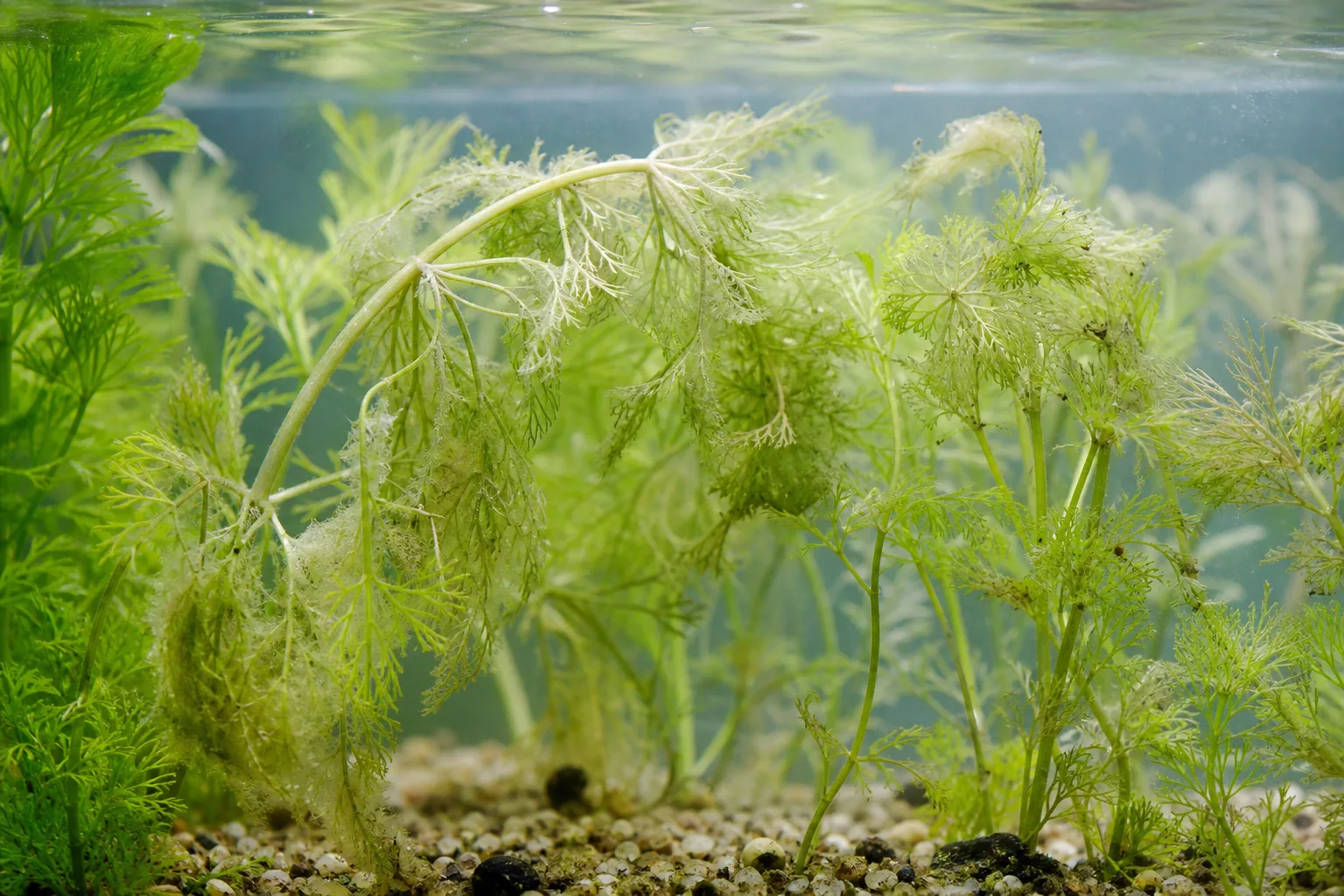
Wilting & Melt on Cabomba: Aquarium Causes, Checks & Fixes
This guide covers wilting on Cabomba. See also the general Wilting guide, watering, and light pages for this plant.
Wilting & Melt on Cabomba: Aquarium Causes, Checks & Fixes
Quick answer
When aquarists search “Cabomba wilting,” they usually mean melt-submerged stems going limp, fan-shaped leaves detaching as fine needles, and lower whorls turning translucent while tips may still look green for a few days. Cabomba (Cabomba caroliniana and related species) is a fully submerged freshwater stem plant, not a potted houseplant. It does not wilt from dry soil or low room humidity.
First step: trim every mushy or translucent section back to firm green stem, remove shed needles from the water, and inspect planting depth plus aquarium light at stem height before adding CO₂, fertilizer, or medication. Change one tank variable at a time so you can read the plant’s response over the next week.
This guide covers submerged aquarium and turtle-tank culture only. For species baselines, see the Cabomba overview. For chronic bare bases without mush, see not enough light. For long internodes on firm stems, see leggy growth.
Wilting vs lookalike problems
| Pattern | What you see | Stem firmness | Urgency | Next page |
|---|---|---|---|---|
| Melt / wilting (this page) | Limp stems, needle shed, translucent lower whorls | Declining; mush at base | Medium-act within 48 hours | This page |
| Low light bare base | Long bare internodes, green tips, no slime | Firm | Low-chronic PAR | Not enough light |
| Leggy stretch | Sparse whorls, elongated nodes, not mushy | Firm | Low-chronic intensity | Leggy growth |
| Copper / medication melt | Rapid whole-tank needle drop after dosing | Collapsing fast | High-same day | This page (medication section) |
If new tips stay firm and compact submerged whorls appear within two weeks, recovery is likely. If collapse keeps climbing into fresh tips after day seven, treat it as active deterioration-not routine store acclimation.
Photo guide - what to compare underwater
When you photograph symptoms for your own records or forum help, capture these two contrasts at the same tank depth:
- Reversible transition melt - Limp but still green lower whorls on a stem that feels firm when pinched; newest tip cluster stays solid and begins compact submerged growth within seven to fourteen days. Label with planting date, PAR reading at stem height, and whether stems were floated or buried.
- Active base rot or light failure - Translucent, slimy internodes with mushy texture, bare stem climbing upward, and soft tips that lose structure within forty-eight to seventy-two hours. Label with planting depth, recent water-change volume, and any medication dosed in the prior week.
These frames separate “trim, wait, and watch tips” from “replant shallow or float now” faster than symptom lists alone.
What wilting and melt look like on Cabomba
Submerged Cabomba fails in recognizable stages:
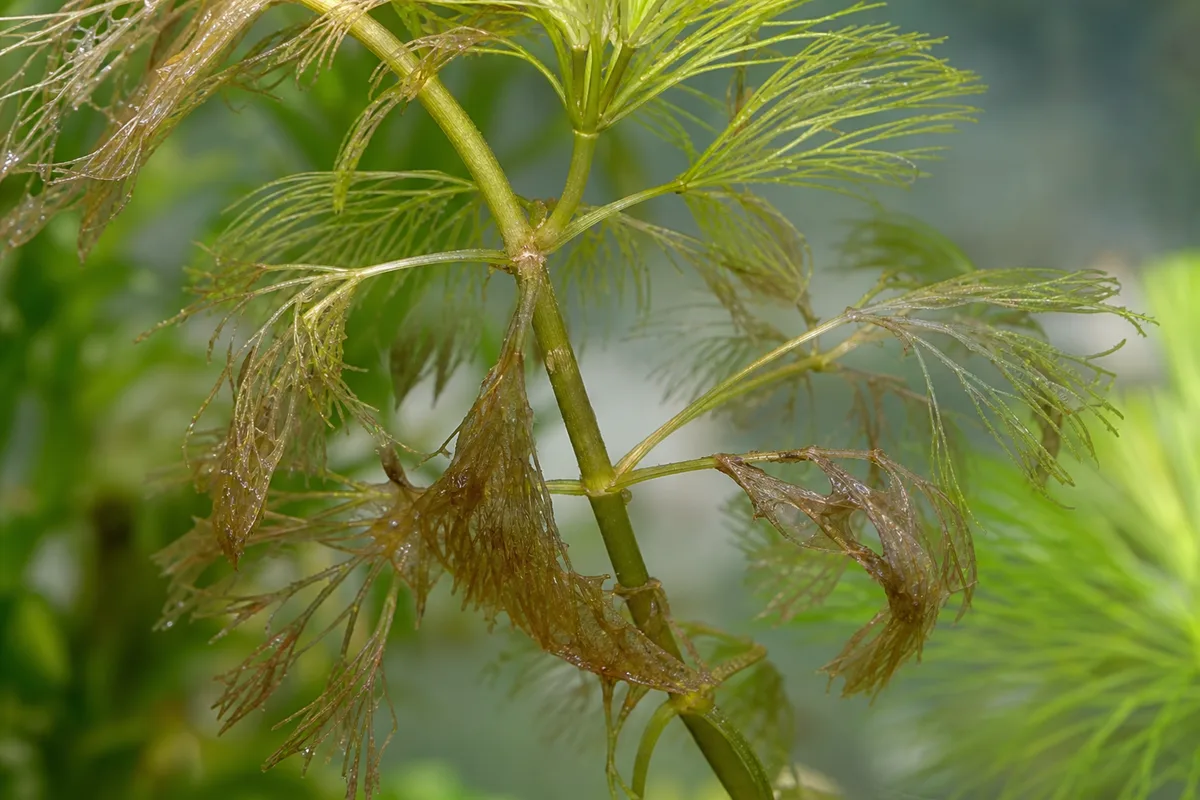
Wilting symptoms on Cabomba - compare with healthy tissue on the same plant.
- Needle shedding - feathery leaf segments detach and drift; the water column looks like green confetti
- Limp stems underwater - stems lose turgor and sag sideways instead of swaying upright in gentle flow
- Translucent or mushy lower whorls - tissue turns glassy, brown, or slimy at the base while upper leaves may still appear healthy
- Bare stem segments - lower internodes stay naked as the plant abandons shaded or rotting tissue
- Top-only green tuft - a small crown of leaves survives at the surface while everything below melts
- Floating uprooted bunches - stems rise from substrate when roots and buried tissue fail
- Tank-wide cloudiness after trimming - decaying fine leaves spike organics and clog filters if left in the tank
Early melt can look like ordinary “bad luck” for a day or two after planting. The distinction that matters is whether firm stem tissue remains after you trim mush and whether new submerged whorls emerge from tips within seven to fourteen days. Chronic wilting without new compact growth means the underlying cause-usually light, planting depth, water chemistry, or transition shock-is still unresolved.
Planted Cabomba vs floating recovery
Floating is the fastest diagnostic when PAR at depth is unverified. Firm tops held at the surface receive the highest light in the tank and often produce compact new whorls within seven to ten days if transition shock-not copper or rot-is the main issue. Float when stems keep uprooting, coarse substrate crushes buried nodes, or you need to confirm whether intensity-not nutrients-is the limiter.
Replanting belongs in the recovery phase, not day one of every melt event. Once you measure adequate PAR at the depth where lower leaves will attach, replant four- to eight-inch cuttings with one to two inches of bare stem buried and the first whorl just above gravel. Planted stems in matched light stay bushier long term; floaters are a bridge, not a permanent display solution for background Cabomba.
If floaters recover while planted neighbors in the same tank keep melting, depth or self-shading is confirmed-raise intensity, thin the canopy, or accept that red C. furcata may be beyond your current setup.
Tissue-culture cups vs emersed bunches
Emersed-grown bunches from farm tanks are the most common store format. Old aerial leaf forms die after submersion; five to ten days of lower-whorl shedding with firm tips is normal. Trim mush daily and resist burying feathery leaves to anchor stems.
Tissue-culture (TC) cups ship gel-grown plants that may never have seen open air. TC Cabomba often melts harder in the first week because every leaf form must switch to submerged growth at once. Rinse gel thoroughly, float individual stems for three to seven days in stable water, then plant shallow once tips firm up. Do not assume TC melt means your tank is broken-assume acclimation is slower and keep decay out of the water column.
Submersed-grown trimmings from another hobbyist tank skip most transition shock. If those stems melt immediately, suspect parameter mismatch, copper residue, or light at depth-not emersed conversion.
Why Cabomba wilts or melts in aquariums
Cabomba grows with all photosynthetic tissue below the water surface in slow-moving freshwater. When tank conditions diverge from that biology, the plant sheds leaves rather than persisting in a losing environment.
Insufficient submerged light is the most common chronic cause for green Cabomba. The plant stretches toward photons, drops lower leaves that receive too little photosynthetically active radiation, and leaves bare limp stems behind. Stock fish-kit LEDs on tanks deeper than about thirty centimeters often trigger this pattern within two weeks.
Emersed-to-submerged transition shock hits newly purchased bunches. Commercial farms grow Cabomba emersed; when you submerge it, old leaf forms die as submerged foliage replaces them. That is normal for several days but must not be confused with months of base-up melt.
Buried stem rot develops when too much stem sits under gravel, when decaying lower sections stay planted, or when anaerobic pockets form around buried nodes. Rot travels upward; the stem feels soft and may smell foul underwater.
Parameter shock from large water changes, cold tap water, or hard alkaline water stresses fine leaves quickly. Cabomba is a water-column feeder that grows well in silty substrate but exhibits reduced vigor in hard substrates; it cannot buffer sudden chemistry shifts the way rooted terrestrial plants might in soil.
Poor water clarity and excessive flow coat feathery leaves with detritus or strip tissue mechanically. Stems look wilted even when PAR at the fixture is technically adequate.
Copper-based fish medications and some algaecides cause rapid die-off because Cabomba is sensitive to copper-the same chemistry used in aquatic herbicides against fanwort in wild waterways.
CO₂ and nutrient imbalance at high light produces pale limp growth and algae-coated leaves. This is more common on red Cabomba and high-tech tanks than on moderate green fanwort, but it still reads as “wilting” when stems thin and collapse.
Turtle and high-bioload tank melt
Turtle tanks combine heavy bioload, warm surface water, and aggressive digging-three stressors Cabomba tolerates poorly. Decaying fanwort needles decompose fast in warm water, spike organics, and can push ammonia upward while filters catch fine debris. If melt appears after a turtle rearranges substrate or knocks stems loose, treat it as urgent: net all shed needles the same day, trim mush above the last firm node, and float salvage tops away from digging zone until PAR and water clarity stabilize.
Do not leave melting Cabomba in turtle displays hoping fish will eat it-most turtles ignore fine needles, and rotting plant matter fouls water faster than intact stems. Match species to setup: green C. caroliniana in a partitioned grow-out with moderate LED light fares better than red fanwort in an open basking tank.
Green Cabomba vs. red Cabomba: different urgency
Green Cabomba (C. caroliniana) tolerates moderate aquarium light without pressurized CO₂ if water is clear and stable. Wilting here is often fixable by raising PAR at stem height, trimming bare bases, and replanting firm tops. You usually have one to two weeks of margin before the entire stand dissolves.
Red Cabomba (C. furcata) wilts faster when PAR or CO₂ falls short. Long internodes, greenish washout, and stem collapse within days-not weeks-signal that Cabomba overview is beyond what a low-tech tank can support. Treat red fanwort melt as urgent: confirm eighty-plus PAR at stem height and injected CO₂ before assuming transition shock.
If you are unsure which species you bought, assume red-grade demands until proven otherwise. Mislabeled red stems in beginner tanks are a common reason entire bunches melt before the keeper identifies light as the problem.
Lookalike symptoms to rule out
Not enough light produces bare bases and elongated internodes while tips stay green-the same silhouette as melt but driven by chronic low PAR. Confirm with a PAR reading or float test; see the not enough light guide if lower stems stay bare after mush is trimmed.
Nutrient deficiency can pale new growth, yet lower-leaf drop with long bare stems on an otherwise stable tank still points to light or rot before iron alone. Confirm PAR and stem firmness first.
Snail or fish damage shreds leaves mechanically. Look for ragged edges, bite marks, and stems stripped unevenly-not uniform translucent mush from the substrate up.
Algae-coated leaves mimic decline because blocked light suffocates tissue. If algae fuzz covers whorls while water tests are stable, rebalance light duration and CO₂ before declaring total plant failure.
Leggy growth without mush is etiolation, not rot. Stems stay firm but sparse; fix intensity rather than emergency trimming.
How to confirm the cause
Work through this tank inspection checklist in order:
- Stem texture - Pinch lower stem gently. Firm green tissue can recover after trimming; soft, translucent, or smelly tissue is rot or advanced melt-cut above the last firm node.
- Planting depth - Bare stem buried one to two inches with the first whorl above substrate is correct. Deeper burial or buried leaves predict rot.
- PAR at stem height - Measure where lower leaves attach, not at the water surface. Green Cabomba typically needs thirty to forty µmol m⁻² s⁻¹ minimum at that point.
- Age of planting - Stems added within the last two weeks may shed from emersed transition; melt climbing past day seven in matched water suggests rot or light, not normal acclimation.
- Water clarity and flow - Note debris on leaves and whether filter outflow blasts the background cluster. Diffuse flow and clean water restore usable light at depth.
- Recent water changes - Large cold changes or unmatched GH/pH explain sudden needle drop forty-eight hours later. Review the Cabomba watering guide for change volume and temperature matching.
- Medication history - Copper or algicide dosing in the last week explains rapid whole-tank melt.
- Species and CO₂ match - Red stems in low-tech tanks or high PAR without CO₂ predict collapse regardless of other care.
- Float test - Float one firm top for seven to ten days. Compact new whorls on the floater while planted neighbors keep melting confirms depth or intensity limits.
If tips stay firm, new submerged leaves appear within two weeks, and mush stops after the first trim, transition shock was likely. If bases keep rotting after shallow replanting, inspect GH and flow before buying replacement bunches.
First fix for Cabomba
Trim all mushy or translucent tissue immediately, net shed needles, and replant only firm stem with one to two inches of bare nodes buried-or float tops temporarily if light at depth is unverified.
That single cleanup prevents decay from fouling the tank and reveals whether healthy tissue remains. After trimming:
- If stems were buried deep, replant shallow per the Cabomba overview planting guidance
- If PAR at stem height is below target, increase aquarium LED intensity or lower the fixture per the light guide before changing fertilizer
- If a copper medication was dosed, stop treating with copper-sensitive plants in place and follow product guidance for carbon or water changes
Do not fertilize melted stands on day one. Do not stack CO₂, replanting, and major water changes the same afternoon. Do not extend photoperiod beyond ten hours to compensate for weak intensity-that fuels algae on feathery leaves without stopping melt.
Step-by-step recovery
After the initial trim and one identified correction:
- Remove decay daily - Net floating needles and pull any new mush before it spikes ammonia
- Replant or float firm tops - Use four to eight inch cuttings with bare lower stems; discard rotten bases
- Set eight- to ten-hour photoperiod on a timer - Consistency beats ad hoc long days
- Acclimate intensity - Ramp LEDs from fifty to seventy percent over two weeks after major upgrades
- Space stems - Plant small clusters with a few centimeters between groups so light penetrates
- Match water changes - Twenty-five to thirty percent weekly with temperature within two degrees Fahrenheit of tank water
- Add CO₂ only after light is confirmed - High PAR without carbon supplementation often produces algae before compact recovery
- Propagate from healthy tips - Follow propagation steps rather than waiting for bare stems to resprout-lower nodes rarely refoliate
Judge success on new compact whorls at tips, not on old bare internodes filling in.
Example recovery log (green Cabomba, 20-gallon background)
Tank note - March 2026, 50 cm deep, stock LED fixture.
| Day | Action | PAR at stem height | Plant response |
|---|---|---|---|
| 0 | New emersed bunch planted deep; base mush within 72 hours | ~18 µmol m⁻² s⁻¹ | Lower two whorls translucent; tips firm |
| 1 | Trimmed mush, floated two firm tops, netted needles | - | Floater tips green; planted stems still limp |
| 7 | Floater showed compact new whorls; replanted shallow after raising LED to ~70% | ~42 µmol m⁻² s⁻¹ | Planted stems firm at base; one bare internode each |
| 14 | Weekly trim; spaced stems 3 cm apart | ~45 µmol m⁻² s⁻¹ | New submerged whorls every 2–3 nodes; melt stopped |
This timeline is typical for light-limited green fanwort-not a guarantee. Red C. furcata or copper-damaged stems rarely recover on this schedule without CO₂ and higher PAR.
Recovery timeline
Transition melt from new purchases often stabilizes in one to two weeks once mush is trimmed and water matches. New submerged leaves at tips confirm the plant is past shock.
Light-correction recovery shows tighter whorl spacing on new growth within one to two weeks after PAR at stem height reaches adequate levels. Bare stem segments never refoliate; trim and replant tops instead.
Buried rot or copper damage may require discarding all but the top five to ten centimeters of each stem. Total stand recovery from severe melt can take three to four weeks if light, CO₂, and water stability align.
If no firm new whorls appear within four weeks after corrected PAR and shallow replanting, replace the bunch and revisit species choice-red Cabomba in low-tech hard water rarely rebounds.
What not to do
Do not treat Cabomba melt with houseplant logic-there is no soil to dry out, no saucer to empty, and window light rarely fixes submerged PAR at depth.
Do not bury feathery leaves to anchor stems; that accelerates rot.
Do not dose copper ich medication in planted tanks without checking labels and accepting plant loss.
Do not leave melting debris in turtle or high-bioload tanks; decaying fanwort fouls water faster than most stems.
Do not assume fertilizer fixes limp stems when PAR is below thirty at the base-nutrients cannot replace photons.
Do not release trimmings into ponds, streams, or storm drains. Cabomba is an invasive species in many regions; fragments establish wild populations easily. Dry and discard in sealed trash.
Cabomba care cross-check
| If you observe… | Likely cause | First adjustment |
|---|---|---|
| Bare base, firm tips, long internodes | Low PAR or self-shading | Raise intensity, trim tops, verify stem-height PAR |
| Mushy base shortly after planting | Buried stem rot | Trim rot, replant one to two inches bare stem only |
| Whole-plant transparency days after purchase | Emersed transition or TC acclimation | Trim mush, float tops, stable water, wait for tip growth |
| Sudden melt after water change | Temperature or GH/pH shock | Match change water; reduce single-change volume |
| Melt after medication | Copper or algicide | Remove decay; carbon per label; replant later |
| Red stems collapse in low-tech tank | Species/light/CO₂ mismatch | Switch to green fanwort or upgrade light and CO₂ |
| Needles coated in brown debris | Flow or clarity issue | Diffuse filter output; increase mechanical cleaning |
| Melt in turtle tank after digging | Uprooting + organics spike | Net debris daily; float salvage; partition grow-out |
Light, water chemistry, and flow interact on this species. Use the cross-check with the overview hub for species biology and legal disposal notes.
How to prevent wilting and melt next time
Verify fixture PAR against tank depth before buying stems-not after melt.
Acclimate new bunches with temperature float, gradual water mixing, and shallow planting. Rinse TC gel and float TC stems longer than emersed bunches.
Trim tops weekly during fast growth so lower whorls keep receiving light.
Keep GH in the soft to moderate range Cabomba prefers; hard substrates reduce vigor even under good lights.
Run moderate diffuse flow; aim filter returns away from background stems.
Quarantine and inspect store plants under adequate light before adding them to display or turtle tanks.
Choose green C. caroliniana for moderate-light community setups; reserve red C. furcata for high-tech tanks with CO₂.
When to worry
Treat as urgent when mush climbs from base to tip within three to five days in an otherwise stable tank, when decay spikes visible ammonia or fouls turtle water, or after copper dosing with rapid needle drop across every stem.
Also act quickly on red Cabomba collapse in low-tech tanks-the window before total loss is shorter than for green fanwort.
Mild lower shedding with firm tips during the first week after planting is common and correctable, not an emergency-trim, confirm PAR, and watch for new submerged whorls.
If corrected light, shallow replanting, and clean water fail to produce compact new growth within four weeks, discard melted stands and reset with species matched to your actual tank parameters.
Conclusion
Cabomba wilting in aquariums is melt-a submerged stem plant shedding fine leaves when light, planting depth, water stability, or transition stress exceeds what fanwort tolerates. Trim mush first, replant only firm tissue, measure PAR where leaves actually grow, and change one tank variable at a time. Green fanwort recovers when those basics align; red fanwort demands higher light and CO₂ from the start. Get the diagnosis domain right-tank parameters, not houseplant soil-and Cabomba returns the dense feathery background that made it worth the extra attention.
When to use this page vs other Cabomba guides
- Cabomba watering guide - Use for routine moisture checks before assuming wilting is the main issue.
- Cabomba problems hub - Browse all 16 common issues on this species.
- Underwatering on Cabomba - Different entry point when symptoms overlap with wilting.
- Overwatering on Cabomba - Different entry point when symptoms overlap with wilting.
- Root Rot on Cabomba - Different entry point when symptoms overlap with wilting.