Leggy Growth on Cabomba: Causes, Checks & Fixes
Quick answer
Leggy Cabomba is etiolation-bare lower stems, stretched internodes, and a small feathery tuft at the tip-caused by insufficient submerged PAR at the height where leaves attach. First step: measure photosynthetically active radiation at stem height (not the water surface), then increase aquarium LED intensity or lower the fixture before trimming, fertilizing, or adding CO₂.
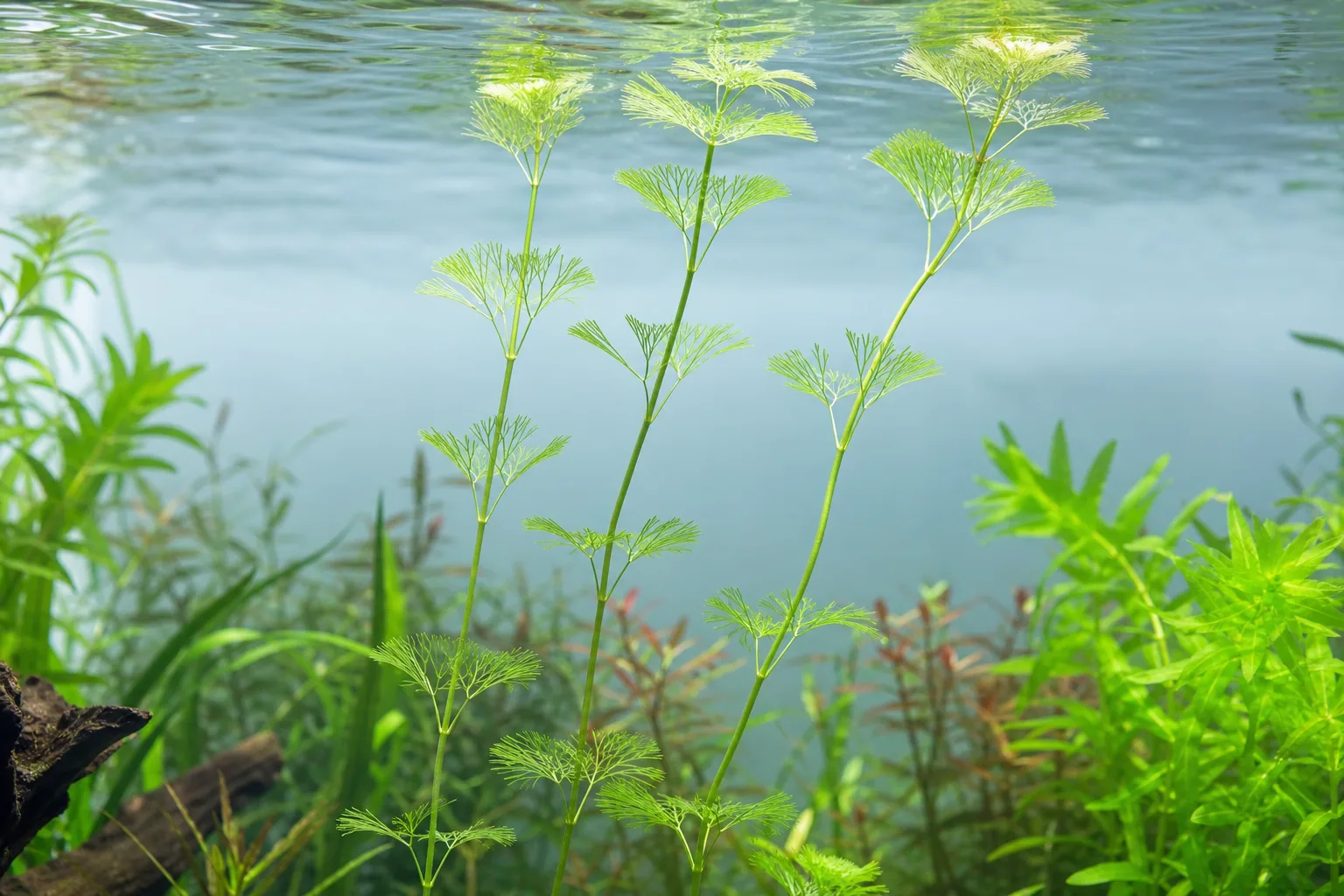
Leggy Growth on Cabomba: Causes, Checks & Fixes
This guide covers leggy growth on Cabomba. See also the general Leggy Growth guide, watering, and light pages for this plant.
Leggy Growth on Cabomba: Causes, Checks & Fixes
Quick answer
Leggy Cabomba (Cabomba caroliniana, Carolina fanwort) is not random bad luck-it is etiolation, the plant stretching toward usable light when submerged photosynthetically active radiation (PAR) at stem height stays too low. The classic pattern is a long bare stalk with a small feathery crown: lower fan-shaped underwater leaves drop, gaps between whorls widen, and only the top keeps growing toward the brightest zone in the tank.
First step: measure PAR where the lowest healthy leaves attach-not at the water surface and not from a window across the room. Green Cabomba typically needs at least thirty to forty µmol m⁻² s⁻¹ at that depth. If readings fall short, increase your dedicated aquarium LED output or mount the fixture closer to the water before trimming, dosing fertilizer, or adding CO₂.
For broader low-light diagnostics-including fixture audits, photoperiod checks, and turtle-tank caveats-see not enough light on Cabomba. This guide focuses on recognizing leggy etiolation, confirming it, and reversing it with light plus trim-and-replant.
What leggy Cabomba looks like
Leggy growth on Cabomba follows a predictable underwater sequence that differs from healthy compact fanwort:
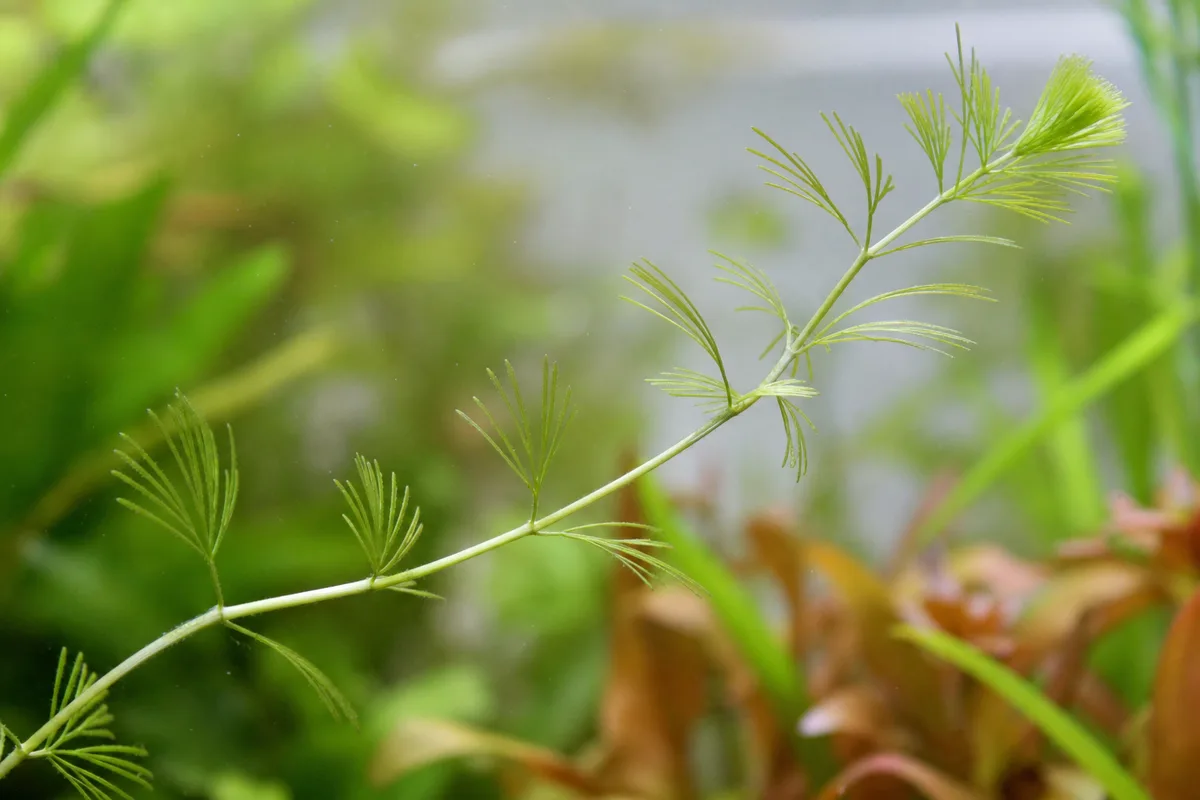
Leggy Growth symptoms on Cabomba - compare with healthy tissue on the same plant.
- Bare lower stems first - feathery leaves near the substrate yellow, detach, and drift; naked brown or green stalk segments appear at the base while tips may still look fine
- Internode elongation - gaps between leaf whorls stretch from roughly one centimeter to two, three, or four centimeters; stems lean or grow toward the tank’s brightest corner
- Crown-only foliage - the plant becomes a wand with a small feathery tuft at the top, the look beginners assume is “just how Cabomba grows”
- Smaller, less divided tip leaves - new whorls lose the dense lime-green feather texture
- Floating cut stems - weak or trimmed pieces rise toward the surface where PAR is highest
- Progressive bottom-up decline when light at depth stays chronically low
Early legginess can be subtle: one bare centimeter at the substrate with otherwise healthy tips. Left uncorrected, even a well-started stand turns into sparse background wands within two to three weeks-especially when fast top growth shades its own base.
Internode spacing: your quickest field check
You do not need lab equipment to spot etiolation. Pinch the stem between two consecutive leaf whorls:
| Spacing between whorls | What it usually means |
|---|---|
| Under ~1 cm, dense feathery leaves | Adequate submerged PAR at that height |
| 1–2 cm, slightly sparse lower stem | Light marginal-trim tops and verify PAR before bases go bare |
| Over 2 cm with bare lower stalk | Chronic under-lighting; old internodes will not shorten |
Measure at mid-stem and near the substrate. A strong reading at the surface with bare bases below confirms depth attenuation or self-shading-not a nutrient problem.
Why Cabomba stretches in aquariums
Cabomba is a fully submerged stem plant rooted in slow water. Its photosynthetic tissue lives entirely below the surface; room lamps and window light through glass cannot deliver the photon density Cabomba needs at planting depth in a typical forty- to fifty-centimeter tank.
Light intensity drops sharply as it travels through water and as depth increases. A fixture that looks bright at the surface often leaves background stems starved ten to twenty centimeters above the substrate-the exact zone where Cabomba holds its lower whorls. When PAR falls below the plant’s compensation point, Cabomba sheds expensive lower foliage and invests growth in stem extension toward brighter water.
Three aquarium-specific drivers make legginess common:
- Stock LED hoods - fish-viewing fixtures rarely sustain Cabomba in tanks deeper than about thirty centimeters
- Self-shading - fast top growth intercepts photons before they reach lower whorls; without weekly trimming, even a once-adequate setup leaves bare bases within weeks
- Species mismatch - red C. furcata needs substantially higher PAR than green C. caroliniana; treating them identically produces leggy red stems that lose color toward the surface
In turtle tanks, basking lamps heat the surface but do not substitute for full-spectrum submerged lighting matched to stem height. Cabomba listed as unsuitable for low-light setups fails predictably when treated like shade-tolerant Anubias or Java fern.
When light is too low, C. caroliniana grows weak and tends to etiolate regardless of water hardness or pH-light comes first for this species.
Lookalikes to rule out before you raise PAR
Acclimation melt after purchase turns emersed leaves transparent or mushy within the first one to two weeks while roots anchor. New submerged whorls from tips confirm recovery even if old tissue dies. Chronic legginess keeps tips alive but bases bare over a longer timeline-often on stems older than three weeks.
Not enough light broadly overlaps heavily with leggy growth; if you are unsure whether PAR, photoperiod, or fixture type is the limiter, work through the dedicated not enough light guide before stacking fixes.
Nutrient deficiency can pale new growth, but lower-leaf drop with long internodes on an otherwise stable tank still points to light first in Cabomba. Confirm PAR at stem height before chasing iron or nitrate alone.
CO₂ limitation at moderate PAR produces pale, slow growth and algae on leaves-but stems may still hold some lower foliage. At high PAR without CO₂, algae often arrives before Cabomba compacts. Match carbon to intensity rather than treating CO₂ as a substitute for photons.
Dirty or stagnant water yellows and melts tissue tank-wide, not just at the base. Check clarity, ammonia, and filter flow when multiple species decline together.
Turtle or fish damage shreds feathery leaves mechanically. Look for bite marks and floating fragments rather than uniform internode stretch toward the light source.
Self-shading from overgrown stands mimics weak fixture output. Trim and replant before buying a new light if PAR at the surface is strong but the base is bare.
How to confirm leggy growth is a light problem
Work through these checks in order before dosing iron, replanting in richer substrate, or adding CO₂:
- PAR at stem height - Measure where lower leaves attach, not at the water surface. Green Cabomba typically needs at least thirty to forty µmol m⁻² s⁻¹ at that point; bare bases with healthy tips strongly suggest readings below that range. See Cabomba light requirements for species-specific PAR targets.
- Internode audit - Mark a stem with tape at the lowest whorl; recheck spacing after one week. Widening gaps confirm etiolation even when tips look green.
- Surface vs base comparison - Dense tip whorls with thirty centimeters of bare stem below mean light is not penetrating-or the canopy is self-shading.
- Fixture audit - Identify whether the tank runs a planted-aquarium LED with published output or a stock fish-kit hood. The latter rarely sustains compact Cabomba long term in deep tanks.
- Photoperiod check - Confirm eight to ten hours on a consistent timer. Extending lights beyond ten hours to compensate for weak PAR usually fuels algae on feathery leaves without restoring lower growth.
- Floater test - Float one healthy stem tip at the surface for seven to ten days. Compact new whorls on the floater while planted neighbors keep losing lower leaves confirms depth and intensity-not macronutrients-as the limiter.
- Planting age - Stems planted within the last two weeks may melt from emersed-to-submerged transition regardless of light. Bare-base elongation on older stems points to lighting.
If PAR at stem height is already adequate and internodes still stretch, inspect for stem rot, snail damage, or turtle shredding before raising light further.
First fix for leggy Cabomba
Increase submerged PAR at stem height by upgrading or repositioning your aquarium LED-then leave photoperiod and nutrients stable for two weeks.
Lower a dimmable fixture toward the water surface, swap a stock hood for a planted-tank LED with verified output at your tank depth, or add a second strip to cover the background zone evenly. Target at least thirty to forty µmol m⁻² s⁻¹ at the height where lower leaves attach for green Cabomba. Start at fifty to seventy percent intensity for the first week if stems are newly planted, then ramp to full target output.
Do not rely on moving the tank closer to a window. Do not extend photoperiod beyond ten hours as a substitute for weak intensity. Do not fertilize heavily on day one-a stressed Cabomba in dim light cannot use extra nutrients and algae may colonize feathery surfaces first.
Light correction alone will not refill bare bases. Plan to trim and replant once PAR is confirmed-see the step-by-step recovery below and the Cabomba pruning guide for cutting technique.
Step-by-step recovery after the lighting upgrade
- Trim bare lower stems - Cut above the last healthy whorl and replant two to three centimeters of bare stem in substrate, or float tops temporarily until roots form.
- Thin the canopy weekly - Remove the top eight to twelve centimeters when stems reach the surface so light reaches mid-stem leaves before they detach.
- Set an eight- to ten-hour timer - Consistent photoperiod beats random long days. Ramp from six hours during the first week after a major intensity jump if algae appears on leaves.
- Space plantings - Plant stems in small clusters with a few centimeters between groups so neighboring whorls do not block light from each other.
- Improve water clarity - Increase filtration or water-change frequency if debris or tannins darken the column; usable light at depth depends on clear water.
- Add CO₂ only after light is confirmed - In high-PAR setups above roughly fifty µmol m⁻² s⁻¹, injected CO₂ helps Cabomba use the extra energy. In low-tech tanks, keep PAR in the thirty-to-fifty range rather than pushing intensity without carbon supplementation.
- Remove melted tissue promptly - In turtle tanks especially, decaying Cabomba fouls water quickly. Net detached leaves during the recovery window.
If one stem responds with compact whorls while background corners stay leggy, fixture coverage is uneven-address shadowed zones before buying more plants.
Recovery timeline
Expect tighter whorl spacing on new tip growth within one to two weeks after PAR at stem height reaches adequate levels. Lower-leaf retention on freshly trimmed and replanted tops may take two to three weeks as submerged leaves regenerate.
Bare stem segments and stretched internodes never refoliate on their own. Success means compact new whorls above a trimmed point-or healthy replanted tops-not magically refilled bases. Total recovery from severe etiolation often requires discarding lower stems and keeping only the top five to ten centimeters of each plant.
Judge improvement by internode spacing on new growth, not by the appearance of old bare stalks you have not yet removed.
What not to do
Do not treat Cabomba like a low-light aquarium plant. It may persist briefly, then shed lower leaves predictably.
Do not prune aggressively without fixing light first-cut stems in dim tanks produce weak regrowth that etiolates again within days.
Do not assume a bright room means adequate submerged PAR. Measure at plant height underwater.
Do not jump from a dim tank to maximum LED output on day one without acclimation-tissue-cultured stems can bleach. Ramp intensity over one to two weeks.
Do not dose fertilizer aggressively while PAR stays low. Cabomba cannot build compact tissue without adequate light energy.
Do not leave long bare stems in turtle tanks hoping they recover. Decaying tissue degrades water quality faster than the plant regrows.
Do not confuse leggy etiolation with the first-week acclimation melt common when emersed-grown stems transition to submerged life-wait two weeks on new purchases before declaring chronic under-lighting.
How to prevent leggy growth next time
Verify fixture PAR maps against your tank depth before purchasing Cabomba stems. The Cabomba overview covers species choice and tank suitability.
Run lights on a timer at eight to ten hours year-round rather than ad hoc switching.
Trim and replant tops weekly during active growth so lower stems keep receiving photons-legginess from self-shading is preventable with routine maintenance.
Choose green C. caroliniana for moderate-light tanks; red C. furcata demands substantially higher PAR and CO₂-do not mix their requirements.
Quarantine new stems under adequate light before adding them to turtle display tanks where water fouling carries extra risk.
Clean aquarium glass and light covers monthly; film and hard water scale cut PAR more noticeably than many keepers expect.
When bare bases appear despite good surface brightness, re-read not enough light on Cabomba for depth attenuation and float-test confirmation before replacing the entire stand.
When to worry
Treat as urgent when melting stems foul turtle or fish water with visible ammonia spikes, filter clogging, or foul odor-remove decaying tissue and improve lighting and filtration immediately.
Also act when every stem loses lower leaves within a single week after a lighting downgrade or bulb failure; waiting allows algae to colonize bare stems before recovery.
Mild bare bases with healthy tips on an otherwise stable tank are correctable, not emergencies-upgrade light and trim before replacing the entire stand.
If corrected PAR and trimming fail to produce compact new whorls within four weeks, inspect roots for rot or damage and confirm the species is green Cabomba rather than red fanwort with higher demands.
Conclusion
Leggy Cabomba is submerged light deficiency expressed as etiolation: bare lower stems, stretched internodes, and a feathery tip tuft. That pattern is predictable and fixable. Measure PAR where leaves actually grow, upgrade or reposition your aquarium LED as the first fix, trim bare sections, and judge recovery on new whorl spacing-not on old bare stalks. Window light and room lamps cannot replace dedicated underwater illumination for this important aquarium plant; get PAR at stem height right, maintain weekly trims, and Cabomba returns the dense lime-green background texture it was chosen for.
When to use this page vs other Cabomba guides
- Cabomba watering guide - Use for routine moisture checks before assuming leggy growth is the main issue.
- Cabomba problems hub - Browse all 16 common issues on this species.
- Not Enough Light on Cabomba - Different entry point when symptoms overlap with leggy growth.
- Slow Growth on Cabomba - Different entry point when symptoms overlap with leggy growth.
- Yellow Leaves on Cabomba - Different entry point when symptoms overlap with leggy growth.