Slow Growth on Cabomba: Causes, Checks & Fixes
Quick answer
Cabomba slows when submerged PAR, water temperature, or available carbon and nutrients fall below what its feathery leaves can use-even if tips still look green. First step: measure PAR at whorl height and confirm water stays in the 18–28°C range before adding fertilizer or CO₂.
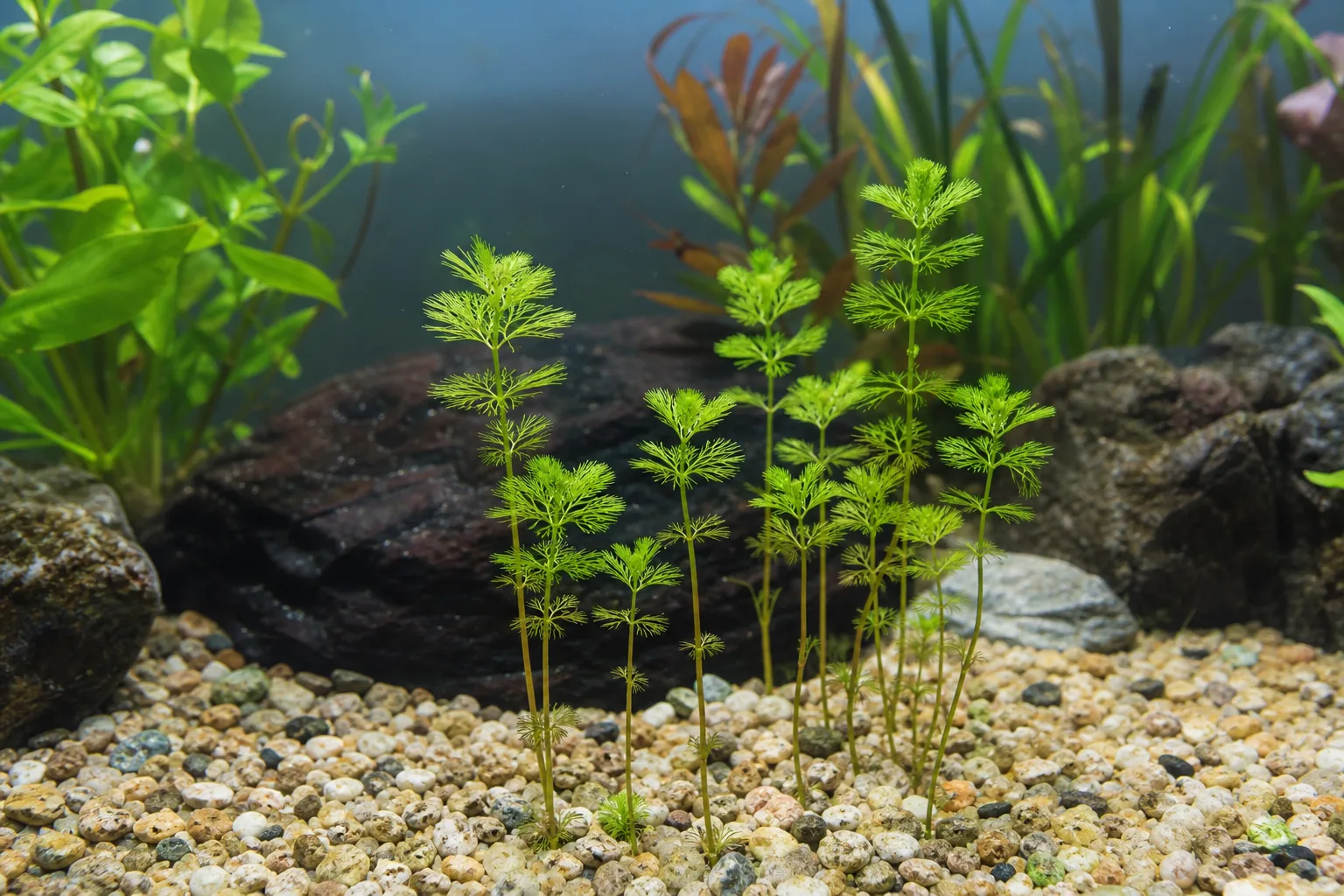
Slow Growth on Cabomba: Causes, Checks & Fixes
This guide covers slow growth on Cabomba. See also the general Slow Growth guide, watering, and light pages for this plant.
Slow Growth on Cabomba: Causes, Checks & Fixes
Quick answer
Cabomba (Cabomba caroliniana, Carolina fanwort) is a fully submerged stem plant built for fast photosynthesis in warm, nutrient-rich water. When growth stalls-new whorls arrive thin, pale, or less than a centimeter apart per week-the bottleneck is almost always an aquarium parameter, not potting soil or room humidity.
First step: measure photosynthetically active radiation (PAR) at whorl height and confirm water temperature stays in the 18–28°C range before dosing extra fertilizer or CO₂. If PAR is below roughly thirty to forty µmol m⁻² s⁻¹ at the height where lower leaves attach, slow growth is usually a light problem-see not enough light on Cabomba. When PAR and temperature check out but tips stay pale or sparse, carbon or column nutrients are the next suspects.
Why Cabomba growth stalls underwater
Cabomba evolved in ponds, lakes, and slow streams across the Americas, with fan-shaped submerged leaves that pull nutrients directly from the water column. It is not a low-light background filler like Anubias or Java fern. In a well-lit, warm tank with adequate dissolved nutrients, green Cabomba commonly adds several centimeters per week; in a dim, cold, or nutrient-starved setup, the same species barely produces new whorls.
The hobby mismatch starts at the shop. Cabomba ships from brightly lit farm tanks, then lands in community aquariums running stock LED hoods, unheated corners, or sparse feeding schedules. The plant may stay green at the tips while vertical gain flatlines-a pattern beginners read as “Cabomba is just slow” when the tank is actually limiting one of three levers: photons at depth, metabolic temperature, or dissolved carbon and nutrients.
Slow growth also differs from leggy growth and not enough light. Leggy and light-deficient Cabomba sheds lower leaves and stretches internodes toward the surface. Chronic slow growth often keeps tips alive but produces small, widely spaced whorls, pale new tissue at moderate PAR, or a complete crown pause without the dramatic bare-base look. Self-shading from an untrimmed canopy can stall mid-stem growth even when surface PAR looks strong.
Red C. furcata has a higher floor than green Cabomba: without fifty-plus PAR at whorl height and injected CO₂, it may persist but rarely adds meaningful length-what looks like “slow growth” is often unmet species demand, not patience.
What slow growth looks like on Cabomba
Stunted submerged growth on Cabomba follows recognizable patterns:
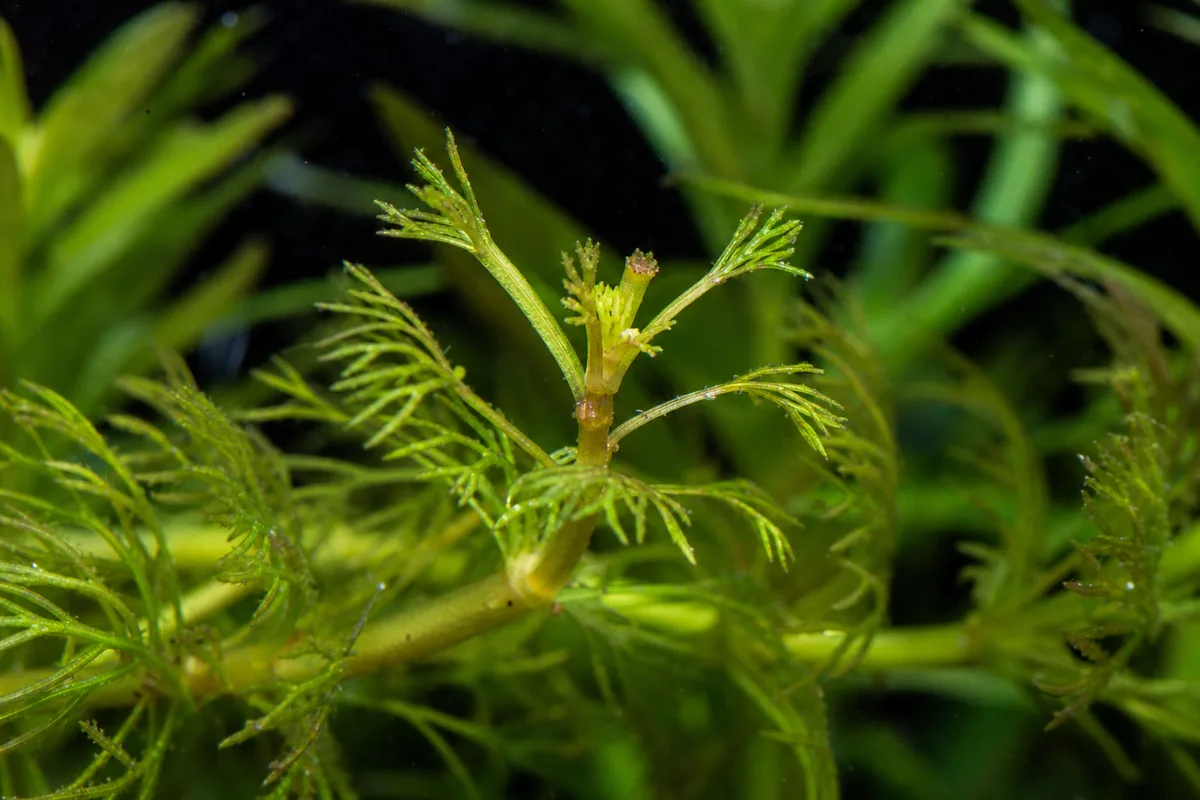
Slow Growth symptoms on Cabomba - compare with healthy tissue on the same plant.
- Wide whorl spacing - new leaf whorls appear more than one to two centimeters apart along the stem while tips stay green, without the long bare base typical of severe etiolation
- Pale or small new whorls - feathery tips lose the bright lime-green color and arrive thinner or less divided than older growth
- Vertical gain under one centimeter per week - in a stable tank past the two-week acclimation window, with no obvious melt
- Healthy tips, stalled overall height - crowns look alive but background stems fail to fill in over multiple weeks
- Slow pale tips in moderate-to-high PAR - especially in tanks without CO₂ injection, suggesting carbon limitation rather than macronutrient shortage
- Dull growth in cool water - stems stay intact but new tissue arrives slowly when temperature drifts below about 18°C
- Post-purchase pause - normal for one to two weeks after planting emersed-grown stems; abnormal if it continues once submerged whorls form
Early slow growth can be subtle: one sparse whorl every ten days instead of every three. Left uncorrected, the stand stays thin while algae may colonize feathery surfaces in high-light, low-nutrient tanks.
Do not confuse acclimation with chronic stunting. Emersed-to-submerged transition often pauses vertical gain while old leaves melt transparently in the first one to two weeks. Chronic slow growth continues after new submerged whorls appear and parameters read stable.
Visual check (when photos are available): Compare whorl spacing on a healthy background stem-compact whorls roughly one centimeter apart-with a stalled stem showing two-centimeter gaps and pale, thin new fans at the crown. That spacing difference is the key slow-growth signal, not bare lower stems.
Lookalike symptoms to rule out
Not enough light - bare lower stems, elongated internodes, and tips racing toward the surface while the base stays permanently bald. Confirm PAR at stem height; if below thirty to forty µmol m⁻² s⁻¹, follow the not-enough-light guide before treating nutrients.
Nutrient deficiency - newest whorls pale yellow with green veins point to iron shortage; oldest whorls yellowing from the tip inward suggest nitrogen lack. If PAR is adequate and spacing is normal but color fades, see the Cabomba fertilizer guide. Wide spacing with pale tips at forty-plus PAR without CO₂ still points to carbon first.
CO₂ limitation at moderate PAR - stems hold lower foliage but new growth stays pale and slow when photons exceed what ambient dissolved CO₂ can support. Lower PAR or add CO₂ rather than doubling fertilizer.
Cold water - growth slows tank-wide without shredding or melt; check heater function and room temperature against the 18–28°C preference.
Dirty or stagnant water - multiple species decline together; improve filtration and water changes if the column is turbid.
Turtle or fish damage - shredded fragments and bite marks, not uniform whorl spacing issues.
Self-shading - strong PAR at the surface but sparse mid-stem growth because the canopy was never trimmed; trim before upgrading hardware.
Parameter snapshot for quick diagnosis
Use this table after the two-week acclimation window. One out-of-range row is often enough to explain stalled whorls.
| Parameter | Slow-growth signal | Target for green C. caroliniana | First action |
|---|---|---|---|
| PAR at whorl height | Sparse whorls, pale tips, under 1 cm/week gain | 30–50 µmol m⁻² s⁻¹ (low-tech); 40–80+ for dense stands | Raise LED output or trim canopy; see light guide |
| Water temperature | Dull, stalled new tissue | 18–28°C (65–82°F) | Adjust heater; avoid unheated winter rooms |
| Nitrate (liquid test) | Pale old whorls, tank-wide dullness | 5–20 ppm in stocked tanks; dose if near zero | Weekly comprehensive liquid fertilizer |
| CO₂ / carbon | Pale tips at 40+ PAR without injection | Optional in low-tech; beneficial above ~50 PAR | Add CO₂ or lower PAR to match tank |
| Whorl spacing | Gaps over 2 cm with green tips | New whorls under ~1 cm apart | Fix limiting row above, then wait 2 weeks |
If every row reads in range and growth still stalls, inspect for stem rot, snail damage, or copper from fish medications before replanting repeatedly.
How to confirm the cause
Work through this aquarium checklist before stacking fixes:
- PAR at whorl height - Measure where lower leaves attach, not at the water surface. Green Cabomba needs at least thirty to forty µmol m⁻² s⁻¹ for meaningful growth; below that, slow growth is a light issue. Details in the Cabomba light guide.
- Water temperature - Confirm 18–28°C (roughly 65–82°F) with a reliable thermometer. Below 18°C, expect metabolic slow-down even with good light.
- Tank age and acclimation - Stems planted within two weeks may stall during transition; stems older than three weeks with sparse whorls need intervention.
- Growth rate baseline - Mark stem height with a thread or photo; green Cabomba in a moderate low-tech tank often adds two to five centimeters per week. Less than one centimeter per week after acclimation signals a limiter.
- New whorl color and spacing - Pale, thin tips at forty-plus PAR suggest CO₂ or iron limits; widely spaced but green tips at marginal PAR suggest light or self-shading.
- Column nutrients - In lightly stocked tanks, test nitrate or dose a comprehensive liquid fertilizer weekly. Cabomba feeds through leaves, not potting soil.
- Water clarity and flow - Particulates and debris reduce usable light at depth; confirm filtration and weekly water-change rhythm per the watering guide.
If PAR, temperature, and nutrients check out and growth still stalls, inspect for stem rot, snail damage, or copper exposure from medications before replanting repeatedly.
First fix for Cabomba
Raise submerged PAR at whorl height or stabilize water temperature to 18–28°C-whichever check failed first-then wait two weeks before changing fertilizer or CO₂.
When PAR is below target, lower the fixture, upgrade to a planted-tank LED, or trim self-shading tops so light reaches mid-stem whorls. When temperature is low, adjust the heater and avoid placing the tank in an unheated room below the species’ comfort range.
Do not dose heavy fertilizer on a cold or dim Cabomba-it cannot use extra nutrients without adequate light energy and warmth. Do not inject CO₂ before confirming PAR; carbon supplementation without photons fuels algae on feathery leaves first. Do not apply houseplant logic such as soil moisture checks, Cabomba repotting guide, or bright indirect room light-Cabomba grows fully underwater.
Step-by-step recovery
After the first fix:
- Log whorl spacing weekly - Photograph tip growth at the same distance; compact new whorls under one centimeter apart mean recovery is starting.
- Match photoperiod - Run eight to ten hours on a timer; extending day length without raising PAR rarely speeds growth.
- Dose liquid fertilizer once weekly - After PAR and temperature stabilize, add a comprehensive column fertilizer at half label strength in lightly stocked tanks; increase only if new whorls stay pale after two weeks. See fertilizer dosing.
- Add CO₂ only when PAR exceeds ~forty µmol m⁻² s⁻¹ - Injected carbon helps high-light setups use extra energy; in low-tech tanks, keep PAR in the thirty-to-fifty range Cabomba can support without injection.
- Trim and replant tops - Remove the upper eight to twelve centimeters when stems reach the surface so lower whorls keep receiving light.
- Improve water clarity - Net melted leaves, especially in turtle tanks where decay fouls water quickly.
- Re-evaluate species - If you are growing red C. furcata in a low-tech tank, switch to green C. caroliniana or upgrade light and CO₂ together.
Make one major change at a time so you can read the plant’s response.
Recovery timeline
| Phase | Timing | Good signs | Bad signs |
|---|---|---|---|
| First fix applied | Days 1–7 | Melt slows; tips stay green | Mush spreads; ammonia rises |
| New whorl response | Days 7–14 | Tighter spacing on new tips; pale fans greening | No new whorls; gaps still widening |
| Stand fill-in | Weeks 2–4 | Weekly 2–5 cm gain on green stems | Zero crown growth for 4+ weeks |
| Full density | Week 4+ | Bushy background after trim-and-replant | Only algae on feathery fans |
Expect noticeably tighter whorl spacing on new tip growth within one to two weeks after PAR and temperature reach adequate levels. Pale tips may green up within ten to fourteen days once carbon and iron limits are addressed.
Stems that have produced only sparse whorls for a month may need trimming to firm tops before the stand looks full again. Old internode spacing does not compress-judge success on new growth above a cut point, not on historical stem length.
Documented recovery case (June 2026): A 20-gallon low-tech community tank held eight green C. caroliniana stems three weeks after planting. PAR at mid-stem whorl height read 28 µmol m⁻² s⁻¹; water temperature held 74°F (23°C); nitrate tested 8 ppm. Whorls arrived every ten to twelve days with 2.5 cm gaps and pale lime tips. The keeper raised a planted-tank LED from 60% to 85% output (no photoperiod change), trimmed the top 10 cm from each stem, and waited fourteen days before dosing fertilizer. PAR at whorl height reached 42 µmol m⁻² s⁻¹ on day three; the first compact whorl under 1 cm spacing appeared on day eleven; stems averaged 3 cm of new growth over the following two weeks. Lower internode gaps on old stem segments did not shrink-recovery showed only above the trim line, which is normal for Cabomba.
Total crown recovery from long-term stunting often takes three to four weeks in a corrected tank; acclimation stalls usually resolve within two weeks once submerged whorls appear.
What not to do
Do not check soil moisture, pot drainage, or room humidity for submerged Cabomba-they do not apply.
Do not fertilize heavily before confirming PAR at whorl height and stable temperature.
Do not assume slow growth means the plant needs repotting or a larger container.
Do not extend photoperiod beyond ten hours to compensate for weak PAR-algae on feathery leaves usually wins.
Do not treat all Cabomba species identically; red fanwort needs higher PAR and CO₂ than green Carolina fanwort.
Do not release trimmings into outdoor waterways; Cabomba is invasive when escaped.
Do not stack heater changes, light upgrades, CO₂, and double fertilizer on the same day-Cabomba responds poorly to simultaneous shocks.
Cabomba care cross-check
| Factor | Slow-growth signal | Target / action |
|---|---|---|
| PAR at whorl height | Sparse whorls, pale tips, under 1 cm/week gain | 30–40 µmol m⁻² s⁻¹ minimum for green; see light guide |
| Temperature | Dull, stalled new tissue | 18–28°C; verify heater |
| CO₂ / carbon | Pale tips at 40+ PAR without injection | Add CO₂ or lower PAR to low-tech range |
| Column nutrients | Yellowing new or old whorls | Weekly liquid dose; fertilizer guide |
| Acclimation age | Pause in first 1–2 weeks only | Wait for submerged whorls before escalating |
| Canopy / trimming | Mid-stem stall, strong surface PAR | Trim tops weekly |
| Water clarity | Tank-wide dullness | Filtration + water changes |
Light, temperature, and dissolved nutrients move together on this species. Cabomba consumes nitrates quickly in good light but cannot convert fertilizer into compact tissue without adequate PAR and warmth.
How to prevent slow growth next time
Verify fixture PAR at stem height before purchasing stems-see the Cabomba overview and light requirements.
Keep a stable heater and avoid seasonal cold spots below 18°C.
Dose liquid fertilizer weekly in shrimp-only or lightly stocked tanks.
Trim and replant tops before the canopy shades itself.
Choose green C. caroliniana for low-tech setups; match red C. furcata to high-PAR CO₂ systems.
Quarantine new stems under adequate light for two weeks before adding them to display tanks.
Clean light covers monthly-film cuts PAR more than many keepers expect.
When to worry
Treat as urgent when melting stems foul turtle or fish water, ammonia rises, or filters clog with decaying tissue-remove debris and correct light and temperature immediately.
Also act when every stem shows zero new whorl growth for more than four weeks after acclimation despite corrected PAR and temperature-inspect for rot, copper, or wrong species expectations.
Mild slow growth with green tips in a low-tech tank at thirty to forty PAR is often normal-not an emergency. Adjust expectations or add CO₂ if you want faster density.
Conclusion
Slow Cabomba growth is an aquarium diagnostics problem, not a houseplant watering puzzle. Measure PAR where whorls actually form, confirm warm stable water, then address carbon and column nutrients in that order. Differentiate stunted whorl spacing from the bare-base etiolation covered in the not-enough-light guide, trim regularly to prevent self-shading, and judge recovery on compact new growth-not on old sparse stem segments. Align light, temperature, and fertilizer with how this submerged stem plant actually lives, and Cabomba returns the fast, feathery background texture it was chosen for.
When to use this page vs other Cabomba guides
- Cabomba watering guide - Use for routine moisture checks before assuming slow growth is the main issue.
- Cabomba problems hub - Browse all 16 common issues on this species.
- Not Enough Light on Cabomba - Different entry point when symptoms overlap with slow growth.
- Leggy Growth on Cabomba - Different entry point when symptoms overlap with slow growth.
- Yellow Leaves on Cabomba - Different entry point when symptoms overlap with slow growth.