Fungus Gnats on Burro's Tail: Causes, Checks & Fixes
Quick answer
Fungus gnats on Burro's Tail mean the soil surface stays wet too long-often because bottom-watering or frequent small drinks keep the top layer damp on a drought succulent. First step: stop watering until the root zone is fully dry, then let only the surface stay dry between drinks.
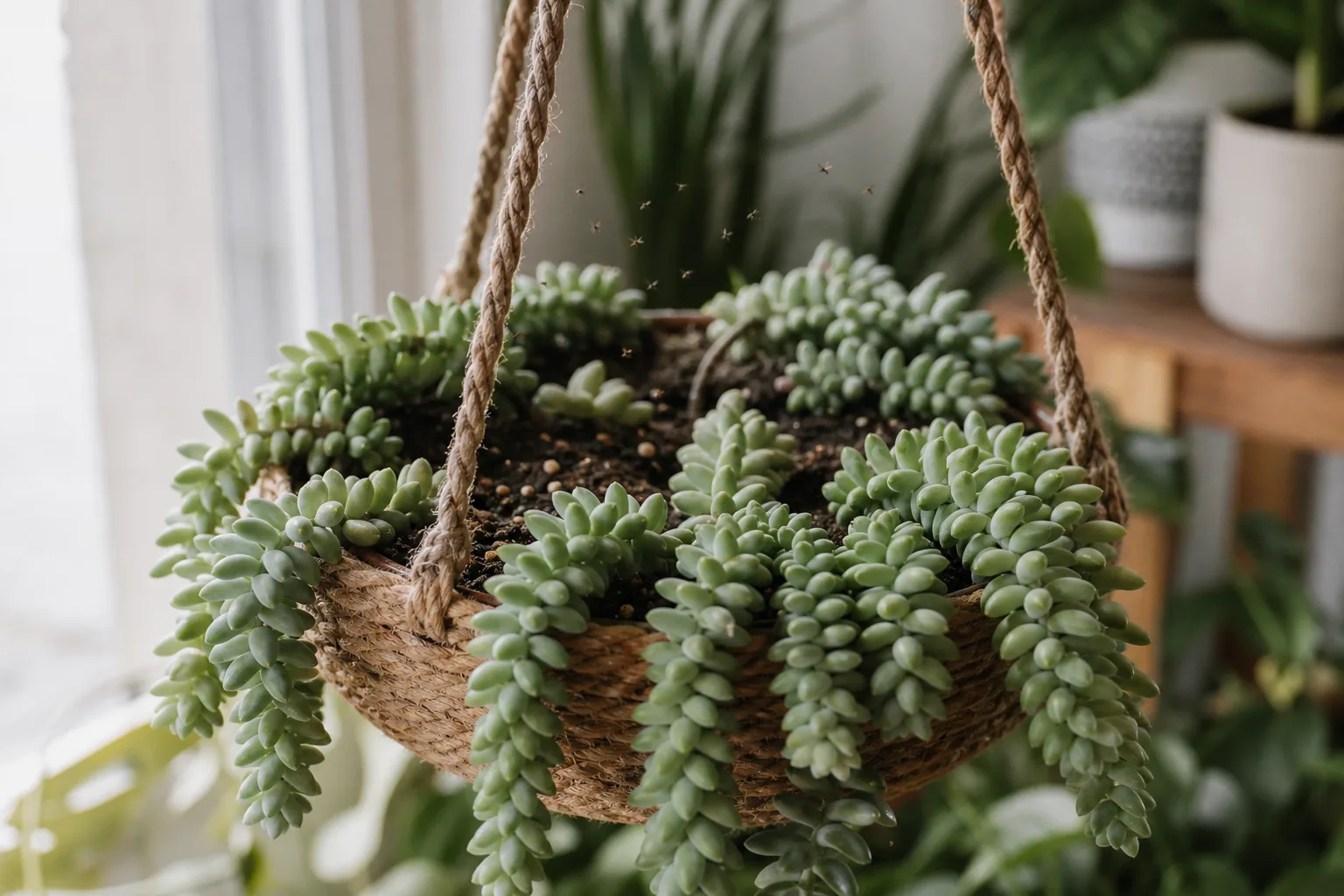
Fungus Gnats on Burro's Tail: Causes, Checks & Fixes
This guide covers fungus gnats on Burro's Tail. See also the general Fungus Gnats guide, watering, and light pages for this plant.
Fungus Gnats on Burro's Tail: Causes, Checks & Fixes
Quick answer
Fungus gnats on Burro’s Tail (Sedum morganianum) are a moisture warning, not a random pest invasion. The adults are mostly a nuisance, but they lay eggs in damp organic soil-and this trailing succulent is built for the opposite: sharp drainage, full dry-down cycles, and a surface that stays matte most of the week.
First step: stop watering and let the root zone dry completely before the next drink, using the same dryness checks in our Burro’s Tail watering guide. That single pause kills larvae in the upper mix and tells you whether the real problem is schedule, bottom-watering habit, hanging-basket airflow, or peat-heavy soil-not the flies themselves.
On Burro’s Tail, gnats and root rot share the same trigger: mix that stays wet too often. Fixing moisture protects the plant; spraying only flying adults does not.
What fungus gnats look like on Burro’s Tail
Above the soil, you will see small, dark, mosquito-like flies-roughly 1/8 inch long-with long legs and narrow wings. On a hanging Burro’s Tail they tend to:
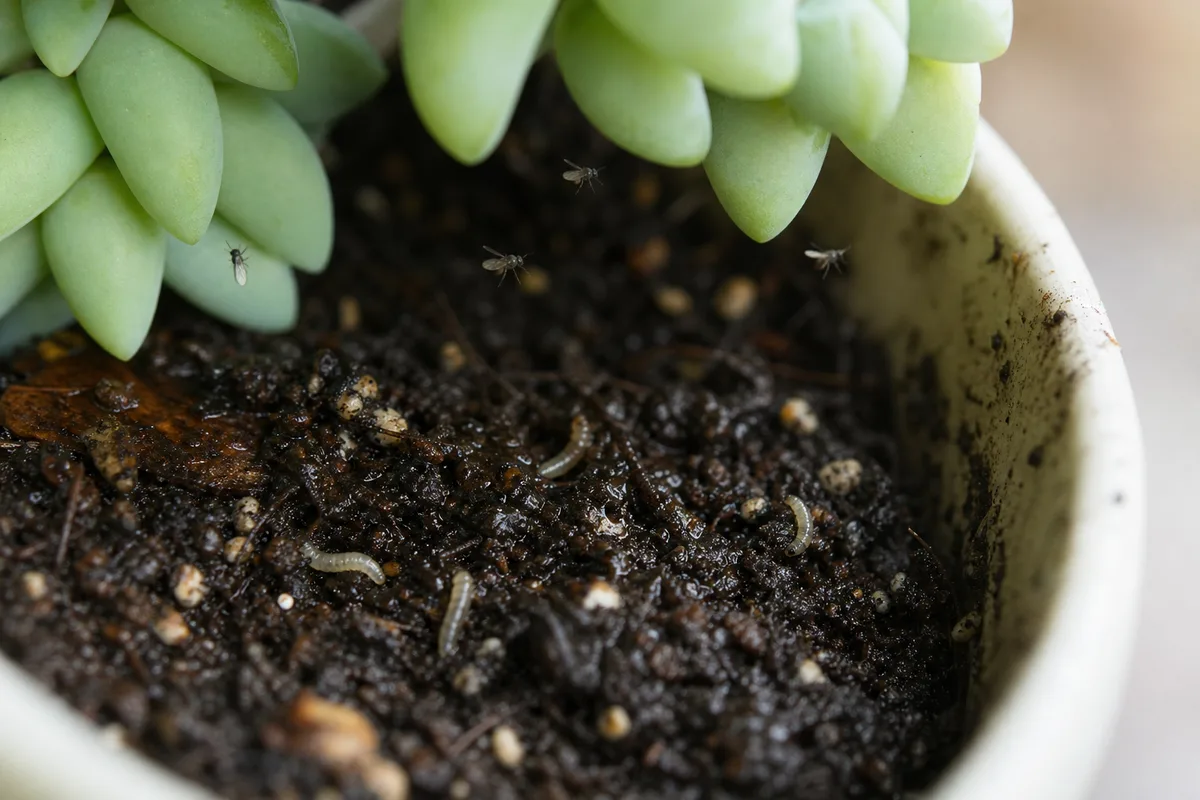
Fungus gnats on Burro’s Tail soil - small dark flies and damp surface mix where larvae breed, not on the succulent leaves.
- Hover just above the pot rim or soil surface, especially when you water or bump the basket
- Scatter toward windows, countertops, or neighboring pots
- Reappear in bursts after each watering if the surface stays damp
- Concentrate around the soil line, not on the smooth blue-green leaves
The larvae live in the top 2–3 inches of mix, not on Burro’s Tail foliage. They are slender, translucent worms with dark heads-easy to miss unless you gently scrape back damp surface soil. You may also notice a thin algae film or fungal fuzz on constantly wet mix; see mold on soil when surface growth is the main clue.
On a healthy Burro’s Tail, leaves stay firm and plump. Gnats alone rarely cause dramatic leaf change. If you also see yellowing, spontaneous leaf drop, or soft lower leaves while soil feels wet, suspect larval root feeding plus chronic overwatering on Burro’s Tail, not gnats in isolation.
Lookalikes worth ruling out:
- Fruit flies cluster around ripening produce in the kitchen, not just one hanging basket
- Drain flies breed in sink or shower drains; check plumbing if flies appear far from plants
- Shore flies have stouter bodies and often appear in very wet, algae-covered saucers
- Whiteflies rest on leaf surfaces and fly up when stems are shaken-different habitat entirely
If flies appear only around the Burro’s Tail pot and the surface mix has been wet for days, fungus gnats fit better than any of the above.
Why Burro’s Tail gets fungus gnats
Fungus gnats need moist organic soil to breed. Larvae feed on fungi, algae, and decaying organic matter in the upper mix-and sometimes on tender feeder roots. Extension services link infestations to overwatered houseplants, not to a particular species being “gnat-prone.”
Burro’s Tail makes the connection obvious because it is built for dry conditions. Sedum morganianum stores water in thick, overlapping leaves on brittle trailing stems and expects well-drained mix with near-complete dry-down between waterings. Wisconsin Extension notes that as a succulent, Burro’s Tail cannot tolerate over-watering, especially in winter, and that root rot due to overwatering is the most common issue on Burro’s Tail overview.
Common Burro’s Tail setups that invite gnats:
- Bottom-watering without dry-down - the preferred routine for protecting brittle stems can leave the surface soggy if you leave the pot in the saucer too long or water before the root zone has fully dried
- Small nursery pots in peat-heavy mix that stay damp on top long after you think you watered lightly
- Hanging baskets in dim corners where trailing foliage shades the soil rim and slows surface evaporation
- Top watering that jostles the basket, causing leaf drop-then compensating with extra small drinks that keep the mix wet
- Oversized plastic pots holding moisture at the center while the surface looks merely “slightly cool”
- Winter calendar watering when growth slows and Wisconsin Extension advises indoor plants may need water no more than once a month in cool, low-light conditions
- Old, broken-down mix that compacts and retains more water over time
Gnats are the visible symptom. On Burro’s Tail, the underlying issue is almost always culture: you are keeping a drought-adapted trailing succulent in soil that behaves like a fern’s.
How to confirm the cause
Work through these checks before reaching for sprays:
- Surface moisture - Press a finger or dry skewer into the top inch near the pot edge. If it comes out cool and clings after several days without watering, the surface is too wet for Burro’s Tail and ideal for gnat larvae.
- Root-zone dryness - Follow the watering guide finger, skewer, and pot-weight tests. Chronic heaviness means water is lingering even when the surface looks dusty.
- Fly behavior - Tap the pot rim gently. Fungus gnats rise from the soil surface, not from leaves. A dozen or more per pot confirms active breeding.
- Larval check - Gently scrape aside the top half-inch of damp mix without lifting the basket. Look for tiny worms or a webby fungal layer. No larvae with only a few adults may mean a new introduction, not a full infestation yet.
- Stem and leaf firmness - Press leaves and the stem base. Firm, plump tissue with wet soil points to a correctable moisture habit. Soft, mushy stem bases with sour-smelling mix suggest root rot has joined the party-see overwatering and root rot.
- Season and placement - In winter semi-dormancy, Burro’s Tail needs water far less often. Gnats appearing in cool months usually mean the mix is not drying fast enough for current growth, not that the plant is thirsty.
Confirmed diagnosis: fungus gnats breeding in persistently moist top soil on a plant that should dry down between waterings. Suspected but unconfirmed: fruit flies from food waste, or gnats arriving on a new nursery plant not yet quarantined.
First fix for Burro’s Tail
Stop watering and let the root zone dry completely.
Do not mist. Do not “give it a little drink” because the trailing stems look fine. Burro’s Tail stores water in its leaves; a short dry spell at the roots will not harm a firm plant the way continued wetness will.
This is the one action that hits both problems at once:
- Larvae die when the surface layer dries, breaking the life cycle
- Egg-laying females find dry mix less attractive
- Root rot risk drops on Burro’s Tail as oxygen returns to the upper root zone
Leave yellow sticky traps near the pot rim to catch adults and track progress-but traps alone are not the fix. They reduce egg-layers; drying soil stops the next generation.
Wait until the root zone is fully dry-confirmed by skewer, weight, and leaf feel-not just “less damp on top” before the next watering. On many indoor Burro’s Tails in hanging baskets, that may take two to three weeks in winter and one to two weeks in active summer growth.
Step-by-step recovery
After the root zone has dried once, continue in this order:
1. Adjust the watering rhythm
Water only when the full dry-down checks in the watering guide confirm readiness-typically every 10 to 14 days in active summer growth and every three to four weeks or longer in winter. Never water on a calendar because the basket “looks fine.”
2. Fix bottom-watering technique
If you bottom-water to protect brittle stems, place the pot in a shallow tray for 15 to 20 minutes until the top feels lightly moist, then remove it immediately and let it drain. Do not leave the pot sitting in water. The surface should return to matte within a day or two.
3. Improve airflow at the soil rim
Move the hanging basket slightly away from walls or dense foliage that traps humidity over the soil line. Trailing leaves shading the rim slow surface dry-down-rotate the basket occasionally if one side stays damp.
4. Keep trapping adults for two to four weeks
Replace yellow sticky traps as they fill. A falling catch rate over two weeks means fewer egg-layers. If adults stay steady, the surface is still too wet somewhere-recheck your dry-down.
5. Apply BTI only if larvae persist after drying
If gnats remain heavy after three to four weeks of proper dry-down, use a product containing Bacillus thuringiensis subsp. israelensis (BTI) labeled for fungus gnat larvae in houseplant soil. UC IPM notes that BTI does not persist indoors and repeat applications at about five-day intervals are commonly needed for control. Follow label rates. Use BTI labeled for fly larvae-not caterpillar Bt (kurstaki), which does not affect fungus gnats.
Pour the drench gently at the soil line without jostling the basket. BTI targets larvae in moist zones-it works best alongside continued surface drying, not instead of it.
6. Repot only when mix is the bottleneck
Repot into gritty succulent mix in spring if the soil stays damp for weeks despite correct watering, the pot has drainage, and you are using appropriate container size. Do not repot on day one just for gnats; drying the surface usually resolves mild infestations. Burro’s Tail repotting guide a wet, stressed Burro’s Tail into fresh mix without fixing the watering habit often brings gnats back.
Recovery timeline and signs of progress
Expect adult numbers to drop within one to two weeks once the surface stays dry. Full suppression typically takes three to four weeks because eggs and larvae hatch in overlapping waves-consistent dry cycles matter more than a single dry spell.
Signs you are winning:
- Fewer flies on traps each week
- Soil surface looks matte and dry most of the week
- Burro’s Tail leaves remain firm; no new soft or yellowing leaves
- Stem base stays hard when pressed gently
Signs the problem is deepening:
- Flies increase weekly despite traps
- Stem softens at soil line while mix stays damp
- Sour smell from pot; roots brown and mushy when inspected
- Leaves drop in clusters after each watering
If rot signs appear, stop treating this as a gnat-only issue-inspect roots and address decay before worrying about flies.
Lookalike symptoms to rule out
| What you see | Likely cause | Quick check |
|---|---|---|
| Flies only in kitchen, near fruit bowl | Fruit flies | Remove produce; flies ignore the Burro’s Tail pot |
| Flies from bathroom or kitchen drain | Drain flies | Clean drain; plant pots unaffected |
| Flies on wet saucer algae, stout bodies | Shore flies | Scrub saucer; improve drainage |
| Webbing on leaves, stippling | Spider mites | Inspect leaf surfaces, not soil |
| White cloud from shaken stems | Whiteflies | Check leaf undersides |
| Mushy stem base, sour wet soil | Root rot / overwatering | Firmness test at soil line; see root rot |
| Green fuzz on surface only | Mold on soil | Often same wet-soil trigger; see mold on soil |
Mistakes to avoid
- Spraying insecticide on trailing stems or into the air around the basket-this misses larvae in soil, risks leaf drop from handling, and adds unnecessary chemical exposure indoors
- Watering more because you see flies, thinking the plant is stressed-Burro’s Tail leaves hold reserves; extra water feeds larvae
- Aggressive soil scraping or repotting on day one-brittle stems shed leaves when the pot is tilted or shaken; dry the surface first
- Leaving the pot in a bottom-watering saucer for hours-saturated mix at the rim is prime gnat habitat
- Using caterpillar Bt instead of BTI-only israelensis subspecies targets fly larvae
- Stopping after one dry week when adults briefly decline-resume watering too soon and the next larval wave hatches
- Ignoring soft stems while focusing on traps-gnats are low severity until wet soil is rotting Crassulaceae roots
Burro’s Tail care cross-check
Gnats should disappear as a side effect of correct Burro’s Tail culture:
| Care factor | Gnat-friendly mistake | Burro’s Tail target |
|---|---|---|
| Watering | Small drinks whenever flies appear | Full soak only when root zone is fully dry |
| Method | Bottom-water with pot left soaking | Brief bottom soak; surface dry within days |
| Mix | Peat-heavy all-purpose soil | Gritty cactus/succulent blend with perlite or pumice |
| Pot | Oversized plastic, no drainage | Slightly potbound terracotta or plastic with drain hole |
| Light | Dim corner hanging basket | Bright light to some direct sun per light guide |
| Winter | Summer watering rhythm in January | Once a month or longer in cool dormancy |
| New plants | Placed immediately near collection | Quarantine two to three weeks; dry surface first |
When culture is right, the soil surface looks matte and dry most of the week. Gnats have nowhere to breed.
How to prevent fungus gnats next time
- Water on dryness, not dates-full root-zone dry-down every time per the watering guide
- Bottom-water with a timed soak and immediate removal so the rim does not stay soggy
- Use gritty succulent mix and avoid oversized pots that hold moisture around modest roots
- Empty saucers within 30 minutes of watering
- Inspect new purchases before they join your collection; treat and dry their soil first
- Wipe fallen Burro’s Tail leaves off the soil surface-decaying organic matter feeds larvae
- Keep a sticky trap in the pot during fall and winter when reduced light slows drying and overwatering is easy
When to worry
Treat fungus gnats as urgent on Burro’s Tail when:
- The stem base goes soft or dark while soil is wet
- Leaves turn mushy and fall without wrinkling first (overwatering pattern, not drought)
- The pot smells sour or fermented
- Multiple pots in one room swarm simultaneously-check every plant’s moisture, not just the Burro’s Tail
Gnats alone, with firm tissue and fixable watering, are a low-grade problem you can clear in weeks. Gnats plus soft tissue mean root health is already compromised-inspect roots, trim rot, and repot into dry gritty mix before resuming a sparse watering schedule.
Burro’s Tail is non-toxic to cats and dogs per the ASPCA, but keep pets away from BTI-treated soil and fallen leaves during treatment cycles, and avoid applying fertilizers or pesticides the plant does not need while roots are recovering.
Conclusion
Fungus gnats on Burro’s Tail tell you the soil has been acting like a moisture-loving houseplant’s, not a trailing succulent’s. The flies are annoying; the moisture habit behind them is what can hurt Sedum morganianum. Dry the root zone, keep the surface matte between drinks, trap adults while you wait, apply BTI only if dryness alone does not stick, and judge success by firm leaves and fewer flies-not by how quickly you can water again.
When to use this page vs other Burro’s Tail guides
- Burro’s Tail watering guide - Use for routine moisture checks before assuming fungus gnats is the main issue.
- Burro’s Tail problems hub - Browse all 16 common issues on this species.
- Overwatering on Burro’s Tail - Different entry point when symptoms overlap with fungus gnats.
- Mold on Soil on Burro’s Tail - Different entry point when symptoms overlap with fungus gnats.
- Root Rot on Burro’s Tail - Different entry point when symptoms overlap with fungus gnats.