Calcium Deficiency on Boston Fern: New Frond Pinnae & Fixes
Quick answer
Calcium deficiency on Boston Fern shows as tan-brown necrosis, cupped pinnae, or a stunted unfurl on the newest arching fiddle frond at the crown while older drooping fronds may stay green. First step: confirm damage on expanding pinnae—not random brown tips on old leaflets from dry air—then keep mix evenly moist (not swinging bone-dry to saturated) before one half-strength complete fertilizer dose.
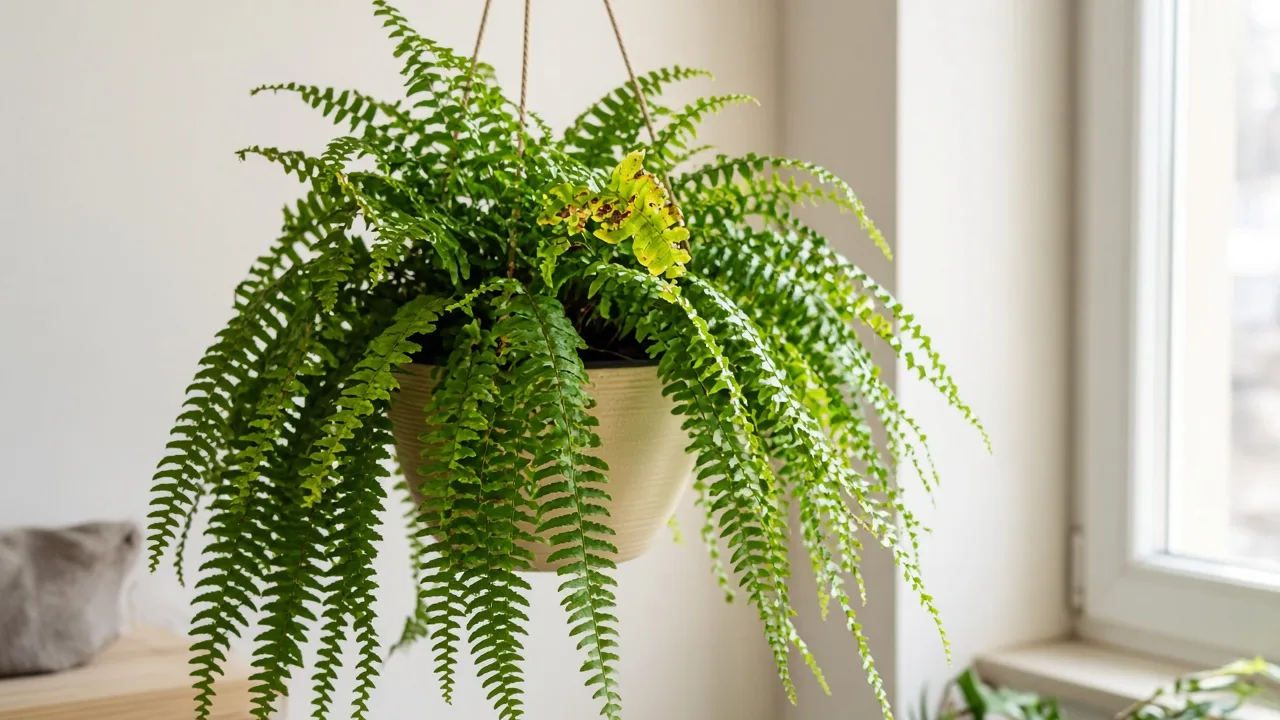
Calcium Deficiency on Boston Fern: Causes, Checks & Fixes
This guide covers calcium deficiency on Boston Fern. See also the general Calcium Deficiency guide, watering, and light pages for this plant.
Calcium Deficiency on Boston Fern: Causes, Checks & Fixes
Quick answer
Calcium deficiency on Boston Fern (Nephrolepis exaltata ‘Bostoniensis’) shows on the newest arching fiddle frond at the crown—tan-brown necrosis along pinnae margins, cupped or crinkled leaflets, or a frond that stalls while uncurling—while older drooping fronds may still look soft green. Calcium is immobile in the plant, so deficiency symptoms show up first on new growth as expanding cell walls fail to get enough Ca, not on the lowest old fronds the way magnesium deficiency often does.
See our calcium deficiency guide and the calcium deficiency symptom hub. On Boston Fern, read damage on pinnae of the blade still opening from the crown—marginal browning and distorted unfurl point here before iron deficiency, which shows pale tissue between darker green veins on the same new frond.
First step: confirm marginal necrosis or hooked distortion on the newest unfurling frond—not winter brown tips on older pinnae from dry air—then stabilize even moisture on moist (not waterlogged) mix.
When to use this page vs other Boston Fern guides
| Pattern | Read next |
|---|---|
| Brown margins or crinkled pinnae on newest crown frond | Calcium deficiency (this page) |
| Pale new pinnae with dark green veins (no brown necrosis) | Iron deficiency |
| Yellow between veins on oldest lower fronds | Magnesium deficiency |
| Uniform pale older fronds without vein pattern | Nitrogen deficiency |
| Brown tips only on mature pinnae, worse in heated winter air | Brown tips or low humidity |
| Crispy edges after recent heavy feed or white soil crust | Salt flush and half-strength feeding per fertilizer |
| All fronds yellow, wet mix, sour smell | Overwatering or root rot |
| Multiple yellow causes at once | Yellow leaves |
What calcium deficiency looks like on Boston Fern
Healthy Boston Fern holds long arching pinnate fronds with rows of small pinnae (leaflets) along a central rachis, often in a hanging basket where blades cascade downward. New fronds push up from the crown at the soil line and unfurl slowly in warm humid months. Calcium supports cell wall formation in that expanding tissue, so when delivery fails, the youngest fiddle frond shows damage while the outer arching ring may look fine.
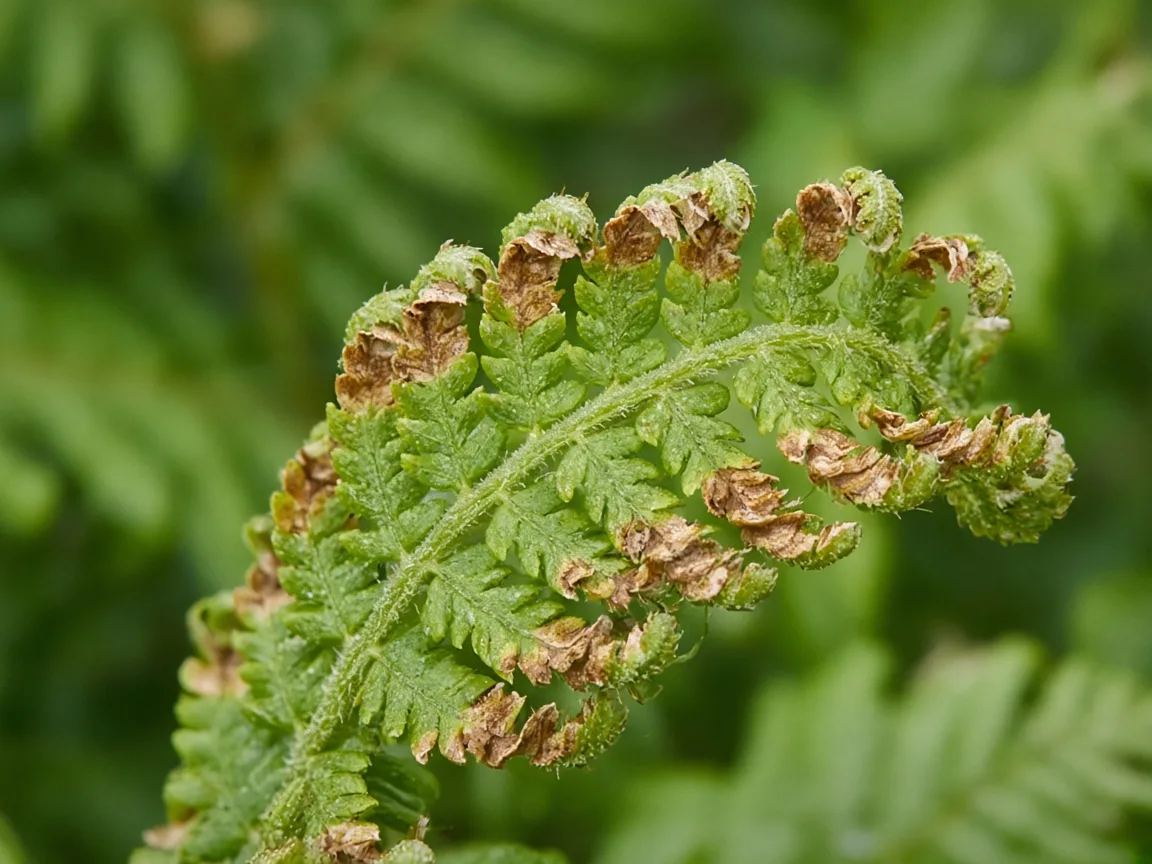
Marginal necrosis on young pinnae along the arching blade still opening from the crown—older drooping fronds on the same plant may stay greener. Judge recovery on the next unfurl, not on hardened scar tissue.
Typical signs:
- Tan or brown necrotic patches along pinnae margins on the frond still uncurling from the crown (young leaves may be misshapen with brown chlorotic spots along margins)
- Cupped, hooked, or crinkled pinnae on the newest arching blade
- Stuck or slow unfurl when the fiddle frond should be opening in spring and summer
- Smaller or ragged new fronds despite adequate indirect light per the light guide
- Older arching fronds may stay bright green while only central new growth looks damaged
Crown still firm:
- Healthy crowns send up new fronds steadily in active growth; roots should feel fibrous, not mushy, when you probe the surface
- Soft, sour-smelling mix points to root rot blocking uptake—not calcium alone
Not calcium deficiency:
- Brown tips and edges on older pinnae only in dry winter rooms—low humidity or brown tips from dry air (tips and edges of pinnae may turn brown in dry interiors)
- Uniform pale lower fronds—nitrogen deficiency
- Green veins with pale tissue between them on new pinnae—iron deficiency
- Browning from the frond ends after a heavy feed—over-fertilizing can brown and dry frond tips
New pinnae on the arching fiddle frond vs brown tips on older pinnae
Boston Fern symptoms are position-specific. Dry heated air attacks exposed pinnae on mature arching fronds first—the leaflet tips farthest from the moist crown dry before the plant can move water to them. Calcium shortage attacks expanding pinnae on the frond still furled or half-open at the crown, where calcium moves with the transpiration stream into rapidly expanding tissue.
Run this split before you mist, flush, or feed:
- Trace the damage backward along the frond. If brown tissue starts at pinnae tips on several fully open lower fronds and skips the center fiddle, treat humidity and watering rhythm first (ferns do best in humid environments).
- Open the newest coil gently (do not yank). If margins are necrotic on pinnae that are still soft and expanding, calcium delivery is the stronger lead.
- Season check—winter brown tips without crown distortion are rarely calcium; spring and summer unfurl failures on a firm crown fit this page better.
Why Boston Fern gets calcium deficiency
Moisture swings interrupt delivery. Boston Fern needs high humidity and moist soil that should never be allowed to dry out completely in active growth. Letting peat-coir mix go bone-dry between heavy drenches stalls the transpiration stream that moves calcium into the enclosed growing tip inside a still-closed frond. RHS notes calcium deficiencies in containers are often caused by poor distribution within the plant following drying of the compost—the mix may still contain Ca, but roots stop drawing it up evenly when the root zone desiccates.
Incomplete or skipped fertilizer is common on a plant that is fed lightly to avoid burn. Half-strength balanced liquid fertilizer monthly in the growing season is typical for indoor Nephrolepis, but products without calcium or micronutrients leave expanding pinnae short on cell-wall material even when nitrogen looks adequate.
Soft-water routines remove the small calcium contribution hard tap might add. Many growers use rainwater or filtered water to limit fluoride and mineral brown tips on mature pinnae—that is reasonable—but then feed must be complete, not nitrogen-only.
Acidic depleted peat-coir mix in the same basket for over a year loses structure and can limit nutrient availability even when you water faithfully. Boston Fern prefers acidic, moisture-retentive mix (about pH 5.0–5.5 in LeafyPixels data); very old, compacted media in a root-bound hanger is a common background issue when new fronds suddenly distort.
Low humidity slows transpiration in dry living rooms. The plant may show brown tips on mature pinnae while the enclosed newest frond receives even less calcium through the transpiration stream. If humidity is already 50–70% and only the crown frond distorts, feed completeness and moisture rhythm are the stronger leads.
Stolon crowns and where to judge the next clean frond
Boston Fern sends thin runners (stolons) that root when they touch moist mix, forming satellite crowns beside the main plant. Calcium stress on the mother crown may show on the tallest central fiddle frond, while a young stolon crown can still push clean pinnae—or the reverse if the satellite sits in drier mix at the basket rim.
When diagnosing:
- Tag which crown produced the damaged frond (main center vs side runner).
- Judge recovery on the next frond from that same crown, not on a healthy stolon elsewhere in the pot.
- Do not remove the distorted frond until a replacement unfurl is underway unless it is fully brown and blocking airflow; Boston Fern recovers through sequential fronds, not single-blade repair.
This runner habit is why a “half healthy” basket can still be calcium-limited on only one crown.
Acidic peat-coir mix at pH 5.0–5.5 and calcium availability
Boston Fern is grown in ericaceous-leaning, peat- or coco-based mix with perlite for drainage—not chalky loam. That acidity suits fine roots but means you should not dump garden lime into the pot to “add calcium.” Lime would fight the acidic soil preference and can lock up iron.
Instead:
- Supply calcium through complete water-soluble fertilizer at half strength during active growth per the fertilizer guide.
- Refresh mix at repotting when fronds yellow broadly or water runs straight through old peat—depleted structure is a common co-factor with distorted new pinnae.
- Flush accumulated salts if white crust rims the basket; salt stress browns mature pinnae and can mimic deficiency on new growth.
Lookalike symptoms
| Pattern | Check | Likely cause |
|---|---|---|
| New crown frond pinnae distorted, marginal necrosis | Older arching fronds normal | Calcium deficiency (this page) |
| Brown tips on oldest pinnae only | Winter heat, low humidity | Brown tips / low humidity |
| Pale tissue between green veins on new pinnae | No marginal necrosis | Iron deficiency |
| Lower fronds yellow between veins | Upper fronds greener | Magnesium deficiency |
| Tips burned after feeding | White soil crust | Overfeed / salt—see fertilizer |
| Sour soil, wilting, yellow fronds | Wet heavy pot | Overwatering |
How to confirm
- Tissue age — distortion confined to the newest arching frond at the crown, not random mature pinnae tips.
- Moisture history — mix allowed to go fully dry between drinks vs evenly moist per watering.
- Fertilizer label — calcium and micronutrients listed; not bloom booster or nitrogen-only feed on a soft-water routine.
- Crown firmness — solid vs mushy on sour mix.
- Humidity — below 50% with mature-tip burn only vs crown distortion at adequate humidity.
- Feed timing — recent heavy dose before tip burn (over-fertilizing browns frond ends).
First fix for Boston Fern
One half-strength dose of complete balanced fertilizer containing calcium and micronutrients—after the top inch of mix is evenly moist (not dust-dry) and crown roots feel firm, not sour or mushy.
Water lightly first if the basket went dry, wait 24 hours so roots rehydrate, then feed per the fertilizer guide. Do not repot, prune heavily, and feed on the same day.
Mistakes to avoid
- Do not assume every brown pinna is calcium—check for dry-air brown tips on older fronds first.
- Do not feed concentrate into bone-dry peat; rehydrate gently, then feed.
- Do not add garden lime to an acidic fern basket.
- Do not confuse post-feed tip burn with calcium shortage on the unfurling crown.
- Do not let the hanging basket sit in a full saucer while diagnosing nutrient issues—sour roots block all nutrient uptake.
Step-by-step recovery
- Restore even moisture—moist root ball, slight dry-down at the surface between drinks.
- Apply one measured complete feed at half strength in active growth.
- Keep soft or room-temperature water consistent with your usual routine (RHS recommends soft water for indoor Nephrolepis).
- Raise humidity toward 50–70% if mature pinnae crisp while the crown frond distorts.
- Flush salts if crust is visible, then wait four weeks before feeding again.
- Repot into fresh soil only if roots fill the basket and distortion persists after two corrected feeds on firm roots.
- Monitor the next arching frond after the damaged one—not pinnae that already hardened.
Recovery timeline
Four to eight weeks for a clean new frond in warm humid growth. The distorted blade rarely straightens—success means the next fiddle opens with even green pinnae and the problem stops advancing to successive fronds.
Prevention
- Feed complete balanced fertilizer with micronutrients during growth per the fertilizer guide.
- Avoid long dry spells in hanging baskets—see watering for dry-down checks.
- Target 50–70% humidity when heating air is dry—see low humidity.
- Refresh acidic peat-coir mix when repotting; do not let old media compact in a crowded basket.
- Flush salts seasonally if you feed regularly in a small pot.
Related Boston Fern guides
- Boston Fern overview
- Problems hub
- Fertilizer — dilute feed timing and salt mistakes
- Watering — even moisture that pairs with calcium delivery
- Soil — acidic peat-coir mix that holds moisture without waterlogging
- Iron deficiency — when new pinnae yellow with green veins
- Magnesium deficiency — when older fronds band between veins
- Brown tips — dry-air and mineral edge burn on mature pinnae
- Yellow leaves — moisture-first diagnosis when color shifts broadly
Scope note: Use this page when tan necrosis or crinkled pinnae hit the newest crown frond on a firm plant. Use iron deficiency when pale tissue between green veins dominates the same new pinnae; use brown tips when only older arching fronds crisp at the leaflet edges in dry air.
Conclusion
Marginal browning or a stuck unfurl on the newest Boston Fern arching frond is a calcium delivery signal during warm active growth—confirm the damage stays on expanding crown pinnae, verify a firm root zone, rule out dry-air tip burn on older fronds, stabilize even moisture, then apply one measured complete feed with calcium on moist mix.
Related tool
Use the Fertilizer Dilution Calculator to narrow causes for calcium deficiency on this plant before changing multiple variables at once.