Aglaonema Light Requirements: A Complete Guide
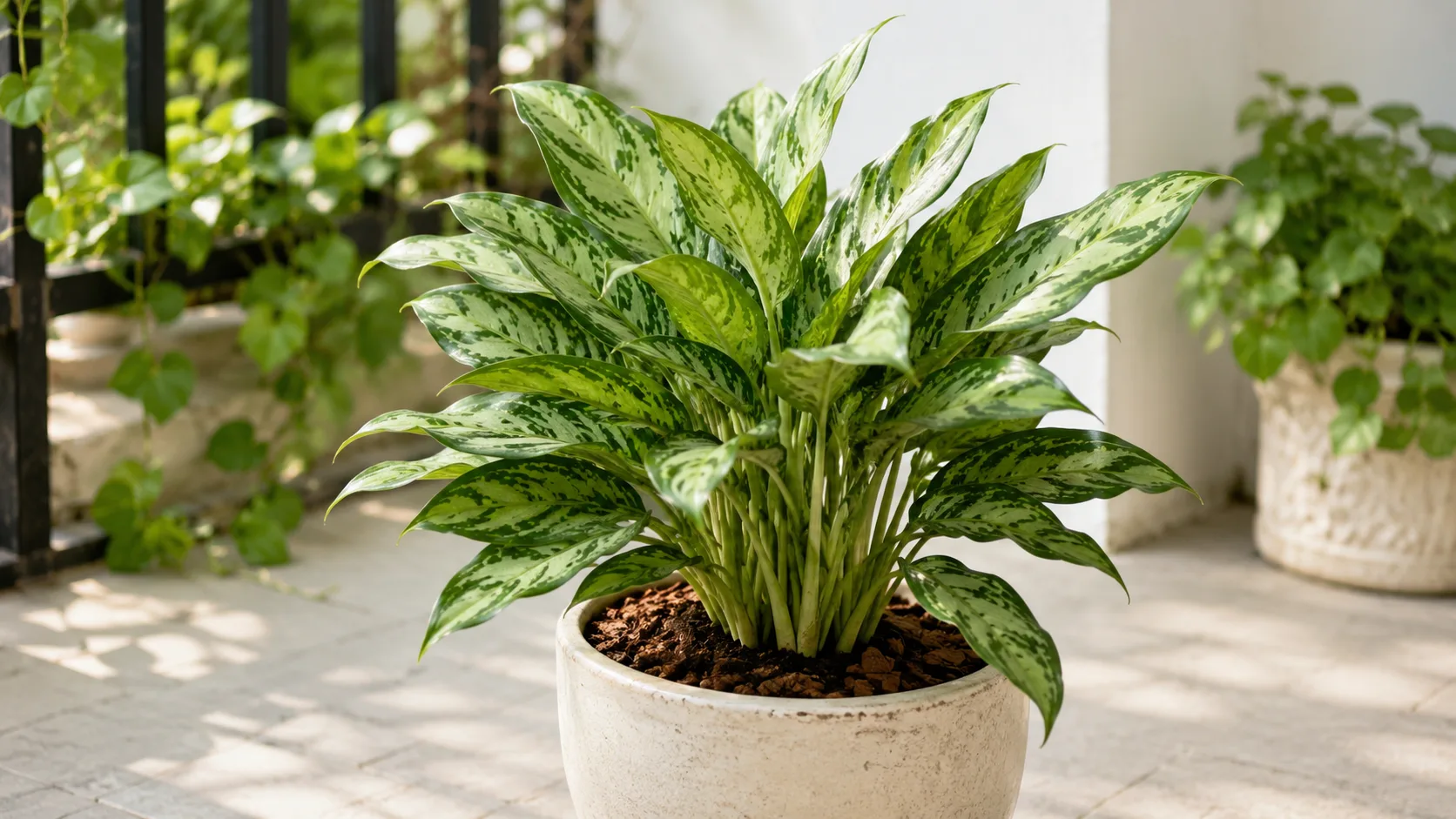
Aglaonema Light Requirements: A Complete Guide
Aglaonema Light Requirements: A Complete Guide
Aglaonema has earned a reputation as a low-light houseplant, but that label is often interpreted too generously. A Chinese evergreen may remain alive in a dim corner for months while producing smaller leaves, longer stems, weaker color, and soil that stays wet too long. Survival shows tolerance; it does not prove the location supports healthy growth. The practical target is enough filtered light for steady leaf production without exposing tender foliage to harsh, sudden sun.
Cultivar matters. Dark green forms generally perform at the lower end of the genus’s light range, while silver, white, red, and pink selections usually hold their pattern and grow more compactly with brighter indirect light. Clemson Cooperative Extension makes the same distinction: solid-green cultivars can grow in low light, while variegated types need low to moderate light and should be protected from direct sun. Start with that principle, then adjust for your actual window, climate, season, and plant response.
The Quick Answer: Best Light for Aglaonema
The best light for most Aglaonemas is medium to bright indirect light for much of the day. Green cultivars tolerate lower light, while colorful or heavily variegated cultivars benefit from the brighter end of that range. Gentle early-morning sun may be acceptable after acclimation, but intense midday or afternoon sun through glass can scorch leaves. Rotate the pot periodically for even growth, and move it gradually whenever exposure changes.
UF/IFAS describes Aglaonema as suitable for medium to low indoor light and warns that overly sunny locations can cause leaf scorch. Missouri Botanical Garden recommends diffused sun or good indirect light for Aglaonema commutatum. University of Minnesota Extension also places Chinese evergreen among plants that can grow under medium or low indoor light, including well-lit office environments. These sources support a broad tolerance range, not a promise that every cultivar will look its best in darkness.
There is no universal “three feet from a window” rule. A clear east window in Seattle, a tinted south window in Miami, and a recessed north window behind an apartment balcony deliver very different light. Use window direction as a starting point, then account for glass, curtains, trees, buildings, latitude, cloud cover, and season. The plant’s new growth is the final check.
Low-Light Tolerance Is Not the Same as Good Light
Plants use light energy to turn carbon dioxide and water into sugars. Those sugars support leaves, roots, defense, and repair. When light falls below the plant’s compensation needs, it cannot produce enough energy for robust growth even if water and fertilizer are abundant. Growth slows first; persistent decline follows if the deficit is severe.
Aglaonema handles lower light better than many colorful tropical plants because green tissues capture light efficiently and the plant naturally grows beneath forest canopies. Indoors, however, human vision is a poor light meter. A room can feel bright because white walls allow us to navigate comfortably while a plant several feet from the window receives only a fraction of the light at the glass. Light commonly falls sharply with distance and obstructions.
A useful low-light test is growth over time. If a plant produces appropriately sized, well-spaced leaves and the potting mix dries at a manageable rate, the location is functioning. If it remains unchanged for months, leans strongly, loses lower leaves, or stays wet for weeks, “tolerating” the spot is not enough. Move it closer to a suitable window or add a grow light.
What Low, Medium, and Bright Indirect Light Mean
Low light is enough to maintain shade-adapted plants but usually too weak for rapid growth. It may occur near an unobstructed north window, farther from a brighter window, or in an office with sustained overhead lighting. Medium indirect light is common close to an east window or a short distance from a bright south or west window outside the direct beam. Bright indirect light is abundant diffuse light without prolonged, hot sun striking the leaves.
Numerical ranges can help but are not absolute biological borders. Horticultural references often discuss indoor illumination in foot-candles, lux, or photosynthetic photon flux density, yet consumer meters and phone apps vary in accuracy. A brief noon reading also misses the rest of the day. Use numbers to compare locations in your home, not to pretend that one measurement guarantees success.
Indirect does not mean no shadows under any circumstances. A bright window may create a soft-edged shadow without delivering damaging direct sun. Conversely, a dim room may have no shadow because almost no useful light reaches the surface. Observe beam duration, leaf temperature, and plant response rather than relying on the shadow test alone.
Duration changes the result. Plants respond to both intensity and duration. Several hours of moderate light may provide more usable energy than a short bright burst followed by deep shade. Day length also changes through the year, especially at higher latitudes. An Aglaonema that grows well in a summer location may stall there in winter even though the pot never moved.
Do not compensate for weak natural light by leaving an ordinary room lamp on all night. Plants benefit from a regular dark period, and household bulbs may deliver little useful light at plant level. If natural exposure is insufficient, use an efficient full-spectrum or white LED grow light on a timer. A consistent schedule is easier to evaluate than irregular switching.
Light and watering are linked. Lower light reduces water use, so the mix dries more slowly and overwatering on Aglaonema becomes more likely. This is why a move to a darker room often causes yellow leaves that are blamed on the move itself. The immediate correction may require both more useful light and a longer interval between waterings.
Match Light to Your Aglaonema Cultivar
Aglaonema cultivars differ in the amount and distribution of chlorophyll-containing green tissue. A mostly green leaf has more area available for photosynthesis than a heavily white or pink leaf of the same size. Breeding, leaf thickness, and overall plant vigor also matter, so color alone is not a perfect formula. Still, it is a practical way to choose a starting location.
When you do not know the cultivar, inspect the leaves and watch new growth. Dark green plants can begin in moderate indirect light and be moved lower if they remain compact. Highly colorful plants should start in bright indirect light and be pulled back if they show bleaching or scorch. Never move either type abruptly from a dim shop shelf into direct sun.
Green and Silver Aglaonema
Green cultivars and classic silver-patterned forms such as those related to Aglaonema commutatum are the strongest candidates for lower-light rooms. They often work near north windows or under sustained office lighting. “Lower” remains relative: a windowless room with lights used only occasionally is not a stable plant habitat. Offices that successfully maintain Aglaonema usually provide many hours of fluorescent or LED illumination.
In low light, expect slower growth and less frequent watering. Do not respond by adding fertilizer; mineral nutrients cannot replace light energy. Keep the plant warm, clean dust from leaves, and avoid placing it behind furniture where even diffuse light is blocked. If stems begin stretching toward the source, improve exposure.
Silver pattern may become less crisp in very low light, but abrupt fading can also reflect leaf age, nutrient problems, or stress. Compare several new leaves before reaching a conclusion. Healthy older leaves naturally differ from newly unfurled foliage, which may take time to harden and reach final color.
Red, Pink, White, and Highly Variegated Aglaonema
Colorful cultivars generally need brighter indirect light to maintain compact growth and strong pigmentation. UF/IFAS describes high-color selections as needing bright indirect light to retain color, while green and silver forms perform well in low-light settings. This does not mean intense sun. Pale sectors contain less chlorophyll and can be especially vulnerable to scorch.
If a pink Aglaonema becomes progressively greener, first move it to a brighter filtered location and assess the next two or three leaves. Genetics set the possible pattern, so light cannot turn a naturally green cultivar pink. Fertilizer also cannot restore variegation that the plant is not genetically producing. Stable color comes from matching a suitable cultivar with sufficient light and otherwise sound care.
White-heavy leaves may grow more slowly because less of their surface photosynthesizes. Keep them close to a bright window behind a sheer curtain or beside, rather than directly in, a strong beam. Check pale tissue frequently for tan scorch patches. A small increase maintained consistently is better than a sudden extreme move.
Choose the Right Window and Distance
Window direction predicts the timing and angle of sun, but it does not dictate an exact distance. In the Northern Hemisphere, north windows usually receive the least direct sun, east windows receive morning sun, south windows can receive long exposure, and west windows receive stronger afternoon sun. In the Southern Hemisphere, north and south behavior is broadly reversed. Local buildings, trees, overhangs, screens, tint, and window cleanliness can outweigh direction.
Start near the window, because indoor light declines quickly into the room. Use a sheer curtain, blinds, or lateral placement to filter direct beams rather than moving the plant so far away that it receives little useful light. Reassess after two to four weeks and focus on new growth. Keep foliage from touching cold or hot glass.
|| Window exposure | Starting placement | Main concern | ||---|---|---| || North, unobstructed | On sill or close to glass | May be too dim in winter | || East | Close to window; gentle morning sun monitored | Sudden sun after a dark location | || South | Behind sheer curtain or outside direct beam | Long, intense sun and heat | || West | Filtered or set back from beam | Hot afternoon sun | || Window obstructed by balcony or tree | Much closer than direction alone suggests | Chronic low light |
North- and East-Facing Windows
An unobstructed north-facing window often suits green and silver Aglaonema, particularly in a bright room. Colorful plants may need to sit directly beside the glass or receive supplemental light. In winter or at high latitude, even the sill can become marginal. Watch the spacing between leaves and the speed at which the mix dries.
East-facing windows are often the easiest match. Morning sun is cooler and less intense than afternoon sun, and the plant receives bright ambient light afterward. A plant acclimated gradually may tolerate a short period of gentle direct morning sun. Thin-leaved, pale, newly purchased, or previously shaded plants still need monitoring.
Do not assume a sheer curtain is always needed. If an east window is shaded by another building, adding fabric may reduce light too far. Stand at plant level at several times of day and observe what actually reaches the foliage.
South- and West-Facing Windows
South and west exposures can provide excellent indirect light when the direct beam is filtered. Place the plant to the side of the window, behind a sheer curtain, or far enough back that hot rays do not strike leaves for long. The safe distance can range from inches to several feet depending on climate and glazing. Leaf temperature and sun duration matter more than a generic number.
West windows require special care because afternoon rays arrive when indoor and outdoor temperatures may already be high. A leaf can experience both intense radiation and heat reflected from glass. Browning may then be compounded by a dry root ball. Use blinds or a sheer curtain during the strongest hours.
A south window may become safer in summer when a roof overhang blocks high-angle sun, then more direct in winter as the sun sits lower. The reverse can happen when deciduous trees lose leaves. Recheck the sun path seasonally instead of treating placement as permanent.
Can Aglaonema Take Direct Sun?
Aglaonema should generally be protected from strong direct sunlight, a position supported by Clemson, UF/IFAS, and Missouri Botanical Garden guidance. Direct midday or afternoon sun through glass can bleach pigments, create tan patches, and leave dry, crispy margins. Damage often appears on the window-facing side and does not heal. New leaves can still be healthy after conditions are corrected.
Brief, gentle early-morning sun may be tolerated by an established plant that has been acclimated. That is a conditional allowance, not a requirement. Cultivar, previous exposure, leaf color, temperature, water status, and glass all affect risk. If the plant already receives strong indirect light and grows well, there is no reason to test its maximum sun tolerance.
Acclimating a Plant Without Burning It
Increase exposure gradually over two to four weeks. Begin with bright filtered light, then allow perhaps 15 to 30 minutes of gentle morning sun. Extend only if leaves remain normal after several days. A sheer curtain can reduce intensity while the plant adjusts.
Acclimation helps leaves build protective responses, but it does not make a shade plant suitable for hot all-day sun. Newly unfurled leaves are particularly tender. Keep the root ball appropriately moist during transitions, but do not keep it saturated as insurance against heat. Water availability cannot prevent radiation damage.
When moving a plant outdoors for warm weather, start in deep shade protected from wind and rain impact. Outdoor shade can be substantially brighter than indoor window light. Check nighttime temperatures, because Aglaonema is cold sensitive, and inspect for pests before bringing it back inside.
Seasonal Changes That Alter Exposure
Sun angle, day length, cloud patterns, and tree cover change throughout the year. Marking the direct-sun boundary on the floor at different seasons can reveal how far the beam travels. A plant safe beside a window in June may sit in direct afternoon sun in December. Check after daylight-saving changes too, not because the sun changes abruptly, but because your curtain routine may.
Winter sunlight is often weaker, yet cold glass and drafts introduce another risk. Keep leaves away from the pane and avoid trapping the plant between a curtain and a cold window overnight. In summer, air-conditioning vents can chill foliage even while the window side overheats. Stable conditions matter alongside light.
After any move, expect the plant to use water at a different rate. Brighter exposure commonly shortens the drying interval; darker exposure lengthens it. Check the mix rather than preserving the old watering calendar.
Using Grow Lights for Aglaonema
A grow light is useful in windowless rooms, during dark winters, or when colorful cultivars lose form despite the best available window. Aglaonema does not require the very high intensity used for fruiting crops. A modest, efficient LED placed correctly can supply more useful light than a powerful fixture mounted too far away. Coverage and duration matter.
White full-spectrum LEDs make it easier to evaluate leaf color and live with the fixture. Specialty purple lights can also drive photosynthesis, but spectrum marketing does not replace output data. Look for manufacturer guidance showing coverage or photosynthetic photon flux at different distances. Household bulbs can work at close range if their output and heat are suitable, but purpose-built grow lights are easier to position.
A Practical Grow-Light Setup
Place the light above the canopy so growth remains upright and even. Start at the manufacturer’s recommended distance for low-to-medium-light foliage plants, often somewhere around 12 to 24 inches for small consumer LEDs, but output varies too much for that range to be a rule. Use a timer for about 10 to 14 hours per day, then adjust based on growth and the fixture’s intensity. Give the plant a consistent dark period.
Keep all leaves within the useful footprint. A narrow bulb may brightly illuminate the center while outer shoots remain dim. Rotate the pot every week or two if the fixture cannot cover the entire canopy evenly. As the plant grows upward, maintain a safe distance from the light.
Check heat at leaf level. LEDs are efficient, but drivers and close fixtures can still warm foliage. If leaves bleach directly beneath the lamp, reduce duration, increase distance, or lower intensity. If growth stretches and leans despite long hours, move the light closer or use a stronger fixture.
Measuring and Adjusting Artificial Light
Lux meters measure light weighted to human vision, while plants respond to photosynthetically active photons. PPFD and daily light integral are more biologically relevant, but inexpensive instruments vary. You do not need laboratory equipment for a healthy Aglaonema. Use measurements to compare setups, then verify with the plant.
Change only one variable at a time: distance, dimmer setting, or duration. Hold the new setup for two or three weeks unless obvious bleaching or burn demands immediate action. Evaluate the next leaf’s size, petiole length, orientation, and color. Existing stretched growth will not become compact, so look at what develops after the change.
Clean dust from the fixture and leaves, because both reduce delivered or absorbed light. Follow electrical safety instructions around watering. Secure clamp lights and cords so a bumped pot cannot pull the fixture down.
Diagnose Light Problems from the Whole Plant
Light symptoms are patterns, not single spots. Examine which side is affected, whether damage occurs on old or new leaves, how quickly it appeared, and what changed recently. Check soil moisture, roots, pests, temperature, fertilizer history, and water quality. Several stresses can occur together.
For example, a plant moved into low light may stay wet, develop root damage, and then yellow. Moving it closer to a window helps future water use, but damaged roots still require attention. Likewise, a sunlit leaf may brown faster when the root ball has gone dry. Accurate diagnosis prevents overcorrection.
Signs of Too Little Light
Low-light warning signs include long spaces between leaves, petioles stretching toward the window, a crown leaning strongly, smaller new leaves, slower or absent growth, and reduced color in some variegated cultivars. Lower leaves may yellow as the plant reallocates resources. The potting mix may remain wet much longer than before.
Move the plant closer to a suitable window in stages or add a grow light. Rotate for balance, but do not use rotation to hide severe leaning while leaving the plant underlit. Reduce watering frequency to match slower drying and pause heavy feeding. Once exposure improves, new growth should gradually become more compact.
One dormant-looking month is not proof of failure, especially in winter. Look for a trend across a season. If adequate light is present but growth remains stalled, investigate temperature, roots, pests, and nutrition.
Signs of Too Much Light
Excess direct light can cause bleached or washed-out areas, tan to brown crispy patches, dry margins, and curling on exposed leaves. Damage tends to occur on the side facing the source and may follow a move or sudden sunny spell. Sunscald patches do not spread like an infection once exposure is corrected.
Move the plant out of the direct beam or add a sheer curtain. Do not place it immediately in deep shade; bright indirect light supports recovery. Remove a damaged leaf only if it is mostly dead or aesthetically unacceptable, because green portions still contribute energy.
Brown tips alone are weak evidence of excess light. They also occur with salt buildup, inconsistent watering, low humidity, damaged roots, or water-quality issues. Inspect the distribution. Sun damage usually creates exposed-surface patches rather than identical tips on every leaf.
Improve light without creating new problems. Clean windows and leaves before making a major move. Dust, screens, and dirty glass can meaningfully reduce light. Open blinds during safe hours, use pale nearby surfaces to reflect diffuse light, and prune outdoor vegetation only when appropriate and permitted. Small improvements may solve the problem without exposing leaves to a harsh beam.
Keep foliage clear of hot radiators, cold drafts, and HVAC vents. A bright location is not good if temperatures fluctuate sharply. Avoid crowding plants so closely that their leaves shade one another and airflow disappears. If you use a sheer curtain, confirm it does not trap the plant against cold glass at night.
After improving light, revisit watering and fertilizer. Faster photosynthesis and warmer leaf surfaces may increase water use, while resumed growth may eventually justify feeding. Make those changes based on measured drying and visible growth, not on the day of the move. Adjusting everything at once turns plant care into guesswork.
Photograph the plant from the same angle every two weeks. This simple record reveals leaning, leaf-size changes, and color trends that are difficult to remember. Use new leaves as the report card. They show how the plant is responding now, while old scars record past conditions.
Conclusion
The most accurate summary of Aglaonema light requirements is medium to bright indirect light, adjusted for cultivar. Green and silver plants tolerate lower exposure; red, pink, white, and heavily variegated plants generally need brighter filtered light to maintain compact growth and color. Strong direct midday or afternoon sun is an avoidable scorch risk, while gentle morning sun may be acceptable after gradual acclimation.
Choose placement by observing the real window rather than following a fixed distance. Account for direction, obstructions, season, glass, and duration, then watch new leaf size, spacing, orientation, and color. Add a timed grow light when the room cannot provide enough energy. The right location is the one where the plant grows steadily, uses water predictably, and holds its form without bleaching or stretching.
When to use this page vs other Aglaonema guides
- Aglaonema overview - Start here for whole-plant context before deep-diving this topic.
- Aglaonema problems hub - Jump to symptom-specific fix guides when this care topic does not resolve the issue.
- Not Enough Light on Aglaonema - Escalate here when light adjustments are not enough.
- Leggy Growth on Aglaonema - Escalate here when light adjustments are not enough.
Related Aglaonema guides
- Aglaonema overview
- Aglaonema watering
- Aglaonema soil
- Aglaonema propagation
- Aglaonema fertilizer
- Aglaonema repotting
- Not Enough Light on Aglaonema
- Leggy Growth on Aglaonema
- Aglaonema problems
Related tool
Try the Plant Problem Diagnosis Tool with aglaonema pre-selected to estimate needs for your setup.