Aglaonema Fertilizer Guide: Type, Dose, Schedule
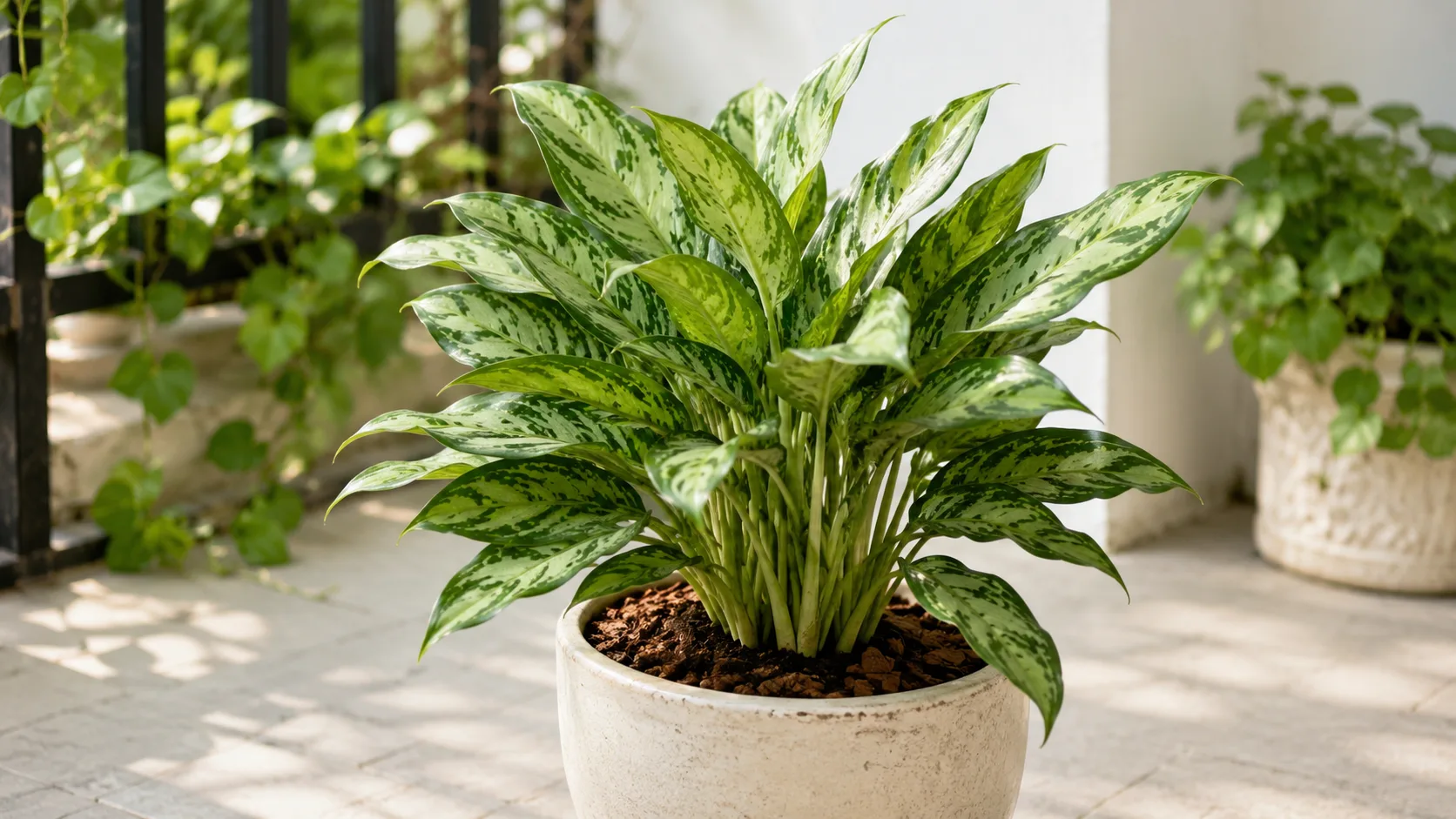
Aglaonema Fertilizer Guide: Type, Dose, Schedule
Aglaonema Fertilizer Guide: Type, Dose, Schedule
Aglaonema, commonly called Chinese evergreen, is a slow-to-moderate-growing foliage plant rather than a heavy feeder. Its roots need nutrients, but they also occupy a small volume of potting mix where fertilizer salts can become concentrated. That combination makes restraint more useful than an aggressive feeding calendar. The goal is not to push constant growth; it is to replace nutrients the plant uses while it has enough light, warmth, water, and healthy roots to build new tissue.
The safest routine starts with a complete houseplant fertilizer, a reduced label dose, and an interval adjusted to actual growth. A plant producing leaves near a bright east window can use more nutrients than the same cultivar sitting in a dim office. Fresh potting mix may already contain fertilizer, while an old, frequently watered mix may have little nutrition left. Treat fertilizer as one part of the growing system, not as a cure for every pale leaf or stalled stem.
The Quick Answer: How to Fertilize Aglaonema
For most established indoor Aglaonemas, use a complete, balanced liquid houseplant fertilizer at one-quarter to one-half of the label rate every four to six weeks during active growth. Apply it to already-moist potting mix, allow surplus solution to drain, and reduce or pause feeding when growth slows in cool, dark months. If the product label specifically provides a houseplant rate, use that rate as the ceiling rather than inventing a stronger mixture. Never combine a full liquid dose with fresh controlled-release fertilizer unless the labels and your plant’s conditions justify it.
There is no single schedule that fits every home. Illinois Extension has recommended balanced fertilizer about every four weeks for Aglaonema, with a longer interval in winter, while general houseplant guidance from Oklahoma State University Extension emphasizes that frequency changes with season, light, temperature, species, and medium. Those recommendations are compatible when you treat four weeks as an active-growth starting point rather than an obligation. Clemson Cooperative Extension describes Chinese evergreen as durable in low to moderate indirect light, but tolerance of low light does not mean efficient nutrient use in low light.
A useful rule is: feed the growth you can see. Expanding leaves, new shoots, and steady root activity support light feeding. No visible growth, cold stress, wilt, saturated soil, recent root loss, or severe pest damage are reasons to wait. Fertilizer supplies mineral elements; it cannot substitute for light or restore roots that are suffocating in wet mix.
How Much Fertilizer Does Aglaonema Really Need?
Aglaonema evolved as a tropical forest-floor plant and has been selected as an interiorscape crop partly because it performs under relatively modest indoor light. Lower photosynthetic energy usually means slower construction of leaves, stems, and roots, so nutrient demand is lower than it would be for a rapidly growing outdoor annual. A plant that adds only a few leaves over several months does not need fertilizer at every watering. Repeated feeding beyond demand leaves soluble salts behind as water evaporates or is used.
Plant size alone is a poor dosing guide. A large, mature clump in a dim corner may use less fertilizer than a smaller plant under a well-positioned grow light. Pot size, root density, mix composition, watering quality, and the presence of fertilizer in the substrate all affect availability. Before feeding, check whether the plant is actively growing and whether its care conditions make continued growth realistic.
What Nitrogen, Phosphorus, and Potassium Do
Fertilizer labels show three numbers representing percentages of nitrogen, available phosphate, and soluble potash, commonly shortened to N-P-K. Nitrogen supports chlorophyll, proteins, and vegetative growth. Phosphorus participates in energy transfer and root and cell functions, while potassium contributes to water regulation, enzyme activity, and general stress response. All three are necessary, but a larger number does not automatically mean a better product.
A balanced product such as 10-10-10 or 20-20-20 can work when diluted according to its concentration and label. The ratios are the same, but 20-20-20 contains twice the percentage of each listed nutrient, so it must not be measured as though it were 10-10-10. Many modern foliage fertilizers use ratios such as 3-1-2, reflecting the relatively higher nitrogen use of leafy plants. Either a balanced formula or a foliage-oriented ratio can maintain Aglaonema when applied conservatively. UF/IFAS describes 3-1-2 N-P-K as an acceptable ratio for Aglaonema production and lists 20-20-20 at 50 ppm N monthly as adequate for interior maintenance.
Do not chase a high-phosphorus “root booster” for routine care. Established houseplants generally need a complete supply, and phosphorus accumulates when repeatedly applied in excess. Likewise, high nitrogen may produce soft, stretched growth if light is inadequate. The best NPK is a complete ratio you can dose accurately, not a magic number detached from growing conditions.
Why Micronutrients and Potting Mix Matter
Plants also need smaller quantities of iron, manganese, zinc, copper, boron, molybdenum, and other elements. A complete houseplant fertilizer lists micronutrients in addition to N-P-K, making it a better long-term choice than a product supplying only one or two macronutrients. Iron-related chlorosis can appear as yellowing between veins on newer leaves, but iron in the bottle does not guarantee uptake. Root damage, unsuitable pH, cold mix, or prolonged saturation can prevent absorption even when nutrients are present.
The potting mix acts as both reservoir and root environment. Commercial mixes may contain a starter charge or controlled-release granules, which can feed a newly purchased or repotted plant for weeks or months. Read the bag and plant label before adding more. Bark-heavy, porous mixes drain quickly and may lose nutrients faster, while dense mixes retain water and salts longer.
Water quality matters too. Hard water may leave a pale mineral crust on the soil or pot, and repeated fertilizer use adds another source of dissolved salts. A crust is not proof that the plant is nutrient deficient; it is often a reason to flush the mix and review both water and fertilizer. If your tap water has high dissolved solids, a lower fertilizer dose and occasional use of rainwater, distilled water, or appropriately filtered water can reduce accumulation.
Choosing the Best Fertilizer for Aglaonema
The best product is one that is complete, easy to measure, compatible with your routine, and unlikely to be doubled accidentally. Brand matters less than nutrient analysis, directions, and application control. University of Missouri Extension notes that both organic and inorganic fertilizers can supply houseplant nutrients, while warning that roots restricted to containers can be burned by excessive application. That is the central trade-off: every form can work, but no form makes overuse harmless.
|| Fertilizer form | Main advantage | Main limitation | Best fit | ||---|---|---|---| || Liquid or water-soluble | Precise, adjustable, immediate | Easy to apply too often | Growers who inspect plants regularly | || Controlled-release | Convenient, gradual supply | Harder to remove or adjust | Stable, warm, well-lit conditions | || Organic liquid | Supplies nutrients in a familiar routine | Analysis may be low or variable; odor possible | Growers comfortable measuring and monitoring | || Castings or compost-based amendment | Mild input and organic matter | Can reduce aeration if overapplied | Small top-dress on a suitable mix |
Liquid and Water-Soluble Fertilizer
Liquid concentrates and soluble powders give you the most control. You can reduce concentration for a low-light plant, lengthen the interval during a heatwave or winter slowdown, and stop immediately if the plant becomes stressed. Choose a product labeled for houseplants or foliage plants, ideally with micronutrients. Mix it in a measured volume of water rather than estimating drops into a partly filled can.
“Weakly, weekly” is sometimes suggested for houseplants, but it is not automatically safer. A quarter-dose every week can equal or exceed a full monthly dose, depending on the math and number of waterings. Aglaonema also should not be watered merely because fertilizer day arrived. A four-to-six-week feeding interval is simpler for many homes because watering remains based on soil moisture.
Never add undiluted concentrate directly to the pot. Do not mix different fertilizers unless you know their combined nutrient and salt load. If you use a liquid product, keep a note of the date and concentration; memory is unreliable when several plants share a watering routine.
Slow-Release Fertilizer
Controlled-release prills release nutrients gradually as moisture and temperature conditions activate them. They are convenient for established Aglaonemas growing steadily in warm, Aglaonema light guide. Use a product labeled for indoor container plants and calculate the amount from actual pot size. Applying “a handful” is not a dosing method, especially in a small pot.
Release can continue when you would otherwise choose not to feed. Warm, consistently wet soil may release nutrients faster, while a plant weakened by root trouble cannot use them effectively. Prills can also be mistaken for insect eggs; inspect before removing them from commercial potting mix. If a new plant already contains granules, do not automatically add another layer.
For an Aglaonema in low light or one whose growth varies strongly by season, liquid fertilizer is easier to control. Slow-release is best when environmental conditions are stable and you reliably avoid supplemental full-strength feeding. Record the application date and expected longevity from the label.
Organic Fertilizer Options
Fish emulsion, seaweed-based blends, worm castings, and other organic products can be used, but “organic” does not mean salt-free, complete, odorless, or impossible to overapply. Check the guaranteed analysis and directions. Some seaweed products supply mostly potassium and trace compounds rather than a complete nutrient profile; some fish products provide useful nitrogen but still need accurate dilution. Choose based on what the product contains, not the marketing category.
Worm castings can be mixed sparingly into a fresh, airy medium or applied as a thin top-dress. A thick layer of compost-like material can stay wet, impede gas exchange, and encourage fungus gnats. Indoor containers have no field soil ecosystem to buffer unlimited amendments. Keep the physical structure of the mix open and drainable.
Coffee grounds are a poor routine fertilizer for potted Aglaonema. Their nutrient release is unpredictable, and a surface layer can compact, retain moisture, and support mold. Composting them elsewhere is more controlled. Kitchen scraps, banana water, eggshell water, and similar recipes also fail to provide a reliably complete or measurable diet.
An Aglaonema Feeding Schedule That Adapts to Growth
Build the schedule around the plant’s active growth period, not a date printed in isolation. In many Northern Hemisphere homes, longer spring and summer days produce the strongest growth. In tropical climates, air-conditioned offices, or homes with grow lights, the pattern may differ. Observe leaf expansion over two or three weeks and consider temperature, light duration, and watering frequency.
A practical baseline for an established plant is every four to six weeks at one-quarter to one-half label strength while new leaves are forming. Plants under genuinely low light may need only a few applications across the entire growing season. Fast-growing specimens with dense roots and strong light may tolerate the higher end of the label-directed range, but increase only after confirming there is no tip burn or surface crust.
Spring and Summer Feeding
Begin or increase feeding after growth clearly resumes. If the plant has recently been repotted into a mix containing fertilizer, wait for the starter charge to decline according to the product information, often several weeks or longer. If the mix has no added nutrients and roots are healthy, a reduced liquid dose can begin once the plant has settled and resumed growth. Newly divided plants should first establish functional roots.
During warm, bright months, inspect the plant at each watering but fertilize only on the chosen interval. A plant close to an east window may grow steadily and use a half-strength dose every four to six weeks. The same cultivar several feet into a room may need one-quarter strength every six to eight weeks. Light duration and intensity, not the cultivar name alone, determine much of that difference.
High-color red and pink Aglaonema cultivars often benefit from brighter indirect light to maintain color, but they do not need a special “color fertilizer.” Pigmentation is largely genetic and influenced by light and leaf development. Extra nitrogen cannot manufacture variegation and may produce greener-looking or weak growth when light is poor.
Fall and Winter Feeding
Reduce feeding as day length and visible growth decline. In a cool home with no supplemental lighting, pausing fertilizer through the darkest months is often safer than following a summer schedule. Missouri Botanical Garden recommends reducing water from early fall through late winter without allowing the mix to become completely dry; lower water use is another clue that nutrient use has slowed. Resume only when conditions and growth improve.
Winter feeding is not universally forbidden. A plant under a properly positioned grow light in a consistently warm room may continue to produce full-sized leaves and use modest nutrition. In that case, extend the interval or maintain a weak dose while monitoring the root zone. The decision should follow growth, not a blanket rule.
Avoid fertilizing a cold plant. Aglaonema is tropical, and extension sources commonly place its preferred indoor temperature around the upper 60s to upper 70s Fahrenheit, with chilling injury possible at lower temperatures. Clemson Cooperative Extension warns that Chinese evergreens are sensitive to chilling below 50–55 °F. Cold roots absorb water and nutrients less effectively. Correct the temperature and assess root health before feeding.
How to Apply Aglaonema Fertilizer Safely
Safe application is mostly about controlling concentration and ensuring drainage. Use a measuring spoon, syringe, or marked cap and a known water volume. Confirm that the pot has an open drainage hole and that excess water can leave freely. Fertilizer applied to a decorative cachepot with no drainage can remain around the roots and concentrate.
Do not fertilize a severely wilted plant, a newly dry root ball, or a plant with suspected rot. Missouri Extension specifically advises against applying liquid fertilizer to a wilted plant; rehydrate it and allow recovery first. A stressed plant’s need is diagnosis, not stimulation.
Choose a Conservative Dose
Start at one-quarter to one-half of the label’s indoor-houseplant rate. This is especially appropriate for low light, a small plant, an uncertain product history, or a mix that dries slowly. “Half strength” means half the product quantity in the same final volume of water, not half the water. Write the calculation down if the label rate is given per gallon and your can holds a liter.
Do not compare dose by NPK numbers alone. One teaspoon of a 2-2-2 liquid and one teaspoon of a 20-20-20 powder do not deliver equivalent nutrients. Follow the formulation’s own label, then reduce proportionally. More fertilizer cannot force faster growth when light is the limiting resource.
Increase only if the plant has shown sustained, healthy growth over multiple applications with no salt crust, burned tips, unusual wilt, or root decline. Change one variable at a time. Doubling both frequency and strength makes it impossible to know which change caused a problem.
Water, Feed, Drain, and Monitor
Check moisture first. If the top layer has dried appropriately and the pot feels ready for water, lightly pre-moisten a very dry mix with plain water, then apply the diluted fertilizer evenly across the surface. Water until some solution drains from the bottom, discard runoff, and never leave the pot standing in it. This distributes nutrients more evenly than pouring a concentrated dose beside one stem.
For a normally moist root ball, the diluted fertilizer solution can serve as that watering. Do not first saturate the pot and then add another large volume unless drainage and timing make sense. The objective is moist, aerated mix with excess salts carried out, not a prolonged swamp.
Every two or three months during active care, water thoroughly with plain water and allow generous drainage to help leach accumulated salts. This is more effective than pouring a token splash into the top. If the mix has become hydrophobic and water runs down the pot wall, rewet it gradually so the root ball actually receives water before any fertilizer is considered.
How to Read Your Plant’s Response
Healthy response is gradual: normal-sized new leaves, stable color appropriate to the cultivar, firm stems, and steady root growth. Fertilizer rarely causes an overnight improvement because plants must absorb nutrients and build tissue. Existing damaged areas generally do not turn green again. Judge success by new growth and whether the plant remains stable over several weeks.
Leaf symptoms overlap. Yellow leaves can result from old age, low light, overwatering on Aglaonema, underwatering on Aglaonema, cold, root rot on Aglaonema, pests, or nutrient imbalance. Brown tips can reflect dry air, inconsistent moisture, water quality, damaged roots, or excess salts. Before diagnosing deficiency, inspect the entire care system.
Possible Nutrient Deficiency Signs
General pale color and slow growth can occur with inadequate nitrogen, particularly in an old, nutrient-poor mix while the plant otherwise has good light and roots. Yellowing between veins may suggest a micronutrient availability problem. Small new leaves can occur when nutrition is limited, but also when light is too weak or roots are crowded or damaged. No single leaf pattern proves that fertilizer is the answer.
Use a process of elimination. Confirm adequate bright or moderate indirect light for the cultivar, normal temperature, proper watering, drainage, and healthy cream-to-tan roots rather than black mushy ones. Review when the plant was repotted and whether the mix contained fertilizer. Then try one reduced application of a complete product and assess subsequent leaves, not the already damaged leaf.
If symptoms progress despite sound care, test the water and potting-medium pH or consult a local extension service. Adding repeated iron or Epsom salt without evidence can create a different imbalance. Epsom salt supplies magnesium and sulfur only; it is not complete fertilizer.
Excess Fertilizer and Salt Buildup
Common warning signs include a white or tan crust on the mix or pot rim, browning tips and margins, sudden wilt despite moist soil, slowed growth, and damaged dark roots. Severe salt concentration draws water away from roots and can mimic drought. Recently fertilized plants that decline quickly deserve immediate attention, especially if concentrate was mismeasured.
Stop feeding and remove visible surface deposits. If the pot drains well and roots are not rotting, slowly flush the mix with several pot volumes of suitable plain water, letting it drain completely. Do not leave the runoff in a saucer. Repeat only as needed; continuous flushing of a saturated, poorly aerated mix can worsen root problems.
For a major overdose, compacted substrate, or clear root injury, repot into fresh, compatible mix. Remove only roots that are genuinely dead and mushy, then keep conditions warm with appropriate indirect light. Do not fertilize again until recovery and new growth are evident. If controlled-release granules caused the overdose, remove accessible granules during Aglaonema repotting guide.
Troubleshooting Common Fertilizer Questions
Can 10-10-10 be used? Yes, if it is labeled for the application and diluted correctly. Its balanced ratio is acceptable, but the product’s concentration and form determine the safe quantity. A granular garden product designed for outdoor beds may be difficult to dose safely in a small indoor pot, so a houseplant formulation is easier.
Should a newly purchased Aglaonema be fed? Usually not immediately. Commercial growers often ship plants with residual controlled-release fertilizer or a nutrient charge in the medium. Give the plant time to acclimate, inspect for granules, and wait for active growth. Feeding during transport stress adds risk without clear benefit.
Should an Aglaonema be fertilized after repotting? Check the new mix. If it contains starter fertilizer, wait for the stated feeding window. If it contains none, let disturbed roots settle and wait until the plant resumes growth before using a weak dose. Fertilizer does not speed wound healing.
Can foliar feeding replace root feeding? It is unnecessary for routine Aglaonema care and raises the chance of residue or leaf spotting. Most nutrition should enter through healthy roots. Never spray fertilizer onto foliage in direct sun, and do not use foliar application to bypass a diseased root system.
What if the plant grows in water or semi-hydro media? Use a fertilizer specifically suitable for hydroponic or soilless culture and manage solution concentration, pH, and reservoir changes. Soil-based dosing does not transfer directly because the medium buffers nutrients differently. Start weak and follow the system manufacturer’s guidance.
Does flowering require extra phosphorus? An indoor Aglaonema may produce an aroid inflorescence, but it is primarily grown for foliage. A complete routine fertilizer is sufficient; a bloom booster is not necessary. Some growers remove flowers so the plant directs resources toward foliage, though this is optional.
Conclusion
An effective Aglaonema fertilizer routine is deliberately modest. Choose a complete houseplant formula, begin at one-quarter to one-half label strength, and apply it about every four to six weeks only while the plant is actively growing. Use less in low light, pause during stress or seasonal slowdown, and account for nutrients already present in fresh mix or controlled-release granules.
The plant’s environment should make the final decision. Adequate indirect light, warm temperatures, healthy roots, correct watering, and free drainage allow Aglaonema to use nutrients; fertilizer cannot compensate when those foundations are missing. Measure every dose, discard runoff, flush accumulated salts periodically, and judge results by healthy new leaves. That approach produces steadier growth with far less risk than feeding by habit.
When to use this page vs other Aglaonema guides
- Aglaonema overview - Start here for whole-plant context before deep-diving this topic.
- Aglaonema problems hub - Jump to symptom-specific fix guides when this care topic does not resolve the issue.
Related Aglaonema guides
- Aglaonema overview
- Aglaonema watering
- Aglaonema light
- Aglaonema soil
- Aglaonema propagation
- Aglaonema repotting
- Aglaonema problems
Related tool
Try the Fertilizer Dilution Calculator with aglaonema pre-selected to estimate needs for your setup.