Best Soil for Aglaonema Pink Dalmatian: Mix, Drainage & pH
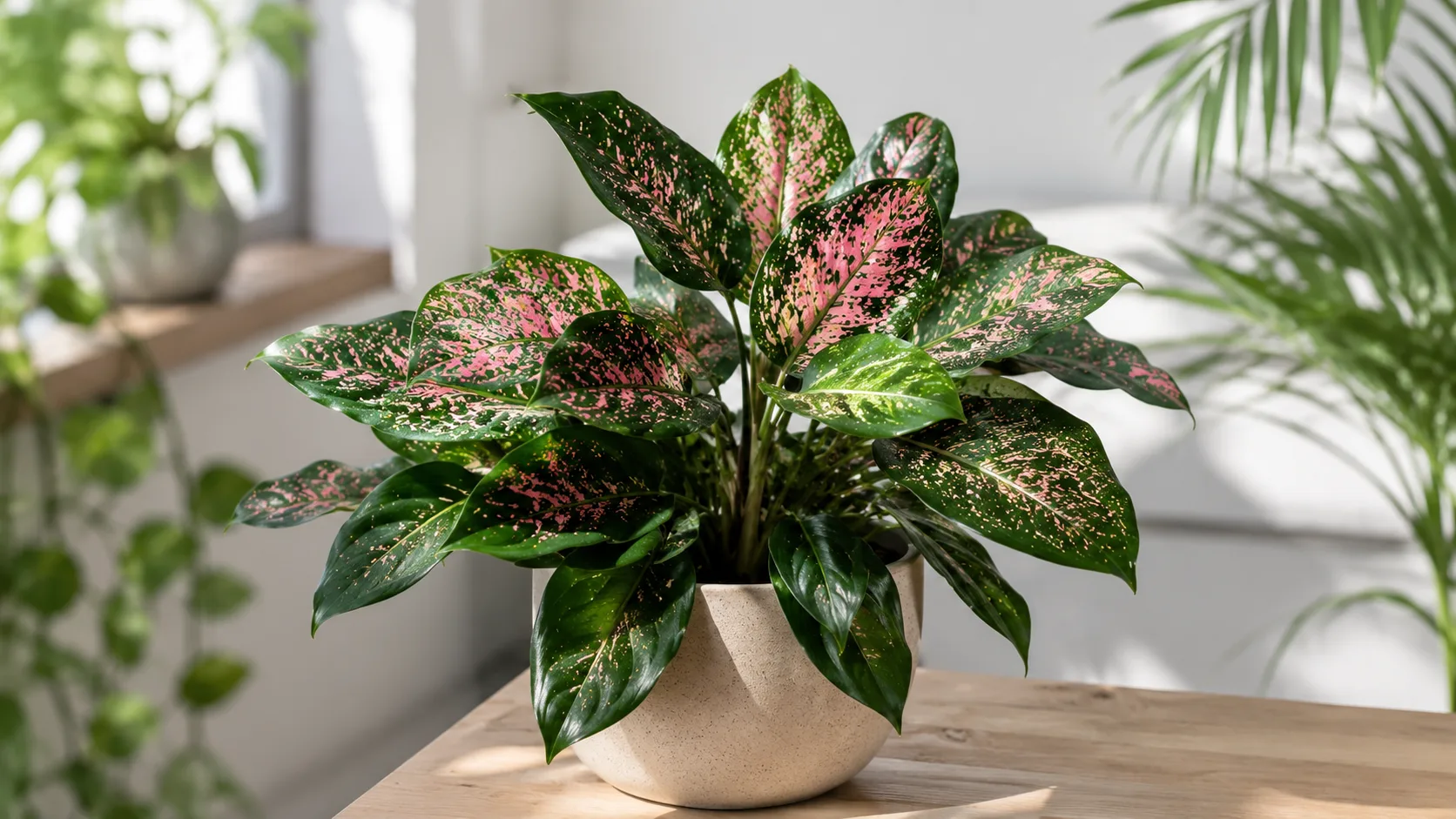
Best Soil for Aglaonema Pink Dalmatian: Mix, Drainage & pH Guide
Best Soil for Aglaonema Pink Dalmatian: Mix, Drainage & pH Guide
Author: sai-ananth · Reviewed by: LeafyPixels Review Board · Updated: 2026-06-15
Aglaonema Pink Dalmatian soil is a moisture-management problem disguised as a recipe question. The speckled pink cultivar grows slowly, uses water conservatively in dim rooms, and still needs enough organic structure that roots do not dry in hard chips every forty-eight hours. If your pot stays heavy for two weeks while the surface looks merely cool, the issue is usually the light–soil–pot triangle, not a missing bag of “pink plant” fertilizer. This page owns cultivar-specific substrate decisions for Pink Dalmatian. For genus-wide cultivar comparisons and semi-hydro notes, see the Chinese evergreen soil guide. For how speckling responds to placement, start with the Pink Dalmatian overview.
Pink Dalmatian’s scattered variegation means less total chlorophyll per leaf than solid-green office Aglaonemas, so the plant often transpires more slowly at a given temperature-especially when light is only “survivable” rather than bright enough to hold pink on new leaves. That biology is why the same 2:1:1 mix that works in a bright kitchen can stay wet too long in a north-facing bedroom. The fix is usually more aeration and a snug pot, paired with better indirect light from the light guide, not a wholesale switch to pure orchid bark.
The Quick Answer
The best soil for Aglaonema Pink Dalmatian is a loose, slightly moisture-retentive blend that drains freely and restores air after watering. Start with two parts quality indoor potting mix, one part perlite or pumice, and one part fine orchid bark-the same genus framework described on the Aglaonema soil hub, but adjust upward on aeration when the plant sits in low light, a glazed cachepot, or an oversized container.
Pot in a vessel with a real drainage hole, water thoroughly until a little exits the bottom, then let the upper half of the mix dry before the next drink-the rhythm detailed in the watering guide. In a typical 6-inch (15 cm) plastic pot in medium to bright indirect light, that often means a 7–14 day dry-down between soakings in active growth; in dim light the same mix may need 14–21 days or more because the plant simply uses less water. Those ranges are home heuristics, not guarantees-your job is to learn your pot’s weight and moisture depth, not copy a calendar.
Pink Dalmatian vs Lady Valentine vs Genus Default
Pink Dalmatian is not Lady Valentine with smaller spots. Lady Valentine carries broad pink or coral leaf fields; Pink Dalmatian keeps a mostly green leaf with discrete speckles. More pale tissue generally means higher light demand and slightly faster water use in bright rooms, while Pink Dalmatian’s speckled pattern sits in the middle-slower than solid-green types, often thirstier in good light than in dim corners.
| Cultivar / baseline | Typical moisture band (6-inch pot, moderate home) | Bark fraction vs 2:1:1 default | When to push more aeration |
|---|---|---|---|
| Genus default (solid-green Aglaonema) | Top third to half dry in ~5–10 days in moderate light | Standard 2:1:1 | Rarely unless overwatering |
| Pink Dalmatian (speckled variegation) | Top half dry in ~7–14 days bright; 14–21+ days dim | Equal parts base, perlite, bark in dim rooms | Low light, cool room, glazed pot |
| Lady Valentine (broad pink panels) | Similar bright-room cadence; may dry slightly faster in strong light | Slightly more base in very dry, bright setups | Less often in dim rooms than Pink Dalmatian |
If you are deciding between this page and the overview soil section: the overview sets the whole-care frame; this page owns mix ratios, amendment choices, pH targets, and failure diagnosis when drainage behavior is the bottleneck.
Understand What Pink Dalmatian Roots Need
Aglaonema roots need water, dissolved nutrients, and oxygen at the same time. After a thorough watering, gravity pulls free water toward the drain hole, but the substrate retains moisture in small pores and on particle surfaces. Air returns mainly to larger pores. When nearly all particles are fine and compressed-as in straight peat or garden soil-the medium can stay saturated long enough to restrict root respiration even though water visibly left the pot.
That is why a drainage hole alone cannot rescue a dense plug. It is also why a gravel layer at the bottom does not substitute for mixing aeration throughout the root zone. Roots occupy the full depth of the container, so useful structure must be distributed through it. NC State Extension advises keeping the potting mix moist during active growth, reducing watering in winter, and avoiding cold conditions for Chinese evergreen. The word moist means available water in aerated pores-not permanent saturation.
Pink Dalmatian follows those genus rules, but variegation changes the pace. In moderate indirect light, transpiration stays steady enough that a balanced 2:1:1 mix usually works. In dim light-where pink speckles fade on new leaves-the plant may use water slowly while the organic fraction still holds moisture, producing the classic outer dry / core wet pattern that precedes yellow lower leaves and root rot. Soil must be paired with light from the light guide and watering checks from the watering guide, not judged in isolation.
Moisture Retention Is Not Waterlogging
Moisture retention is beneficial when water remains available in pore spaces that still permit gas exchange. Waterlogging occurs when water displaces air for too long-often because particles are too fine, the pot is oversized, drainage is blocked, or the plant uses water slowly. The same bagged mix can perform in a small warm pot and fail in a large cool one. Soil behavior is a property of the entire setup.
Do not judge a mix only by how quickly water exits during irrigation. Water can channel down the side of a hydrophobic peat root ball and leave the center dry, creating the illusion of excellent drainage. Conversely, a well-hydrated blend can drain from the hole while retaining a useful reserve. Check moisture at several depths and track how pot weight changes over days.
Repeatedly letting peat become bone dry can make it difficult to rewet, while keeping it continuously wet depletes oxygen and encourages fungus gnats. Aim for a controlled cycle: water thoroughly, drain completely, allow the upper portion to dry appropriately, and water again before the whole root ball becomes severely desiccated. The correct interval shifts with season and room.
Use a Reliable Base Mix
The base provides fine particles that hold moisture and nutrients around the roots. A quality indoor potting mix commonly contains sphagnum peat or coco coir, composted bark, wetting agents, and sometimes starter fertilizer. Read the ingredient label and feel the product. It should be light, clean-smelling, and fibrous rather than heavy, sour, or muddy.
Avoid outdoor topsoil and garden soil in containers. Mineral soil behaves differently when confined: fine particles settle, pore space declines, and excess water has no surrounding ground into which it can disperse. It may also carry weed seeds, insects, and disease organisms. University of Minnesota Extension recommends new sterile potting soil and clean pots for indoor plants and warns against garden soil or open bags stored outside.
Clemson HGIC lists a commercial soilless mix with extra humus as the baseline for Chinese evergreen, with containers that have drainage holes. That is the right starting point for Pink Dalmatian before you add perlite and bark. Do not assume “organic” means structurally suitable: high compost or worm-castings fractions make small indoor pots dense and slow to dry.
Add Aeration and Structural Ingredients
Aeration amendments create larger pores and slow collapse of the organic base. They do not make overwatering impossible, and they work only in meaningful proportion mixed throughout the root zone-not as a decorative top dressing.
Perlite is expanded volcanic glass: light, porous, widely available, and effective at reducing bulk density. It can float during watering, crush over time, and create dust when dry. Wet it before mixing and wear a mask if the product is dusty.
Pumice is heavier, usually more stable, and less likely to float. Its pores retain a small amount of water while preserving structure. It costs more in many regions but is an excellent long-term amendment for plants prone to chronic wet feet.
Fine orchid or composted pine bark adds resilient chunks and a different pore structure from mineral amendments. It gradually decomposes, so a bark-rich mix is not permanent. Use pieces small enough to integrate around Aglaonema’s fibrous roots. Large orchid bark alone leaves broad dry gaps, gives a small root system poor contact, and suits epiphytic orchids better than terrestrial Chinese evergreen.
Perlite, Pumice, and Bark Compared
| Ingredient | Main role | Strength | Limitation |
|---|---|---|---|
| Perlite | Aeration and lower bulk density | Light and affordable | Floats, crushes, dusty |
| Pumice | Aeration and durable structure | Stable and reusable when clean | Heavier and often costly |
| Fine bark | Structure plus moderate moisture buffering | Loose forest-floor texture | Decomposes; grade varies |
Combining bark with perlite or pumice usually works better than relying on one amendment alone. If your commercial mix already contains abundant bark and perlite, add less. The goal is balanced pore distribution, not a target ingredient count.
Labeled texture example: Springy amended mix - when squeezed after wetting, the blend forms a loose clump that crumbles when poked; no water streams out and no smooth paste forms. Dense nursery plug - sticky ball that holds shape and sheds water from the sides while the center stays saturated-the pattern that causes Pink Dalmatian to wilt on wet soil.
Choose Between Peat and Coco Coir
Sphagnum peat holds substantial water and nutrients and is familiar in commercial horticulture. When very dry, it can become hydrophobic and channel water around the root ball. If you use peat, choose a reputable product, rehydrate evenly, and avoid repeated extreme drying.
Coco coir is made from coconut husk fibers and can wet more readily after drying. Quality varies: inadequately processed coir may contain salts. Reputable horticultural coir should arrive prepared for use. Coir is not automatically lower maintenance-some grades retain more water than growers expect.
Pink Dalmatian grows well in either base when amended. Peat-heavy blends suit growers who maintain moderate moisture in brighter rooms; coir-heavy blends may suit those wanting easier rewetting, provided salinity is controlled. In both cases, add structural components rather than using fine fiber alone.
Make a Balanced DIY Pink Dalmatian Mix
For a typical home with moderate humidity, bright indirect light, and a plastic nursery pot, combine two scoops of indoor potting mix, one scoop of perlite or pumice, and one scoop of fine bark. Break apart compressed material, remove oversized wood fragments, and mix until components are evenly distributed. Pre-moisten the blend so it is slightly damp and cohesive but does not release water when squeezed.
If starting from raw materials, Clemson HGIC indoor soil guidance suggests workable foliage blends such as two parts peat, one part perlite, and one part coarse sand, or one part peat, one part pine bark, one part perlite-reasonable templates before you tune for Pink Dalmatian’s variegation and your room.
Make only as much as you can store cleanly. Keep leftover mix sealed, dry enough to discourage gnats, and protected from outdoor contamination. Label the recipe and date.
Adjust the Recipe for Your Home
In low light, cool temperatures, high humidity, or a glazed pot, increase aeration. Try equal parts base, mineral amendment, and fine bark, keep the pot snug, and extend the interval between waterings. Do not solve slow drying only by adding extremely coarse chunks; ensure the root ball still has even contact and improve light if speckles are fading-see not enough light.
In bright indirect light, warm temperatures, low humidity, or terracotta, increase the base fraction slightly: three parts base, one part perlite or pumice, one part bark is a reasonable trial. A slightly more retentive substrate beats allowing severe wilt every few days in active growth.
For small plants or fresh divisions, use finer bark and moderate perlite so roots contact the medium. For a large established plant, somewhat coarser particles can preserve structure in a deeper pot. For a plant recovering from root rot, downsize the container and use a clean, airier blend-details in the repotting guide.
Evaluate Commercial and Aroid Mixes
Ignore the plant pictures on the bag long enough to read ingredients. A suitable commercial mix should be intended for indoor containers and contain a moisture-retentive base plus visible aeration. Squeeze a moist handful: it should clump lightly, then break apart. A dense sticky mass needs amendment; a bag of nearly all large bark may need finer base material for Aglaonema.
Pink Dalmatian is an aroid, but “aroid mix” is not standardized. Some products target thick-rooted climbers with very large bark and coco chips. Used alone around a small Aglaonema, they can dry abruptly and leave roots with poor contact. Blend a very chunky aroid mix with quality indoor base until it retains even moisture.
Cactus or succulent mix can be a useful amendment, but many commercial cactus bags are peat with extra sand. Fine sand increases weight and may fill air spaces rather than improve them. Test texture and combine with bark or pumice as needed.
Orchid bark is an ingredient, not a complete Pink Dalmatian medium. Terrestrial Aglaonema roots need more continuous moisture than many epiphytic orchids. Use fine bark as roughly one-quarter to one-third of a blend, adjusting for particle grade.
Understand Soil pH and Fertility
Aglaonema generally performs in a mildly acidic potting medium. UF/IFAS EP160 reports that commercial Aglaonema production targets media with 10 to 20 percent air space, 50 to 75 percent total porosity, and pH roughly 6.0 to 6.5 for finished plants, with cuttings rooting best around pH 5.5 to 6.5 in well-aerated media. Home mixes rarely get lab-tested, but those ranges explain why extremely dense peat plugs fail: they collapse air space.
Inexpensive pH probes are often unreliable. Do not add acidifiers or lime based on one uncalibrated reading. Start with a reputable indoor substrate, observe growth, and use validated slurry testing only if a persistent nutrient problem justifies it.
Irrigation water and fertilizer salts shift the root environment over time. Periodically water deeply for runoff and discard it rather than letting the pot reabsorb concentrated drainage.
Pink foliage does not require a special “color fertilizer.” Variegation is a cultivar trait; excessive nitrogen can produce weak growth or salt stress without guaranteeing more pink. Pale leaves often trace to low light, damaged roots, cold, or imbalance-diagnose before feeding. See the fertilizer guide after soil and light are stable.
Match Soil to Pot, Light, and Watering
Substrate cannot be judged separately from container size or light intensity. A large pot stores more water outside the active root zone and dries slowly, even with amendments. Choose a pot only modestly larger than the roots-usually around 1–2 inches wider for routine repotting. If root rot has reduced the system, downsize.
Plastic and glazed ceramic slow evaporation through walls. Terracotta increases evaporation and may require a somewhat more retentive mix or more frequent checking. Every long-term setup needs a functional drainage hole. A cachepot works only when the inner pot drains fully and no runoff remains trapped.
Water the whole root ball rather than habitual small sips. Thorough watering dissolves nutrients and encourages roots throughout the pot, while drainage removes excess free water. Then wait for the upper layer to dry appropriately. Clemson HGIC recommends allowing the top 1 to 2 inches to dry before watering again-a useful cross-check against the “top half dry” rule used for Pink Dalmatian in deeper pots.
When refreshing soil around the crown during repotting, remember that Aglaonema contains calcium oxalate crystals that irritate skin and are toxic to pets (ASPCA Chinese evergreen listing). Wear gloves if sap bothers you, wash hands after handling broken stems, and keep disturbed plants away from cats and dogs. Full safety context lives on the overview.
Test a Mix Before Potting
Moisten a sample and squeeze it. It should hold together loosely, then crumble when touched. If water streams from a gentle squeeze or the material becomes a smooth paste, add coarse structure. If the mix will not hold slight moisture and falls apart like dry chips, add more base.
Fill a spare pot and water slowly. Water should wet the surface rather than bead indefinitely, pass through the profile, and exit the drain without leaving the mix collapsed. After draining, lift the pot and record its weight by feel. Check daily in the intended location to learn wet-to-moist timing.
A single drainage test does not reveal long-term performance because organic particles decompose. Still, it catches extreme recipes before roots are involved and teaches what “saturated” feels like for future watering decisions.
Diagnose Soil Problems
When Pink Dalmatian struggles, inspect the system before replacing random ingredients. Check light, temperature, pot size, drainage, root condition, and actual moisture below the surface. A good mix in deep shade can remain wet too long; a moisture-retentive recipe in terracotta near a warm bright window may dry quickly. Correct the limiting condition rather than treating soil as one variable.
Healthy roots are firm; rotting roots are soft, dark, may lose outer tissue, and can smell sour. Brown color alone is not diagnostic because organic mixes stain roots. If rot is present, follow the root rot guide. If roots are healthy, unnecessary bare-rooting can create the damage you were trying to prevent.
Persistent wet surface with no root disease may show as harmless saprophytic growth-see mold on soil. Chronic saturation with gnats points to overwatering and mix–pot mismatch.
Wet Mix, Fast Drying, Gnats, and Salt Buildup
Mix stays wet too long: verify the drainage hole, empty the cachepot, improve indirect light and warmth, and stop watering until the appropriate upper depth dries. If the pot is oversized or the mix is dense, repot into a smaller container with more pumice, perlite, or bark per the repotting guide. Do not use a fan to desiccate foliage while the core remains saturated.
Mix dries too fast: confirm water penetrates rather than channeling around hydrophobic peat. Soak and drain the root ball once if needed, then increase the fine base fraction at the next repot or use a less porous pot. A severely root-bound plant may need one size larger. Do not respond with tiny daily sips that leave part of the root mass dry-see underwatering.
Fungus gnats persist: larvae thrive in moist organic media. Let the upper layer dry appropriately, remove decaying debris, correct drainage and pot size, and use targeted controls when necessary. Gnats signal moisture-management stress; their presence alone does not prove root rot.
White crust or burned tips: accumulated fertilizer and hard-water minerals may be involved. Flush with suitable water, discard runoff, reduce fertilizer concentration, and scrape severe crust from the rim. If the mix is old and salt-laden, replace it rather than repeatedly adding amendments.
Replace or Refresh Old Soil
Organic potting media change as bark, peat, and coir decompose. Particles become smaller, pores close, and watering behavior shifts. Replace the medium when it remains wet much longer than before, shrinks into an unmanageable block, develops severe salt accumulation, smells sour, or no longer rewets evenly. Root condition and substrate performance beat a fixed yearly schedule.
During routine repotting, remove loose degraded material while preserving healthy fine roots. You do not need to wash every root unless disease, pests, or incompatible plugs demand it. If the plant is not root-bound, refresh the mix and return it to the same clean pot. If it is root-bound, move up modestly following the repotting guide.
Store components dry, sealed, and away from outdoor contamination. Never reuse substrate from a plant with suspected root disease.
Related Pink Dalmatian Care
- Overview - whole-plant care frame and cultivar differences
- Light - speckle retention and dim-light dry-down coupling
- Watering - moisture depth and seasonal rhythm
- Repotting - refresh workflow and pot sizing
- Fertilizer - feeding after soil and light are stable
- Genus soil guide - cultivar comparisons and semi-hydro notes
- Root rot · Overwatering · Mold on soil · Fungus gnats
How we reviewed this guide: Recommendations were checked against UF/IFAS EP160, NC State Aglaonema, Clemson HGIC Chinese evergreen, Clemson indoor soil mixes, University of Minnesota Extension indoor plant media, UF/IFAS FP025, and LeafyPixels Pink Dalmatian care data. Dry-down day bands are labeled practical heuristics where formal cultivar trials are unavailable.
Conclusion
The best soil for Aglaonema Pink Dalmatian holds moderate moisture while restoring air after watering. Begin with a quality indoor potting base, add a meaningful proportion of perlite or pumice and fine bark, and tune the balance for your light, temperature, humidity, pot material, and root mass. Pink Dalmatian often needs more aeration in dim rooms than solid-green Aglaonemas because speckled leaves use water slowly while organic mix still holds moisture.
Avoid garden soil, oversized pots, blocked drainage, and color-themed fertilizers that ignore root physics. Test the mix, water thoroughly, let the upper portion dry appropriately, and watch how roots and foliage respond over time. When substrate, container, light, and watering work together, Pink Dalmatian can maintain healthy roots and the crisp speckling that makes the cultivar worth growing.
When to use this page vs other Aglaonema Pink Dalmatian guides
- Aglaonema Pink Dalmatian overview - Start here for whole-plant context before deep-diving this topic.
- Aglaonema Pink Dalmatian problems hub - Jump to symptom-specific fix guides when this care topic does not resolve the issue.
- Root Rot on Aglaonema Pink Dalmatian - Escalate here when soil adjustments are not enough.
- Mold on Soil on Aglaonema Pink Dalmatian - Escalate here when soil adjustments are not enough.
Related Aglaonema Pink Dalmatian guides
- Aglaonema Pink Dalmatian overview
- Aglaonema Pink Dalmatian watering
- Aglaonema Pink Dalmatian light
- Aglaonema Pink Dalmatian propagation
- Aglaonema Pink Dalmatian fertilizer
- Aglaonema Pink Dalmatian repotting
- Root Rot on Aglaonema Pink Dalmatian
- Mold on Soil on Aglaonema Pink Dalmatian
- Aglaonema Pink Dalmatian problems