Pink Dalmatian Light Guide: Windows, Foot-Candles & Grow
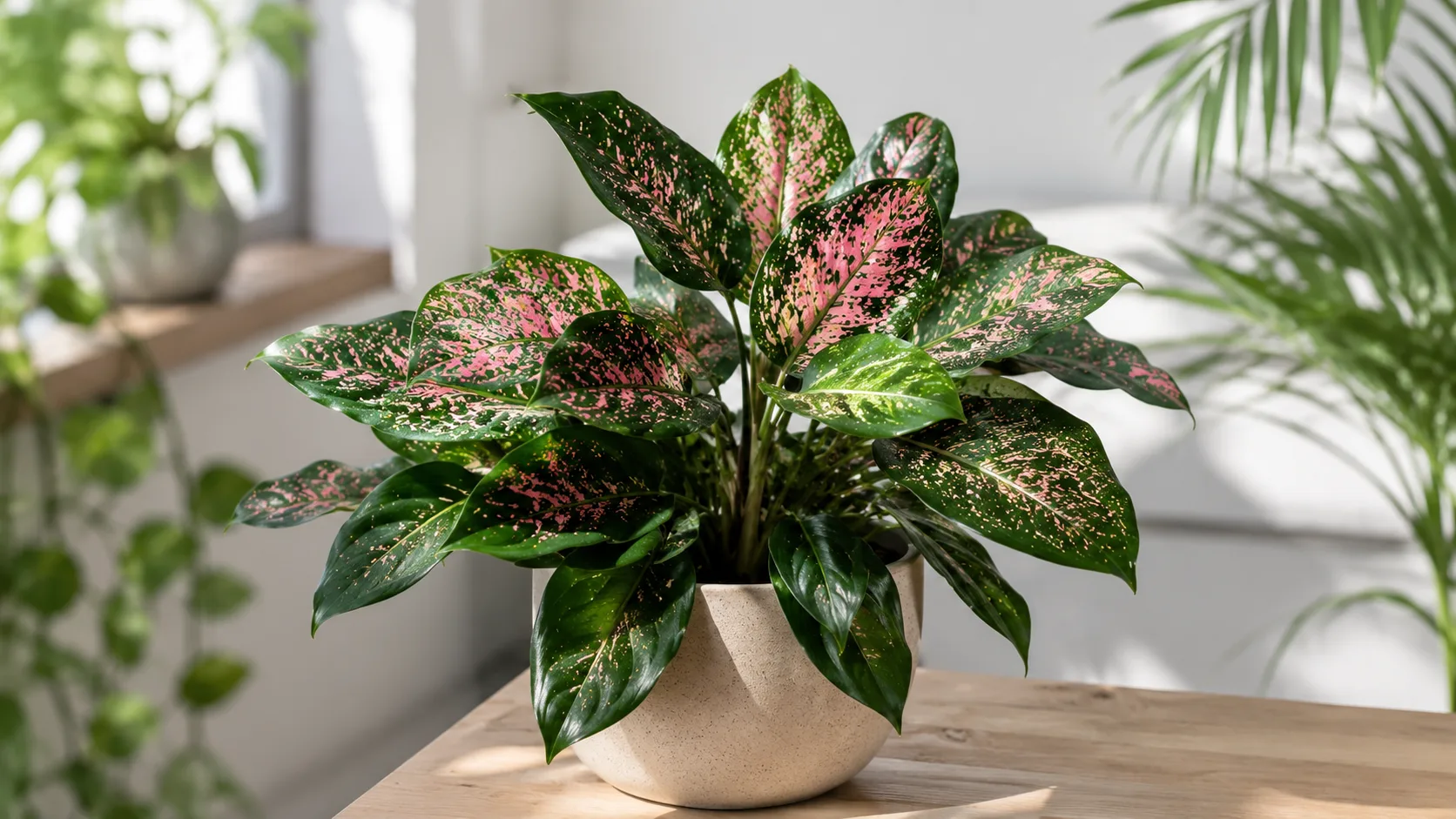
Pink Dalmatian Light Guide: Windows, Foot-Candles & Grow Lights
Pink Dalmatian Light Guide: Windows, Foot-Candles & Grow Lights
Aglaonema commutatum ‘Pink Dalmatian’ is the Chinese evergreen cultivar with scattered pink speckles on a green leaf base-a dalmatian-like pattern rather than the broad pink panels on Lady Valentine or the solid red leaves on Red Anjamani. Those pale pink zones carry less chlorophyll per square inch than green tissue, so Pink Dalmatian needs brighter filtered light than a dark-leaved office Aglaonema while still rejecting hot direct sun on the glass. This page is the cultivar-specific light guide for the Aglaonema Pink Dalmatian care cluster; for genus-wide comparisons, see the Chinese evergreen light guide.
The practical trap is treating “low-light tolerant” as permission to park Pink Dalmatian in a dim corner. It may survive there-Chinese evergreens are famously durable-but new leaves often emerge with weaker speckling, longer petioles, and slower soil drying that sets up overwatering on Aglaonema Pink Dalmatian if you keep the old watering calendar. Light is the variable that decides whether Pink Dalmatian looks like the plant on the nursery tag or a plain green Aglaonema with a memory of pink.
Quick Answer: Medium to Bright Indirect Light
Place Aglaonema Pink Dalmatian where leaves receive broad, diffuse daylight for much of the day-typically within 1 to 3 feet (30 to 90 cm) of an unobstructed east-facing window, or behind a sheer curtain at a south- or west-facing window where harsh afternoon beams do not strike the foliage. North-facing rooms can work when the plant sits close enough to the glass to receive bright ambient daylight; if the room feels dim for reading without a lamp, speckling will likely soften on new growth.
Clemson Cooperative Extension recommends low to moderate indirect light for Chinese evergreen and warns against direct sun on foliage. NC State Extension describes Aglaonema as performing well in diffuse sun or good indirect light. Pink Dalmatian sits at the brighter end of that safe indirect range because its variegation depends on adequate photons in pale tissue-UF/IFAS publication FP025 is explicit that high-color selections require bright indirect light to retain their color.
Judge success by the newest two or three leaves: firm texture, compact spacing, and visible pink speckles consistent with the cultivar’s normal pattern. One greener leaf among speckled siblings is not diagnostic; a run of plain-green new growth after a dim spell is.
Pink Dalmatian’s Target Light Band (Foot-Candles and Lux)
Extension data gives Pink Dalmatian a measurable starting band instead of vague “bright room” advice.
UF/IFAS publication EP160 documents commercial Aglaonema production in 75% to 90% shade (roughly 3,000 to 1,250 foot-candles at the production bench) and notes interior survival down to about 25 foot-candles, with full sun causing leaf scorch. University of Arkansas Extension places Aglaonema’s light compensation point near 10 foot-candles-where photosynthesis equals respiration-while noting average interior rooms deliver 20 to 60 foot-candles and a good reading spot near a window may reach 100 foot-candles.
For home Pink Dalmatian placement, translate those numbers conservatively:
| Band | Foot-candles (fc) | Lux (approx.) | Pink Dalmatian response |
|---|---|---|---|
| Survival floor | 25–75 fc | 270–800 lux | Plant holds on; speckles fade on new leaves; soil dries slowly |
| Healthy target | 100–300 fc | 1,100–3,200 lux | Compact growth; clear pink speckling on new leaves |
| Upper comfort | 300–500 fc filtered | 3,200–5,400 lux | Faster leaf emergence; watch pale tissue for wash or heat |
| Scorch risk | Sustained direct sun | 5,000+ lux at leaf | Bleached pink patches, tan crispy spots, hot leaf surfaces |
Pink Dalmatian’s scattered speckles can mask low-light stress differently than Lady Valentine’s broad pink fields-a few green-heavy new leaves may appear while the plant still leans or stretches. Use the table as a decision aid and confirm with the new-leaf test: after a placement change, photograph the next rolled leaf at emergence and again two weeks after opening; compare size, petiole length, and speckle density against the leaf before it.
Why Pink Variegation Changes the Light Equation
Green leaf tissue contains chlorophyll that captures light for photosynthesis. Pink speckles contain less visible green pigment, so a highly variegated leaf has less photosynthetic surface per square inch than a solid-green leaf of the same size. The plant can still produce energy, but it has less margin for extremely dim placement than a dark-leaved Maria or a solid-green Chinese evergreen.
Variegation is also genetic. Light does not manufacture the Pink Dalmatian pattern from nothing-better light helps the plant grow compactly and express its normal coloration, while poor light may coincide with greener, smaller, or more widely spaced growth. Individual leaves naturally vary in spotting density; one greener new leaf is not proof of a lighting failure. Evaluate a run of several new leaves, stem spacing, and how fast the pot dries before relocating the plant.
Pink Dalmatian vs Lady Valentine vs Solid-Green Aglaonema
| Cultivar | Variegation pattern | Relative light demand | Typical failure mode |
|---|---|---|---|
| Solid-green Aglaonema | Mostly green foliage | Lowest; tolerates dim offices | Slow growth, not speckle fade |
| Pink Dalmatian | Scattered pink speckles on green base | Medium-high; brighter than green types | Speckle fade, stretch in dim rooms |
| Lady Valentine | Broad pink/coral panels with green margins | Medium-high; similar photon need | Edge scorch on pale panels in hot sun |
| Red Anjamani | Predominantly red leaves | Highest in the pink-red group | Color wash or scorch if light is weak or too harsh |
Pink Dalmatian is more forgiving of moderate light than Red Anjamani but less forgiving than solid-green types for holding pink on new leaves. When buying, inspect newest leaves for clear speckling-nursery shade can produce plain-green growth that recovers only after better placement at home.
Low-Light Tolerant Does Not Mean Best for Pink Speckles
Chinese evergreens earned their reputation in dim offices because the genus survives conditions that kill faster-growing tropicals. Pink Dalmatian inherits that toughness but not the same performance floor. In insufficient light, a healthy root system and thick leaf tissue let the plant enter survival mode-existing leaves stay green while new growth slows, petioles lengthen, and speckling softens toward plain green.
Low light also changes watering risk. A pot that dried in eight days near a bright window may take two or three weeks in an interior corner because the plant uses water slowly. Keeping the summer watering schedule after a move into shade is a common route to root problems-see the Pink Dalmatian watering guide and adjust moisture checks whenever light changes. Do not compensate with extra fertilizer; University of Missouri Extension states explicitly that insufficient light cannot be cured by extra fertilizer, water, or Aglaonema Pink Dalmatian repotting guide.
Artificial office lighting can sustain some Aglaonema plants, but ceiling fluorescents alone often deliver only 50 to 150 foot-candles at desk height-enough for survival, rarely enough for vivid speckling without a directed grow light. If Pink Dalmatian produces no new growth for a long warm period and repeatedly leans toward one side, move it gradually toward brighter filtered light or add a fixture above the canopy.
What Bright Indirect Light Means for Pink Dalmatian
For Pink Dalmatian, bright indirect light means strong sky brightness at the leaf surface without a hard, hot solar beam resting on pale tissue for hours. Outdoors, open shade provides a broad light field from the sky; indoors, walls and window frames shrink that field, so a spot that looks bright to human eyes may deliver little plant-usable light. Your eyes adapt to dim rooms; leaves do not.
Use a practical shadow test at the plant’s position during the brightest part of the day. Hold your hand above a white sheet: a soft but recognizable shadow suggests useful indirect light; no meaningful shadow indicates a dim position; a crisp, dark shadow means direct or very intense light. This is a screen, not a measurement-but it compares spots in the same room reliably.
A phone lux meter at leaf height, pointed toward the window, helps repeat comparisons even though phone sensors are not lab instruments. UF/IFAS Gardening Solutions notes Aglaonema tolerates light as low as 25 foot-candles but should never be placed in full sun. Duration matters as much as a noon snapshot: six hours of moderate brightness often beats one intense hour followed by shade.
Best Window for Aglaonema Pink Dalmatian
Start by mapping where direct solar beams travel through the day at leaf level. Identify a nearby position that stays broadly illuminated without receiving the harshest beam. Recheck at another season-sun paths shift, deciduous trees lose leaves, and neighboring buildings reflect light differently. A safe July placement may become too dim in December or too hot in June.
Clean glass and clean leaves improve effective exposure. Dust reduces leaf light capture; wipe with a damp cloth rather than oil-based shine products. Rotate the pot a quarter turn weekly if growth leans strongly toward the window, unless one face is intentionally displayed. Rotation balances shape but cannot fix an overall dim location.
Window Direction Guide
| Window | Typical opportunity | Likely adjustment |
|---|---|---|
| North | Gentle, consistent indirect light | Keep fairly close if unobstructed |
| East | Bright light with mild morning sun | Acclimate; filter if leaves heat or bleach |
| South | Strong, long-duration exposure | Sheer curtain or offset from direct beams |
| West | Bright but hot afternoon exposure | Filter carefully or place outside the beam |
These descriptions assume the Northern Hemisphere; north and south reverse in the Southern Hemisphere. Overhangs, tree canopy, tinted glass, and neighboring walls often matter more than compass direction-treat the table as a starting hypothesis and verify at leaf level.
Gentle Morning Sun
Early sun through an east-facing window is often mild enough for an acclimated Pink Dalmatian, particularly outside peak summer heat. Begin with short exposure and inspect leaves over several days. If speckle color stays stable and no pale, dry patches appear, the placement may work. A sheer curtain softens the beam while preserving brightness.
Do not assume every east window is gentle. An unobstructed pane in a hot climate can still deliver strong light, while an east window shaded by a deep balcony may be dim. Moving a shade-house nursery plant directly into sun can cause damage because it was grown under protective cloth.
Harsh Afternoon Sun
West-facing afternoon sun is the highest-risk common indoor exposure-it combines strong radiation with accumulated daytime heat. South-facing windows can be equally intense, especially in winter when lower sun angles drive beams deeper into the room. Scorch on Pink Dalmatian often appears as bleached, tan, or brown patches on the most exposed pink speckles; damaged tissue will not regain its original color.
Filter strong windows with a sheer curtain, place the pot to the side of the beam, or move it far enough back that direct exposure no longer rests on foliage. Acclimate gradually-a plant adapted to shade can scorch at levels another specimen already tolerates.
How Far From the Window?
Advice such as “three feet from a window” is unreliable because light falls rapidly as a plant moves into a room, and every window differs. A Pink Dalmatian beside a small shaded window may receive less light than one farther from a wall of glass. If moving backward makes the hand shadow disappear, that is a meaningful reduction.
Furniture geometry matters. A plant tight against the wall beside a window may see little sky, while one directly in front has a wider light field. Position foliage where it can “see” the bright opening. Keep enough distance to avoid cold winter glass, hot panes, and drafts-both can injure leaves in ways that resemble light stress.
Signs Pink Dalmatian Needs More Light
Low-light symptoms develop gradually and affect form and pace more than sudden dead patches. Watch for long petioles, stems leaning toward the window, wider spacing between leaves, smaller new foliage, prolonged lack of growth, and a pot that stays wet much longer than before. Speckling may look less prominent on new leaves, although natural leaf-to-leaf variation prevents color alone from proving the diagnosis.
Compare current growth with older growth under known conditions. If the plant was recently moved, timing strengthens the conclusion. Rule out cold, root problems, and nutrient imbalance, which can also slow growth. Improve light incrementally and reduce watering frequency while the plant uses water slowly. For a structured recovery path, see not enough light on Pink Dalmatian and leggy growth when stems stretch before you repot or feed.
The New-Leaf Test Timeline
After any brighter move, expect roughly 2 weeks before the next leaf fully opens enough to judge speckle density, and 4 weeks before you can compare two complete new leaves for spacing and size trends. Do not relocate again every few days in response to one unfolding leaf-stable placement plus patient observation beats reactive shuffling.
Signs of Excess Light or Heat on Pink Tissue
Excess direct light often produces localized bleaching, tan or brown papery areas, crisp margins on the exposed side, or washed-out pink. Damage may appear a day or more after a sudden move. If only window-facing leaves are affected and the pattern matches direct beams, sun scorch is likely. Widespread brown tips alone are less specific and may involve salts, dry air, or watering stress.
Move the plant out of the harsh beam but keep it in bright indirect light. Do not place a scorched plant in a dark corner-intact tissue still needs energy for recovery. Leave partly green leaves in place because they continue to photosynthesize; remove them later if cosmetic damage is severe. New growth is the measure of improvement.
How Light Affects Pink Color and Speckling
Adequate indirect light helps Pink Dalmatian produce the compact growth in which speckling looks strongest. Too little light may reduce growth and lead to greener-looking new leaves, but fertilizer cannot correct that energy shortage. Too much direct sun can bleach both green and pink tissue, making leaves look pale before they turn brown. The target is strong diffuse light, not maximum brightness at any cost.
Color can shift as a new leaf hardens-fresh leaves may emerge lighter and deepen over time. Track photographs under the same room lighting for accurate comparison rather than memory. Speckle fade on several consecutive new leaves points to insufficient light; one odd green leaf among otherwise speckled siblings usually reflects normal genetic variation, not an emergency relocation.
Grow Lights for Pink Dalmatian
An LED grow light helps when the best natural spot is still too dim-common in winter or interior rooms without usable window access. Choose a full-spectrum fixture rated for houseplants, position it 12 to 24 inches (30 to 60 cm) above the canopy, and follow the manufacturer’s distance guidance because intensity varies widely. Run a timer for roughly 12 to 14 hours daily; continuous 24-hour lighting is inappropriate.
Fixture output falls as distance increases. Position the light so the whole canopy is covered, then rotate the pot if one side stays shaded. Increasing duration helps only within limits-a weak lamp run longer cannot always replace adequate intensity. Conversely, a powerful panel may need dimming or greater distance even when used for fewer hours.
Target roughly 100 to 300 foot-candles at the leaf surface for healthy speckling-the same band as a good filtered window placement. University of Missouri Extension notes fluorescent lights placed close to houseplants can improve growth and gives roughly 16 hours as an example duration for fluorescents; modern LEDs differ, so start around 12 to 14 hours and adjust based on plant response. If growth stretches, increase useful intensity or reduce distance within the fixture’s safe range. If upper leaves bleach or feel warm, raise or dim the light.
Acclimating to Brighter Light
Move Pink Dalmatian in stages over two to four weeks. Start with a short period in the brighter position or behind a sheer curtain. Increase exposure every several days while checking the most exposed leaves. A plant that spent months in deep shade needs slower acclimation than one moved between two similar bright rooms.
Acclimation changes leaf tolerance, but it does not make Pink Dalmatian a full-sun plant. Shade-grown leaves may remain more vulnerable than leaves produced after the move. If scorch appears, step back to the last safe level. Avoid combining a major light change with repotting, heavy feeding, or an abrupt watering change-multiple stressors make diagnosis difficult.
Seasonal Light Adjustments
Sun angle and day length change through the year. In winter, direct beams may reach farther into a room even though total daylight is shorter. In summer, tree canopy may shade the glass while higher sun misses the plant-or intense heat may make an otherwise acceptable window dangerous. Recheck exposure around seasonal transitions rather than treating placement as permanent.
Moving slightly closer to a window in darker months or adding a grow light can maintain growth. When spring brightness returns, reverse the change gradually. Also watch leaf temperature near cold winter glass and heating vents-both can cause injury that resembles a light problem.
Light, Water, and Fertilizer Work Together
A brighter plant generally consumes water faster than the same plant in shade, while a dim plant may keep the root zone wet for many days. Every light move should trigger a fresh moisture assessment per the watering guide. Do not automatically water more because a spot looks brighter-monitor until you learn the new dry-down time. Root health determines whether the plant can use available light.
Fertilizer demand follows growth. Feed only when Pink Dalmatian is actively producing healthy leaves. If growth is stretched and slow, solve the light problem before adding nutrients-the fertilizer guide assumes the plant already has adequate energy from light.
Pet and child placement: Pink Dalmatian contains insoluble calcium oxalate crystals and is toxic to cats and dogs if chewed. Low window sills, plant stands within reach, and sunny ledges where pets jump are poor choices even when the light is perfect. Elevate the pot or choose a pet-safe species for accessible spots-details in the Pink Dalmatian overview.
Common Placement Mistakes
The first mistake is interpreting “low-light tolerant” as “best in a windowless corner.” The second is moving a shade-grown plant directly into sun to improve color. Other errors include measuring distance instead of actual exposure, ignoring seasonal sun paths, pressing leaves against hot or cold glass, and assuming a sheer curtain makes every high-heat window safe.
Frequent relocation is another problem. Plants need time to express a change, and constantly moving the pot makes trends hard to read. Choose a reasoned position, document it, and evaluate several weeks of growth unless immediate burn requires action. Adjust one variable at a time.
Placement Example: East Window vs Interior Corner
Scenario A - healthy target: Pink Dalmatian 18 inches (45 cm) from an unobstructed east window in a temperate climate, sheer curtain open until 10 a.m., then bright indirect light for the rest of the day. Phone lux meter reads ~180 foot-candles (1,900 lux) at midday at leaf height. New leaves every 4 to 6 weeks in summer with clear pink speckles; pot dries upper half in 8 to 10 days.
Scenario B - survival only: Same plant moved to a north-facing interior corner 8 feet (2.4 m) from a small window, ~45 foot-candles (480 lux) at leaf level. After 6 weeks, newest leaves show wider spacing, smaller size, and muted speckling; soil stays wet 18+ days. Recovery: gradual move toward Scenario A over 3 weeks, reduce watering interval, judge the second new leaf after the move-not the first.
This vignette illustrates the survival-vs-performance gap; your room will differ-use relative brightness and new-leaf trends, not copied distances.
Related Pink Dalmatian Care
Light sits upstream of almost every other Pink Dalmatian problem. When placement is wrong, watering, feeding, and speckle stability all look broken.
- Aglaonema Pink Dalmatian overview - quick-start care, toxicity, and cultivar basics
- Not enough light - diagnosis when speckles fade and stems stretch
- Leggy growth - when low light produces long petioles
- Watering - moisture rhythm that must track every light change
- Chinese evergreen light (genus) - cultivar comparison across the genus
How We Wrote and Verified This Guide
By Sai Ananth · Reviewer: LeafyPixels Review Board (tropical foliage care) · Last reviewed: 2026-06-15
Guide recommendations are reviewed against botanical or extension references, LeafyPixels plant-care data, and practical indoor growing constraints before publication. This page was cross-checked against Clemson HGIC Chinese evergreen guidance, NC State Extension Plant Toolbox, UF/IFAS EP160, UF/IFAS Gardening Solutions Aglaonema, University of Arkansas Extension Chinese evergreen profile, University of Missouri Extension lighting and houseplant care, and LeafyPixels sibling pages linked above.
Conclusion
Action checklist before you close this tab:
- Measure or shadow-test your spot; aim for 100–300 foot-candles at the leaf canopy for strong speckling.
- Place Pink Dalmatian in bright filtered light-east window, filtered south/west, or a grow light-not a dim corner.
- Run the new-leaf test for 2–4 weeks after any move; judge speckle density on several new leaves, not one.
- Adjust watering when light changes; do not feed your way out of shade.
- Keep the pot out of pet reach on sunny sills; link symptoms to not enough light before stacking other fixes.
The best position is the brightest stable filtered light that maintains compact, speckled new growth without scorch-and the watering rhythm that matches how fast the plant actually uses water there.
When to use this page vs other Aglaonema Pink Dalmatian guides
- Aglaonema Pink Dalmatian overview - Start here for whole-plant context before deep-diving this topic.
- Aglaonema Pink Dalmatian problems hub - Jump to symptom-specific fix guides when this care topic does not resolve the issue.
- Not Enough Light on Aglaonema Pink Dalmatian - Escalate here when light adjustments are not enough.
- Leggy Growth on Aglaonema Pink Dalmatian - Escalate here when light adjustments are not enough.
Related Aglaonema Pink Dalmatian guides
- Aglaonema Pink Dalmatian overview
- Aglaonema Pink Dalmatian watering
- Aglaonema Pink Dalmatian soil
- Aglaonema Pink Dalmatian propagation
- Aglaonema Pink Dalmatian fertilizer
- Aglaonema Pink Dalmatian repotting
- Not Enough Light on Aglaonema Pink Dalmatian
- Leggy Growth on Aglaonema Pink Dalmatian
- Aglaonema Pink Dalmatian problems