Spider Mites on Aglaonema Maria: Causes, Checks & Fixes
Quick answer
Spider mites on Aglaonema Maria show as fine yellow stipples along silver-gray stripes in warm, dry air-common beside radiators or AC vents in winter. First step: isolate the pot and rinse leaf undersides with lukewarm water before any spray.
Spider Mites on Aglaonema Maria: Causes, Checks & Fixes
This guide covers spider mites on Aglaonema Maria. See also the general Spider Mites guide, watering, and light pages for this plant.
Spider Mites on Aglaonema Maria: Causes, Checks & Fixes
Quick answer
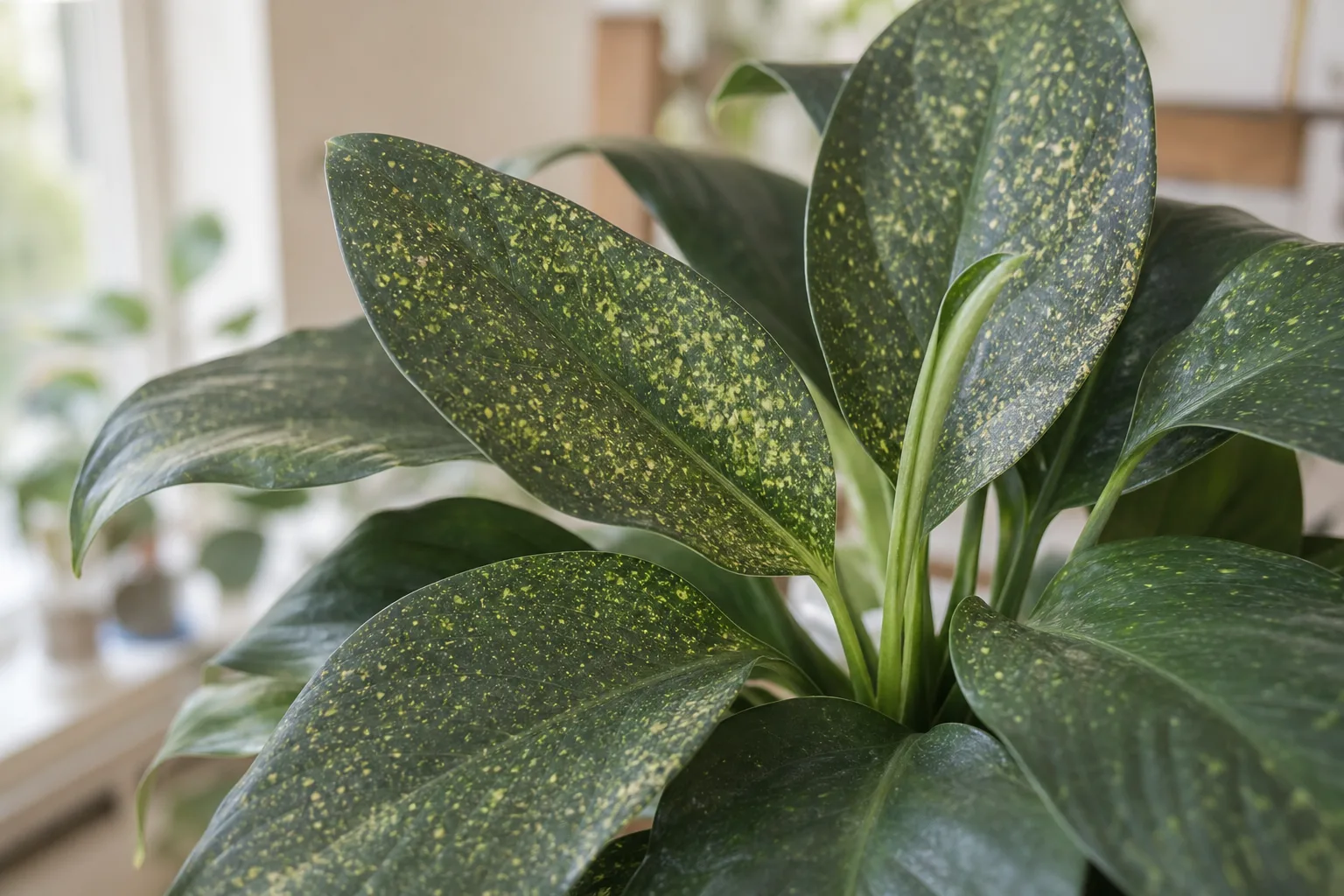
Spider mites on Aglaonema Maria (Aglaonema commutatum ‘Maria’) show up as fine yellow or white stipples along the silver-gray stripes on otherwise glossy green leaves, often with delicate webbing where upright petioles meet the stem. They thrive in warm, dry air-exactly the microclimate beside a radiator, sunny glass, or AC vent where Maria commonly lives in offices and north-facing rooms.
First step: isolate the pot and rinse leaf undersides with lukewarm water before reaching for sprays. Mites feed on the bottom surface; a forceful underside rinse knocks down adults and eggs while you confirm the pest with the paper-tap test. Do not mist the crown or let water pool where Maria’s leaves cluster at the stem base.
For dry brown tips without stippling or webbing, see low humidity on Aglaonema Maria-that page owns dry-air margin damage when soil moisture is otherwise fine.
What spider mites look like on Aglaonema Maria
Healthy Maria leaves are smooth, lance-shaped, and upright, with dark green margins and silver striping along the veins. Mite damage has a recognizable pattern on this cultivar:
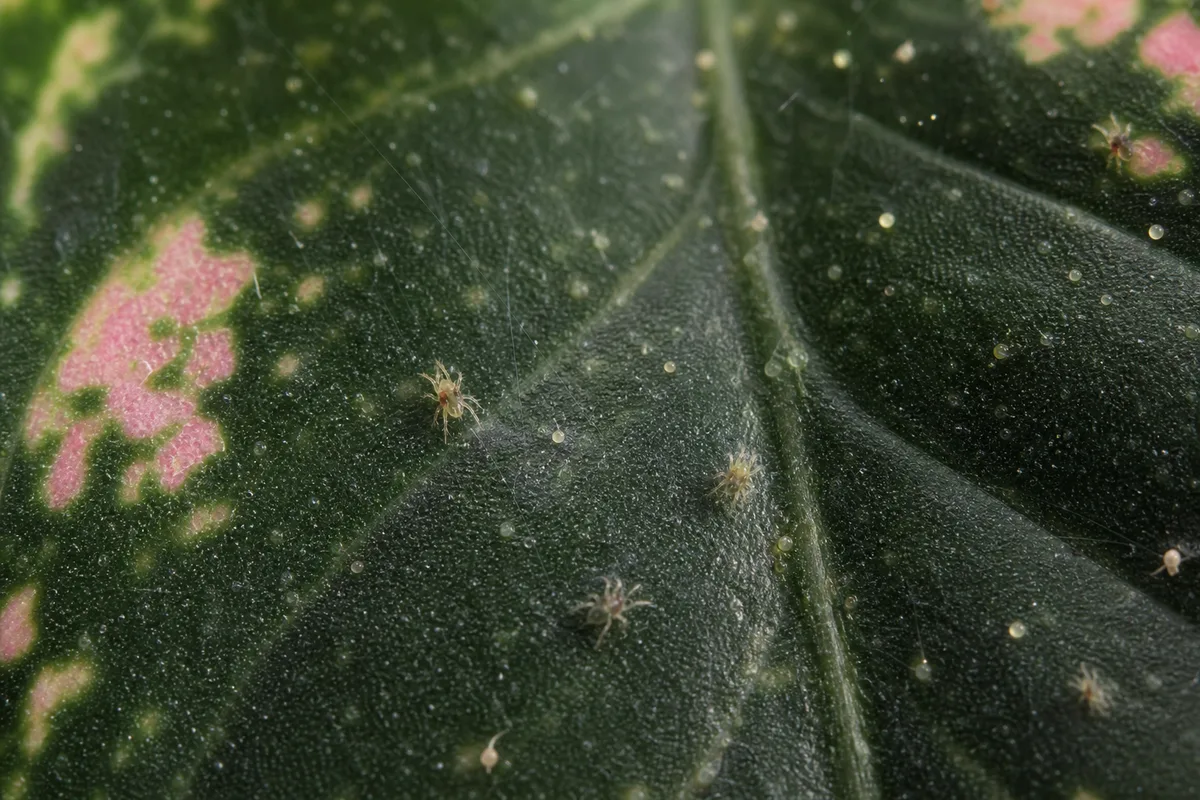
Spider Mites symptoms on Aglaonema Maria - compare with healthy tissue on the same plant.
- Stippling on variegation - Tiny pale yellow or white dots cluster along the silver stripes first, because mites pierce individual leaf cells from below. From the top, the pattern looks like someone dusted the variegation with fine sand.
- Bronzing over time - Untreated stippling spreads into dull bronze patches; heavily fed leaves may crisp at the margins while the center stays partially green.
- Webbing at petiole bases - Fine silk threads appear where short upright stems meet the crown and along leaf undersides-not the fluffy white masses of mealybugs.
- No sticky residue - Unlike aphids or some scale, mites leave no honeydew shine on Maria’s smooth foliage.
Early damage is easy to miss because Maria grows slowly and owners often interpret first stipples as normal variegation fade in dim light. Check undersides weekly in heating season.
Why Aglaonema Maria gets spider mites
Spider mites are tiny arachnids that reproduce fastest in warm, dry, still air. They are not picky about species-they follow stress. Maria’s typical indoor placement creates several risk factors:
Winter heating and vent drafts. Central heat drops whole-room humidity while Maria on a desk beside a radiator or floor vent sits in a hotter, drier microclimate. Mississippi State Extension notes plants under heating vents are especially susceptible to spider mites.
Office AC and dim light. Maria is sold as a low-light survivor, which is accurate-but a dim cubicle with constant AC airflow still dries leaf surfaces. Clemson HGIC lists Chinese evergreen as remarkably tolerant of dry air, which can make owners slow to raise humidity until mites are established.
Drought tolerance masks dry-air stress. Maria stores moisture in fleshy roots and survives missed drinks. That resilience does not protect leaf surfaces from desiccating air; mites exploit the gap between “plant still alive” and “air comfortable for foliage.”
Grouped plant displays. Mites crawl short distances between pots on the same shelf. A neighboring infested plant can seed Maria even when your care is sound.
The mites are the visible alarm. The underlying fix pairs pest treatment with reduced dry-air stress-often the same winter conditions discussed in the low-humidity guide.
How to confirm the cause
Work through these checks before buying sprays:
- Paper-tap test - Hold white paper under a suspect leaf and tap the blade. Slow-moving specks confirm live mites; static dust does not.
- Underside inspection - Use your phone flashlight on leaf bottoms. Mites, eggs, and early webbing concentrate there-not on Maria’s glossy upper surface.
- Webbing location - Fine silk at petiole bases and along veins points to mites. Fluffy white tufts in axils suggest mealybugs.
- Stippling pattern - Pinpoint pale dots along silver stripes fit mite feeding. Silvery scrape marks or black specks with distorted new growth suggest thrips.
- Soil and tip check - Dry papery tips on oldest leaves without stippling on smooth blades often mean low humidity, not mites. Wet heavy soil with yellow lower leaves points to watering stress-see overwatering.
- Neighbor scan - Inspect pots within arm’s reach on the same shelf; mites travel between stressed plants in dry rooms.
Lookalike symptoms on Aglaonema Maria
| What you see | Likely cause | Quick differentiator on Maria |
|---|---|---|
| Pale dots along silver stripes + fine webbing | Spider mites | Paper-tap specks move; damage on undersides |
| Silvery streaks, distorted new leaves, black specks | Thrips | Scraped look on young silver-striped growth |
| Dry tan tips on oldest leaves only; no stippling | Low humidity | Clean new center growth; vent-side pattern |
| Fluffy white cotton in leaf axils | Mealybugs | Wipes away; no stipple matrix |
| Sticky shine + soft new shoots | Aphids | Insects visible on tender growth |
| White crust on soil + new-leaf tip burn | Mineral/fluoride | See brown tips |
First fix for Aglaonema Maria
Isolate the pot and rinse leaf undersides with lukewarm water.
Move Maria away from neighboring plants. In a sink or shower, support the pot and direct a gentle stream at undersides of every leaf and along short petioles-where mites feed. Keep the crown dry: do not pour water into the center where Maria’s leaves cluster upright. Let foliage dry in Aglaonema Maria light guide the same day.
This single rinse is your diagnostic confirmation step and your first population knockdown. Do not apply oil or soap on the same day if leaves are still dripping-wait until blades are dry, then treat.
Step-by-step treatment protocol
After the first rinse and paper-tap confirmation, layer treatments in this order:
Cycle 1–3: Rinse plus contact spray
- Rinse undersides - Repeat every 5–7 days. Mississippi State Extension recommends washing leaves at 3- to 5-day intervals for small houseplants; five to seven days fits Maria’s indoor schedule.
- Apply horticultural oil or insecticidal soap labeled for spider mites - Cover undersides thoroughly. Colorado State Extension lists horticultural oil as among the most effective houseplant mite sprays. Follow label dilution; patch-test one leaf if Maria was recently stressed.
- Improve air moisture - Move off vents; add a pebble tray or small humidifier. Dry indoor air increases pest pressure on foliage plants.
Run at least three full cycles (roughly two to three weeks). Repeat until webbing stops appearing on new growth.
If mites persist after three cycles
- Escalate to a miticide labeled for ornamentals - Standard insecticides for aphids often miss mites. Read labels for “miticide” or “acaricide” language.
- Inspect the full collection - Treat or quarantine neighboring pots that share a dry shelf.
- Consider predatory mites - In enclosed indoor collections, biological controls can supplement sprays when humidity stays moderate.
Throughout treatment, keep Maria on its normal watering rhythm-water when the top half of mix dries. Do not overwater a stressed plant.
Recovery timeline
- Active mites and webbing: Should decline within one to two weeks once rinse-and-spray cycles start and the plant leaves the hottest dry zone.
- Stippled old leaves: Will not re-green; bronzed tissue is permanent on that blade.
- Clean new growth: Expect four to six weeks on Maria because this cultivar grows slowly. New leaves should emerge clean if humidity and treatment hold-judge success by the center rosette, not old damaged margins.
Worry if webbing spreads to new leaves after four consistent cycles, stems soften, or multiple plants on the same shelf decline together.
What not to do
- Do not use insecticides labeled only for insects-mites need miticides, oils, or soaps labeled for mite control.
- Do not soak Maria’s crown during rinses; smooth leaves tolerate gentle underside washing, but standing water at the stem base risks rot on this upright Chinese evergreen.
- Do not spray oil in direct sun or on heat-stressed leaves; apply in indirect light and let foliage dry.
- Do not assume brown tips alone mean mites-check for stippling and webbing first, or read the low-humidity page.
- Do not ignore pet safety during treatment: Maria is toxic to cats and dogs (insoluble calcium oxalates). Keep treated plants away from pets, ventilate the room during spraying, and wash hands after handling foliage or bottles.
How to prevent spider mites next time
- Raise local humidity in winter - Move Maria off radiators and vents; use a pebble tray or humidifier when heating runs. Increase humidity and inspect plants regularly in dry indoor air.
- Weekly underside checks - November through March, scan silver-striped leaves with a flashlight before stippling spreads.
- Quarantine new plants - Six weeks minimum before joining a Maria shelf.
- Stabilize watering - Follow the watering guide so drought stress and pest stress do not stack.
- Monitor neighbors - Early pest colonies on nearby pots seed Maria in grouped displays.
For full species context, see the Aglaonema Maria overview.
When to worry
Escalate or consider discarding the plant if:
- Webbing coats new center leaves after four treatment cycles and isolation.
- Stems collapse or smell sour-that is root failure, not mites alone; check root rot.
- The whole shelf is infested-treating one Maria while five dry, stressed neighbors remain usually fails.
- You cannot physically reach all leaf undersides on a dense, old specimen-professional disposal may cost less than months of failed sprays.
Maria is worth saving when stems are firm, new growth still appears (even if stippled), and you can commit to three to four weeks of rinse-and-spray discipline.
Conclusion
Spider mites on Aglaonema Maria are a dry-air pest problem on a plant that otherwise tolerates neglect. The silver-striped foliage makes stippling visible once you know to look along the variegation-not just at brown tips. Isolate, rinse undersides, repeat oil or soap on a five-to-seven-day cadence, and move the pot off winter heat paths. Old stippled leaves will not heal; watch for clean new silver-striped growth from the center. If stippling mimics other damage, use the lookalike table and sibling guides for thrips, mealybugs, and low humidity before you change your whole care routine.
When to use this page vs other Aglaonema Maria guides
- Aglaonema Maria watering guide - Use for routine moisture checks before assuming spider mites is the main issue.
- Aglaonema Maria problems hub - Browse all 16 common issues on this species.
- Low Humidity on Aglaonema Maria - Different entry point when symptoms overlap with spider mites.
- Slow Growth on Aglaonema Maria - Different entry point when symptoms overlap with spider mites.