Best Soil for Aglaonema Maria: Mix, Drainage & pH Guide
Best Soil for Aglaonema Maria: Mix, Drainage & pH Guide
Best Soil for Aglaonema Maria: Mix, Drainage & pH Guide
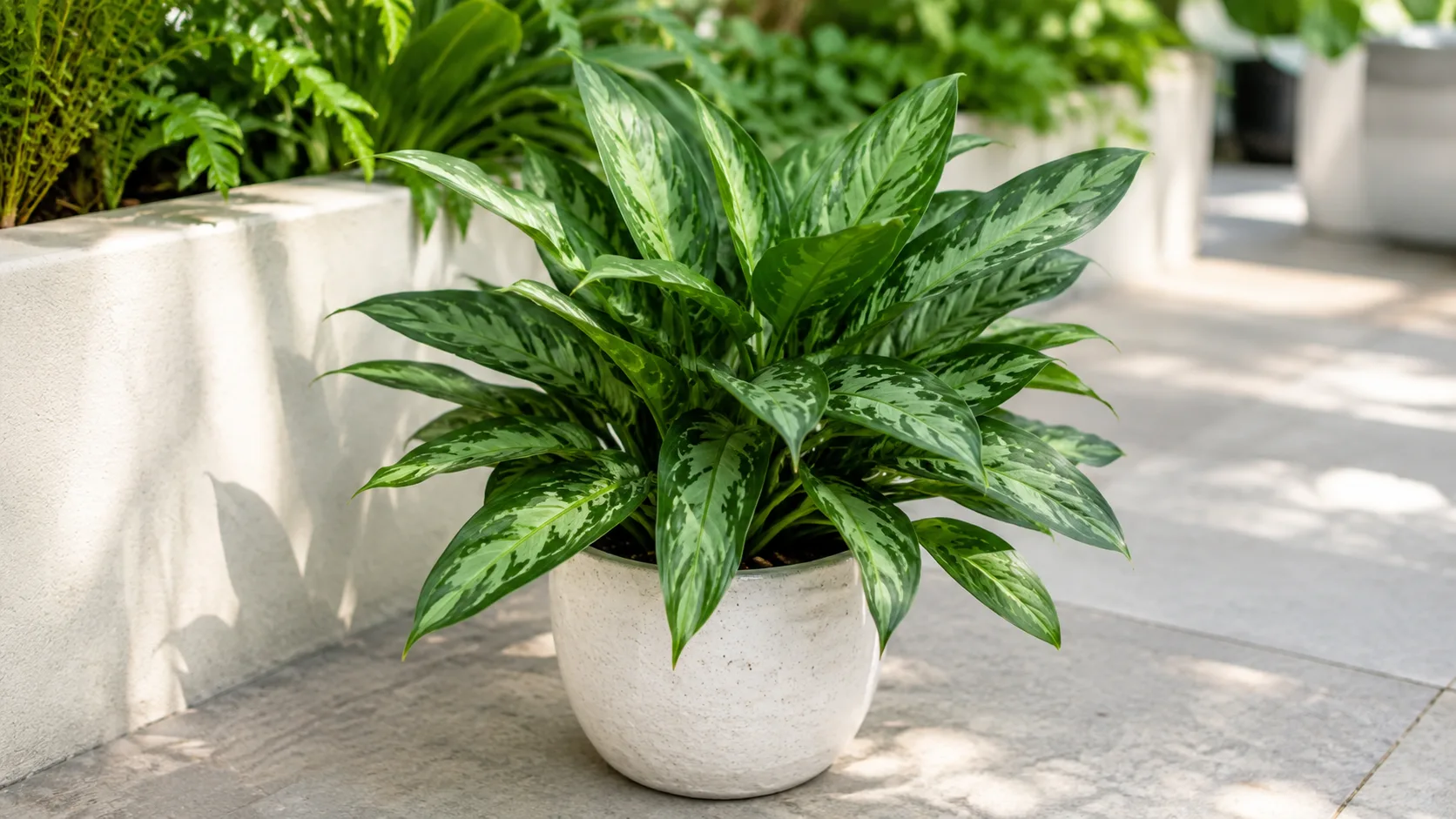
The best Aglaonema Maria soil is not a branded “aroid mix” bag and not dense all-purpose compost straight from the nursery. Aglaonema commutatum ‘Maria’ carries finer roots and a steadier moisture preference than thick-rooted Monstera or Anthurium - yet it still needs oxygen around those roots. A substrate made almost entirely of large bark chunks can dry too fast in a warm office, while fine peat-heavy plug mix can stay saturated for weeks in low light. Maria’s useful middle ground combines moisture-retentive fine material with coarse particles that preserve durable pores. Your pot, light level, and watering habits determine exactly where that middle lies.
This page owns cultivar-specific substrate nuance for ‘Maria’. For genus-wide comparisons and semi-hydro notes, see the generic Aglaonema soil guide. Pair mix decisions with the Maria overview, repotting workflow, and problem guides for mold on soil, overwatering, and root rot when symptoms appear.
Quick Answer: The Best Soil Structure for Maria
Start with two parts quality indoor potting mix, one part perlite or pumice, and one part fine orchid or pine bark - measured by volume, not weight. That 2:1:1 blend is the same genus baseline, but Maria usually needs slightly more fine base and slightly less bark than a fast-draining Silver Bay mix in the same home. Think springy and evenly moist, not chunky-desert or slick-mud.
Maria adjustment rules:
- Low light or humid cool rooms: keep the 2:1:1 ratio; do not add extra bark “for drainage” after one overwatering - check pot size and light first.
- Bright filtered window or dry heated air: increase fine base to roughly 2.5 parts base : 1 perlite : 0.75 bark so Maria does not swing from wet to wilted between drinks.
- Pure commercial aroid mix: dilute at least 50% with indoor potting mix before potting Maria; undiluted bark-heavy blends often create outer-dry / core-wet mismatches on fine roots.
The finished mix should pass a squeeze test: moist handful holds together loosely, then breaks apart with a touch rather than smearing like clay. Water should penetrate the surface, wet the root zone evenly, and exit the drainage hole promptly.
Maria vs Silver Bay vs Genus - Moisture and Bark Adjustments
UF/IFAS EP160 lists ‘Maria’ with dark green and grey leaves and a compact habit - a profile that pairs with moderate moisture retention and less aggressive drying than suckering, faster-flushing cultivars. The RHS ‘Maria’ profile describes slow growth in filtered light with moderate watering and well-drained compost. Silver Bay, by contrast, is often grown in chunkier aroid blends because its larger silver-centred leaves and typical nursery sizing push faster water use in bright conditions.
| Cultivar / page | Root character | Typical bark fraction | Moisture band (6-inch plastic, moderate office light) | When to shift mix |
|---|---|---|---|---|
| Maria (this guide) | Fine, compact crown | Lower - fine bark or 25% of total volume | Top 1–2 inches dry in roughly 10–14 days after a thorough drink | Add base, not bark, if wilt appears between waterings |
| Silver Bay | Medium; faster leaf flush in bright light | Higher - often 30–40% chunky bark | Top dry in roughly 7–10 days in similar light | See Silver Bay soil for chunkier defaults |
| Genus default (Aglaonema soil) | Varies by cultivar | 2:1:1 starting point | Check top 1–2 inches; interval varies by light | Use genus page when growing multiple cultivars |
These dry-down ranges are observation targets, not calendar rules. A Maria in a dim corner may remain moist 14–21 days in winter; beside a bright east window in summer, 7–10 days is common. Track pot weight and skewer moisture with the Maria watering guide rather than copying a number blindly.
Translate Tropical Habitat Into Container Conditions
Aglaonema species evolved on shaded tropical forest floors where leaf litter stays loose and oxygenated - but a 6-inch plastic pot on a desk is not that floor. In the ground, water disperses through a large profile and roots explore outward. In a container, the same finite substrate receives every irrigation and fertilizer dose. Simply making a mix “rich and moist” ignores those physical limits.
Maria’s shaded-habitat ancestry explains two preferences: protection from harsh sun and a root zone that should not remain bone dry for long stretches. It does not mean the plant wants stagnant, oxygen-poor mud. Roots respire, and saturated pore spaces limit gas exchange. Chronic oxygen shortage weakens fine roots and invites decay organisms - the pathway behind root rot on Maria when overwatering meets dense mix.
The practical goal is even moisture with aeration, integrated with how you water. A good Maria substrate lets the plant use water while air returns to larger pores after irrigation. It also distributes moisture through the root ball so one peat plug does not stay soaked while surrounding bark dries - a common failure when repotting from a nursery plug into undiluted aroid bark without blending the transition zone.
Balance the Three Core Soil Requirements
Every ingredient should serve at least one of three functions: moisture distribution, structural aeration, or modest nutrient retention. Fine peat, coir, composted bark, and similar materials hold water through capillary forces. Perlite, pumice, and coarser bark interrupt the fine matrix and preserve larger pores. Organic particles and certain mineral surfaces also hold nutrient ions, though fertilizer management remains separate from structure.
Too much of any function creates a trade-off. Fine material holds water well but can collapse and shrink over time. Very coarse material preserves air but may dry quickly and let water bypass fine roots. Rich compost contributes nutrients but can increase density and soluble salts. The objective is not maximum drainage, maximum fertility, or maximum retention - it is a stable compromise matched to Maria’s finer roots and typical low-to-medium indoor light.
Particle size matters as much as ingredient name. Fine bark behaves differently from large orchid chunks. Dusty perlite contributes less useful macroporosity than intact coarse particles. When copying a recipe, compare actual texture in your hand rather than assuming every product sold under the same word is interchangeable.
Understand Drainage Beyond the Drainage Hole
Drainage has two parts. The container needs an unobstructed exit for excess water, and the substrate needs connected pores through which that water can move. A hole under compact mud does not make the mud airy. Conversely, a loose mix cannot release runoff from a sealed decorative vessel.
After watering, some water drains under gravity and some remains in smaller pores - that retained water is normal and useful. Problems arise when fine particles dominate, pores collapse, roots sit in cold low light, or irrigation repeats before enough air returns. A handful of perlite on top cannot compensate for a pot vastly oversized or permanently sitting in a full saucer.
Do not place a gravel layer beneath potting mix to “improve drainage.” It reduces usable substrate depth and does not replace a drainage hole. Keep the blend reasonably uniform from top to bottom so Maria’s roots encounter consistent moisture behavior.
Retain Enough Moisture for Fine Roots
Maria should not be grown in a mix that becomes completely dry within hours under ordinary indoor conditions. Fine roots can be damaged by repeated severe drought, and hydrophobic peat becomes difficult to rewet after drying hard. A useful moisture reserve lets the plant continue taking up water while the surface and larger pores begin to dry.
Peat and coir are common water-holding bases. Both can work, but performance depends on processing, particle size, and the rest of the blend. Peat can shrink and repel water when allowed to dry excessively. The UC Master Gardeners of Santa Clara County note that peat-based potting soils become hydrophobic and water-repellent when they dry out, with water channeling past the root ball rather than rewetting it - bottom-watering or gradual surface trickle helps rehydrate.
Moisture retention should be judged over several days in the actual pot. If Maria wilts while the center is dry only a day after watering, the mix may be too coarse, roots may be extremely crowded, or the room may be hot and dry - increase fine base at the next repot rather than watering more often. If the center remains wet for two weeks or more in weak light, correct mix, pot volume, or watering frequency before adding bark.
Preserve Air Around the Root System
Coarse ingredients create spaces that do not remain completely water-filled after irrigation. Perlite is light and widely available; pumice is heavier and tends to stay distributed; bark contributes structure but gradually decomposes. University of Florida IFAS commercial guidance for Aglaonema emphasizes well-aerated media and reports an air-space target of roughly 10 to 20 percent for rooting cuttings and production containers. Household growers rarely measure air-filled porosity, but the principle is clear: Maria needs durable gas-exchange pores, not a dense “rich” blend.
The Perlite Institute describes horticultural perlite as sterile, lightweight, neutral-pH volcanic glass that does not compact or decompose - a reliable aeration component. Aeration ingredients also affect watering technique: coarse bark can channel water rapidly, leaving a dry core if irrigation is too brief. Water slowly and thoroughly, pause, then water again when dry mix initially resists wetting. Let runoff leave completely.
Keep Soil pH in a Useful Range
UF IFAS guidance gives Aglaonema a mildly acidic substrate range of pH 5.5 to 6.5 for rooting cuttings and a finished-container target of pH 6.0 to 6.5 with soluble salts of 1 to 2.5 dS/m, per EP160. Within that range, nutrient availability generally suits the crop. Maria does not require routine pH testing when growth is steady and leaves are firm. The number becomes more relevant when irrigation water is highly alkaline, symptoms persist despite sound care, or you build a mix from unbuffered ingredients.
Do not adjust pH based on leaf color alone. Yellowing may result from overwatering, root loss, low light, natural leaf aging, pests, or nutrient imbalance. Cheap probes used in chunky mix can produce inconsistent readings. Periodic thorough watering that produces runoff helps flush accumulated salts, provided the pot drains freely.
Make a Reliable DIY Aglaonema Maria Mix
Use a clean tub and measure by volume. For a general indoor starting blend:
- Two parts indoor potting mix based on peat, coir, or composted bark.
- One part perlite or pumice in a useful medium particle size.
- One part fine orchid bark or screened pine bark without excessive dust.
Moisten gradually and mix from the bottom so fine particles do not settle in one zone. Remove very large wood chunks that create unstable voids in a small pot. If the base already contains substantial perlite, begin with less additional mineral amendment and evaluate the squeeze test. Record the ratio so you can adjust the next batch using actual drying performance.
Do not make a huge batch until you know how components behave together. Test enough for one pot and observe through several watering cycles. A recipe that performs in a greenhouse may remain wet in an air-conditioned apartment or dry rapidly beside a heater.
Choose Peat, Coir, or Potting Mix as the Base
A packaged indoor potting mix is usually the simplest base because it may already contain wetting agents, lime for pH adjustment, and a small nutrient charge. Clemson Cooperative Extension recommends a commercial soilless mix with extra humus for Chinese evergreen - texture matters more than marketing category. Avoid bags that smell sour, are waterlogged, or have decomposed into fine sludge.
Peat moss holds substantial water and is lightweight, but dry peat can become hydrophobic. Coco coir is renewable and often rewets well, but poorly washed coir may carry undesirable salts. Neither is universally superior. If using straight peat or coir without a formulated mix, you also take responsibility for pH buffering, nutrients, wetting behavior, and structure - beginners usually get more predictable results amending a reputable potting base.
Add compost or worm castings conservatively: a small fraction per batch, never half the volume. Unfinished compost consumes oxygen and can release ammonia; indoor Maria roots benefit more from predictable structure than maximum biological richness.
Add Perlite, Pumice, or Bark for Structure
Perlite is expanded volcanic glass - light, porous, useful for loosening fine substrates, though it can float during watering. Dampen before mixing and avoid breathing airborne dust. Pumice is heavier and more stable but may be expensive regionally. Fine bark introduces irregular large pores and decomposes more slowly than soft compost, although it still breaks down over time. Screen oversized orchid-bark chunks for small Maria pots.
Vermiculite holds more water than perlite and can compress - it is not a direct substitute when the objective is greater aeration. Coarse sand adds weight; fine sand can fill pores and make a mix denser. Select amendments by physical function rather than treating every gritty material as equivalent.
Evaluate Ready-Made Potting Mixes
A ready-made indoor or tropical mix can work without modification if it remains open when wet and dries within a reasonable interval in your conditions. Open the bag and inspect particle diversity. A useful product contains springy fibers or composted bark plus visible coarse particles. A uniformly fine, heavy mix usually benefits from perlite, pumice, or bark.
Commercial aroid mix is not automatically ideal for Maria. Some products target thick-rooted Monstera with mostly large bark, coco chips, and mineral chunks. Maria may grow in them, but watering must be more frequent and precise - and many home growers overestimate drainage needs after a single soggy week. Blend a very coarse product with fine potting base when it cannot maintain even moisture for Maria’s finer roots. The Missouri Botanical Garden describes Aglaonema as preferring a well-drained, peaty potting mixture and warns that rot may occur if plants are over-watered - a reminder that “chunky” is not the same as “appropriate.”
Cactus and succulent soil is a conditional ingredient, not a complete answer. Some brands are only ordinary peat mix with extra sand; others drain very rapidly. It may serve as part of the blend when combined with a moisture-retentive base. Test the actual product rather than trusting the category name.
Adjust the Recipe for Climate and Care Habits
In humid tropical conditions or a cool, low-light room, increase stable coarse components only after confirming the pot is not oversized - water loss is slow, so extra bark alone may not fix chronic wetness. In a hot, air-conditioned, or heated room with low humidity, too much bark and perlite may create frequent drought stress; increase the base proportion or use a less porous container.
Your watering behavior is part of the recipe. A grower who checks plants daily and waters lightly may create uneven wetting in a coarse mix. A grower who waters on a weekly calendar may repeatedly irrigate a fine mix before it needs water. The better practice is a thorough watering followed by observation of pot weight and moisture decline - the same rhythm described in the Maria watering guide.
Light has a major indirect effect. A Maria in brighter appropriate indirect light uses water faster than the same plant in a dim corner. After moving the plant, reassess drying time before changing soil. Sometimes the “bad mix” is simply paired with insufficient light or a pot much larger than the root system.
Match the Mix to the Pot and Root Ball
Pot material changes evaporation. Terracotta walls lose moisture and may pair well with a somewhat more retentive blend. Plastic and glazed pots retain moisture longer and often benefit from more aeration in humid or dim conditions. A nursery pot inside a cachepot works only when runoff is emptied and air can circulate around the liner.
Pot size can overwhelm a good recipe. A small root ball in a large mass of mix cannot remove water quickly, especially in low light. Use a container only slightly larger than healthy roots - details in the Maria repotting guide. After root-rot pruning, reduce pot size to fit what remains rather than returning the plant to the same oversized volume.
Old and new substrates should have reasonably compatible moisture behavior. A dense nursery plug surrounded by chunky bark may stay wet after the outer mix appears dry. Conversely, a dry peat core can repel water while the outer mix drains. Loosen or partly remove a problematic core during repotting, but preserve healthy roots instead of washing them bare without cause.
Test a Mix Before and After Potting
Use simple repeatable checks:
- Squeeze test: moist mix should feel springy and break apart, not smear like clay.
- Wet-out test: water should penetrate the surface rather than bead for minutes.
- Drain test: a test pot should release excess water promptly from an open hole.
- Dry-down test: a wooden skewer and pot weight should show gradual, not stagnant or overnight, moisture loss.
What to look for - squeeze-test texture: Correct Maria mix feels like a wrung-out sponge - it holds shape briefly when squeezed, then crumbles when poked. A failing dense nursery plug smears like clay and stays in a tight wet ball. That texture difference predicts whether Maria’s fine roots get both moisture and oxygen between waterings.
Test with the same pot type and approximate size you plan to use. Record how long the center stays moist under the plant’s actual light and temperature. After potting, insert a skewer near the edge without repeatedly stabbing the central root ball. When removed, damp dark material indicates moisture; a nearly clean skewer indicates drying. Lift the pot after watering and again as it dries to learn the weight difference.
Diagnose Common Soil Problems
If soil stays wet for an unusually long time, check for an oversized pot, blocked drainage, low light, cold temperatures, dense fine particles, or water trapped in a cachepot. Do not simply add more bark to the top. A structural problem throughout the pot requires repotting into a better blend and a container fitted to the roots. Persistent surface mold or algae often signals chronic surface wetness - see mold on soil for Maria-specific surface diagnosis.
If water runs straight through while the root ball remains dry, the mix may have shrunk from the pot wall, become hydrophobic, or developed channels. Water slowly in several passes, or bottom-soak briefly to rehydrate, then drain completely. If the condition returns quickly, replace the degraded substrate.
If the mix dries too fast, first confirm that roots are not severely crowded. Then reduce the coarse fraction, use a plastic pot, or add more moisture-retentive base at the next repot. If roots smell sour or feel soft, treat root rot and correct watering conditions - soil symptoms and root symptoms should be evaluated together per the root rot guide.
Avoid reaching for charcoal, biochar, or mycorrhizal inoculants as substitutes for structure. Small amounts may affect chemistry or odor, but they do not sanitize a saturated pot or prevent rot when drainage and pot size are wrong.
Refresh Soil Without Unnecessary Repotting
Replace potting mix when it has compacted, decomposed, accumulated damaging salts, become persistently hydrophobic, or developed a moisture mismatch around the roots. That may coincide with root crowding, but it does not always require a larger pot. You can refresh the substrate and return Maria to a cleaned container of the same size - the full workflow lives in the repotting guide.
Top-dressing replaces only the surface layer and cannot repair a saturated lower root zone. It is useful for removing crusted material or topping up minor settling, but do not keep raising the soil line around the crown. Aglaonema Maria contains calcium oxalate crystals that can irritate skin and mucous membranes; wear gloves when working mix around the stem base, wash hands after handling soil and debris, and keep the plant out of reach of pets per the overview safety notes.
Between repottings, water thoroughly enough to produce some runoff, empty the saucer, and avoid excessive fertilizer. Store leftover mix dry and sealed against pests, but do not keep wet homemade blends for long periods.
Conclusion
The best Aglaonema Maria soil balances fine moisture-retentive material with durable air space - usually starting from 2:1:1 potting base, perlite or pumice, and fine bark, then adjusting for Maria’s finer roots and compact habit rather than copying Monstera-grade chunkiness. Keep pH near 5.5 to 6.5, integrate mix choice with your watering rhythm, and judge success by behavior: even wetting, prompt drainage, springy texture, and a repeatable dry-down cycle that gives roots both moisture and oxygen. When something fails, diagnose the whole system - pot size, light, mix texture, and irrigation - before searching for a miracle ingredient.
When to use this page vs other Aglaonema Maria guides
- Aglaonema Maria overview - Start here for whole-plant context before deep-diving this topic.
- Aglaonema Maria problems hub - Jump to symptom-specific fix guides when this care topic does not resolve the issue.
- Root Rot on Aglaonema Maria - Escalate here when soil adjustments are not enough.
- Mold on Soil on Aglaonema Maria - Escalate here when soil adjustments are not enough.