Aglaonema Maria Light Requirements: Window & Grow Light
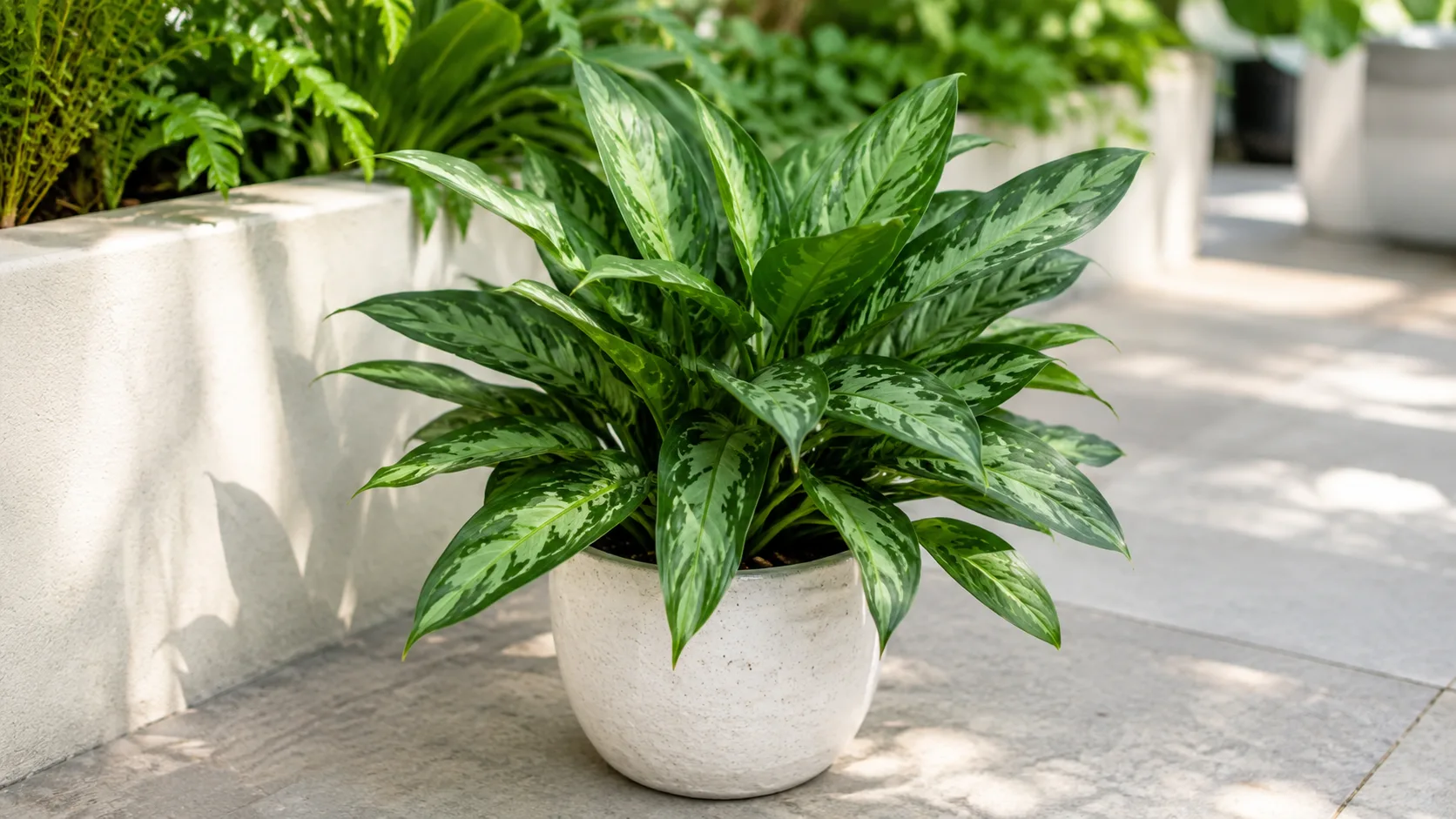
Aglaonema Maria Light Requirements: Window & Grow Light Guide
Aglaonema Maria Light Requirements: Window & Grow Light Guide
Aglaonema commutatum ‘Maria’ is sold as a low-light plant for good reason: its dark forest-green leaves with silver-gray vein striping carry more chlorophyll per square inch than pale pink or cream cultivars, so it photosynthesizes efficiently in offices and north rooms where showier Aglaonema fade. That biology is also a trap. Maria can look healthy in a dim corner while stems stretch, silver markings dull, and potting mix stays wet for weeks - the classic survival-without-growth pattern. This page is the cultivar-specific light guide for the Aglaonema Maria care cluster; for genus-wide cultivar comparisons, see the Chinese evergreen light guide.
The practical question is not whether Maria tolerates low light - it does - but whether your spot delivers enough usable filtered daylight for compact new leaves without hot direct sun on the glass. Judge placement from new growth and soil drying, not from how green the plant still looks.
Quick Answer: Filtered Medium to Bright Indirect Light
Place Aglaonema Maria where leaves receive broad, diffuse daylight for much of the day - typically within 1 to 3 feet of an unobstructed north or east window, or several feet back from a south or west window behind a sheer curtain. Soft morning sun through ordinary glass is often fine for an acclimated plant; harsh midday and afternoon beams are not. The Royal Horticultural Society specifically recommends filtered light for ‘Maria’, and Clemson Cooperative Extension describes Chinese evergreen as adaptable to low-light interiors while warning that environmental stress still accumulates.
Monitor the newest two or three leaves after any move. Healthy placement produces leaves of stable size, compact petiole spacing, firm texture, and the cultivar’s normal green-and-silver pattern. Slow growth alone is not failure - Maria is naturally slow - but zero new leaves across a warm bright season means light or roots deserve review.
Maria’s Target Light Band (Foot-Candles and Lux)
Commercial interiorscape guidance gives Maria a measurable starting band. UF/IFAS publication EP160 recommends growing Aglaonema in 75% to 90% shade, equivalent to roughly 3,000 to 1,250 foot-candles at the production bench, and notes that leaves of most cultivars lose color and stand upright when grown at the upper end of that range. Most growers therefore use 80% to 90% shade. EP160 also documents that Aglaonema can tolerate interior light as low as 25 foot-candles - survival territory, not thriving territory.
For home placement, translate those numbers conservatively:
| Band | Foot-candles (fc) | Lux (approx.) | Maria response |
|---|---|---|---|
| Survival floor | 25–75 fc | 270–800 lux | Plant holds on; growth minimal; silver may dull; soil dries slowly |
| Healthy target | 75–250 fc | 800–2,700 lux | Compact new leaves; crisp silver striping; reasonable drying cycle |
| Upper comfort | 250–400 fc | 2,700–4,300 lux | Faster leaf emergence; watch for color wash or upright leaf posture |
| Scorch risk | 400+ fc sustained direct | 4,300+ lux | Bleached patches, tan crispy areas, hot leaf surfaces |
Maria’s dark camouflage variegation masks low-light stress longer than Silver Bay’s broad silver center does, so use the table as a decision aid, not a decoration. A phone lux meter at leaf level, pointed toward the window, helps compare spots even though phone sensors are not lab instruments.
Low-Light Tolerant Does Not Mean No Light
“Low light” indoors still means photons - not a windowless closet with a ceiling lamp used ten minutes a day. Maria reduces growth and water use in dim conditions, which is why a watering routine developed near a bright window becomes dangerous after the plant moves into a darker room. Owners often blame yellow leaves on light alone when the immediate injury is root decline from chronically wet soil.
University of Arkansas Extension notes Aglaonema’s light compensation point - where photosynthesis equals respiration - is around 10 foot-candles. The average interior room delivers roughly 20 to 60 foot-candles; a good reading spot near a window may reach 100 foot-candles. Below compensation, the plant waits without dying. Above it, Maria grows - slowly, which is normal.
Dark green foliage does not prove adequate light. Shade-adapted leaves can retain rich color while internodes stretch and silver striping softens. Better indicators: leaf production rate, leaf size, stem strength, soil drying pattern, and whether the plant sheds more lower foliage than it replaces. When those signs align with a dim corner, see the dedicated not enough light guide for step-by-step recovery before Aglaonema Maria repotting guide or fertilizing.
How Light Controls Growth, Color, and Water Use
Light powers photosynthesis; fertilizer supplies minerals but cannot replace that energy. An Aglaonema in inadequate light may not respond to feeding because light remains the limiting resource, and excess salts can accumulate when slow growth removes little from the pot. According to the University of Minnesota Extension, all plants require light to convert carbon dioxide and water into carbohydrates.
Brighter filtered light usually supports faster water use, more frequent leaf emergence, and denser growth. It may also preserve clearer silver striping, although Maria’s pattern is naturally subtler than pink or white cultivars - strong sun will not manufacture high-contrast color genetics does not provide. A warm bright Maria transpires and draws water through its roots, helping mix progress from evenly moist toward partially dry; a cool dim Maria uses water slowly. That coupling is why the same pot may need water in eight days during a bright season and two or three weeks later without any other change.
Maria vs Other Aglaonema Cultivars on Light
| Cultivar | Variegation type | Relative light demand | Maria placement takeaway |
|---|---|---|---|
| Maria | Dark green + silver veins | Low to medium; strong dim-room survivor | Owns the dimmest reliable band in the genus |
| Silver Bay | Broad silver center, green margin | Medium; needs brighter band for crisp silver | Maria tolerates ~30–50 fc less before silver dulls |
| Silver Queen | Heavy silver marbling | Medium; color washes in excess light per EP160 | Maria holds color in offices Silver Queen may not |
| Pink / red hybrids | Pale or pink sectors | Higher; pale tissue needs more photons | Do not use pink-cultivar windows as Maria’s ceiling |
Maria will not develop Silver Bay’s high-contrast silver plate even in perfect light - compare only stripe crispness and internode spacing, not total silver area.
What Bright Indirect Light Means in a Real Room
Bright indirect light is strong ambient daylight without an intense direct solar beam on foliage for a damaging duration. Filtered light passes through sheer fabric, translucent blinds, tree canopy, or glass that scatters rays. Two rooms both called “bright indirect” can differ greatly, which is why compass direction is only a starting clue.
Use the shadow test at leaf level: a sharp dark hand shadow suggests direct or very intense light; a soft-edged visible shadow suggests brighter indirect; almost no shadow suggests a dimmer setting. Repeat when the window receives its strongest exposure because weather and season change the result.
A phone light-meter app helps compare locations. Measure at the canopy, sensor facing the incoming light, on several days at midday. The absolute number matters less than relative ranking - a spot reading three times brighter than a dim corner is meaningfully different even if the phone’s calibration is imperfect.
Best Window for Aglaonema Maria
Window direction predicts the timing and angle of direct sun, not the final intensity. Apartment towers, awnings, tinted glazing, trees, and deep eaves modify every rule. Stand where the pot will sit and evaluate visible sky and hours of unobstructed brightness.
At-a-Glance Window Direction Table
| Exposure | Typical opportunity | Main risk | Maria starting point | Approx. fc at leaf* |
|---|---|---|---|---|
| North | Gentle diffuse light | Too dim behind obstructions | Close to glass | 75–200 fc |
| East | Bright morning, soft direct | Brief sun after sudden move | Near window; sheer if leaves heat | 150–350 fc |
| South | Strong long-duration light | Midday scorch | Behind sheer or 3–6 ft back | 200–500+ fc (filter) |
| West | Hot afternoon sun | Heat + intensity through glass | Filter rays or outside beam | 200–600+ fc (filter) |
*Foot-candle ranges are editorial estimates for clear-day northern-hemisphere homes; measure your spot.
Keep leaves away from cold glass in winter and hot panes during heat waves. Suitable light intensity does not prevent temperature injury at the same location.
North- and East-Facing Windows
An unobstructed north-facing window is often forgiving: broad diffuse light with limited direct sun in the Northern Hemisphere. Place Maria close enough for a wide view of the pane. A narrow north window under a porch may still be too dim - watch whether the plant replaces old leaves and whether the pot dries within a reasonable period.
East-facing windows commonly balance brighter ambient light with gentler morning sun. An established plant can often take a short early sun period, especially outside the hottest season. Introduce exposure gradually; a plant raised in deep shade can scorch under exposure another specimen tolerates. If leaves become hot or pale patches appear, add a sheer curtain.
In the Southern Hemisphere, north-south exposure patterns reverse because north-facing windows receive more sun. East remains morning light and west afternoon light - observe the actual beam rather than relying only on a hemisphere chart.
South- and West-Facing Windows
South- and west-facing windows can provide excellent indirect light when managed, but direct beams are often too intense for an unacclimated Maria. A sheer curtain enlarges the usable zone. Alternatively, place the plant beside the window or beyond the direct-ray path while preserving a broad view of bright glass.
West light deserves caution because afternoon sun arrives when outdoor and indoor temperatures are already elevated. Leaves near glass can heat faster than surrounding air, causing bleached tan patches or crisp margins on the window-facing side while shaded leaves remain normal.
Do not place Maria in a direct southern beam and compensate with extra water. Root moisture does not prevent leaf tissue from overheating; it may instead leave the pot saturated. Solve excessive exposure at the window, not in the watering can.
How Far From the Window Should Maria Sit?
Light falls rapidly as you move away from glass. A location that looks bright to human eyes can be poor for photosynthesis because vision adapts. Moving from 1 foot to 6 feet away is not a small adjustment - usable daylight can drop dramatically when side walls limit visible sky.
Begin close to a gentle window and farther from a harsh one. Observe where direct sun falls at the brightest time, then position leaves just outside that beam or diffuse it. Large plants need evaluation across the whole canopy; the top may be bright while lower leaves are shaded by furniture or the plant’s own foliage.
If a location is chosen for decor rather than performance, compare it with a meter before committing. Periodic relocation changes temperature and watering demand; a timed grow light is usually cleaner for a permanently dim display area.
Direct Sun, Scorch, and Acclimation
Direct sun is not automatically fatal. Short gentle morning exposure may be safe for an acclimated plant. Risk depends on intensity, duration, leaf temperature, previous acclimation, and cultivar. UF/IFAS EP160 warns that Aglaonema should never be placed in full sun or leaves will scorch.
Scorch appears as bleached, pale yellow, tan, or brown patches on the most exposed surfaces. Damaged tissue does not recover. A distinct exposure pattern, sudden onset after a move, and damage concentrated on window-facing leaves support a light diagnosis. Uniform yellowing with wet soil points elsewhere.
Acclimation protocol: move closer to the window while staying outside direct sun for one to two weeks without stress, then introduce brief mild morning exposure or partially open the sheer. Increase duration gradually - not intensity and duration simultaneously. Existing leaves formed under old conditions and may never tolerate as much as new growth after acclimation. Avoid combining the move with repotting, heavy fertilization, or a major watering change.
Signs Maria Needs More Light
Low-light signs develop gradually: long intervals between leaves, successively smaller growth, petioles stretching toward the window, an open one-sided shape, lower-leaf loss exceeding replacement, and mix that remains wet unusually long. Rotation improves symmetry but does not solve inadequate intensity.
Pale or yellow leaves are not specific to low light - check soil moisture and roots because chronic wetness in dim conditions is a common yellowing pathway. Also consider cold exposure and normal aging when only the oldest leaf is affected.
Move closer in stages and wait for new growth. Stretched petioles will not shorten; improvement appears as firmer, better-sized new leaves and a more reasonable drying cycle. Do not fertilize heavily to accelerate the test.
New-leaf timeline after a brighter move:
- ~2 weeks: First new leaf may emerge; judge spacing and firmness, not color of old foliage.
- ~4 weeks: Second new leaf confirms the trend - tighter internodes and clearer silver mean the placement works.
- Beyond 6 weeks with no new growth in a warm season: re-check roots, temperature, and whether the “bright” spot still measures under ~75 fc at the canopy.
Full symptom photos and recovery steps live on the not enough light problem page.
Signs of Excess Light or Heat
Excess exposure produces localized bleaching, tan patches, crispy areas, curling away from the window, and damage concentrated on the brightest side. Heat injury can occur near glass even when ambient room temperature seems acceptable.
Brown tips alone are ambiguous - they can result from fertilizer salts, inconsistent moisture, low humidity, or water quality. Sun scorch is more often patchy across the blade or confined to exposed margins rather than identical tips on every leaf. Compare damage with the sun path before moving the plant to a much darker location.
Remove severely damaged leaves only when mostly dead or unattractive. Partly green tissue still contributes energy. Correct exposure and evaluate subsequent leaves - sunburn is permanent, so absence of new damage confirms the new placement works.
Placement check (illustrative): Well-placed Maria - compact rosette, petioles roughly parallel, silver stripes crisp along veins, new leaf every few weeks in warm months, pot dries in 7–14 days. Low-light Maria - stems lean one direction, internodes visibly longer on newest growth, silver looks washed to plain dark green, soil wet 2+ weeks. Sun-stressed Maria - chalky bleached patch on the window-facing leaf half, tan crispy margin, leaf warm to touch at midday. Original labeled comparison photos are pending; use the new-leaf test and fc band above until then.
Grow Lights for Aglaonema Maria
A grow light can supplement or replace weak window light when it delivers suitable intensity across the canopy for a consistent daily period. A white full-spectrum LED is practical in homes because color rendering is comfortable and fixtures are widely available. Marketing terms like “full spectrum” do not reveal intensity - use manufacturer coverage maps and plant response.
Position the fixture above or slightly in front of the plant so leaves receive even coverage. Side lighting alone encourages leaning. Maintain air movement and follow the manufacturer’s minimum clearance.
Distance, Duration, and Fixture Guidance
For Maria’s 75–250 fc target, start with the manufacturer’s low-to-medium interior foliage recommendation - often 12 to 24 inches above the canopy for modest 15–40 W full-spectrum LED houseplant lamps - then adjust for the actual fixture. Run roughly 10 to 12 hours per day on a timer and provide a dark period. The University of Minnesota Extension recommends 12 to 14 hours of light daily for foliage houseplants under artificial light and emphasizes that plants need darkness for respiration.
If growth remains stretched and the lamp is rated for closer use, reduce distance gradually. If leaves bleach, curl, or become warm, increase distance or shorten duration. Clean dust from foliage and fixture lenses. Reassess as the plant grows toward the lamp.
Office fluorescent baseline: continuous overhead tubes often deliver 50–150 fc at desk height - enough for Maria to survive and sometimes grow slowly if leaves are not blocked by monitors or shelves. For compact habit year-round, add a small desk LED aimed at the canopy rather than relying on distant ceiling panels alone.
Do not use a grow light as an excuse to ignore watering changes. Stronger artificial light increases water use; weak supplemental light may change little. Track the pot rather than assuming the label “grow light” transforms the environment.
Seasonal and Regional Light Changes
Sun angle and day length shift through the year. A south window gentle in winter may become harsh in summer, or may be shaded by eaves until leaf fall on a deciduous tree outside. Review position at the beginning of each season - a successful spot is not permanently fixed.
At high latitudes, winter daylight can be both short and weak, making supplemental lighting useful. In tropical or subtropical regions, windows can deliver intense sun and heat year-round, so filtering and distance matter more. Monsoon cloud, wildfire smoke, and urban towers also reduce light regardless of latitude.
When daylight falls, expect slower drying and reduce watering frequency per the Maria watering guide. When exposure increases, check moisture more often but water only when the root zone reaches your chosen dryness.
Balancing Light With Water, Temperature, and Humidity
Light cannot be optimized in isolation. A bright cold windowsill can chill this tropical plant - UF/IFAS EP160 notes chilling injury below 55°F in Aglaonema - while a warm dark corner encourages slow water use and wet soil. The best location balances usable light with stable warmth.
Keep Maria away from cold drafts, air-conditioning jets, heaters, and leaves pressed against glass. Humidity can reduce edge drying but does not compensate for low light or saturated compost. Misting leaves does not increase photosynthesis.
Once light improves, reconsider fertilizer conservatively per the fertilizer guide. Active growth can use regular weak feeding, but wait until the plant demonstrates that response. Better light often resolves stagnation without an immediate nutrient increase.
Pet and child placement: Aglaonema Maria contains insoluble calcium oxalate crystals and is toxic to cats and dogs if chewed. Low window sills, plant stands within reach, and sunny ledges where pets jump are poor choices even when the light is perfect. Elevate the pot or choose a pet-safe species for accessible spots - details in the Maria overview.
Troubleshooting Common Placement Problems
If the plant leans, move it closer to brighter filtered light first, then rotate a quarter turn every week or two once intensity is adequate. If only window-facing leaves bleach, filter direct rays. If the entire plant yellows while mix stays wet, inspect roots and reduce watering before blaming brightness.
When silver striping looks subdued, compare only mature leaves produced under similar conditions. Young leaves often harden and change tone slightly. Maria will not develop pink or white sectors - do not chase color with harsh sun.
Room placement rubric (use at the prospective spot):
- Can leaves see a broad window area or a dedicated grow light?
- Does harsh direct sun strike them, and for how long?
- Are cold panes, hot glass, heaters, or strong drafts nearby?
- Does the pot dry progressively rather than staying wet for weeks?
A living room with a large filtered east window is straightforward. A bedroom works when the plant sits close to usable daylight, not across the room. A bathroom needs an adequately bright window or grow light - humidity alone does not replace photons. An office with all-day ceiling lighting may maintain Maria, but a desk-level LED usually produces tighter growth than distant fluorescents alone.
After placement, record when a new leaf emerges and how long mix takes to dry. Recheck after one month and after the season changes.
Related Maria Care
Light sits upstream of almost every other Maria problem. When placement is wrong, watering, feeding, and pattern stability all look broken.
- Aglaonema Maria overview - species basics, toxicity, and seasonal rhythm
- Not enough light - diagnosis when silver dulls and stems stretch
- Watering - moisture rhythm that must track every light change
- Chinese evergreen light (genus) - cultivar comparison across the genus
How We Wrote and Verified This Guide
By Sai Ananth · Reviewer: LeafyPixels Review Board (tropical foliage care) · Last reviewed: 2026-06-15
Recommendations were cross-checked against the RHS ‘Maria’ page, Clemson HGIC Chinese evergreen guide, NC State Extension Plant Toolbox, UF/IFAS EP160, University of Minnesota Extension lighting guide, University of Arkansas Extension Chinese evergreen profile, Missouri Botanical Garden Aglaonema entry, ASPCA Chinese evergreen toxicity, and LeafyPixels sibling pages linked above.
Conclusion
Aglaonema Maria needs filtered, usable light in the 75–250 foot-candle healthy band - not a dark corner and not an abrupt blast of hot sun. Start close to a gentle north or east window, or manage brighter south or west exposure with distance, a sheer curtain, or placement outside the direct beam. Treat those as starting positions and evaluate actual sky view, sun path, temperature, and new leaf size, spacing, and silver crispness.
Low-light tolerance means Maria can function at lower intensity, usually with slower growth and slower water use. It does not remove the need for light. Acclimate any move gradually; use a timed grow light when a room lacks adequate daylight; link symptoms to the not enough light guide before stacking other interventions. The best position is the brightest stable one that maintains healthy foliage without scorch - and keeps the pot out of reach of pets on sunny sills.
When to use this page vs other Aglaonema Maria guides
- Aglaonema Maria overview - Start here for whole-plant context before deep-diving this topic.
- Aglaonema Maria problems hub - Jump to symptom-specific fix guides when this care topic does not resolve the issue.
- Not Enough Light on Aglaonema Maria - Escalate here when light adjustments are not enough.
- Leggy Growth on Aglaonema Maria - Escalate here when light adjustments are not enough.