Aglaonema Maria (Chinese Evergreen) Fertilizer Guide
Aglaonema Maria (Chinese Evergreen) Fertilizer Guide
Aglaonema Maria (Chinese Evergreen) Fertilizer Guide
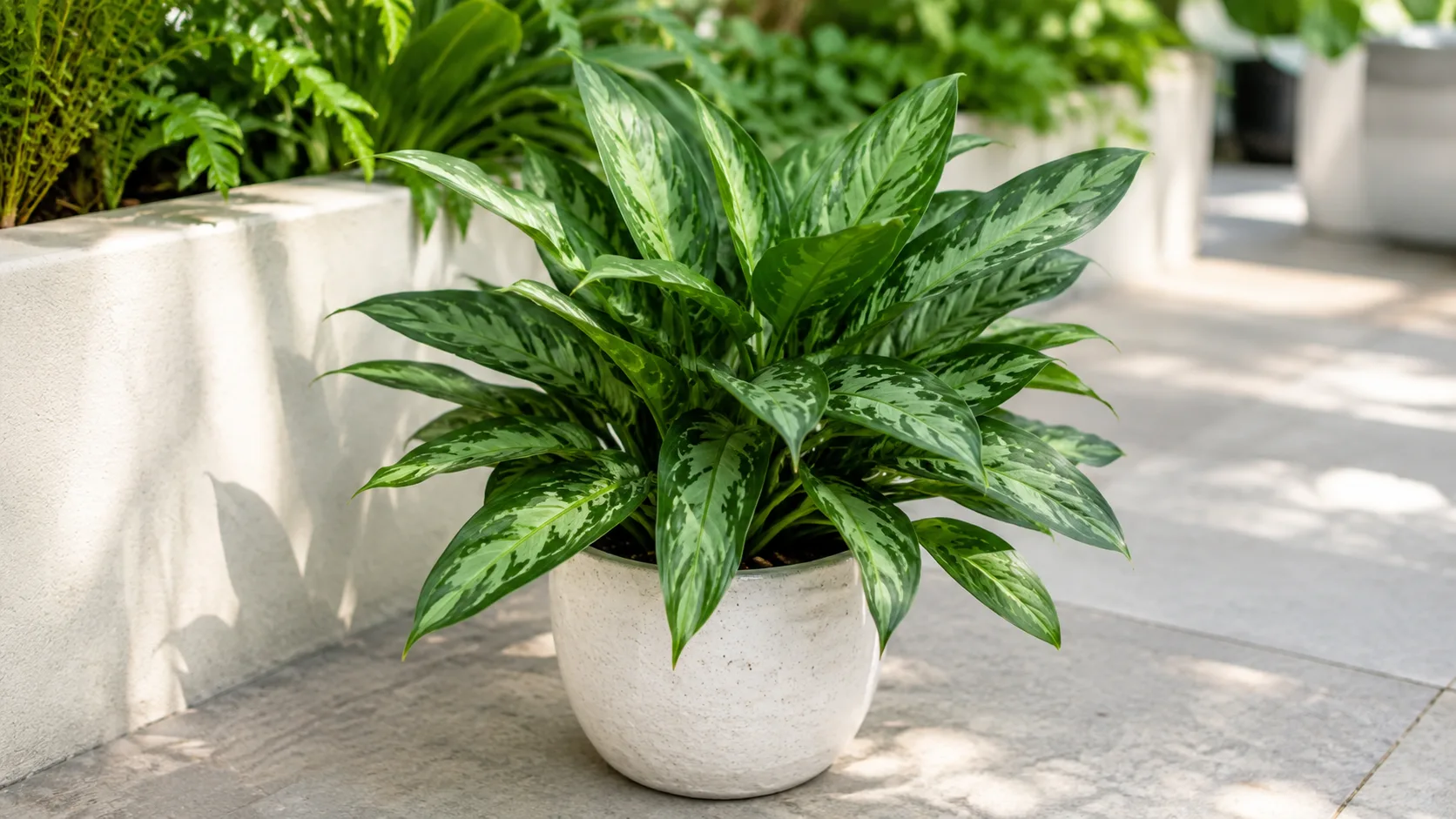
If your Aglaonema ‘Maria’ sits on an office desk or in a north-facing room, feeding should be lighter than the label on most houseplant fertilizers suggests. The Royal Horticultural Society describes ‘Maria’ as a slow-growing Chinese evergreen with dark green, silver-speckled leaves that ultimately reaches about 50 cm under filtered light - a profile built for shaded interiors, not for pushing rapid leaf turnover. That biology matters more than the generic advice to “fertilize monthly” printed on a bottle.
Maria’s feeding story is tied to how little photosynthesis happens in typical low-light placement. A plant that makes few new spears each season cannot use a heavy nutrient load, and its closed container root zone keeps unused minerals as soluble salts until water carries them out the drainage holes. The goal is therefore maintenance: replace what active growth consumes while keeping the mix aerated and salt-free. This page is for Maria growers who want cultivar-specific defaults; for genus-wide background, see the generic Aglaonema fertilizer guide and pair feeding with our Maria light, watering, and soil guides on the same plant.
Quick Answer - Feed Lightly During Active Growth
Use a complete balanced houseplant fertilizer with micronutrients. During active spring and summer growth, apply it at roughly one-quarter to one-half of the label’s standard houseplant strength every four to six weeks. Start at the lower end when Maria lives in low light, the potting mix already contains starter fertilizer, or you are unsure how the nursery treated the plant. Increase only when roots are healthy and new spears are emerging at a steady pace.
University of Florida IFAS commercial guidance recommends a 20-20-20 water-soluble fertilizer at 50 ppm nitrogen about once a month under interior conditions for Aglaonema, and warns that over-fertilization indoors causes soluble salt buildup and leaf margin or tip injury. That 50 ppm target is a useful ceiling for a desk Maria; a bright-window plant may tolerate the upper half of the quarter-to-half label range but still rarely needs full label strength in a small pot.
Apply fertilizer to already-moist potting mix and let excess solution drain fully. Do not leave the nursery pot standing in drained solution inside a decorative cover. In cool or low-light winter conditions, stop feeding or extend the interval substantially. If the plant continues visible growth under a strong grow light in a warm room, a very dilute application every six to eight weeks may be reasonable - plant response is the evidence, not the calendar.
The operating rule: feed growth, not stress. New leaf spears, expanding foliage, and firm roots indicate that nutrients can be used. Persistent wetness, recent root loss, wilting in damp soil, pest infestation, cold damage, or no measurable growth mean feeding should wait. Fertilizer supports functioning systems; it does not restart systems failing for environmental reasons - a point the Clemson Cooperative Extension reinforces when noting that excessive fertilizer can cause leaf edge burn on Chinese evergreen.
Why Maria Needs Less Fertilizer Than Colorful Cultivars
Not every Aglaonema shares the same appetite. Pink, red, and heavily variegated cultivars such as ‘Pink Dalmatian’ or ‘Cherry’ are often grown in brighter nursery light and may produce softer, faster shoots when light and humidity are high. ‘Maria’ is different. Its dark, camouflage-patterned foliage is adapted to lower usable light, and the cultivar’s slow crown expansion means fewer new leaves are drawing nitrogen each month.
Slow Growth, Low Light, and Office Desks
UF/IFAS EP160 notes that Aglaonema cultivars can tolerate light as low as 25 foot-candles in interior settings but should never receive full sun. Maria is commonly sold for fluorescent-lit offices and dim living rooms precisely because it holds color there - yet those same conditions reduce carbohydrate production, water use, and nutrient demand. A fixed monthly full-strength dose in a cubicle can add minerals faster than the roots and shoots remove them.
Container culture compounds the problem. In a garden bed, rainfall and a large soil volume disperse minerals. In a 6-inch pot on a desk, salts remain until the plant absorbs them or leach water exits the drainage holes. Repeated light watering without occasional thorough drainage, hard tap water, and routine feeding can gradually concentrate salts even when no single application seems excessive. That is why Maria on a watering schedule tuned for a bright window often needs half the fertilizer frequency after a move to a darker corner - adjust both water and feed together.
Maria vs the Generic Aglaonema Fertilizer Guide
The LeafyPixels genus Aglaonema fertilizer page covers N-P-K basics, salt physiology, and flush recovery for any Chinese evergreen. Use this Maria page when:
- Your plant is ‘Maria’ (dark green with silver chevrons) in low to medium indirect light
- You want office-desk or winter-pause defaults tied to slow spear emergence
- You need a worked dilution example and month-by-month calendar calibrated to UF/IFAS 50 ppm interior guidance
Use the genus guide when you grow several Aglaonema cultivars and want one reference for shared Araceae biology, or when your plant is a bright-light pink/red cultivar with faster summer flush. Maria-specific feeding is more conservative on frequency in dim rooms; colorful cultivars in bright filtered windows may justify the shorter end of a four-to-six-week interval at half strength - still not full label rate in most home pots.
| Source | Published guidance | Practical Maria indoor read |
|---|---|---|
| RHS ‘Maria’ cultivar | Monthly balanced liquid in growing season; filtered light; moderate water | Upper framework - dial down for dim offices |
| UF/IFAS EP160 interiorscape | 20-20-20 at 50 ppm N once monthly under interior light | Matches quarter-strength dilution; do not stack with CR granules |
| Clemson HGIC | Warns excessive fertilizer → leaf edge burn | Pause feed when tips brown after a dose |
Best Fertilizer Type and N-P-K for Maria
The best general choice is a complete liquid fertilizer formulated for foliage houseplants, used below full label strength. “Complete” means nitrogen, phosphorus, potassium, and useful micronutrients such as iron, manganese, zinc, boron, copper, and molybdenum. According to Iowa State University Extension, plants require 17 essential nutrients, with N, P, and K used in large quantities while iron, boron, manganese, zinc, copper, and molybdenum are needed in trace amounts; Purdue Extension lists the same micronutrient set as essential for normal plant function.
A product labeled 3-1-2, 7-3-6, 9-3-6, 10-10-10, or 20-20-20 can work if diluted correctly. The numbers are percentages by weight, so one teaspoon of concentrated 10-10-10 is not equivalent to one teaspoon of a weaker 3-1-2 product. Never transfer a dosing rule between bottles without reading each label. Avoid bloom boosters as the default - Maria is grown for foliage, and heavy phosphorus is unnecessary for routine leaf production.
N-P-K Roles and Micronutrients
Nitrogen supports chlorophyll and leafy growth. Phosphorus participates in energy transfer; potassium regulates water relations and enzyme activity. Healthy growth needs all essential elements in suitable proportions - not isolated “leaf” or “root” nutrients. The University of Missouri IPM nutrient-deficiency guide notes that mobile nutrients (nitrogen, phosphorus, potassium, magnesium) show deficiency first on older leaves, while immobile nutrients (iron, manganese, zinc, copper, boron, calcium) appear first on younger leaves - a pattern that helps you diagnose before reaching for the bottle.
Micronutrients matter in peat-based indoor mixes that gradually lose their reserve. Iron or manganese availability can be restricted by unsuitable root-zone pH or damaged roots even when the element is present; adding more N-P-K does not always fix pale new growth.
Liquid Versus Controlled-Release Fertilizer
| Type | Main advantage | Main risk | Best Maria use |
|---|---|---|---|
| Liquid concentrate | Easy to reduce, stop, or seasonally pause | Measuring errors; repeated salt additions | Default for low-light desks - full control |
| Controlled-release granules | Convenient gradual delivery | Hard to remove; release rises in heat | Only at labeled container rate; no stacking with liquid |
| Pre-fertilized potting mix | Starter nutrition after repot | Silent double-feeding | Check bag; wait before adding liquid |
| Organic liquids | Broad nutrition | Variable concentration; gnats/odor | OK if concentration is predictable |
Liquid fertilizer offers the most control for a low-demand cultivar because you can stop immediately when growth slows. Do not combine full-rate controlled-release granules with routine liquid feeding unless the product instructions explicitly allow it.
Month-by-Month Feeding Calendar
Treat the calendar as a reminder to inspect, not an obligation to feed. Before every planned application, confirm active growth, healthy roots, appropriate light, and moist-but-not-soggy soil. Missing one feeding is less damaging than fertilizing compromised roots.
| Month (temperate indoor home) | Typical Maria activity | Feed? | Notes |
|---|---|---|---|
| January | Minimal growth; wet soil persists | No | Pause unless grow lights + new spears |
| February | Occasional slow spear in warm rooms | No / rare weak dose | Office heat only; not mandatory |
| March | Days lengthen; first spears possible | Optional weak | First feed only if new growth visible |
| April | Active growth in bright homes | Yes - quarter strength | Start conservative after winter pause |
| May–August | Peak indoor growth season | Yes - every 4–6 weeks | Half strength max in bright filtered light |
| September | Growth slowing | Reduce | Skip if no new leaves for 6+ weeks |
| October–December | Low light; cool rooms | No | Salts accumulate faster when growth stops |
Spring and Summer Active Growth
Spring is the sensible restart when days lengthen and new spears appear. Make the first application weak, especially if the plant was not fed through winter. Observe the next four weeks for normal leaf expansion and no increase in tip browning. During summer, do not fertilize a severely dry, wilted plant and then place it in hot sun - rehydrate with plain water first, restore stable conditions, and feed at a later watering.
Fall and Winter Pause Rules
Reduce feeding as growth slows in fall. In winter, many indoor Maria plants receive substantially less light even when room temperature stays comfortable. Under those conditions, fertilizer demand drops, mix stays wet longer, and salts are more likely to accumulate. Pausing until spring spears emerge is usually the safest choice. Winter feeding is justified only when Maria grows under a consistent grow-light photoperiod, stays warm, and continues producing full-sized leaves - and even then, use a weaker solution or longer interval than peak season.
Worked Dilution - 20-20-20 to About 50 ppm N
Label math is where most feeding injuries start. Many water-soluble 20-20-20 products specify about 1 teaspoon per gallon of water for full label strength. UF/IFAS EP160 targets 50 ppm nitrogen monthly for interior Aglaonema - roughly one-quarter of a typical full-strength 20-20-20 gallon mix.
Worked example (check your own label):
- Read the bottle: suppose it says 1 tsp 20-20-20 per 1 US gallon for houseplants.
- Quarter strength = ¼ tsp per gallon (or 1 tsp per 4 gallons).
- Mix into the full water volume; stir before applying.
- Water Maria’s moist mix until a little drains; empty the saucer.
- Mark the date; repeat no sooner than four weeks unless growth and light clearly justify it.
If your product uses a different base rate, scale down proportionally - the goal is a dilute complete solution, not a strong monthly shot. A dedicated measuring spoon beats kitchen teaspoons, which vary in volume.
Apply on Moist Soil and Drain Completely
Read the product label from beginning to end. Identify whether its rate is per liter, gallon, or pot diameter, and whether it assumes every watering or periodic use. Mix fertilizer into the full volume of water before applying so concentrated solution does not hit one section of the root ball.
Dry roots are more vulnerable to sudden mineral concentration. If the mix has become very dry or pulled away from the pot, water thoroughly with plain room-temperature water first, let the root ball rehydrate and drain, then fertilize at the next normal watering. “Moist soil” does not mean chronically saturated soil - if the pot is still heavy from the previous watering, delay both water and fertilizer.
Use a dedicated measuring spoon or graduated cap. Do not assume half the number of applications equals half the exposure when each dose is full strength; for Maria, reducing concentration is usually more forgiving than applying a strong solution less often.
Adjust Dose for Light, Mix, and Growth Rate
Light is the first adjustment. A Maria several feet from a window may hold leaves yet grow slowly, so it needs less fertilizer than one receiving bright, filtered light. Fertilizer cannot manufacture energy - when growth is limited by light, increasing nutrients mainly increases mineral load in the pot. Cross-check placement with the Maria light guide before increasing feed.
Next consider the substrate. Barky, fast-draining, low-nutrient mixes may need regular dilute feeding. Compost-rich or pre-fertilized mixes may supply substantial nutrition for months. Semi-hydroponic or inert mineral substrates require a purpose-designed complete nutrient program - ordinary soil-based Maria advice does not transfer directly.
Increase feeding only when roots are healthy, successive spears are appearing, and new leaves are unexpectedly small despite adequate light, water, temperature, and root space. Reduce or stop when tips brown after applications, a crust develops, or the plant enters a slower phase.
After Purchase, Aglaonema Maria repotting guide, or Propagation
Do not fertilize a newly purchased Maria on arrival. Commercial growers often supply controlled-release fertilizer, and granules may be visible on the soil surface. Give the plant several weeks to acclimate per the overview guide, learn how quickly its mix dries, and watch for growth before feeding.
After repotting, check whether the new mix contains starter fertilizer. If it does, wait for the stated effective period. If it does not, a healthy plant generally benefits from two to four weeks of root establishment before weak feeding resumes. Fresh divisions and rooted cuttings need functioning roots before routine feeding - begin only after resistance, new roots, or new leaf growth confirms establishment.
Deficiency Signs vs Overfertilization and Salt Buildup
Possible deficiency signs include persistently pale new growth, smaller successive leaves, or very slow growth during favorable conditions - meaningful only when the plant has adequate filtered light, correct watering, healthy roots, and no pests. A single old yellow basal leaf is usually not enough evidence.
Common overfertilization warnings include brown or crispy tips and margins that appear or worsen after feeding, a white or tan crust on the mix or pot, stalled growth, wilting despite moisture, and damaged dark roots. Clemson HGIC links excessive fertilizer to leaf edge burn on Chinese evergreen - timing after a recent strong dose makes fertilizer injury more likely than a sudden pest issue.
Iron Deficiency vs Salt Burn in Peat Mixes
Both can yellow or blemish Maria’s new foliage, but the mechanisms differ. Salt burn often follows a recent feed, comes with surface crust, and may wilt a plant in wet soil. Iron deficiency in peat-based mix sometimes shows as pale new leaves with darker veins while older leaves remain greener - especially when pH has drifted high or roots are compromised by overwatering on Aglaonema Maria. Flushing helps salts; it does not fix iron availability if pH is wrong. Do not stack iron supplements and fertilizer without identifying which pattern you see.
Flush Soil and Recover From Salt Injury
If the pot drains freely and roots are not rotten, place it over a sink and slowly run room-temperature water through the mix. Use several times the pot’s volume, allowing water to move through rather than overflow the rim. Let the container drain completely, empty the saucer, and return Maria to stable filtered light. One thorough flush is generally safer than keeping the pot waterlogged through repeated daily flushing.
If water cannot penetrate, the mix smells sour, or roots are black and soft, unpot the plant instead of blindly flushing. Remove failed roots, replace degraded mix, and use a clean pot with drainage. Do not fertilize during early recovery. Existing brown tissue will remain brown - judge recovery by firm stems, normal water uptake, and clean new foliage over several weeks.
Common Mistakes and Kitchen Remedies to Avoid
The most common mistake is treating a schedule as an obligation. Other errors include feeding dry roots, eyeballing concentrate, combining several fertilizer sources, fertilizing a sick plant, and trying to correct low light with extra nitrogen. Regularly adding Epsom salt without a diagnosed magnesium need contributes to total salt load.
Coffee grounds, banana peels, and similar kitchen remedies do not provide a complete, measurable nutrient profile for an indoor Maria pot. Do not water routinely with sodium-softened water - ion-exchange softeners replace calcium and magnesium with sodium that can accumulate in containers. Use a labeled houseplant fertilizer in the pot; compost organics elsewhere.
Before feeding, confirm: (1) new growth or active period, (2) enough filtered light, (3) healthy roots, (4) slightly moist but not saturated mix, (5) no duplicate fertilizer from granules or fresh mix. If all five are true, use a measured dilute complete fertilizer and drain the pot. If several are false, skip fertilizer and correct the limiting condition - a short nutrient delay is recoverable; damaged roots can set slow Maria back for months.
Conclusion
Maria rewards a light, measured feed tied to real spear emergence - not to guilt over a dusty fertilizer bottle. Use complete balanced liquid at quarter to half label strength every four to six weeks during active growth, pause in typical winter dim rooms, and account for nursery granules or pre-fertilized mix. On an office desk, the safest default is closer to UF/IFAS 50 ppm monthly than to full label strength. When salt buildup or tip burn appears, stop feeding, flush or repot as needed, and fix light and watering before restarting. That restraint keeps silver-striped foliage steadier than trying to force a low-light Chinese evergreen to outgrow its placement.
When to use this page vs other Aglaonema Maria guides
- Aglaonema Maria overview - Start here for whole-plant context before deep-diving this topic.
- Aglaonema Maria problems hub - Jump to symptom-specific fix guides when this care topic does not resolve the issue.