Snake Plant Propagation: Water vs Soil Method Compared
Compare snake plant propagation in water and soil, including cutting steps, rooting time, risks and aftercare tips.
Quick Answer: Water vs Soil for Snake Plant Leaf Cuttings
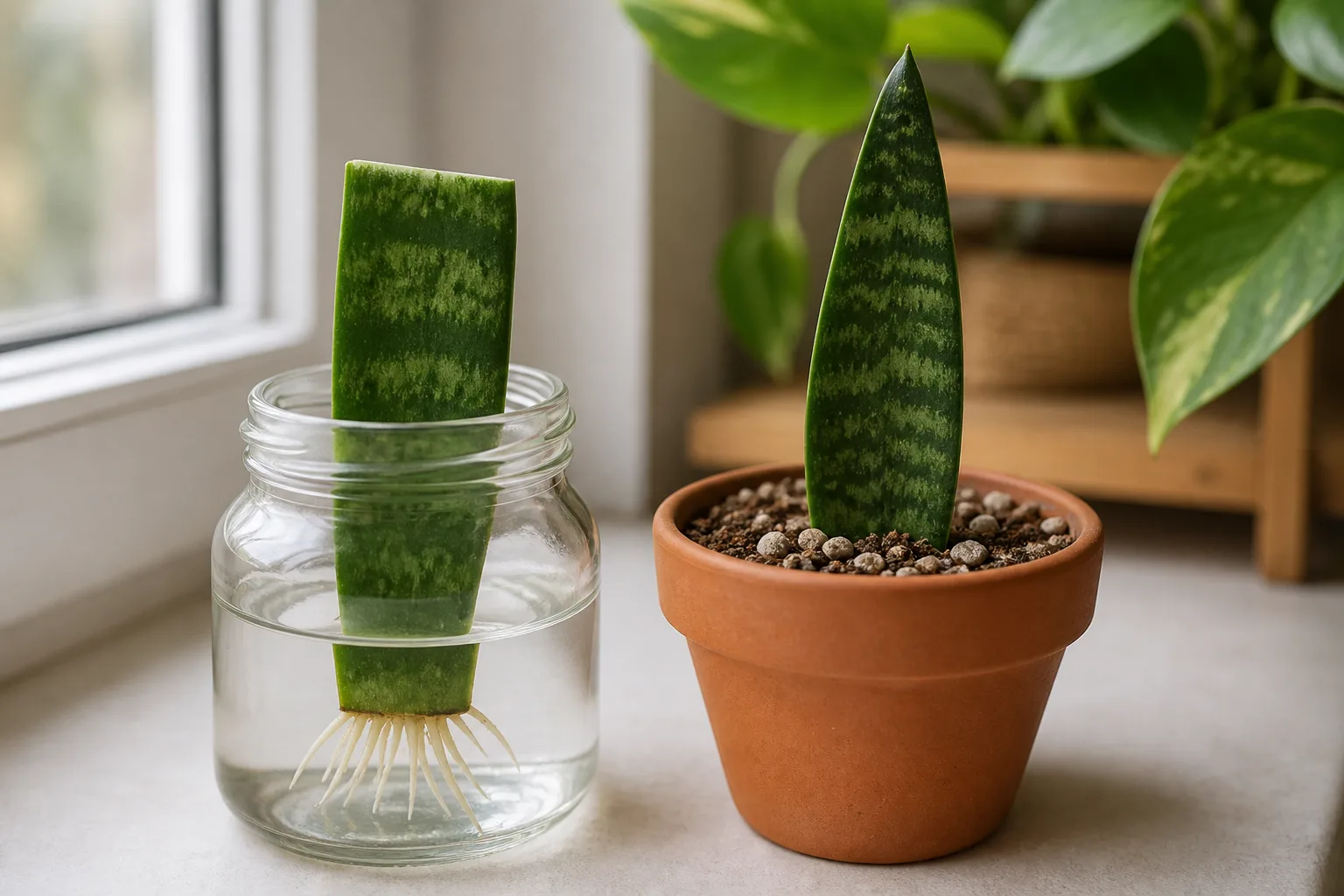
Water propagation is the easier way to monitor progress - you can see roots form and catch rot early. Soil propagation is usually the cleaner long-term finish - roots grow in the medium the plant will keep using, so there is no water-to-soil transition later. Neither method is universally “best”; the right pick depends on your habits, your cutting, and whether variegation must be preserved.
If your plant already has pups or multiple crowns, skip the water-vs-soil debate. Division is faster and more reliable than leaf cuttings in either medium. For step-by-step division, mix ratios, and full troubleshooting, use the Snake Plant propagation guide - this page stays focused on choosing and executing water vs soil for leaf segments.
Use the comparison table below once you know you are working with leaf cuttings, not division.
Who This Guide Is For
This page is for growers who already decided to propagate from a leaf or leaf section and are stuck on medium choice. Beginners who want visible roots in a jar will get a clear water workflow. Growers who dislike transplant shock will get a soil path with numeric planting depth and watering discipline.
You are not in the right place if you need a full propagation encyclopedia - division walkthroughs, rhizome anatomy deep dives, and tug-test timing live on the Snake Plant propagation hub. You are exactly in the right place if your search was “snake plant propagation water or soil” and you want a decision framework without rereading the same primer twice.
When to Use This Guide vs the Propagation Hub
| You need… | Start here (this guide) | Use the hub instead |
|---|---|---|
| Pick water or soil for leaf cuttings | Yes | - |
| Side-by-side comparison table | Yes | - |
| Division step-by-step with rhizome photos | Brief summary only | Propagation hub |
| 50/30/20 soil mix formula | Mentioned | Full ratios on hub |
| Heating mat temps, tug-test timing | Summarized | Detailed on hub |
| General snake plant care | Link out | Snake Plant hub |
Think of this URL as the comparison companion to the propagation hub, not a duplicate of it.
How Snake Plant Leaf Propagation Works
The common snake plant is Dracaena trifasciata (still widely sold as Sansevieria). Plants of the World Online lists Dracaena trifasciata as the accepted name with Sansevieria trifasciata as a synonym. Kew describes it as native to West and West Central Africa, with thick sword-shaped leaves adapted to dry tropical climates.
That biology explains the central rule of snake plant propagation: this is a patience project, not a moisture project. Leaf cuttings store water internally; they tolerate drying and slow rooting better than they tolerate stagnant, low-oxygen wetness. NC State Extension recommends division and stem cutting for propagation and warns that overwatering may cause root rot - a warning that matters even more for cuttings without mature roots.
A leaf cutting must rebuild both roots and a new shoot from detached tissue. Purdue Extension notes that leaf cuttings use just the leaf, so both new roots and new stems must form before the segment becomes an independent plant. Roots are the first milestone; pups often appear weeks or months later.
Why Orientation and Callus Matter Before You Pick a Medium
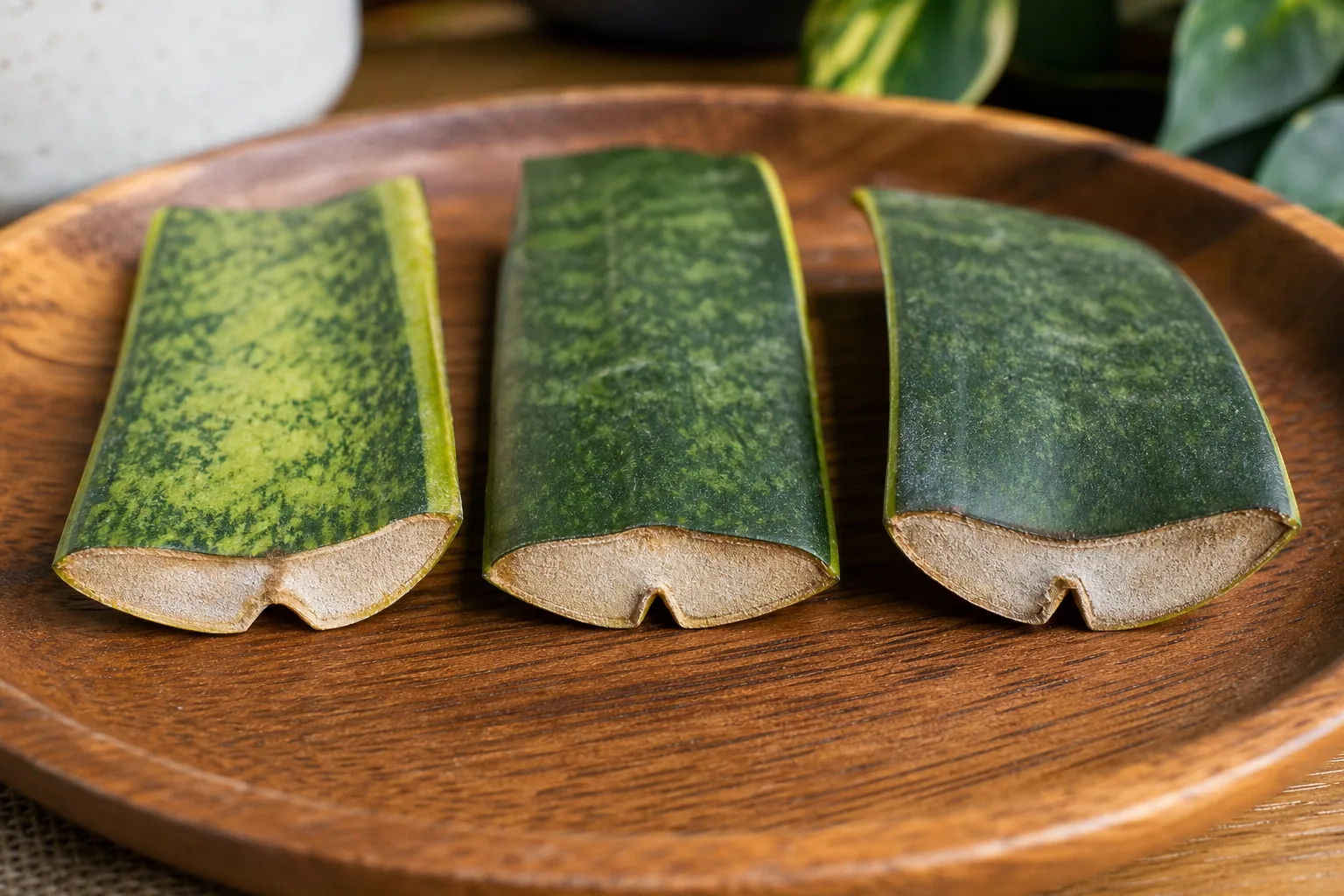
Snake plant leaf sections are directional. Roots and pups emerge from the basal end that was attached to the mother plant. Upside-down segments usually fail even if they root. Mark the bottom with an angled cut, tape, or a shallow V-notch before callusing.
Callus the cut end before water or soil. Lay segments in dry, shaded air for 1–3 days (longer in humid rooms). The surface should look matte and dry, not glossy. Fresh wet cuts in water or damp mix rot quickly on thick leaves.
Materials Checklist for Water or Soil Propagation
Gather before you cut:
- Sterile sharp knife or shears (wipe with rubbing alcohol)
- Healthy mature leaf from a pest-free Snake Plant
- For water: narrow clear jar, room-temperature water
- For soil: small pot with drainage, gritty mix (roughly 50% cactus/succulent mix, 30% perlite or pumice, 20% coarse sand - same philosophy as the Snake Plant soil guide)
- Optional: propagation heating mat set to 21–24°C (70–75°F) in cool homes
- Bright indirect light - see Snake Plant light requirements
Cut leaves into 5–8 cm (2–3 inch) horizontal sections if you want multiple plants. Discard segments shorter than about 5 cm; they desiccate before rooting.
Water Propagation for Snake Plants
Water propagation means placing only the callused basal end in clean water while the rest of the leaf stays above the line. It is popular because progress is visible. It is not a permanent home - snake plants are not aquatic, and long jar stays create fragile roots that struggle after potting.
Step-by-Step: Leaf Cuttings in Water
- Remove a firm leaf at the base with a clean cut.
- Segment if desired; mark the bottom of each piece.
- Callus 1–3 days until the cut end is dry.
- Submerge only the bottom 1–2 cm (½–1 inch) in water. Use a narrow glass so the leaf stays upright.
- Place in bright indirect light - not harsh sun through glass, which heats water.
- Change water when cloudy or roughly weekly. Stale water is the main rot trigger.
- Pot up when roots are roughly 2.5 cm (1 inch) or longer and firm - not at the first white nub, and not after months in the jar.
Full jar-care detail, tug-test guidance, and division alternatives are on the Snake Plant propagation page.
Pros and Cons of Water Propagation
Pros: High visibility; easy rot detection; minimal setup; great for salvaging a broken leaf without disturbing the parent root ball.
Cons: Stagnant water rot risk; water-to-soil transition shock when roots adapted to liquid meet gritty mix; temptation to leave cuttings in the jar too long, producing tangled fragile roots. Iowa State Extension notes that division creates genetic clones - leaf cuttings in water do not solve variegation preservation the way division does.
Soil Propagation for Snake Plants
Soil propagation plants the callused segment directly into fast-draining mix. You lose the visual feedback loop, but roots form in their long-term environment. Experienced growers often prefer this for leaf cuttings because it skips the second transition.
Step-by-Step: Leaf Cuttings in Soil
- Prepare segments the same way as for water - cut, mark bottom, callus 1–3 days.
- Fill a small pot with drainage using gritty mix (see checklist above). Pre-moisten until the mix holds shape but does not drip.
- Insert the basal end 2–3 cm (about 1 inch) deep. Firm lightly so the segment stands without wobbling. Do not bury half the leaf.
- Water lightly after planting if mix was dry; otherwise wait 3–5 days, then keep the base barely moist, not wet.
- Place in bright indirect light at 18–27°C (65–80°F). Optional heating mat at 21–24°C speeds rooting in cool rooms.
- Expect roots in 4–8 weeks under warm bright conditions; visible pups often need an additional 2–4 months after rooting begins.
- Confirm progress with a very gentle tug after six weeks - slight resistance suggests roots. Avoid repeated digging.
If the mix stays wet for days, read overwatering on Snake Plant before the cutting softens.
Pros and Cons of Soil Propagation
Pros: No water-to-soil shock; roots adapted to mix from day one; teaches the same moisture discipline mature snake plants need; cleaner windowsill setup.
Cons: Hidden progress - pulling the segment weekly tears new roots; silent rot if mix is dense or cold; feels slower because early action is underground. Soil punishes anxious watering more than water punishes forgotten water changes.
Water vs Soil: Side-by-Side Comparison
| Factor | Water Propagation | Soil Propagation |
|---|---|---|
| Best for | Beginners who need visible roots | Growers who want one transition |
| Visibility | High | Low |
| Typical root window | 6–10 weeks (warm, bright) | 4–8 weeks (warm, bright) |
| Pups after roots | Often +2–4 months | Often +2–4 months |
| Rot risk | Stagnant water, fresh uncallused cuts | Dense wet mix, cold rooms |
| Transplant steps | Two (water → soil) | One |
| Variegated cultivars | Leaf cuttings may revert | Leaf cuttings may revert |
| Better for variegation | Division | Division |
Timelines vary with season. RHS recommends taking leaf cuttings when plants are actively growing - typically spring through summer indoors.
Best Method by Goal
- Fastest independent plant: Division or pups - already rooted. See propagation hub.
- Watch roots form: Water - change water on schedule and pot up at ~1 inch firm roots.
- Fewest transitions: Soil - bury 2–3 cm deep in gritty mix, water sparingly.
- Preserve Laurentii margins or Moonshine pattern: Division only - leaf tissue alone usually reverts to green.
- Salvage one broken leaf without unpotting parent: Water - turn segments into jars on the windowsill.
Timelines, Light, Temperature, and Aftercare
Light: Bright indirect - an east window or 1–2 meters from a south or west window. Low light slows propagation; direct midday sun on de-rooted segments causes desiccation.
Temperature: 18–27°C (65–80°F) for active rooting. Below 10°C (50°F), expect months of idle time or rot. A 21–24°C heating mat under the pot optional in cool homes.
After potting water-rooted cuttings: Use a small pot with drainage, fast-draining mix, and lightly moist - not soggy - soil for 1–2 weeks while mix-adapted roots take over. Avoid fertilizer until you see new growth.
After soil-rooted cuttings push pups: Treat as a young plant - water when mix dries appropriately per the Snake Plant watering guide. Repot only when crowded; see Snake Plant repotting.
Division: When Water and Soil Are Not the Answer
Leaf cuttings - water or soil - are slow because they rebuild from a detached blade. Division separates a pup or clump section that already has rhizome and roots. Iowa State Extension explains that division creates genetic clones of the parent with all vegetative parts intact.
Choose division when:
- Visible pups crowd the pot
- You need results in weeks, not months
- You propagate ‘Laurentii’, Moonshine, or other variegated forms
- The parent is mature enough to split without cosmetic damage
This comparison page will not duplicate the hub’s division photos and rhizome cut diagrams. Follow the Snake Plant propagation guide for the full walkthrough.
How to Prevent Rot and Failed Cuttings
Most failures trace to a short list:
- Unhealthy leaf material - soft, yellow, or pest-infested blades
- Skipping callus - fresh cuts straight into water or wet mix
- Too much moisture - half the leaf submerged, or soil wet for days
- Wrong orientation - basal end not down
- Cold, dim conditions - metabolism too slow to outpace decay
- Dirty tools or reused soggy mix
NC State Extension is explicit: well-drained soil and careful watering are required; overwatering causes root rot. That applies doubly to cuttings.
Troubleshooting Common Propagation Problems
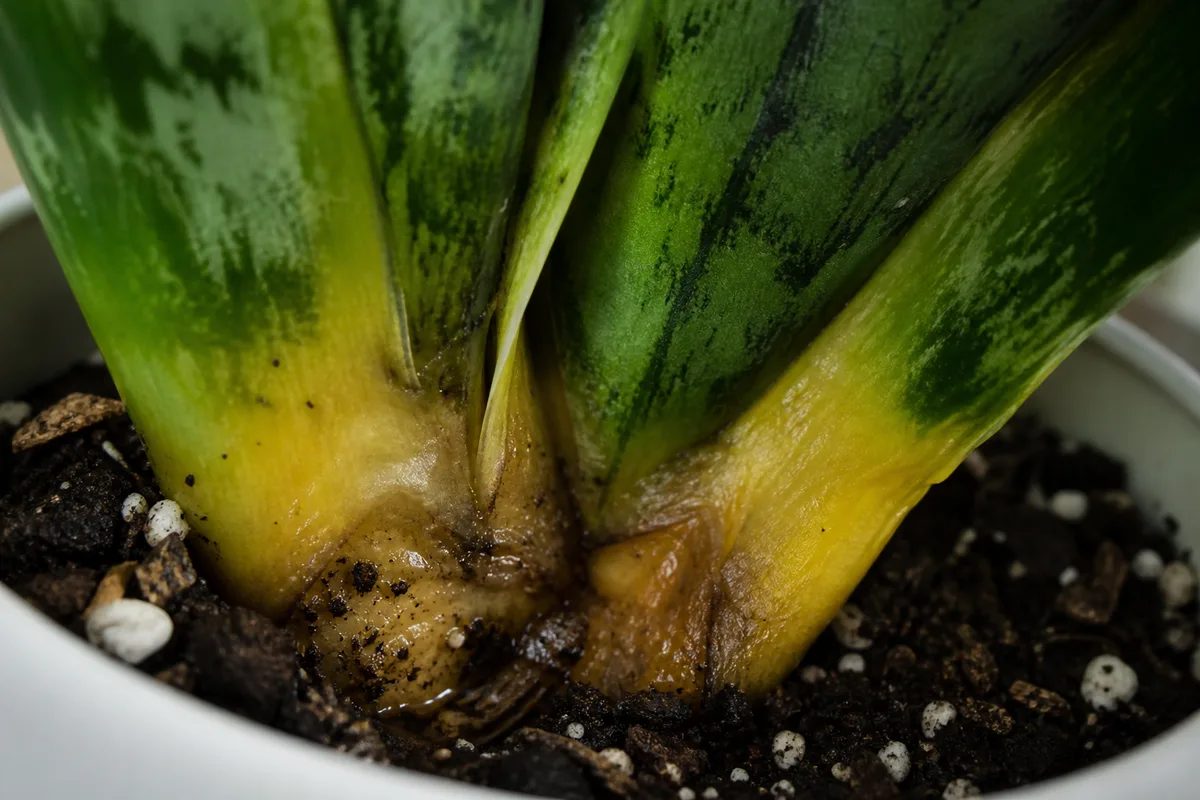
Mushy base: Rot started. Cut back to firm tissue, re-callus 2–3 days, restart in cleaner conditions. Discard fully collapsed segments.
No roots after 8–10 weeks but leaf still firm: Check orientation, warmth, and light before assuming failure. Snake plants are slower than pothos - a firm leaf may still be working.
Water-rooted cutting wilts after potting: Transition shock. Keep soil lightly moist, avoid direct sun, do not tug. Give 1–3 weeks for mix roots.
Roots but no pup for months: Normal. Pups require additional energy after roots. Wait unless the base softens.
Variegated parent, green pup from leaf cutting: Expected biology - chimeric margin tissue lives at the crown, not uniformly in leaf cells. Use division next time.
Variegated Snake Plants Need a Different Strategy
Variegated snake plants like ‘Laurentii’ may root from leaf cuttings in water or soil, but new growth often loses yellow margins because variegation sits in chimeric meristem tissue at the crown. A rooted green plant is biological success but not a pattern match for the parent.
For variegated cultivars, treat leaf cuttings as experiments and division as the reliable path. The propagation hub covers chimeric tissue and cultivar-specific rules in depth.
Pet safety during propagation: Cuttings in jars on low shelves are easy for pets to reach. The ASPCA lists snake plant as toxic to dogs and cats (saponins), with possible nausea, vomiting, and diarrhea. If a pet chews a cutting, contact your veterinarian or the ASPCA Animal Poison Control Center at (888) 426-4435 (consultation fee may apply).
Conclusion
Water fits growers who need visible roots and can maintain clean jars. Soil fits growers who want roots built for pot life from the start. Division fits mature clumps, variegated cultivars, and anyone who wants the fastest reliable result.
Match the method to your goal, not to a social-media default. Mark orientation, callus cut ends, keep moisture restrained, and use bright indirect warmth. For everything beyond medium choice - division steps, mix math, and week-by-week hub timelines - continue with the Snake Plant propagation guide and the broader Snake Plant care guide.
Related Snake Plant Guides
- Snake Plant propagation - division, leaf cuttings, water and soil depth, full timelines
- Snake Plant hub - species home for care and problems
- Light · Watering · Soil · Repotting
- Snake plant care guide - consolidated beginner setup
- How to water indoor plants - soil-check skills that apply during propagation aftercare