Tradescantia Nanouk Fertilizer: When, How, and Mistakes
Tradescantia Nanouk Fertilizer: When, How, and Mistakes
Tradescantia Nanouk Fertilizer: When, How, and Mistakes
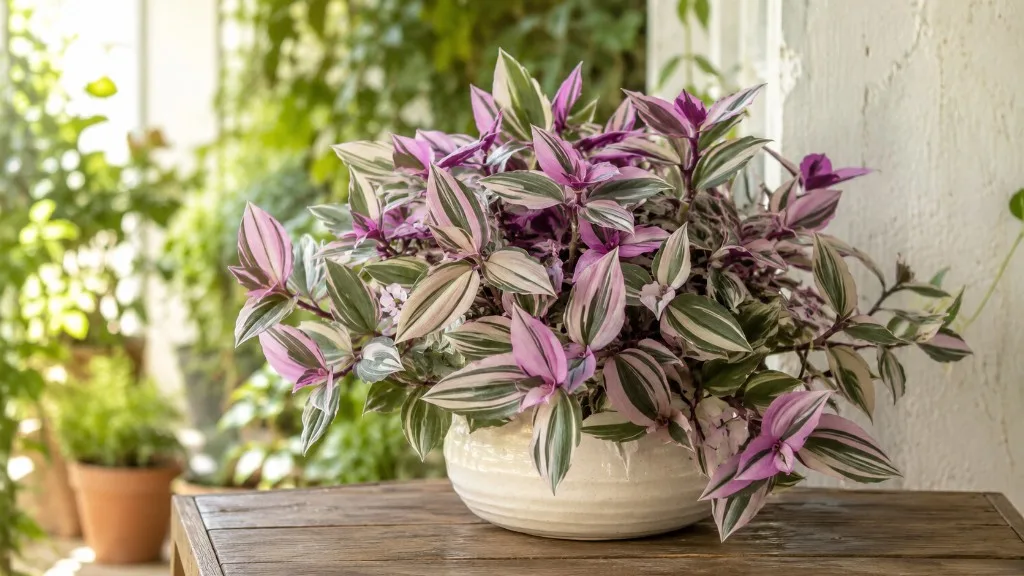
Tradescantia Nanouk shows fertilizer mistakes on its pink and white leaf margins before solid-green tissue ever complains - brown crispy edges with a thin yellow halo, white salt crust on a 10 cm nursery pot, and washed-out stripes that make owners think the plant “turned green” overnight. Tradescantia albiflora ‘Nanouk’ (retail tags often read Fantasy Venice) is a Dutch-bred compact cultivar selected for thick, striped foliage and short internodes, not for heavy feeding. Nutrients support dense pink-and-green growth during active seasons, but they do not paint stripes onto leaves - bright light does that job first. Feed too strong, onto dry soil, or through a dim winter, and variegated margins concentrate salts faster than a solid-green Tradescantia zebrina in the same window.
This page is the deep-dive fertilizer guide for Nanouk. For the full care map - light, water, soil, propagation - start with the Tradescantia Nanouk overview. Feeding guidance here matches the overview’s monthly half-strength balanced liquid during spring and summer rhythm; this article adds NPK detail, symptom matrices, flush steps, and cultivar-specific warnings the hub summary cannot carry.
Quick answer: half-strength feeding tied to new striped leaves
Feed Tradescantia Nanouk with balanced water-soluble fertilizer at half the label strength while you see new leaves unfurling with pink, green, and white striping - typically once monthly from mid-spring through late summer indoors. Water onto moist soil using the moist-soil rule from our watering guide; never pour concentrate onto a dry root ball. Pause entirely from late fall through winter unless strong grow lights keep obvious new growth coming (then every six to eight weeks at half strength). Wait four weeks after repotting into fresh mix. If white crust appears on the soil or brown tips with a yellow border show on variegated edges, flush twice with plain water and skip feeds for four to six weeks. If pink stripes fade on elongated mostly-green new leaves, fix light before increasing food.
Why fertilizer matters for Tradescantia Nanouk
Nanouk grows as a moderately fast trailing or mounding houseplant in bright rooms - often 15–30 cm (6–12 inches) tall with stems that can trail 45–60 cm (18–24 inches) in a season when light, water, and warmth align. That growth pulls nitrogen, phosphorus, potassium, and trace elements from a finite pot of well-draining mix. Watering leaches some; roots consume others. Fertilizer replaces what the plant uses - but only up to the point roots can absorb without salt damage.
The RHS recommends feeding houseplants during the growing season from March to October, with liquid fertilizer once or twice monthly or quarter strength at every watering. Nanouk’s small root zone in a 10–15 cm pot cannot dilute salts the way garden soil can. This cultivar tolerates under-feeding far better than over-feeding - a pattern Clemson HGIC echoes for fast-growing indoor trailers: fertilize more often during spring and summer growth, withhold during winter rest, and watch for white soil film as an overfeeding signal.
Think of feeding as maintenance for healthy active Nanouk - not a rescue for pale plants sitting in too little light or drying out on an erratic watering schedule. Pink anthocyanin pigments respond to photons more than to extra nitrogen; feeding a dim plant harder usually produces greener, softer, stretchier stems rather than richer pink.
Dutch-bred compact cultivar and light-feeder biology
According to U.S. Plant Patent PP29,711, Nanouk arose from a planned breeding program in Sappemeer, The Netherlands, with objectives including compact habit, strong leaves, and good interiorscape performance. Those thick, sessile leaves hold less total chlorophyll per area in pink and white zones than all-green tissue - so the plant needs stronger light to produce the same energy as a green tradescantia, yet it still cannot safely process fertilizer salts at full label strength in a small container. That combination - high light demand, low salt tolerance - defines Nanouk’s feeding personality.
When to fertilize Nanouk: active growth vs rest
Timing follows metabolism and visible new growth, not a wall calendar alone. Feed when Nanouk is actively producing striped leaves and extending stems; stop when growth slows sharply. Indoors, heated rooms and supplemental light can extend the window, but most houseplant Nanouk still slow in late fall and winter even when old foliage stays upright.
A Nanouk on a windowsill in December often looks “alive,” which tricks growers into summer feeding through the holidays. Lower light and shorter days reduce new shoot production while roots absorb water more slowly - unused nutrients accumulate as soluble salts, a common path to brown tips on variegated margins.
Spring and summer feeding window
Start feeding when you see fresh growth at stem tips - new leaves unfurling with intact striping, side shoots filling in after pinching, and roots visibly active if you gently lift the pot. In temperate climates indoors, that usually means mid-spring through late summer, roughly March through August depending on room temperature and light.
During this active window, half-strength balanced liquid feed once monthly is the default for Nanouk and matches the monthly half-strength schedule outlined in the quick answer above. Growers in very bright rooms who see continuous new leaves through September can extend to early fall at the same dose, but taper before growth visibly slows rather than feeding on autopilot into October.
| Month (temperate climate, indoors) | Growth phase | Feeding guidance |
|---|---|---|
| January–February | Low growth, short days | No fertilizer |
| March | Waking up, first new shoots | Start monthly half-strength if active growth visible |
| April–July | Peak foliage production | Monthly half-strength balanced liquid on moist soil |
| August | Still active in bright rooms | Monthly half-strength; watch for slowing |
| September | Taper period | Skip or one final half-strength feed if still growing |
| October–December | Rest phase | Pause entirely |
Watch the plant, not only the table. A Nanouk under strong grow lights may push leaves into fall; a north-window plant may barely grow in June. If it is building striped new leaves steadily, timing is right. If it is static, solve light and water before adding food.
Fall taper and winter pause
Taper feeding in early to mid-fall as day length drops. Give a final half-strength feed in early fall only if you still see new growth, then stop entirely from late fall through winter - typically October through February for most room-grown Nanouk. Winter rest is not full dormancy, but metabolic demand drops sharply. University of Maryland Extension notes that excessive or frequent fertilizer is a primary cause of high soluble salts indoors, with symptoms including brown leaf tips and marginal necrosis - exactly what variegated Nanouk margins show first.
Exception: under strong supplemental grow lights with continuous new striped leaves, feed lightly every six to eight weeks at half strength and watch for salt crust. Even then, skipping winter feeds is safer than forcing growth with nutrients roots cannot process.
Best fertilizer type and NPK ratios for Nanouk
The best Tradescantia Nanouk fertilizer for most homes is a complete water-soluble balanced houseplant formula with moderate nitrogen, modest phosphorus, and adequate potassium plus micronutrients on the label - iron, magnesium, and manganese matter when pale new growth appears on otherwise well-watered plants.
Balanced liquid formulas and what to skip
A 10-10-10 or 20-20-20 water-soluble fertilizer diluted to half strength is the default recommendation for Tradescantia species and fits Nanouk cleanly. Equal ratios keep feeding simple when your goal is steady foliage, not flowers. Nanouk blooms occasionally with small white flowers at stem tips, but feeding targets leaf quality and compact habit - not bloom promotion.
Some growers prefer a slightly nitrogen-leaning ratio such as 3-1-2 at half strength. Avoid high-phosphorus bloom boosters; excess phosphorus can shift energy toward flowering and away from the bushy colorful habit most owners want. RHS guidance notes high-nitrogen formulas suit foliage plants while flowering types need more phosphorus - Nanouk is firmly in the foliage camp.
Skip for routine care: slow-release granules or spikes in small indoor pots (unpredictable release, salt hot spots near roots); foliar feeding on variegated leaves (spotting and edge burn when solution sits on pink/white sectors); combo pesticide-fertilizer products unless you have a specific pest issue. Organic liquids - fish emulsion, seaweed - work at half strength or weaker; rinse residue from fleshy leaves because droplets in bright windows can act like tiny lenses on variegated tissue.
Pet note: The ASPCA lists Tradescantia species (inch plants) as toxic to cats and dogs, with ingestion causing dermatitis and gastrointestinal upset (ASPCA - Inch Plant). Concentrated fertilizer solution and crusty soil are not safe for pets either. Keep plants, runoff, and stored bottles out of reach; contact your vet or ASPCA Animal Poison Control at (888) 426-4435 if a pet ingests fertilizer or plant tissue.
How much and how often to fertilize Nanouk
If you remember one number, make it half strength - never full label strength on a container-grown Nanouk. Example: if the bottle says 1 teaspoon per gallon for houseplants, use ½ teaspoon per gallon for monthly feeding. Measure with a spoon or syringe - a 10 cm pot’s small root volume amplifies dilution errors.
| Situation | Suggested frequency | Strength |
|---|---|---|
| Active growth, bright light, standard pot | Monthly | Half label strength |
| Active growth, moderate light | Monthly or every 6 weeks | Half label strength |
| Early fall, slowing growth | Once, then pause | Half strength |
| Winter indoors, low light | Skip | - |
| Winter under grow lights, new shoots | Every 6–8 weeks | Half strength |
| After repotting into fresh mix | Wait 4 weeks | Then resume monthly half strength |
| Recovering from over-fertilizing | Pause 4–6 weeks | Flush; resume at half strength |
| Freshly rooted propagation cuttings | Wait until established | Then match parent schedule |
Nanouk in hard tap water carries a double mineral load - if you see tip burn while feeding modestly, switch to filtered or rainwater before increasing fertilizer. That overlap is why brown tips need differential diagnosis, not a single “feed more” reflex.
A real feeding timeline: winter mistake and spring recovery
Picture a 15 cm (6-inch) Nanouk in a bright east window, fed correctly at half-strength 10-10-10 monthly from April through July - vivid pink striping, internodes under 2 cm, no crust on the soil. In early December, the owner sees green-but-static foliage and applies one “winter boost” feed onto soil that was only lightly moist. Within ten days, white crystalline crust forms on the soil surface and the newest leaves show brown margins with a thin yellow halo on pink sectors first. The fix: two slow flushes with plain water (each using at least twice the pot volume), saucer runoff discarded, then a six-week feed pause. By mid-March, new striped leaves unfurl with clean edges and restored pink contrast - not because fertilizer painted them back, but because salts cleared and spring light returned. The lesson: green-but-not-growing in winter is a pause signal, not a hunger signal.
Step-by-step: how to feed Nanouk safely
Safe feeding is mostly order of operations. The brand matters less than whether soil was moist first, whether the plant was stressed, and whether salts were already accumulating on variegated edges.
- Check the calendar and the plant. Confirm active growth window and new striped leaves forming. If it is winter and nothing is growing, stop here.
- Inspect for salt crust or tip burn. White residue or yellow-bordered brown tips mean skip feeding and flush instead.
- Water with plain water if the top inch feels dry. Bring the root zone to evenly moist before any fertilizer touches it. Never apply fertilizer to dry soil - salts concentrate at the root surface and burn tissue, with variegated margins showing damage first.
- Mix fertilizer at half strength in room-temperature water.
- Apply slowly across the soil surface, directing solution away from the leaf crown and trailing stems. Stop when a little water drains from the bottom.
- Discard drainage from the saucer within 30 minutes.
- Mark the date so you do not double-feed in an enthusiastic week.
Morning feeding after the plant has hydrated is fine, but the moist-soil rule matters more than the clock.
Pre-feed checks and the moist-soil rule
Before every feed, run a three-point check: soil moisture, newest leaf striping, and season. If the top inch is dry, water with plain water and fertilize the next day. If new leaves are mostly green and spaced far apart, check light before assuming hunger. Active growth gets food on the monthly schedule; slow winter metabolism gets plain water only.
Variegated leaf sensitivity and fertilizer burn
Nanouk’s pink, green, and white variegation is why fertilizer mistakes show up faster than on solid-green inch plants. Leaf margins, where water exits through transpiration, concentrate dissolved salts. When fertilizer loads exceed what the plant can use, osmotic stress produces brown dead tissue with a thin yellow border (University of Maryland Extension) - a useful diagnostic that humidity-only browning often lacks.
White and pink sectors can scorch visually before green tissue shows equal damage. Owners report Nanouk losing pink after aggressive feeding; excess nitrogen pushes greener, softer growth and dilutes stripe contrast. The fix is half strength, monthly timing, moist soil, and adequate light - not more fertilizer. Rinse accidental splashes on leaves; droplets in bright windows can cause localized burn.
Deficiency vs over-fertilizing vs low light vs hard water
Most “hungry” Nanouk diagnoses are actually low light, inconsistent watering, or salt injury. Use this matrix before changing your feeding schedule:
| Symptom pattern | Likely cause | First action |
|---|---|---|
| Brown tips with thin yellow halo on newest variegated leaves; white soil crust | Over-fertilizing / salt buildup | Flush ×2, pause feeds 4–6 weeks |
| Mostly green new leaves, long internodes, faded pink, no crust | Low light | Move brighter per light guide |
| Uniformly paler new leaves in peak season, compact growth, good light | Possible deficiency or depleted mix | One season at monthly half strength; consider repot |
| Crispy tips without yellow halo, no crust, soil very dry | Underwatering | Adjust watering |
| Tip burn with modest feeding, chalky pot rim, no heavy soil crust | Hard tap water minerals | Filtered water; review feed interval |
| Lower old leaves yellow, new growth healthy | Normal senescence or watering issue | Check moisture before feeding |
True deficiency shows gradually on new growth in peak season - slower leaf production, uniformly paler new blades, smaller leaves after a year in depleted mix. If only older lower leaves yellow while new growth looks fine, suspect senescence or watering first.
How to flush Nanouk after over-feeding
If you suspect over-fertilizing, stop feeding immediately and leach salts before the plant loses more variegated tissue.
- Move the pot to a sink or tub where copious drainage will not damage surfaces.
- Water slowly with plain room-temperature water until water runs freely from drainage holes. Use at least two to three times the pot volume total. UMD Extension recommends leaching with clear water until it runs from the bottom; repeat for heavily salt-loaded pots.
- Wait ten minutes, then repeat the slow flush a second time.
- Let the pot drain completely. Do not leave it sitting in saucer water.
- Pause all fertilizer for four to six weeks while monitoring new growth. Do not feed within 24 hours of flushing - allow roots to recover.
- Resume at half strength on the monthly schedule only when new leaves emerge without fresh tip burn and the soil surface stays free of heavy crust.
Badly burned leaf tips will not green up again - recovery shows in the next one or two leaves with clean margins and stable striping. If burn continues after flushing, repot into fresh soil mix, trim mushy roots if present, and hold off feeding another month. Severe cases may require propagating healthy cuttings from nodes above a salt-damaged root zone.
Seasonal and situational adjustments
The monthly half-strength schedule is a baseline, not a cage. In very bright rooms with fast-draining mix, monthly feeding usually still suffices at half strength. If new growth looks consistently pale across the whole plant in those conditions despite good light and watering, shorten the interval to every three weeks at half strength for one month and reassess - but watch for salt crust.
In moderate light, stay at monthly half strength or stretch to six weeks. Nanouk in dim corners should not be fed on a bright-window schedule.
After repotting, propagation, and grow-light setups
After repotting into fresh mix with starter fertilizer, wait four weeks before the first liquid feed - fresh mix plus immediate fertilizer is a common burn trigger on small Nanouk roots. See the repotting guide for timing.
Freshly propagated cuttings need no fertilizer until they show new leaf growth and a small root mass. The first feed should be quarter to half strength once, then normal monthly half strength after establishment - details in the propagation guide.
Grow-light setups that keep Nanouk growing through winter can justify occasional half-strength feeds every six to eight weeks, but only while new striped leaves are visibly forming.
Common Tradescantia Nanouk fertilizer mistakes
The errors that cause the most damage: full label strength (use half), fertilizing dry soil (water first), winter feeding without grow lights, slow-release spikes in small pots, chasing pink with extra nitrogen (light drives pigment), skipping salt flushes during the feeding season, feeding stressed or newly repotted plants, and splashing solution on variegated leaves. Each mistake shows up first on pink and white margins - treat those warnings seriously before they spread to leggy green growth mistaken for hunger.
When to use this page vs other Tradescantia Nanouk guides
- Tradescantia Nanouk overview - Start here for whole-plant context before deep-diving this topic.
- Tradescantia Nanouk problems hub - Jump to symptom-specific fix guides when this care topic does not resolve the issue.
Related Tradescantia Nanouk guides
- Tradescantia Nanouk overview
- Tradescantia Nanouk watering
- Tradescantia Nanouk light
- Tradescantia Nanouk soil
- Tradescantia Nanouk propagation
- Tradescantia Nanouk repotting
- Tradescantia Nanouk problems
Conclusion
Set half-strength balanced liquid on moist soil, once monthly during active striped-leaf growth, with a full winter pause unless grow lights keep new leaves coming. Nanouk’s variegated margins are your early warning system - brown tips with a yellow halo and white crust mean flush and hold, not feed harder. When pink fades on elongated green new growth, open the light guide before the fertilizer bottle. A skipped summer month hurts less than one over-strong dose on dry soil ever could.