Brown Tips on Tradescantia Nanouk: Causes, Checks & Fixes
Quick answer
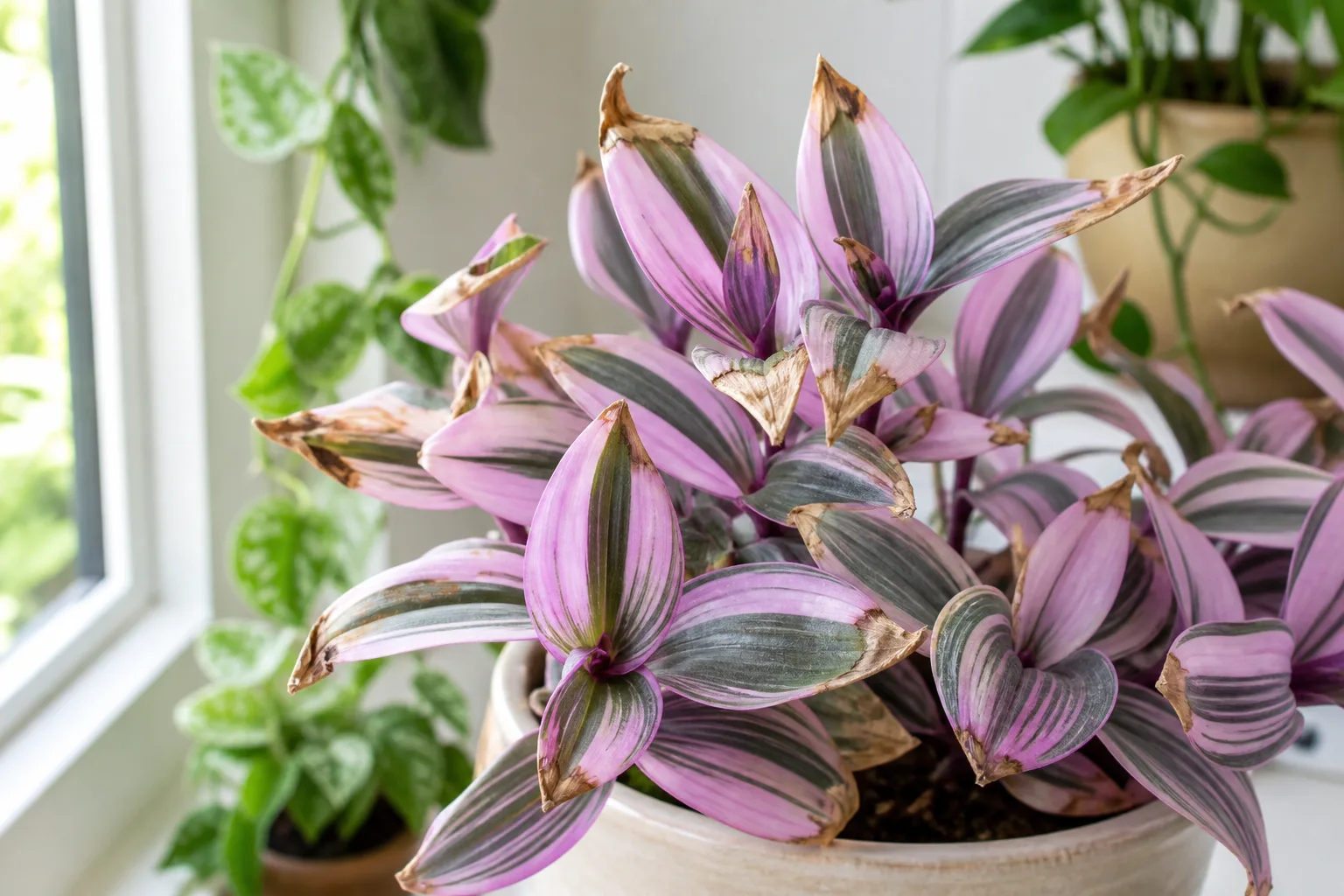
Brown tips on Tradescantia Nanouk usually show as tan-to-brown crispy margins on pink, lilac, or white leaf zones while stems stay firm. First step: measure humidity at leaf height and check whether the top inch of soil is dry or wet-before flushing salts, moving the plant, or changing your watering rhythm.
Brown Tips on Tradescantia Nanouk: Causes, Checks & Fixes
This guide covers brown tips on Tradescantia Nanouk. See also the general Brown Tips guide, watering, and light pages for this plant.
Brown Tips on Tradescantia Nanouk: Causes, Checks & Fixes
Quick answer
Crispy tan-to-brown margins on pink, lilac, or white zones of Tradescantia Nanouk (Tradescantia albiflora ‘Nanouk’, trade name Fantasy Venice) are one of the most common cosmetic complaints on this cultivar. Nanouk’s thicker variegated leaves hold water better than thin T. zebrina, so stems often stay firm while pale leaf edges desiccate first-a pattern that looks alarming but is usually fixable once you name the stressor.
Brown tips on Nanouk are not one disease. The same crispy edge can come from dry winter air near heat vents, fertilizer salt buildup, hot afternoon sun on pale patches, underwatering after the mix went too dry, or spider mites exploiting dry indoor conditions. Wet soil plus brown tips usually means salts or overwatering stress-not “add humidity.”
First step: place a hygrometer at leaf height and push your finger into the top inch of mix before you change anything. Record relative humidity, whether soil is dry or wet, whether you fed recently, and which side of the plant faces the window. That two-minute read separates dry-air crisp from salt burn from drought-without stacking fixes that hide what actually helped.
If humidity alone is the story-firm stems, normal soil, damage clustered near vents-our low-humidity guide goes deeper on humidifiers and winter placement. This page covers every major brown-tip cause on Nanouk and routes you to the right first fix.
Brown tips vs low humidity on Nanouk - which guide to use
Both URLs live on the same plant hub because searchers use different words for overlapping symptoms. Use this routing:
| Your situation | Start here |
|---|---|
| Whole winter room feels dry; crispy pink/white margins near radiators; soil dries on a normal rhythm | Low humidity on Tradescantia Nanouk |
| Brown tips after recent fertilizer; white crust on soil; yellow halo at margin | This page - salt flush section |
| One-sided bleached or papery patches after moving to a brighter window | This page - sun scorch section |
| Limp leaves, lightweight pot, dusty dry soil throughout | Underwatering |
| Fine stippling, webbing at stem joints in dry heat | Spider mites |
| Yellow lower leaves, soft base, wet heavy soil | Overwatering |
Low humidity is the most common winter cause, but assuming humidity without checking soil moisture or feeding history is how owners overwater Nanouk while leaves still crisp.
What brown tips look like on Tradescantia Nanouk
Nanouk leaves are broad, slightly succulent, and striped in pink, lilac, green, and white. Brown tips rarely start as whole-leaf death-they begin at the most exposed tissue.
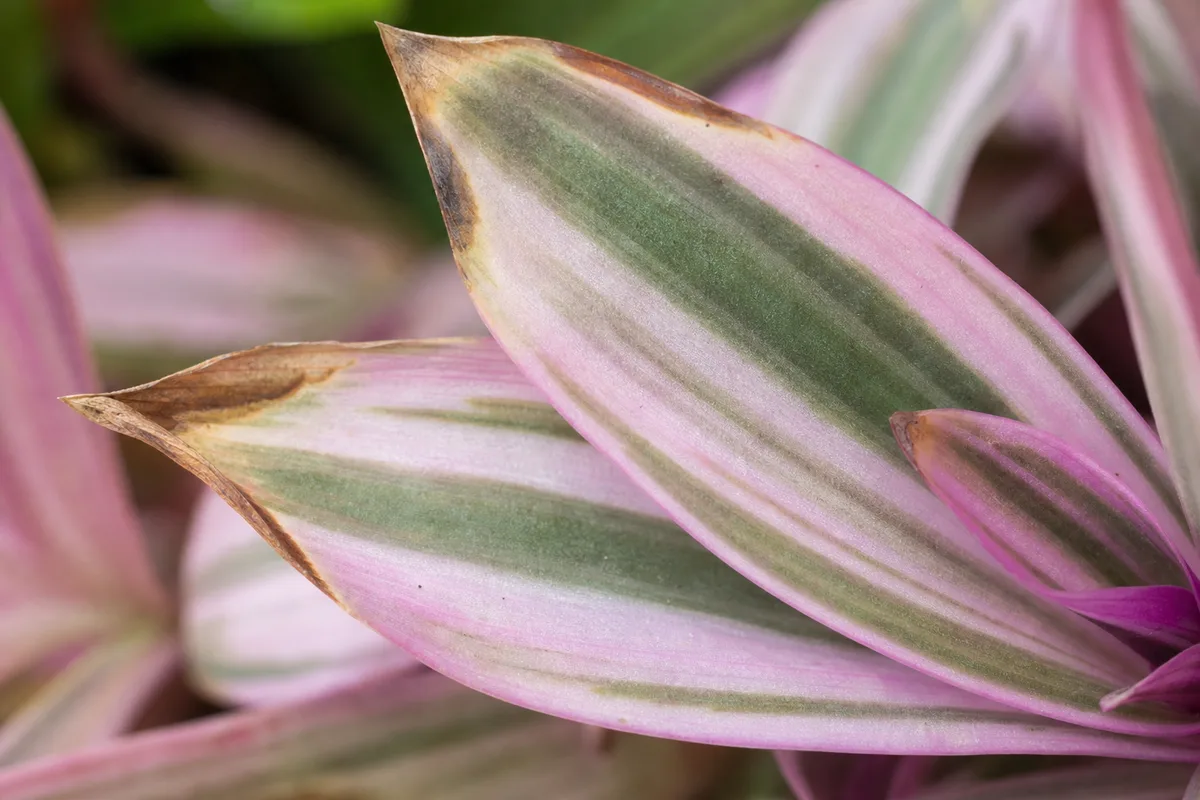
Brown Tips symptoms on Tradescantia Nanouk - compare with healthy tissue on the same plant.
Dry-air or humidity crisp (common in heating season):
- Narrow tan-to-brown band along pink, white, or lilac margins and leaf tips
- Papery, dry texture on an otherwise firm leaf with purple-backed stem
- Damage worse on the side facing a vent, radiator, or sunny winter window
- New leaves may emerge with stuck or twisted pale edges when air stays very dry
Fertilizer or salt burn:
- Brown tips with a thin yellow border between dead tissue and healthy green
- White or chalky crust on soil surface, pot rim, or outside of terracotta
- Often follows recent feeding at full label strength or fertilizer applied to dry mix
- May hit many leaves at once even when light and humidity seem fine
Sun scorch on variegated zones:
- Bleached, papery brown patches on the side that faces glass-not uniform margin burn
- Often appears days after moving from a dim shop shelf to a hot west- or south-facing sill
- Pale pink and white sections fade and crisp before green tissue; stems may still be firm
Underwatering crisp:
- Crispy edges plus limp stems and a light, dusty pot
- Whole leaf may feel thinner; recovery often visible within hours of a thorough drink
- Differs from humidity burn where soil moisture was normal and only margins failed
Spider mite lookalike:
- Fine yellow stippling on undersides plus delicate webbing at nodes-not uniform edge crisp alone
- Worsens in warm, dry indoor air; often on sheltered stem joints under trailing canopy
- See spider mites on Tradescantia Nanouk when stippling appears
Old brown tissue does not turn green again. Judge recovery by new leaves at stem tips, not by expecting damaged margins to heal.
Why Nanouk gets brown tips
Dry indoor air and heat vents
Related inch plants prefer bright, indirect light in humid subtropical conditions. Central heating can hold room air below 30% relative humidity for months. Nanouk near a floor register or radiator sits in a microclimate drier than the rest of the room. Variegated pale zones transpire faster than green tissue, so edges brown before the plant wilts.
Fertilizer salt burn on soft leaf edges
Nanouk is a light feeder during active growth. Fertilizers are salts; excess accumulates in soil and concentrates at leaf margins where water exits. Feeding bone-dry mix or using full-strength product every two weeks is a common path to tip necrosis with yellow halos. White crust on the pot confirms mineral buildup-not a leaf disease.
Sun scorch on variegated foliage
Nanouk tolerates some morning sun when acclimated, but hot afternoon rays through glass bleach and burn pale stripes. Leaves formed in lower light burn faster than sun-hardened foliage. Scorch shows as directional patches, not even margin crisp around the whole pot. See our light guide for placement that keeps pink tones without hot glass.
Underwatering crisp vs overwatering stress
Nanouk wilts fast when dry but can also show brown tips when roots struggle in wet mix. Dry soil plus limp stems points to underwatering. Wet soil plus yellow lower leaves and soft bases points to overwatering or root rot-humidity fixes will not help. The top-inch-dry watering rule separates thirst from saturation.
How to confirm the cause
Work through these checks in order. One pass beats guessing.
- Hygrometer at leaf height - Read RH for 24 hours near the canopy, not across the room. Below 40% with vent-side damage supports dry air. Above 45% with crust on soil points away from humidity as the sole cause.
- Top-inch soil moisture - Dry, light pot with limp leaves: underwatering. Cool, heavy pot with damp surface and yellow lower leaves: wet-soil stress before you add humidity.
- Recent feeding history - Any fertilizer in the last four weeks? Full label strength? White rim crust? Salt burn moves up the list.
- Light direction and recent moves - One-sided bleaching on the window-facing side after a light increase fits sun scorch. Uniform margin burn on vent-facing leaves fits dry air.
- Pest undersides - Tap a stem over white paper; stippling, grit, or webbing at nodes means spider mites-two-spotted spider mites favor hot, dry conditions indoors.
- New growth test - After one targeted fix, the next leaf that opens tells the truth. Clean margins on new variegation confirm the cause; continued spread means recheck the list.
Lookalike comparison table
| Pattern | Likely cause | Nanouk clue | Route |
|---|---|---|---|
| Crispy pink/white margins, firm stems, normal dry-down | Low humidity | Clustered near vents | Low humidity |
| Brown tips + yellow halo + white soil crust | Salt / fertilizer burn | After recent feed | Salt flush below |
| One-sided bleached brown patches | Sun scorch | After brighter window | Light guide |
| Crispy tips + limp plant + dry soil | Underwatering | Recovers after deep water | Underwatering |
| Stippling + webbing at nodes | Spider mites | Dry winter room | Spider mites |
| Yellow from petiole, soft base, wet mix | Overwatering / rot | Wilts on wet soil | Overwatering |
First fix for Tradescantia Nanouk
Make one correction based on what you confirmed-do not repot, fertilize, flush, and mist on the same day. Stacking treatments hides the response and stresses fast-growing Nanouk further.
If dry air is the main trigger
Move the pot at least one metre from heating vents, radiators, and AC returns so trailing stems do not hang over heat paths. Re-check humidity at leaf height after 48 hours. If still below 40%, add a room humidifier or pebble tray-details in our low-humidity guide. Do not water more to compensate for dry air.
If salt or fertilizer burn is likely
Flush the soil with plain, room-temperature water:
- Water until excess runs freely from drainage holes.
- Let the pot drain completely; empty the saucer.
- Repeat two to three times in one session so mineral buildup leaches out.
- Hold all fertilizer for four to six weeks while new leaves open.
- Resume at half label strength every four to six weeks in active growth only-see our fertilizer guide.
Always moisten soil before feeding stressed Nanouk; never fertilize bone-dry roots.
If sun scorch is the pattern
Move back from hot glass or add a sheer curtain on west- and south-facing windows. Acclimate over one to two weeks if increasing light for variegation-see Nanouk light requirements. Trim fully dead scorched tissue only after placement stabilizes.
If underwatering contributed
Water thoroughly when the top inch dries, then drain fully-follow the full watering rhythm. Nanouk often perks within hours when thirst was the driver.
If spider mites are present
Isolate, rinse undersides in the shower, and treat per our spider mites guide. Raising humidity helps prevention but does not replace mite control.
Recovery timeline and what improvement looks like
Placement and humidity fixes often slow new margin burn within three to seven days when vents were the trigger. Salt flush results show on the next one to two new leaves-typically two to four weeks in active growth. Sun adjustment prevents new scorch within one to two weeks; old bleached patches stay cosmetic.
Mild cases stabilize within one to two normal watering cycles once the correct stressor stops. Severe tip necrosis on many leaves may take several weeks of stable care before the plant looks full again. Old brown margins never regreen-success means clean variegated edges on new growth and firm purple-backed stems, not repaired old blades.
Escalate if bases soften, rot smell spreads, or multiple leaves fail while soil stays wet-see root rot.
What not to do
Do not fertilize a stressed Nanouk before confirming moisture, salts, and light. Feeding worsens salt burn and wet-root stress.
Do not keep watering because leaves look tired if the root zone is already wet. Overwatering displaces oxygen and can yellow leaves while tips still look crisp.
Do not rely on once-daily misting as your only humidity fix. Moisture evaporates in minutes without changing ambient RH at leaf height.
Do not blast pale leaves with hot afternoon sun to “fix” fading pink-light and dry air together burn variegation faster.
Do not trim aggressively before fixing the cause. Cosmetic cuts do not stop active spread on newest growth.
How to prevent brown tips next time
- Water when the top inch of mix dries, then drain fully-never let the pot sit in standing water (Missouri Botanical Garden watering guidance)
- Keep Nanouk in bright indirect light with acclimated morning sun only-avoid hot glass (overview)
- Feed lightly in spring and summer; flush soil every few months during feeding periods
- Run a humidifier or keep plants off vents when heating drops RH below 40%
- Inspect weekly during routine care-new leaf margins are the earliest barometer on variegated cultivars
- Use room-temperature water; mineral-heavy tap water can contribute to edge burn on sensitive foliage over time
Prevention on Nanouk means respecting this cultivar’s rhythm-fast growth in good light, short dry-down cycles, and pale zones that fail first when any stressor stacks.
Practical checks
Urgency check
Treat as urgent if bases soften, rot smell spreads, pests cover multiple shoots, or several leaves fail at once while conditions stay wet or declining. A few crispy tips on older leaves with firm stems and clean new growth is lower urgency-confirm cause before escalating.
Best inspection order
Newest growth → bases and roots → top-inch moisture → hygrometer at leaf height → light direction → leaf undersides for mites → recent feeding and soil crust.
Severity note
Use spreading damage on new leaves and root firmness-not a single old blemish-to decide how fast to act. Cosmetic tips on lower trailing stems while the crown pushes clean variegation usually mean the environment is already improving.
When to use this page vs other Tradescantia Nanouk guides
- Tradescantia Nanouk watering guide - Use for routine moisture checks before assuming brown tips is the main issue.
- Tradescantia Nanouk problems hub - Browse all 2 common issues on this species.