Low Humidity on Syngonium: Causes, Checks & Fixes
Quick answer
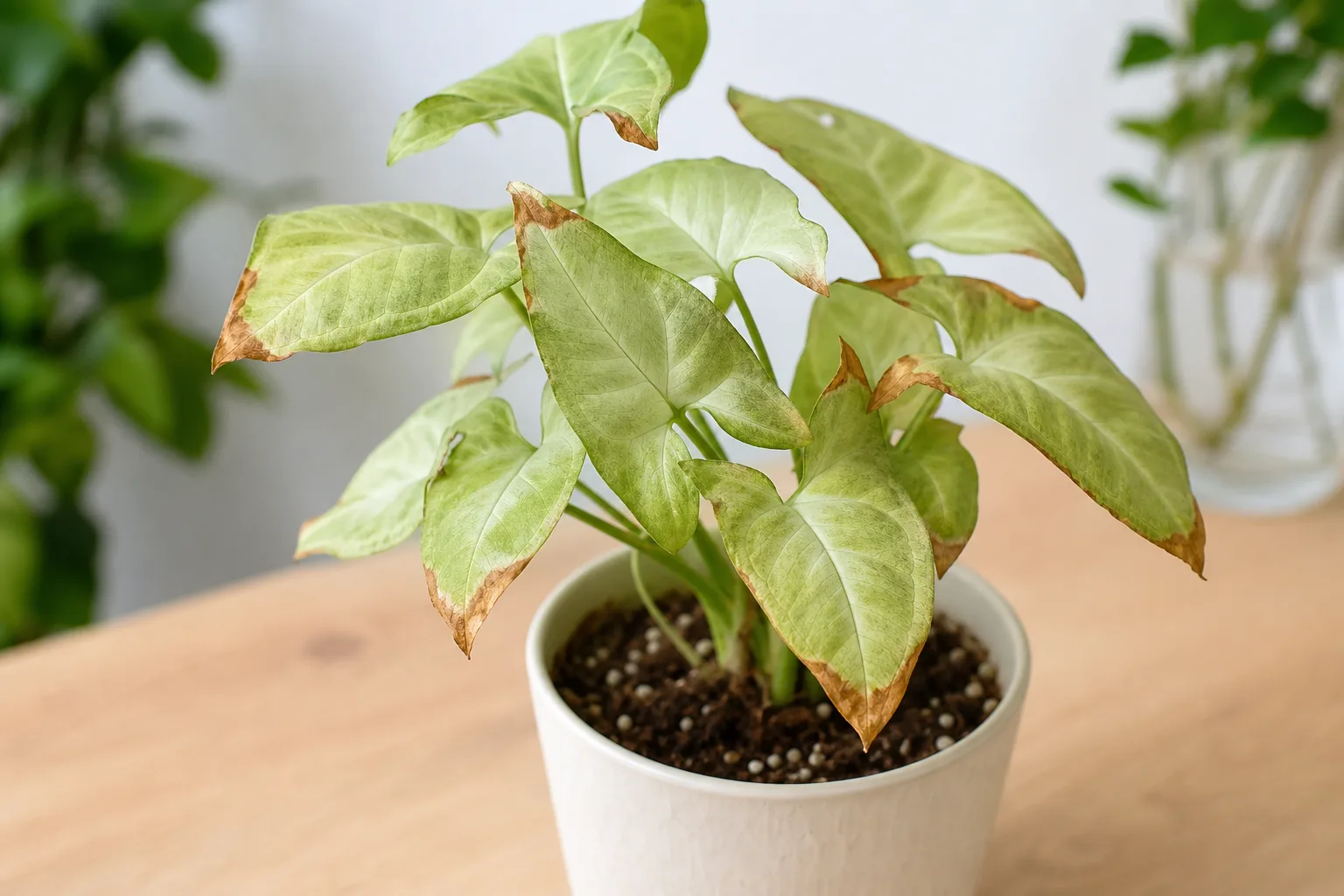
When Syngonium leaf edges crisp but the top inch of soil is evenly moist, dry indoor air-not thirst-is the usual cause. First step: move the pot off heating vent blast paths and measure humidity at leaf height before adding water or buying a humidifier.
Low Humidity on Syngonium: Causes, Checks & Fixes
This guide covers low humidity on Syngonium. See also the general Low Humidity guide, watering, and light pages for this plant.
Low Humidity on Syngonium: Causes, Checks & Fixes
Quick answer
Your arrowhead vine tips are crispy but the soil feels moist-that combination is the signature low-humidity pattern on Syngonium, not underwatering. Dry winter air pulls water from thin leaf margins faster than roots replace it, even when your watering rhythm is correct.
Low humidity on Syngonium podophyllum shows up as crispy brown leaf edges, sometimes fine stippling from spider mites in heated rooms, and slower new growth when furnace air holds 20–30% relative humidity. This tropical climbing aroid evolved in warm, humid understory-not the dry blast path beside a radiator.
Moist soil plus crispy margins means raise humidity, not water more. Syngonium tolerates average indoor conditions better than true rainforest specialists, but sustained dry air still damages thin juvenile arrowhead leaves faster than thick succulent foliage. Target 40–60% humidity at leaf height; below that for weeks, expect cosmetic edge burn and higher pest pressure.
First step: move the pot off the blast path of heating vents, radiators, and forced-air returns, then measure humidity at leaf height with a hygrometer. If the reading is under 40% and edges are crisping, fix the air before Syngonium repotting guide, fertilizing, or spraying pesticides.
Low humidity vs. brown tips - which guide to use
| Your main symptom | Start here | Also check |
|---|---|---|
| Crispy margins in dry heated air; hygrometer under 40% at leaves; moist soil | This page | Spider mites if stippling and webbing appear |
| Brown tips with hard tap water, white salt crust on soil, or fluoride history | Brown tips | This page if winter dryness stacks with water quality |
| Uniform wilt, feather-light pot, soil pulled from edges | Underwatering | Not humidity alone |
| Yellow lower leaves, wet sour soil, soft stems | Overwatering | Do not add water for dry air |
This page owns air-moisture diagnosis, hygrometer-at-leaf-height protocol, humidifier placement, vent microclimate, and spider-mite crossover in dry rooms. The brown tips guide owns water quality, fluoride and salt buildup, and filtered-water trials-even when low humidity is also present.
What low humidity looks like on Syngonium
Dry air damage on arrowhead vine is pattern-based, not random spotting.
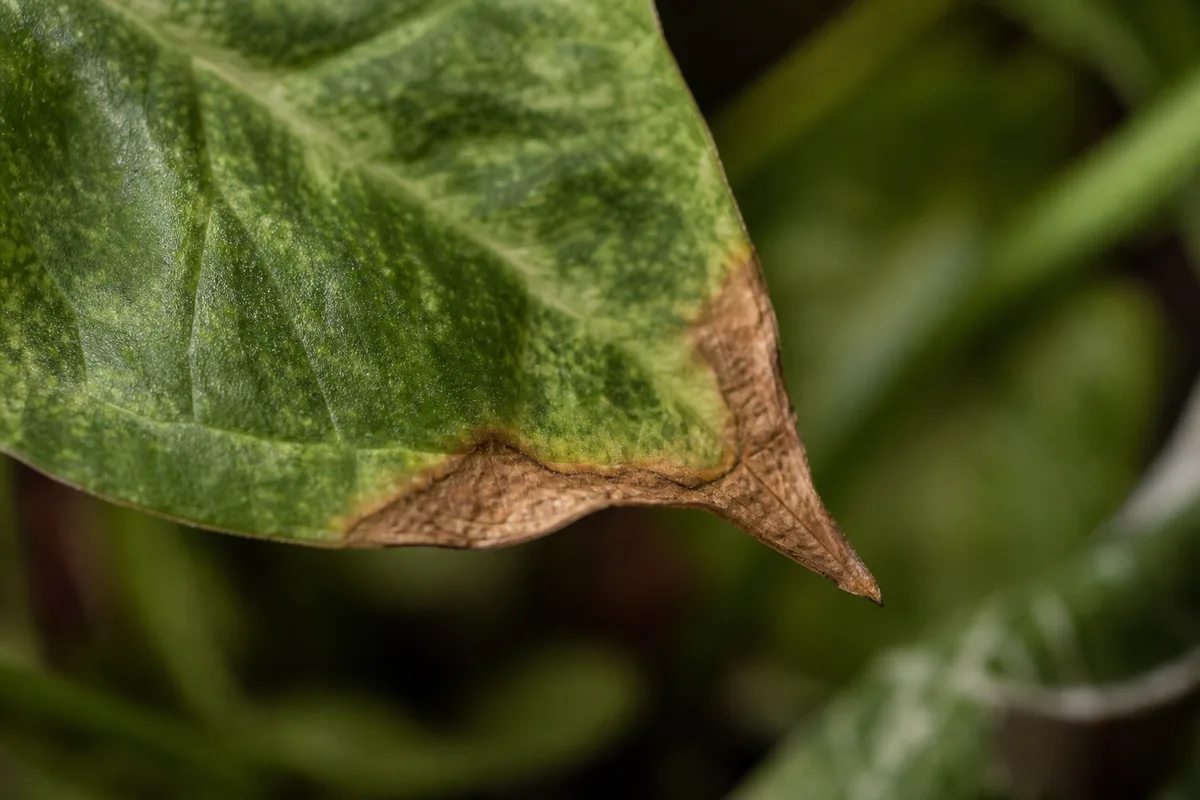
Low Humidity symptoms on Syngonium - compare with healthy tissue on the same plant.
Typical humidity stress signs:
- Brown, papery margins on otherwise green arrow-shaped juvenile leaves
- Crispy tips that feel dry when rubbed-distinct from soft yellowing from wet roots
- Edge burn on newest leaves first when heating season just started
- Curling or slight cupping on thin leaf tissue during prolonged dry spells
- Fine yellow or white stippling on leaf undersides when spider mites move in
- Wispy webbing between stems and along leaf midribs in advanced mite cases
Syngonium podophyllum changes leaf shape as it matures-juvenile arrowheads are thinner and lose moisture faster than the later lobed leaves. That is why young growth at the vine tips often shows dryness before older foliage does.
Cultivar sensitivity: Pink Allusion, Neon Robusta, and White Butterfly carry thinner or variegated tissue that desiccates sooner in dry bright windows. White or pink sectors on new leaves brown first when humidity drops-see the overview cultivar section for pigment context.
Low humidity rarely collapses a healthy Syngonium overnight. The plant usually keeps firm stems and normal soil drying rhythm. If the whole plant wilts with wet soil, look at roots and watering before blaming air moisture.
Why arrowhead vine struggles in dry air
Juvenile arrow vs. lobed adult leaf vulnerability
NC State Extension describes juvenile leaves as arrow-shaped and adult foliage as progressively lobed on climbing stems. The juvenile blade has less mass and a higher surface-to-volume ratio-so margins dry first when ambient humidity falls. Adult lobed leaves on the same vine may look fine while tip growth crisps.
Indoor heating, AC, and localized dry zones
Syngonium wants a warm setting with high humidity and bright indirect light-not direct sun that bleaches foliage. Winter forced-air furnaces, radiators, and fireplace drafts pull moisture from room air just when closed windows trap dry conditions inside.
Plants on mantels, window sills above radiators, or directly beside floor vents experience localized humidity far below what a wall hygrometer across the room suggests. Hot air from furnace vents can drop leaves or crisp margins even when the room average looks acceptable.
Hanging baskets near ceiling heat registers catch rising dry air layers. Small pots on sunny sills heat up and shrink the humid boundary layer around leaf edges.
Spider mites as a secondary dry-air problem
Dry air sets up a second issue Syngonium is prone to: spider mites. NC State lists spider mites among common insect problems on this species, and they reproduce quickly in warm, low-humidity rooms. A plant that looked fine in October can show stippling by January without any change to your watering schedule. When mites are the visible problem, follow the dedicated spider mites guide after you address dry airflow.
Syngonium’s soft leaf tissue transpires steadily in bright light. When air is dry, the plant loses water through leaf margins faster than roots can replace it-especially if you are correctly avoiding overwatering. The result is edge necrosis from hot dry exposure rather than whole-leaf yellowing.
Mineral-heavy tap water can brown tips independently of humidity. If humidity reads 45%+ but white crust rings the pot, cross-check brown tips for fluoride and salt stress-the two problems often stack on thin juvenile tissue.
How to confirm low humidity is the cause
Work through these checks in order before buying humidifiers or repotting:
- Hygrometer at leaf height - Place a meter beside the foliage, not on the floor. Readings consistently below 40% with crisp edges strongly support low humidity. Mid-40s to 60% with ongoing tip burn suggests tap-water minerals or salt buildup instead-see brown tips.
- Microclimate scan - Is the pot above a radiator, within 1 m of a heat vent, or on a sun-baked window ledge? Single-sided browning on the vent-facing leaf side is a placement clue.
- Soil moisture - Stick a finger into the top inch. Even moisture with crispy edges fits air dryness. Wet soil with yellow lower leaves points to overwatering-not the same fix.
- Pest check - Hold white paper under a leaf and tap the blade. Moving specks plus stippling confirm spider mites. Dry air may be the underlying trigger even when mites are the visible problem.
- Water history - Do you use hard tap water without flushing? Brown tips on older leaves with white crust on soil rim may be salts, not humidity alone.
- Season timing - Did edges crisp within weeks of turning on heat? That timeline fits environmental dryness better than sudden root failure.
If humidity reads above 50%, soil dries normally, and pests are absent, reconsider light scorch or fertilizer burn before chasing more moisture.
First fix for Syngonium
Move the plant away from heating vents, radiators, fireplaces, and cold window glass drafts, then measure humidity at leaf level.
This single step stops active drying at the leaves and tells you whether the room truly needs a humidity boost. Slide the pot to a stable spot with bright indirect light-Syngonium prefers part shade to indirect sun-and leave it there for at least a week. Bouncing between rooms daily makes it hard to judge recovery.
Do not compensate for dry air by watering more often. Syngonium root rot on Syngonium risk rises in dense wet soil; extra water does not replace atmospheric humidity and can trigger yellow leaves.
Do not mist once and walk away. A brief mist evaporates in minutes in a heated room and can leave foliar spots if nights are cool.
Humidifier setup, placement, and 40–60% RH target
If repositioning alone does not lift readings above 40% at the leaves:
- Run a cool-mist humidifier sized for the room-not pointed directly at foliage, which can leave water sitting on leaves and invite foliar disease on crowded aroids
- Place the unit roughly 1–2 m (3–6 ft) from the plant grouping, elevated toward leaf height so vapor mixes with room air before reaching the canopy
- Aim the nozzle near the plants, not at them-the goal is higher ambient RH, not wet leaves
- Use a hygrometer beside the foliage to verify 40–60%; judge success at leaf level, not across the room
- Run through heating season for 8–12 hours daily in furnace-dry homes; refill and clean the tank weekly to prevent bacterial buildup
Grouping and pebble-tray options - limits in winter
- Grouping plants shares transpired moisture and can add a few percentage points locally, but leave space for airflow-crowded wet foliage on aroids risks disease
- A pebble tray raises humidity only in the air zone immediately above the water surface-useful for a small shelf plant, rarely enough alone for a trailing basket or a whole dry living room in January
- Keep the pot bottom above the water line on pebbles to avoid root rot
Step-by-step recovery
After repositioning and measuring:
- Raise local humidity toward 40–60% - Humidifier first in heated rooms; pebble tray or grouping as supplements, not sole fixes for furnace-dry air.
- Rinse foliage weekly in winter - Shower leaf undersides with lukewarm water or wipe with a damp cloth. This removes dust, dislodges early spider mites, and briefly raises leaf-surface moisture.
- Treat confirmed spider mites - If stippling and webbing are present after washing, isolate the plant and follow the spider mites recovery path. Repeat water rinses every two to three days before escalating to insecticidal soap on undersides only.
- Switch to filtered or rainwater if tips keep browning - When humidity is adequate but old margins stay crisp on new growth, reduce fluoride and salt exposure per the brown tips guide. Flush the pot occasionally if white crust builds on soil.
- Trim only fully dead tissue - Snip brown tips if they bother you aesthetically; partial edge damage can stay until new leaves emerge. Syngonium contains calcium oxalate crystals-wear gloves if sap irritates skin, keep trimmings away from pets, and sterilize scissors between cuts if mites were present.
- Hold fertilizer and repotting - Wait until new growth looks clean for two to three weeks. Syngonium does not need feeding while recovering from environmental stress.
Keep bright indirect light and water when the top inch of mix dries-the same rhythm that works when humidity is adequate.
Recovery timeline and what improvement looks like
Expect stabilization within one to two weeks once dry airflow stops and humidity rises. New arrowhead leaves should emerge without fresh crisping within two to four weeks in active growth season.
Old browned margins will not turn green again. Judge success by untouched new tips and reduced mite activity, not by old leaf cosmetics.
If crisping continues on new growth after four weeks with verified 45%+ humidity at the leaves, revisit water quality via brown tips and light intensity before adding more moisture. Chronic failure despite a humidifier running at 50%+ may warrant contacting your local extension office for a placement review.
Lookalike symptoms to rule out
| Symptom pattern | Likely cause | Route to |
|---|---|---|
| Crispy dry margins, moist soil, low hygrometer, winter heat on | Low humidity | This page |
| Slow creep of tan tips, white soil crust, hard tap water | Minerals / salts | Brown tips |
| Yellow pinprick stippling, fine webbing, moving specks on tap test | Spider mites | Spider mites |
| Yellow lower leaves, wet sour soil, soft stems | Overwatering | Overwatering |
| Whole vine droops, pot feels light, soil shrunk from edges | Underwatering | Underwatering |
| Bleached or scorched patches on window-facing side only | Direct sun | Light guide |
| Juvenile arrows maturing to lobed adult leaves | Normal growth | Overview |
| Water-soaked lesions, mushy tissue | Bacterial soft rot | Extension diagnosis-not humidity |
Mistakes to avoid
Do not flood the soil to fix dry air. Syngonium stores little water in its stems; wet roots in a dry room still produce crispy leaves.
Do not rely on occasional misting as your only humidity plan in heated winter rooms.
Do not place Syngonium tight against cold window glass in winter-the leaf touching glass can brown from cold injury that mimics dryness.
Do not spray pesticides before confirming spider mites. Uniform edge crisp without stippling is environmental, not chemical.
Do not point a humidifier nozzle directly at leaves or crank humidity above 70% in a dark corner without airflow-stagnant dampness invites foliar disease on crowded aroids.
Do not assume one pebble tray will fix a hanging basket trailing three feet below a ceiling vent.
Syngonium care cross-check
While correcting humidity, keep the basics steady:
- Watering - When the top inch of mix dries; see Syngonium watering for seasonal rhythm. Extra drinks do not substitute for atmospheric moisture.
- Light - Bright indirect supports even transpiration; direct sun plus dry air burns variegated cultivars faster. See Syngonium light.
- Soil and roots - Well-draining mix prevents wet-soil confusion; if lower leaves yellow with soggy mix, check wilting and overwatering before raising humidity further.
- Overview - Native habitat and cultivar context live on the Syngonium overview.
How to prevent low humidity next time
- Run a humidifier in the room through heating season, targeting 40–60% at plant level
- Group tropical plants to create a shared microclimate, but leave space for air movement
- Scout undersides monthly from November through March when mite risk peaks
- Water with room-temperature filtered or rainwater if your tap is heavy with minerals
- Keep the plant in bright indirect light so growth stays steady without the extra transpiration stress of direct sun in dry air
- Quarantine new plants for two weeks before placing them in a grouped humidity cluster
When to worry
Low humidity is rarely fatal to Syngonium, but act promptly when:
- New leaves open already browned despite stable watering
- Spider mite webbing spreads to multiple stems within a week
- Stippling covers most leaves and growth stalls
- Combined stress-dry air plus wet soil from overcompensating watering-yellows leaves and softens lower stems
A few brown tips on an otherwise bushy plant in a normal home is cosmetic, not a crisis. Widespread mite infestation or repeated failure of new growth needs faster intervention-start with spider mites if webbing is present.
Where to go next
Use this page when dry air explains crisp margins with moist soil. Switch to brown tips when water quality or salts lead the diagnosis. For stippling and webbing after humidity improves, continue with spider mites on Syngonium. Broader care context-including cultivar humidity sensitivity-lives on the Syngonium overview.
When to use this page vs other Syngonium guides
- Syngonium watering guide - Use for routine moisture checks before assuming low humidity is the main issue.
- Syngonium problems hub - Browse all 17 common issues on this species.
- Brown Tips on Syngonium - Different entry point when symptoms overlap with low humidity.