Not Enough Light on Stromanthe Triostar: Causes, Checks &
Quick answer
Not enough light fades Stromanthe Triostar's pink variegation, slows spear unfurling, and causes leggy lean toward windows. First step: move the plant to bright filtered light within 2–4 feet of an east-facing window, then watch the next new spear for improved tricolor.
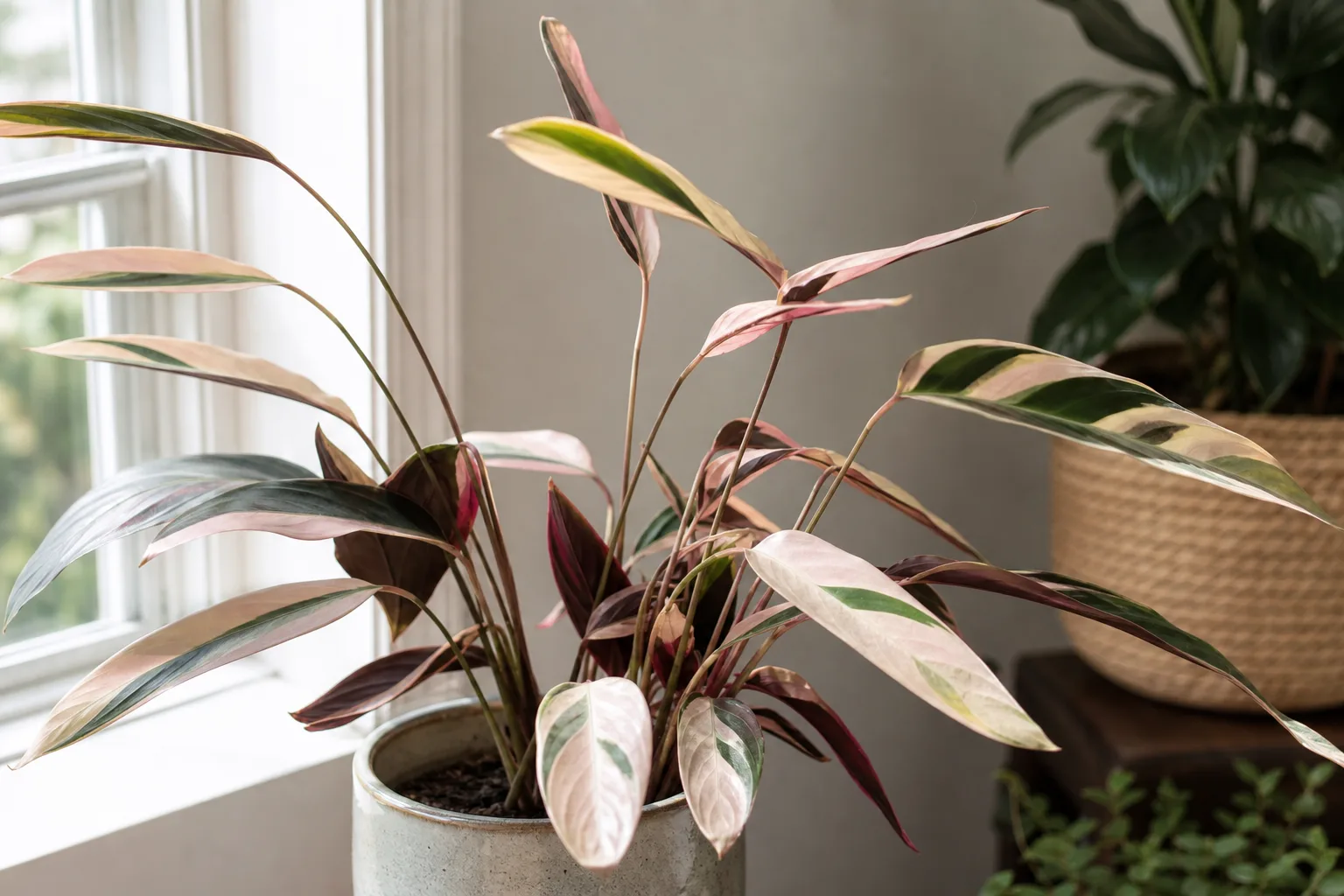
Not Enough Light on Stromanthe Triostar: Causes, Checks & Fixes
This guide covers not enough light on Stromanthe Triostar. See also the general Not Enough Light guide, watering, and light pages for this plant.
Not Enough Light on Stromanthe Triostar: Causes, Checks & Fixes
Quick answer
Stromanthe Triostar is sold as a houseplant, but it is not a low-light plant. The tricolor prayer plant needs bright, filtered light to hold pink, cream, and green contrast on new foliage. In dim rooms, new leaves green out, spears unfurl slowly, and petioles stretch toward the brightest window.
First step: move the plant to bright filtered light within 2–4 feet of an east-facing window (or a filtered west or south exposure where the canopy sees sky brightness without harsh midday sun on pale panels). Do not repot, fertilize, or overhaul humidity on the same day. Wait for the next new spear to open before judging whether the spot is bright enough.
What not enough light looks like on Stromanthe Triostar
Low light on Triostar shows up on new growth first. Older leaves can keep faded pink for weeks while every new spear tells the truth.
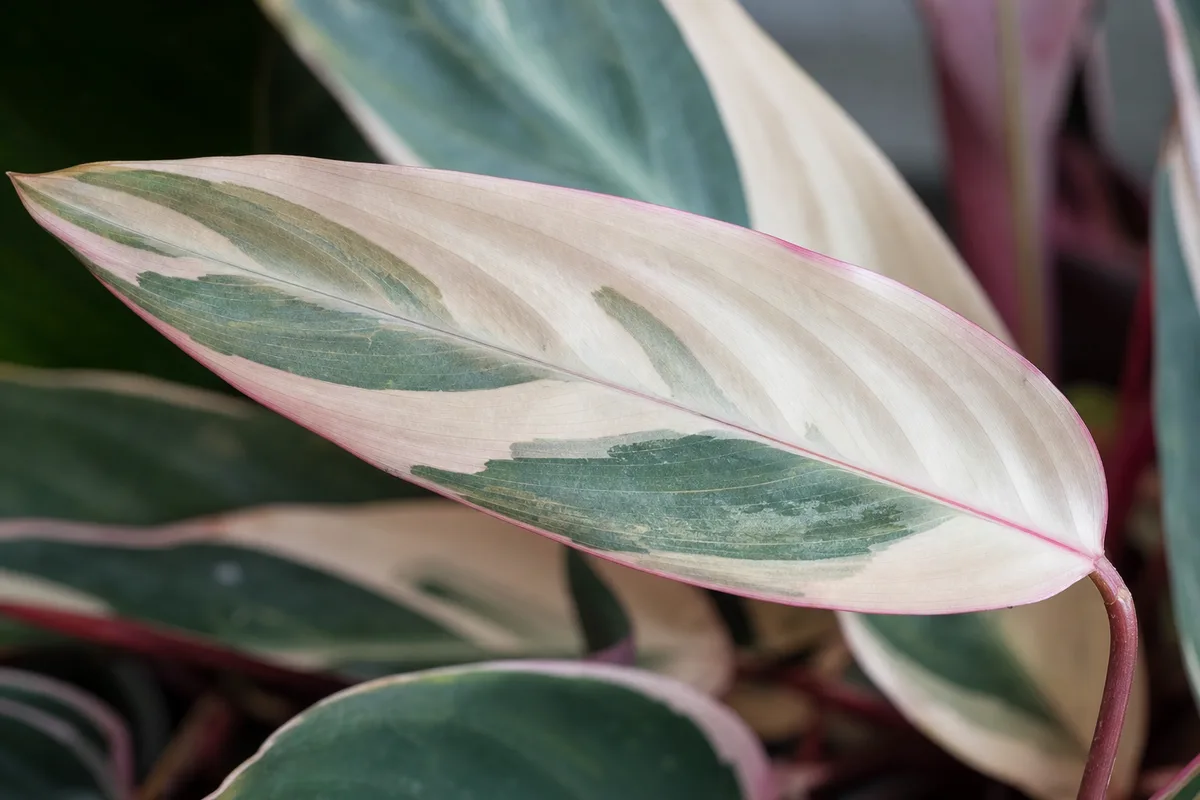
Not Enough Light symptoms on Stromanthe Triostar - compare with healthy tissue on the same plant.
Color loss on new foliage:
- New spears and young leaves emerge with more green and less pink or cream
- Tricolor contrast softens leaf by leaf until new blades look nearly solid green
- Pink panels wash toward cream or white before disappearing on successive spears
Growth and posture changes:
- Petioles elongate and leaves space farther apart along the stem
- The whole clump leans or angles sharply toward the brightest window
- New spears stay rolled longer or stall during warm months when growth should be steady
- New blades open smaller than leaves formed in brighter conditions
Secondary stress that mimics other problems:
- Soil stays wet longer because the plant uses less water in low light
- Lower leaves yellow while the canopy still looks vaguely healthy
- Edge crisping on old leaves may persist even after you raise humidity, because metabolism never matched the Stromanthe Triostar watering guide
Triostar’s thin, variegated leaves respond faster than many slow tropicals. If three or four new spears in a row look greener and more stretched than the last, treat that as a light problem until you prove otherwise.
Why Stromanthe Triostar struggles in dim light
Stromanthe Triostar belongs to the prayer plant family and evolved in the shaded understory of Brazilian rainforests. That ecology means filtered brightness-not deep interior shade. In nature, light arrives through canopy gaps as diffuse illumination strong enough to drive growth but rarely as sustained direct beams on pale leaf tissue.
The cultivar’s value is tricolor variegation: cream, green, and pink breaking across each blade with burgundy undersides. Those pale zones carry less chlorophyll by design. In low light, the plant cannot maintain high-contrast ornamentation across slow rhizome growth. It compensates by pushing more chlorophyll into newer tissue, which reads as greener, duller foliage with less pink anthocyanin pigment.
That trade-off is more pronounced on Triostar than on many solid green houseplants. A pothos can look acceptable in medium light because chlorophyll is distributed across most of the leaf. Triostar’s patchwork creates tissue types on a single blade, and the palest sections are disadvantaged when photons are scarce. Wisconsin Horticulture Extension notes that the plant will grow in lower light but bright light produces the best color development-an important distinction between surviving and looking like the plant you bought.
Low light also breaks the watering balance. A Triostar in proper Stromanthe Triostar light guide uses moisture at a predictable rate. The same plant in a dim corner with unchanged watering sits in wet soil longer, loses root oxygen, and develops yellowing or edge damage that sends growers chasing humidity fixes while light was the root cause.
Marketing adds confusion. Triostar shares care tags with easier tropicals and is sometimes grouped with “low-light tolerant” foliage. In practice, it sits on the brighter end of prayer plant light needs because variegation intensity depends on adequate brightness at the crown where spears form.
How to confirm insufficient light
Work through these checks in order before changing water, fertilizer, or humidity tools.
- New-spear color test - Compare the three newest fully opened leaves to leaves from six months ago. Progressive green drift on successive spears confirms photon deficit. One faded old leaf alone is not diagnostic.
- Leaf-level brightness - Stand at the pot and look at the top of the foliage, not the floor. At midday, a fuzzy soft shadow on the canopy means useful indirect light. No meaningful shadow at leaf height means the spot is too dim for strong tricolor long term.
- Lean and spacing - Measure whether petioles on new growth are noticeably longer than older ones and whether the plant faces one direction. Strong lean toward glass with wider leaf spacing points to stretch for light.
- Spear rhythm - During spring and summer, new spears should appear at a steady pace. Months without a new leaf in warm conditions suggest the plant lacks energy-not necessarily a pest or root catastrophe.
- Soil dry-down speed - Press a finger into the top inch of mix. If soil stays wet four to five days after watering while the plant is not growing, pair that with placement checks. Dim light plus wet soil is a common Marantaceae failure pattern.
- Rule out too much light - Pale cream panels with tan crispy necrosis on the window-facing side mean excess direct sun, not deficit. Triostar can show both mistakes on different leaves if it was moved recently; read the newest growth direction carefully.
If new spears keep emerging green, stretched, and slow in a spot that fails the shadow test at leaf height, you have enough evidence to fix light first.
First fix to try
Move Stromanthe Triostar to bright filtered light within 2–4 feet of an east-facing window, with the canopy-not just the pot-receiving window-level brightness.
East exposure is the most reliable default because morning light is bright but relatively cool, which supports variegation without instantly bleaching pale panels. If east glass is unavailable, use a west or south window with several feet of setback or a sheer curtain that blocks hot direct rays at midday.
Rotate the pot a quarter turn when you move it so future growth does not repeat one-sided lean. Do not jump from a dim interior shelf to unfiltered south glass in one afternoon. Increase brightness over seven to fourteen days if the plant has been in very low light for months, because leaves formed in shade lack pigment readiness for sudden hard sun.
After the move, change nothing else for ten to fourteen days except watering frequency if the soil now dries faster. Judge success by the next rolled spear and the youngest opened leaf, not by old foliage that will never regain pink.
Step-by-step recovery
Once the plant is in brighter filtered light:
- Watch dry-down for one week - Brighter light increases water use. Check the top inch of mix before every watering rather than following the old calendar from the dim corner.
- Add a grow light if windows are insufficient - Position a full-spectrum LED 12–18 inches above the crown and run it 12–14 hours daily on a timer. Start at the farther end of that range and adjust based on whether new spears hold tricolor or show pale-tissue bleaching.
- Rotate weekly - A quarter turn prevents one-sided lean and uneven fading on the window-facing face.
- Trim only after stability - Remove severely damaged old leaves that are mostly necrotic or fully green and floppy if they crowd the crown. Do not mass-prune while the plant is still adjusting to new light.
- Hold fertilizer - Do not feed a stressed Triostar hoping to restore color. Nutrients do not replace photons. Resume light feeding only after new spears open with improved contrast for several weeks.
- Keep humidity steady - Triostar still wants high humidity, but do not let humidity work distract from light correction. Stable moisture plus brighter light solves edge crisping faster than misting a dim plant.
If the first brighter spot still produces green spears after three to four weeks in growing season, move closer to the window or add supplemental light before assuming the plant is a lost cause.
Recovery timeline
Light correction is gradual because Triostar forms each new leaf under whatever exposure it currently receives.
Within seven to fourteen days of better placement, you should see a new spear begin unfurling if the plant is in active growth. Within three to six weeks, that spear should show noticeably more pink and cream than the previous leaf if brightness is adequate. Petiole stretch should slow on subsequent growth.
Existing faded leaves do not regain lost pigment. Recovery proof is always the newest growth. Old green-shifted blades can stay on the plant without harming it; remove them only for aesthetics once new foliage looks strong.
If no new spear appears for eight or more weeks during warm months despite brighter placement, reassess whether the new spot still fails the leaf-level shadow test or whether roots, pests, or chronic overwatering on Stromanthe Triostar need separate attention.
Lookalike symptoms to rule out
Low humidity causes brown crisp edges and tip dieback, often uniformly along margins, while new spears may still show reasonable color if light is adequate. If pink fades on every new leaf but edges are not uniformly crispy, light is the primary suspect.
Overwatering in dim conditions produces yellow lower leaves, sour-smelling soil, and soft stems. Check whether soil stays wet more than four days. If yes, reduce watering-but still brighten the plant so future moisture use matches your routine.
underwatering on Stromanthe Triostar makes leaves curl, droop, and feel dry; variegation does not systematically green out leaf by leaf on new spears. Soil will be light and dry deep in the pot.
Direct sun scorch bleaches or crisps cream and pink panels on the window-facing side within days of a sudden move. Green tissue may look fine briefly. That is too much light, not too little.
Spider mites cause stippling and fine webbing, usually in hot dry air. Mites can worsen on stressed plants, but the hallmark is speckled chlorosis with webbing, not progressive loss of pink variegation on clean undersides.
Mistakes to avoid
Do not leave Triostar on a dim shelf because the room looks bright to human eyes. Leaf-level brightness at the crown is the standard.
Do not move it to unfiltered south or west glass to “fix” legginess instantly. Pale variegation scorches faster than green tissue recovers.
Do not increase watering or fertilizer in a dim corner hoping to push color. That compounds root stress without adding photons.
Do not judge recovery by old leaves. Wait for new spears.
Do not change light, repot, fertilize, and add a humidifier in the same week. Move light first, wait for a new leaf, then adjust water if dry-down changed.
Do not assume a north window far from the pane is enough if new spears keep emerging green. North can work close to glass in bright rooms; north corners ten feet from windows usually are not.
Stromanthe Triostar care cross-check
Light sits upstream of almost every other Triostar care decision. When brightness is wrong, humidity and watering fixes land late.
Watering - Keep evenly moist; water when the top inch dries. A brighter plant dries faster. A dim plant needs less frequent watering even in the same pot size.
Humidity - Target high humidity (60%+). Humidity prevents edge crisping but cannot restore anthocyanin pigment lost to low light.
Temperature - Comfortable range is 18°C to 27°C (65–80°F). Cold drafts slow growth and make low-light stall more obvious in winter.
Soil - Use moisture-retentive, well-draining peat-based mix. Wet soil in dim light is especially risky; brighter placement makes the same mix safer.
If you correct light and new spears improve but edges still crisp, address humidity and water quality next-not before the light fix.
How to prevent low light next time
Place new Triostar purchases where the canopy sees bright filtered light from day one, ideally within 2–4 feet of east glass or behind sheer fabric on stronger exposures.
Rotate the pot a quarter turn weekly so variegation develops evenly and you catch early scorch or fade on the window-facing face.
Clean windows and remove obstructions that cut winter light. Seasonal sun-angle shifts can pull a previously safe sill into direct beam path.
Use a full-spectrum grow light before accepting green drift as normal in basement rooms, north-only bedrooms, or short winter days.
When buying, choose plants with strong color on the newest spear, not only on old leaves that formed in greenhouse brightness.
When to worry
Low light alone rarely kills Triostar quickly, but it becomes urgent when combined with wet soil, yellowing lower leaves, or no new growth through an entire warm season. That pattern suggests roots are declining while the canopy has too little energy to replace lost leaves.
Worry if, after four to six weeks in a clearly brighter spot during growing season, every new spear is still solid green and smaller than the last. You may need a stronger window position, a dedicated grow light, or a root inspection if water stress stacked on top of months in shade.
Do not panic over one green spear after shipping or Stromanthe Triostar repotting guide. Temporary medium light during recovery is acceptable for a few weeks if soil moisture stays appropriate and you plan to return the plant to brighter filtered light once it stabilizes.
Conclusion
Not enough light on Stromanthe Triostar is a variegation and metabolism problem before it is a mystery disease. The plant tells you on each new spear: greener, slower, and more stretched means the crown needs brighter filtered light, not another humidity tray.
Move it to a proper window position, watch the next leaf, adjust watering when dry-down changes, and add a grow light if your home cannot deliver leaf-level brightness. Old faded blades will not repaint themselves, but new growth can restore the watercolor tricolor that makes Triostar worth the extra placement care.
When to use this page vs other Stromanthe Triostar guides
- Stromanthe Triostar watering guide - Use for routine moisture checks before assuming not enough light is the main issue.
- Stromanthe Triostar problems hub - Browse all 17 common issues on this species.
- Leggy Growth on Stromanthe Triostar - Different entry point when symptoms overlap with not enough light.
- Slow Growth on Stromanthe Triostar - Different entry point when symptoms overlap with not enough light.
- Yellow Leaves on Stromanthe Triostar - Different entry point when symptoms overlap with not enough light.