Thrips on Portulaca: Causes, Checks & Fixes
Quick answer
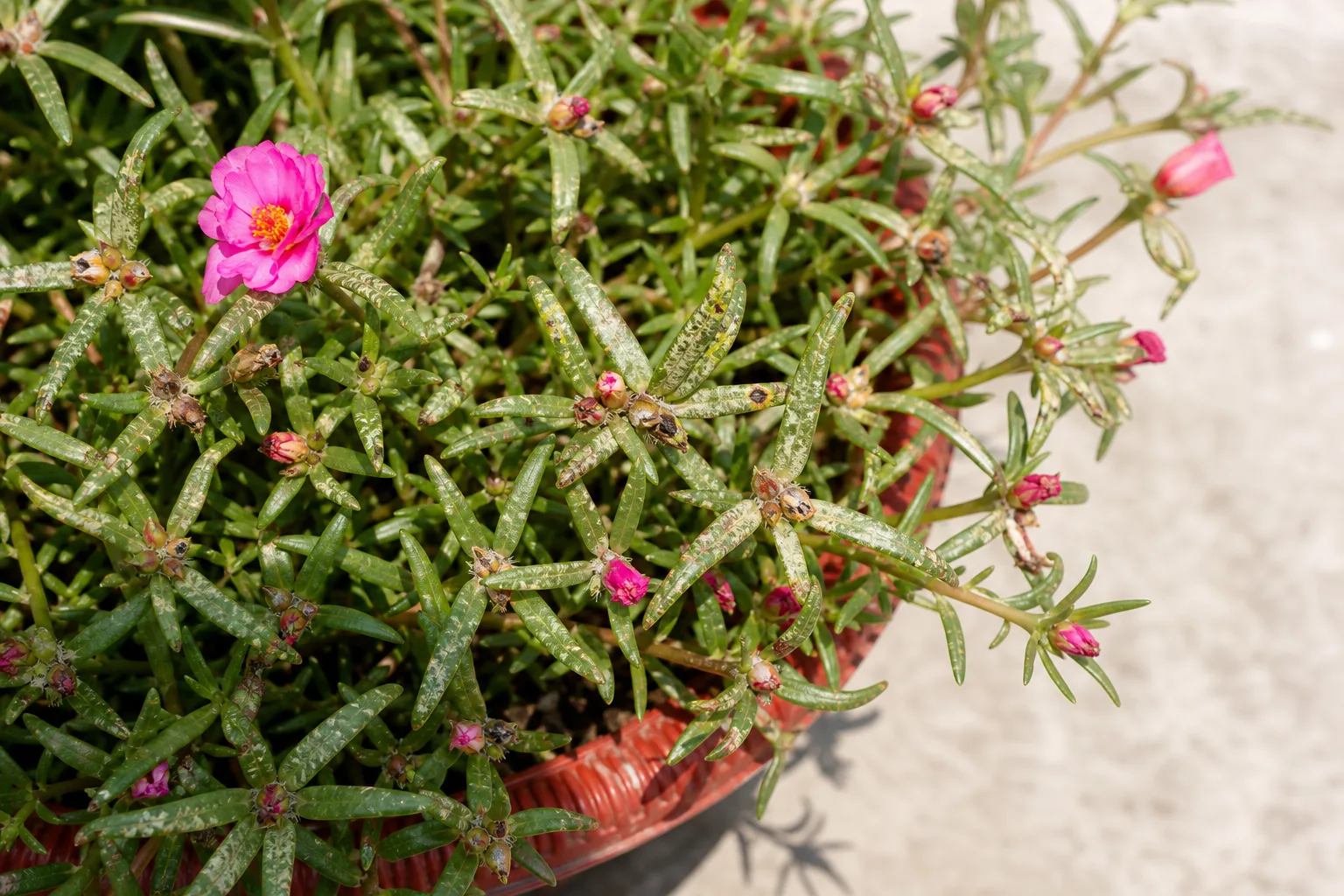
Western flower thrips scar Portulaca succulent leaves with silvery streaks and distort tightly wrapped Moss Rose buds before flowers open. First step: Isolate the basket, tap blooms over white paper to confirm slender insects, and hang a blue sticky trap just above the trailing canopy.
Thrips on Portulaca: Causes, Checks & Fixes
This guide covers thrips on Portulaca. See also the general Thrips guide, watering, and light pages for this plant.
Thrips on Portulaca: Causes, Checks & Fixes
Quick answer
Western flower thrips (Frankliniella occidentalis) scar Portulaca (Portulaca grandiflora, Moss Rose) succulent leaves with silvery streaks and distort new buds before papery flowers open in Portulaca light guide. UConn IPM lists portulaca among favorite WFT hosts, and UF/IFAS notes that thrips rasp plant cells and leave silver-flecked, scarred foliage on ornamentals.
Moss Rose buds stay tightly wrapped in bright sun-exactly where western flower thrips hide before petals open streaked. Trailing runners on hot terrace rails concentrate feeding on outer tips, which can look like drought stress until a tap test confirms slender insects.
First step: isolate the basket, tap unopened blooms and newest tips over white paper to confirm thrips, and hang one blue sticky trap just above the trailing canopy. Do not spray until you see moving rice-shaped insects-not static debris.
For Moss Rose culture context-full sun, lean soil, and dry-down watering-see the portulaca overview.
Why Portulaca gets thrips
Thrips are slender, winged insects less than 1/8 inch long that feed with rasping-sucking mouthparts on young leaves, buds, and petals. Moss Rose pushes soft new tips and tightly wrapped flower buds during warm spring and summer flush-exactly where thrips congregate and hide inside sheltered tissue.
Tightly wrapped buds on hot sunny rails
Unlike open-faced zinnia composite heads, Moss Rose keeps buds papery and closed until strong sun triggers opening. That protected bud tissue is a thrips shelter sprays often miss. Sakata ornamental culture guidance notes WFT feeding on Portulaca flowers and leaves causes leaf scarring, necrotic spotting, distorted growth, and flower bud deformation-damage concentrated where outer runners meet the hottest rail exposure.
Trailing habit matters. Moss Rose forms a low mat of succulent needle leaves along pot rims and hanging-basket edges. Thrips feed on the softest outer tips first while inner runners still look fine-delaying detection until silver streaks spread across visible blooms.
Mixed-basket introduction and neighbor carryover
Portulaca in full sun on hot rails is often grouped with petunias, zinnias, verbena, or calibrachoa in mixed summer baskets. Thrips hitchhike from those neighbors onto Moss Rose pockets where dense mats hide colonies until bud streaking appears. Western flower thrips is also a vector for INSV and TSWV tospoviruses-petunias carry the higher virus risk in shared containers, but thrips still scar Moss Rose blooms even when virus signs stay on a neighbor plant.
While Missouri Botanical Garden lists aphids as the main pest on Portulaca, western flower thrips still attack Moss Rose when populations build on nearby hosts. If you see pear-shaped clusters and sticky honeydew instead of silvery streaks, open the aphids guide first.
Fast-release nitrogen that pushes tender growth can also increase thrips susceptibility. Moss Rose evolved for lean sandy mix in full sun-heavy feeding softens succulent tips thrips prefer. Match the portulaca fertilizer guide before blaming random pest pressure.
What thrips look like on Portulaca
On succulent foliage:
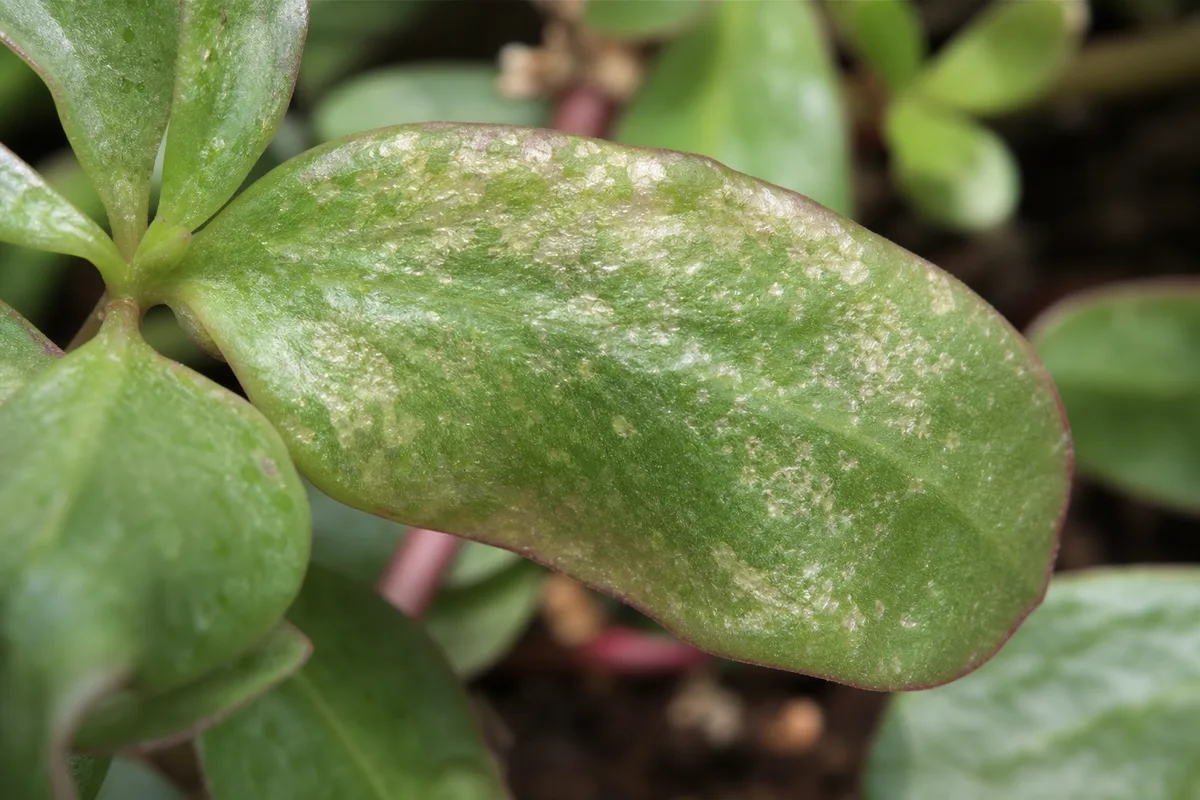
Thrips symptoms on Portulaca - compare with healthy tissue on the same plant.
- Silvery or bleached streaks and flecks on fleshy needle-like leaves-the collapsed cells reflect light and look metallic
- Tiny black varnish-like frass specks on leaf undersides or inside unopened buds
- Stunted or curled new leaves at stem tips on outer trailing runners
- Dull, stopped bud production on severely fed runners while inner stems still look green
On flowers-the showpiece damage on terrace baskets:
- Distorted, streaked, or partially opened Moss Rose blooms that should fully open in bright sun
- Papery petals with silver scrape marks and black fecal dots at petal seams
- Buds that abort or open lopsided when feeding is heavy at bloom peak
In severe cases, outer runners look dull and stop producing buds. Unlike aphids, thrips leave dry scraped tissue-not shiny honeydew. Unlike spider mites, damage shows silvery streaks with black frass, not fine stippling plus webbing at nodes.
How to confirm the cause
Work through these checks in order:
- Tap test - Hold an unopened bud or newest tip over white paper and tap sharply. Thrips are about 1/16 inch long, slender, and yellow to brown. Moving rice-shaped insects confirm thrips; static debris does not.
- Bud seam inspection - Gently part a sacrificial unopened Moss Rose bud with a fingernail or hand lens. Thrips hide in sheltered flower tissue where petals stay wrapped in full sun.
- Silver streak pattern - Metallic flecks on succulent leaves with black frass specks point to thrips. Fine yellow dots with webbing on dusty hot baskets suggest spider mites instead.
- Blue sticky trap - Hang a blue sticky trap just above the trailing canopy for three to five days. Several western flower thrips per card supports active infestation on Moss Rose.
- Neighbor scan - Check petunias, zinnias, and verbena in the same mixed basket or on touching rails. Thrips rarely stay on one annual once flowers overlap.
- Care cross-check - If soil is wet, stems feel mushy at the crown, and silver streaks sit on lower leaves only, split diagnosis-thrips may be secondary to overwatering or rot. Confirm stem firmness and dry-down watering separately from pest treatment.
Lookalike symptoms to rule out
| What you see | Likely cause | Next step |
|---|---|---|
| Silvery streaks on succulent leaves + black frass in buds | Thrips | Tap test; blue trap; isolate basket |
| Fine stippling + webbing on dusty hot basket | Spider mites | Spider mites guide |
| Pear-shaped clusters + sticky honeydew on tips | Aphids | Aphids guide |
| Winding pale tunnels inside fleshy leaves | Leaf miners | Leaf miners guide |
| White cottony masses in stem joints | Mealybugs | Mealybugs guide |
| Bleached outer tips on bone-dry soil, no insects | Drought or sun scorch | Underwatering check first |
| Dark ringed lesions around feeding scars on petunia neighbor | Possible tospovirus | Remove virus-suspect plant; see petunia thrips virus protocol |
First fix for Portulaca
Isolate the basket, tap blooms and tips over white paper to confirm active thrips, and hang one blue sticky trap just above the trailing canopy.
That single step separates thrips from drought stress, mite stippling, and aphid honeydew while starting population monitoring. Move the pot away from neighbors for one to two weeks while treating-thrips crawl and fly short distances between touching annuals on shared rails.
Do not spray everything on day one. Confirm slender moving insects first, then treat based on trap counts and bud damage severity.
Step-by-step recovery
Once thrips are confirmed on Moss Rose:
- Prune heavily infested buds - Pinch out deformed, streaked buds and discard them in a sealed bag-not the compost pile. Focus on outer runners where thrips concentrate.
- Water rinse - Spray trailing stems, leaf undersides, and remaining buds with a strong jet of cool morning water to dislodge adults and larvae. Let succulent tissue dry the same day in sun.
- Soap or oil on cool mornings - Follow with insecticidal soap or narrow-range horticultural oil per label on a cool morning, avoiding peak midday heat on succulent Moss Rose tissue. Spot-test one runner first-Clemson Extension lists Portulaca among soap-sensitive plants that need a 24-hour patch test.
- Repeat every 5–7 days - One application rarely controls thrips; run at least two to three cycles to catch newly hatched nymphs as eggs hatch in sheltered bud tissue.
- Trap monitoring - Keep blue sticky traps up and note weekly counts. Rising counts mean populations are still building; falling counts mean control is working.
- Hold heavy nitrogen - Do not push fast-release fertilizer on a pest-hit Moss Rose. Resume lean feeding after two weeks of clean new buds per the fertilizer guide.
- Virus watch on mixed baskets - If a petunia neighbor shows dark ringed lesions around thrips feeding scars, bag and remove that plant. There is no cure for INSV or TSWV on ornamental annuals-protect remaining Moss Rose by stopping thrips movement, not by waiting for Moss Rose to show virus rings first.
For heavy infestations, rotate product classes if label allows-western flower thrips develops resistance quickly when the same active ingredient is repeated. Home growers should exhaust water rinses, sanitation, and soap or oil cycles before broad-spectrum sprays that flare spider mites in the same hot dry conditions.
Recovery timeline
Silvery scarring on mature succulent leaves does not fade. Expect clean new growth and normally opening buds within two to three weeks if treatments continue through thrips life cycles-WFT females can lay up to 250 eggs across a 45-day lifespan, so short treatment windows often fail.
Light infestations caught on the first streaked outer bud often stabilize within one to two weeks of trapping plus soap repeats. Moderate mixed-basket infestations usually need two to three full treatment cycles. Old scarred petals will not revert to solid color-judge success by clean new flowers and fewer insects on tap tests.
Severely distorted outer runners can be trimmed once new clean tips appear. If stippling spreads across new growth despite two full soap cycles, reassess whether thrips persist or a neighbor virus has taken hold.
What not to do
Do not return an isolated Moss Rose to mixed baskets until you see no new streaking for two weeks after the last treatment and trap counts stay low.
Do not rely on a single spray-thrips eggs hatch in cycles inside wrapped buds and resistance develops quickly with repeated use of the same product. Read labels and rotate modes of action when escalating beyond soap or oil.
Do not spray soap or oil at midday on full-sun Moss Rose-succulent tissue burns when product dries in peak heat. Treat early morning so foliage dries the same day.
Do not overwater after rinsing; Portulaca still needs dry-down watering in full sun. Wet soil plus damaged foliage invites rot unrelated to thrips.
Wear gloves when handling treated plants-Portulaca is toxic to cats and dogs because of soluble calcium oxalates. Call ASPCA Animal Poison Control at (888) 426-4435 if a pet ingests treated foliage.
Do not compost heavily infested buds or virus-suspect neighbor plants from shared baskets.
How to prevent thrips on Portulaca
Quarantine new baskets for two weeks before placing them near established portulaca displays on sunny rails. Inspect unopened buds and outer tips weekly during peak bloom season.
Hang blue sticky traps above trailing canopies early in the season-not only after silver streaks appear. Raise traps as runners spill over pot rims.
Use slow-release fertilizer at planting rather than heavy nitrogen bursts that soften new tissue on lean-soil Moss Rose. Rinse dust from trailing stems occasionally in hot weather-dusty terrace baskets also favor mites.
Outdoors, conserve natural predators by avoiding broad persistent sprays when light infestations appear. Minute pirate bugs and predatory mites can suppress thrips when chemical broad-spectrum products have not wiped them out.
Space mixed baskets so flowers are not touching across rails. One infested petunia combo can seed thrips across an entire terrace row.
Practical checks
Urgency check
Treat promptly when multiple Moss Rose buds streak, fail to open on sunny afternoons, or show black frass inside petals. Escalate immediately when a petunia neighbor in the same basket shows dark ringed virus lesions-remove that plant before thrips spread further.
Best inspection order
Unopened flower buds on outer runners → newest stem tips → silvery leaf streaks → white-paper tap test → blue sticky trap counts → neighboring pots in mixed baskets.
Portulaca care cross-check
Thrips damage plus wet soil and mushy stems suggests two problems-confirm stem firmness and drainage separately from pest treatment. Mushy crown with no live insects points to root rot, not thrips alone. Distorted tips without insects may tie to excess nitrogen-see distorted leaves.
Related Portulaca problems
- Portulaca overview - full sun, lean soil, and seasonal care hub
- Watering - dry-down rhythm after rinse treatments
- Aphids - honeydew and bud-coated clusters vs. silvery thrips streaks
- Spider mites - stippling and webbing on hot dusty baskets
- Leaf miners - tunnels inside fleshy leaves
- Mealybugs - waxy cotton in stem joints
- Overwatering - mushy stems that mimic outer-tip collapse
- Distorted leaves - nitrogen or light stress without insects
When to use this page vs other Portulaca guides
- Portulaca watering guide - Use for routine moisture checks before assuming thrips is the main issue.
- Portulaca problems hub - Browse all 50 common issues on this species.
- Curling Leaves on Portulaca - Different entry point when symptoms overlap with thrips.