Portulaca Fertilizer: When, How, and Mistakes to Avoid
Portulaca Fertilizer: When, How, and Mistakes to Avoid
Portulaca Fertilizer: When, How, and Mistakes to Avoid
Portulaca fertilizer decisions start with a counterintuitive truth: Portulaca grandiflora - the moss rose sold in summer bedding packs and hanging baskets - is a lean-soil succulent annual, not a hungry foliage houseplant. Its fleshy needle leaves and shallow roots evolved on sandy, fast-draining ground in South America where nutrients are scarce and heat is relentless. Proven Winners describes portulaca as thriving in “full sun, heat, humidity, drought and poor soils.” That biology means the default answer for most terrace displays is no supplemental fertilizer - especially if you planted into commercial potting mix, compost-enriched beds, or slow-release starter fertilizer already mixed in at the nursery.
When feeding does make sense, it is optional and light: slow-release granules scratched into the top of the bed at planting, or one to two mid-season applications of balanced liquid at quarter to half label strength on already-moist soil - never monthly houseplant strength, never on dry roots, and never on a stressed or rotting plant. Excess nitrogen is the bloom killer: Proven Winners warns that rich soil or overfertilizing produces foliage growth at the expense of flowers. If your moss rose is green, thick, and shy to open buds in full sun, suspect shade, overwatering on Portulaca, or overfeeding before hunger.
This guide covers whether moss rose needs feed at all, product and dilution choices, container vs in-ground schedules, over-fertilizing symptoms and recovery, and how feeding fits the wider portulaca care hub alongside light, watering, and soil guidance.
Quick answer
Default: Skip supplemental fertilizer if moss rose sits in lean sandy soil, gritty succulent mix, or standard pre-fertilized potting soil and blooms reliably in full sun (6+ hours daily).
Optional at planting: A light sprinkle of slow-release balanced granules mixed into the top few centimeters of bed or container - enough for the season in many displays.
Optional mid-season: One or two diluted balanced liquid feeds at quarter to half strength between early summer and late summer, only when the plant is healthy, soil is moist, and blooms have stalled despite correct sun and dry-down watering.
Never: Monthly houseplant feeding, full-strength liquid on dry roots, fertilizer on mushy or cold-stalled plants, or winter feeding schedules - moss rose is a frost-killed warm-season annual in temperate climates, not an indoor dormant houseplant.
Know your plant: moss rose is a lean-soil succulent annual
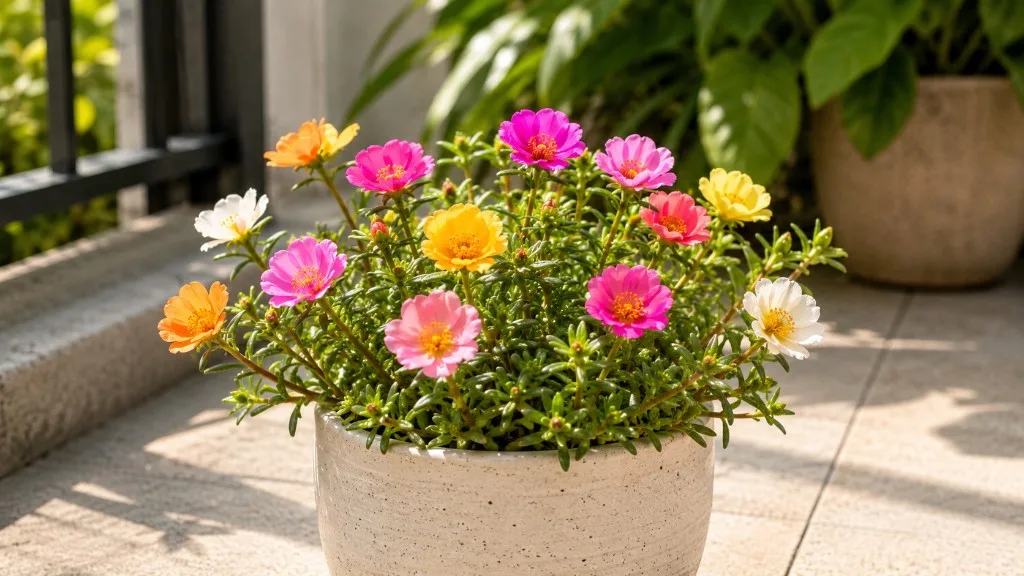
Moss rose is Portulaca grandiflora, a low, trailing succulent annual in the Portulacaceae family, native to Argentina, Uruguay, and Brazil. It forms a dense mat roughly 8–20 cm tall and 30–40 cm wide with cylindrical fleshy leaves, reddish stems, and papery flowers that open in bright sunlight and close at night or on cloudy days. Cornell Home Gardening calls it an easy annual that “needs hot, dry, almost desert-like conditions” but is otherwise not fussy.
Do not confuse moss rose with common purslane (Portulaca oleracea), a related edible weed with flat leaves and small yellow flowers. Both like sun and drainage, but moss rose is grown for ornamental blooms and shares toxicity concerns with other portulaca species - more on that in the safety section below. For full species context, see the portulaca overview.
Native habitat and why poor soil favors blooms
In habitat, moss rose roots occupy shallow, gritty, low-fertility soils that dry fast after rain. The plant stores water in leaves and stems, so it does not need - and often does not benefit from - the nitrogen push that makes petunias or impatiens explode with foliage. Wayne County NC Extension notes moss rose performs well in soils with low fertility and flowers all summer with very little care when sited in full sun and well-drained ground.
That is the mechanism behind “less is more for blooms.” Nitrogen drives vegetative growth; on a succulent annual bred for flower display, vegetative push means soft stems, closed buds, and fewer open flowers even when light and water are otherwise correct. Lean soil keeps the plant’s energy budget pointed at reproduction - the colorful blooms you actually bought the pack for.
Does portulaca need fertilizer at all?
Often no. The North Carolina Extension Plant Toolbox lists maintenance as low for moss rose, and multiple extension sources describe it as thriving with minimal inputs when drainage and sun are right. If your hanging basket or terrace bowl already blooms heavily from June through August in full sun with gritty soil and sparse watering, adding fertilizer is optional at best and harmful at worst.
Default: no supplemental feed in lean or pre-enriched mix
Skip feeding when any of these apply:
- Plants grow in sandy garden soil, rock garden pockets, or lean succulent-style container mix and produce steady blooms.
- You used standard commercial potting mix that already contains starter fertilizer or slow-release prills - many Indian terrace growers using rich bagged mix unknowingly overfeed moss rose and then wonder why flowers stay closed.
- Beds were amended heavily with compost or manure before planting.
- Blooms open reliably on sunny afternoons and stems stay compact.
Proven Winners states portulaca “needs little or no supplemental fertilizer” and prefers lean conditions. Treat that as the baseline, not the exception.
When light feeding can help
Consider one optional mid-season boost only when all of these are true:
- Moss rose sits in full sun with correct dry-down watering and still shows stalled bloom production mid-summer - not closed flowers from cloudy weather, which is normal.
- Soil is genuinely lean - pure grit/sand mixes, very old depleted mix, or in-ground sand with no recent compost.
- The plant is healthy: no mushy stems, no salt crust, no active rot.
- You have ruled out shade creep from neighboring plants, a moved pot under an eave, or chronic overwatering - both suppress blooms harder than mild nutrient deficit.
Proven Winners’ mid-summer protocol for leggy plants is instructive: prune back by up to half, then apply a very light, one-time dose of fertilizer to stimulate new growth and flowers - not a recurring monthly schedule. That is a targeted rescue, not maintenance.
What type of fertilizer to use
Moss rose does not need specialty bloom-booster formulas high in phosphorus unless you already own them and dilute heavily. A balanced NPK - 10-10-10 or 20-20-20 liquid, or a balanced slow-release granular - matches the low, even nutrient demand of a succulent annual. Avoid high-nitrogen lawn fertilizers, uncomposted manure top-dressing, and “super bloom” products that push nitrogen anyway.
Slow-release granules at planting (optional)
At planting time, you may mix a small amount of balanced slow-release fertilizer into the top 5–8 cm of bed soil or container mix - follow the label rate for annual flowers and err on the low side in pots. One application at establishment can carry a lean-display through the warm season without mid-summer liquids. This is compatible with Proven Winners’ lean-soil guidance because the release is spread over weeks, not dumped as a monthly salt load.
Slow-release in small hanging baskets is acceptable when used sparingly at planting; the audit-flagged contradiction on old template pages was recommending slow-release in one paragraph and banning all pellets in another. The real rule is dose and context: a pinch at planting in gritty mix differs from repeated pellet top-ups on already-rich commercial soil.
Balanced liquid at quarter to half strength (mid-season only)
For mid-season intervention, use balanced liquid fertilizer diluted to quarter or half the label strength for outdoor annuals. Apply to moist soil only - water the day before if the mix is dry. One pass over the soil surface, avoiding foliar drench on heat-stressed leaves, is enough. Repeat once, at most, if blooms stall again four to six weeks later and the plant remains healthy.
Do not use full label strength “because it is outdoors.” Moss rose roots are shallow and rot-prone in wet conditions; they are also quick to burn when salts hit dry fine roots.
How often to fertilize portulaca
Think in seasonal events, not houseplant calendars.
| Situation | Feeding approach |
|---|---|
| Lean sandy bed or grit mix, strong blooms | No feed |
| Standard potting mix at planting | Optional slow-release once at planting; otherwise no feed |
| Lean mix, blooms stalled mid-summer in full sun | 1 liquid feed at quarter–half strength |
| Leggy August plant after hard prune | 1 very light feed per Proven Winners rescue protocol |
| Rich compost bed or monthly liquid habit | Stop feeding; fix soil richness instead |
Maximum for most growers: slow-release at planting plus zero to two diluted liquid applications across the entire warm season. A monthly half-strength houseplant schedule is inappropriate and contradicts every species-specific source cited here.
In-ground beds vs containers and hanging baskets
In-ground moss rose in sandy, well-drained beds rarely needs anything beyond optional planting granules. Native soil minerals and occasional summer rain often suffice when sun is strong.
Containers and hanging baskets dry faster and leach nutrients with each soak, so they are the only context where a single mid-season liquid feed sometimes helps - especially if you built a very lean grit-heavy soil mix without starter fertilizer. Even then, one or two light doses beat a monthly program. Small pots accumulate salts faster; if you see white crust on the soil surface, flush with plain water and stop feeding rather than adding more product.
There is no winter feeding pause in the houseplant sense because moss rose is replaced after frost in temperate climates. When nights drop below about 10°C and growth stalls in autumn, stop feeding and let the annual finish its cycle.
Signs you are doing it right
Healthy, correctly fed - or correctly unfed - moss rose shows:
- Flowers open wide on sunny afternoons and close at night - the normal rhythm described by NC State.
- Compact, slightly succulent stems without soft watery puffiness.
- Steady bloom count from mid-summer into early fall in full sun.
- Soil surface free of white salt crust; mix dries fully between waterings.
- No sudden shift to all-green growth after a feed event.
If blooms are abundant on plain gritty mix with zero fertilizer, you have your answer: keep doing nothing.
Signs of over-fertilizing
Over-fed moss rose diverges from the healthy picture above in predictable ways:
- Thick green stems and lush foliage with few or no open flowers in full sun - the classic nitrogen bloom-suppression pattern Proven Winners documents.
- Buds present but staying closed on clear afternoons after a recent feed or rich soil top-dress.
- White mineral crust on the soil surface in containers.
- Brown, crisp leaf tips or margins on succulent needles - salt injury on shallow roots.
- Sudden collapse when fertilizer was applied to dry or heat-stressed plants - salts burn fine roots before water can dilute them.
These symptoms overlap with shade and overwatering, so confirm sun exposure and soil moisture before assuming fertilizer alone is the culprit. Closed flowers on cloudy days are normal; closed flowers on blazing terrace afternoons are not.
Step-by-step: how to fertilize safely
When you have decided a light feed is justified, follow this sequence:
- Confirm the plant is healthy - firm stems, no rot smell, no active mush at the crown.
- Check light and water first - full direct sun and complete dry-down between soaks.
- Moisten the soil the day before if it is dry; never pour fertilizer concentrate onto dust-dry mix.
- Mix balanced liquid fertilizer at quarter to half outdoor-annual label strength in a watering can.
- Apply evenly at the soil line, not as a foliar spray on midday heat-stressed foliage.
- Let excess drain freely; empty saucers so salts do not re-concentrate.
- Mark the date and wait at least four to six weeks before considering a second dose - most plants need zero or one repeat.
For planting-time slow-release, incorporate granules into the top layer only, water once to settle, then return to the normal sparse watering rhythm.
Common mistakes
Treating moss rose like a monthly houseplant feeder. Petunia-style “half strength every month” schedules are copy-pasted across templated care pages; they are wrong for moss rose and contradict Proven Winners’ lean-feeding guidance.
Feeding rich potting mix without realizing it is already fertilized. Commercial blends often include starter charge or slow-release prills. Adding liquid on top stacks nitrogen and closes flowers.
Applying fertilizer to dry soil on a hot terrace. Salts contact fine roots before moisture disperses them - burn appears within days.
Chasing closed flowers with more nitrogen. If blooms shut on sunny afternoons, the fix is usually more sun and less water or feed, not another dose.
Using winter dormancy advice on an annual. Moss rose does not need an “autumn pause then spring resume” houseplant calendar; it dies at frost or fades naturally as temperatures drop. Replace plants next warm season.
Ignoring pets when feeding balcony containers. Liquid fertilizer does not make moss rose safe for pets - ASPCA lists portulaca species as toxic - and spilled product on rails adds unnecessary exposure risk. Keep pots off pet reach.
Recovery after over-fertilizing
If you overfed or see salt crust:
- Stop all fertilizer immediately.
- Flush containers thoroughly - run plain water through the mix until it flows freely from drainage holes; repeat after an hour if crust is heavy.
- Move the pot to confirmed full sun if shade crept in.
- Hold feed for the rest of the season - moss rose often recovers vegetatively within one to two weeks; blooms may take longer.
- Prune leggy green growth by up to half if the plant is otherwise firm; optional one very light feed only after new shoots appear, per Proven Winners’ mid-summer rescue - not a repeat of the overdose.
Badly burned crowns that turn mushy will not recover. Discard, refresh mix, and replant with no fertilizer in lean gritty soil.
How fertilizer connects to light, water, and soil
Fertilizer is the last lever, not the first. Moss rose in full sun metabolizes nutrients and dries soil predictably; in shade it stretches, closes flowers, and needs less water and zero feed. In soggy mix, roots cannot uptake safely - feeding wet, rotting plants accelerates collapse. In rich, moisture-retentive soil, nitrogen is already abundant enough to suppress blooms.
Work the triangle in order: sun → drainage/dry-down → optional lean feed. The portulaca overview fertilizer section and closed-flowers FAQ align with this sequence: if flowers will not open on sunny afternoons, fix placement and watering before buying bloom booster.
Pet and child safety
Moss rose is not pet-safe. The ASPCA lists Portulaca - including entries for moss rose and related common names - as toxic to dogs, cats, and horses, with toxic principles of soluble calcium oxalates. Possible signs include vomiting, diarrhea, tremors, hypersalivation, and kidney injury in severe exposures. Fertilizer products near floor-level pots add chemical exposure on top of plant toxicity.
Keep moss rose on high balcony rails, fenced beds, or out of pet-accessible rooms. If ingestion is suspected, call ASPCA Animal Poison Control at (888) 426-4435 (US) and your veterinarian promptly. Choose confirmed pet-safe summer color for low trays and floor pots.
Conclusion
Moss rose fertilizer is simpler than the houseplant internet makes it sound: lean soil and full sun produce the best blooms; feeding is optional, light, and mid-season at most. Start with no supplemental fertilizer unless your display proves it needs help - stalled flowers in gritty mix with perfect sun and dry-down - then use quarter- to half-strength balanced liquid on moist soil once or twice, or a small slow-release sprinkle at planting, never a monthly salt routine. When stems go green and thick while flowers stay shut, pull back on nitrogen, confirm light and watering, and flush salts if crust appears.
Replace tired plants each warm season rather than fighting an overfed, soggy August mat in old mix. For the full care picture - propagation, pruning, toxicity, and troubleshooting - return to the portulaca care hub. Get feeding boundaries right, and moss rose rewards you with open, papery blooms in the hottest corner of the garden - the place where hungrier annuals give up.
Reviewed by LeafyPixels Review Board · Methodology: botanical and extension references, LeafyPixels plant-care data, and practical terrace-growing constraints.
When to use this page vs other Portulaca guides
- Portulaca overview - Start here for whole-plant context before deep-diving this topic.
- Portulaca problems hub - Jump to symptom-specific fix guides when this care topic does not resolve the issue.
- Fertilizer Burn on Portulaca - Escalate here when fertilizer adjustments are not enough.
- No Flowers on Portulaca - Escalate here when fertilizer adjustments are not enough.
- Nitrogen Deficiency on Portulaca - Escalate here when fertilizer adjustments are not enough.