Brown Tips on Pilea Moon Valley: Causes, Checks & Fixes
Quick answer
Brown tips on Pilea Moon Valley usually start at the raised green margins of quilted leaves when dry air, salt buildup, watering swings, or spider mites stress the mound. First step: move the pot off heat drafts and measure humidity at leaf height before changing watering.
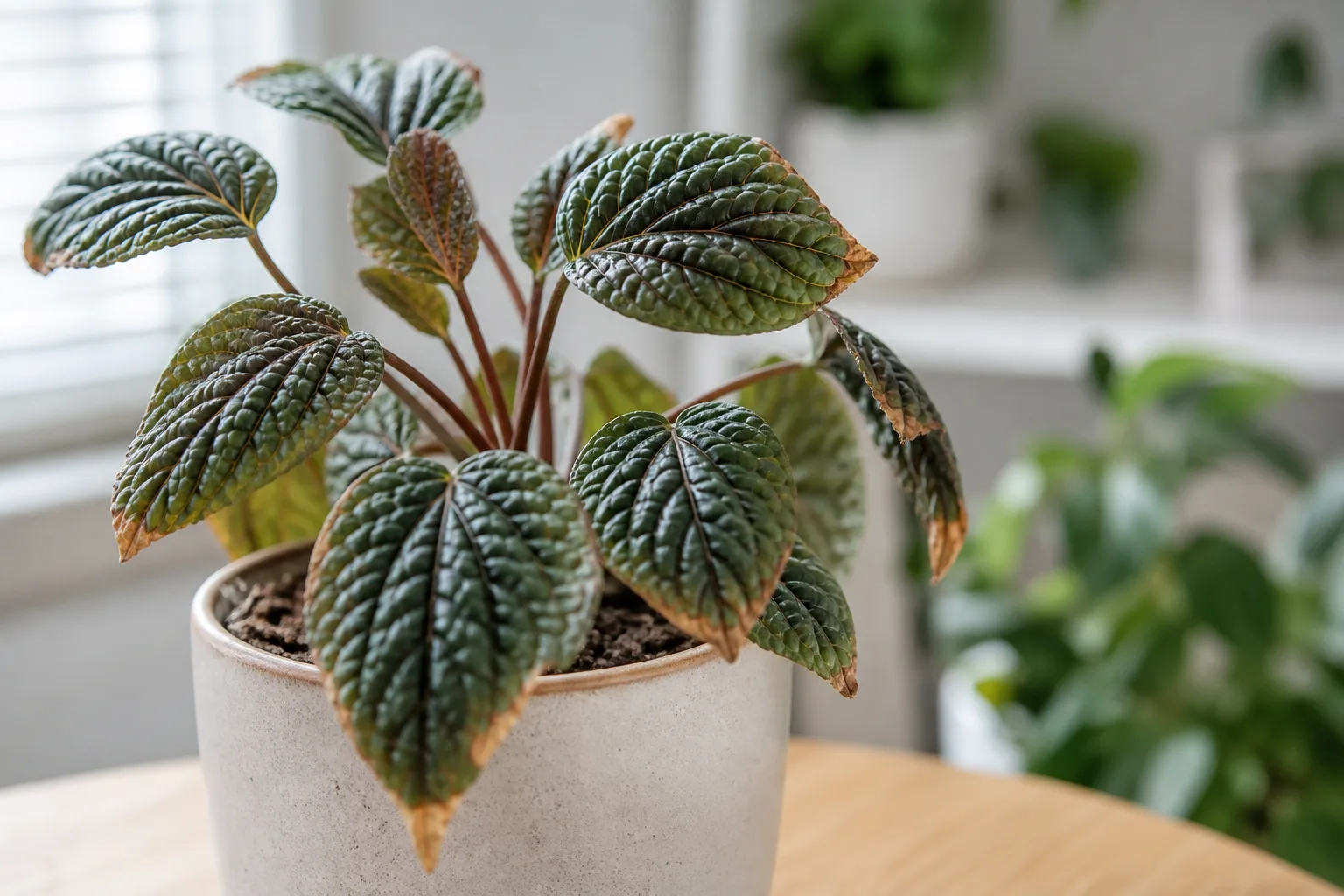
Brown Tips on Pilea Moon Valley: Causes, Checks & Fixes
This guide covers brown tips on Pilea Moon Valley. See also the general Brown Tips guide, watering, and light pages for this plant.
Brown Tips on Pilea Moon Valley: Causes, Checks & Fixes
Quick answer
Brown tips on Pilea Moon Valley (Pilea mollis ‘Moon Valley’) almost always start at the raised green margins of quilted leaves-the thin outer rim dries before the bronze cratered center. That edge-first pattern is tied to the cultivar’s texture: more exposed margin surface per leaf means margins lose moisture faster when air is dry, salts accumulate at transpiration hotspots, or spider mites feed along ridge lines.
First step: move the pot off heat drafts and measure humidity at leaf height before you water more, fertilize less, or repot. Grouping with other plants over a pebble tray helps only after placement is corrected; pebble trays alone rarely fix a plant sitting in a heating vent’s path.
Browned tissue will not turn green again. Judge recovery by whether the next two puckered leaves emerge with clean edges and whether spread stops on the rest of the mound.
Symptom signatures on Moon Valley
Moon Valley brown tips look different from generic houseplant edge burn because of leaf morphology.
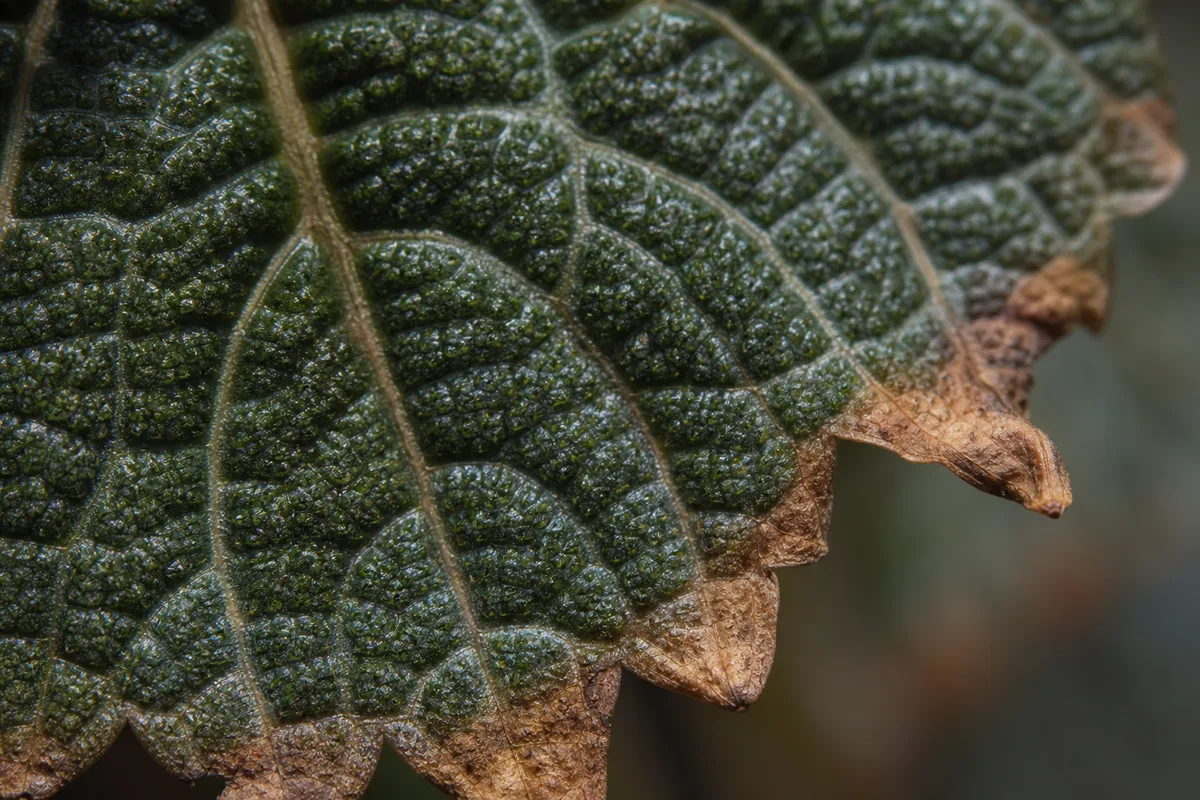
Brown Tips symptoms on Pilea Moon Valley - compare with healthy tissue on the same plant.
Typical dry-air or draft pattern:
- Tan-to-brown crisping on the outer green rim of quilted leaves
- Centers and bronze grooves stay green while margins desiccate
- Older leaves on the exposed side of the mound show damage first
- Stems feel firm; soil moisture may be normal
Salt or hard-water edge burn:
- Tips brown after a recent feed or when white crust appears on mix surface
- Damage concentrates at leaf tips and outer margins, not stippled grooves
- Plant otherwise looks perky; no webbing in leaf craters
Spider mite feeding on textured foliage:
- Dull bronzing on raised ridges plus fine stippling in grooves
- Webbing in stem joints and between puckered leaves-not only dry margins
- Tap test over white paper reveals moving specks
- Often flares when indoor heat runs and RH drops below 40%
Sun scorch through glass:
- Sharp tan patches on window-facing leaves, often sudden after bright days
- Damage may cross both margin and crater surface, not margin-only crisping
Why textured leaves brown at the edges first
Pilea mollis ‘Moon Valley’ evolved in wet tropical understory (Missouri Botanical Garden) where humidity stays high and light is filtered. Indoors, the cultivar’s strongly puckered surface increases leaf area for gas exchange-but the bright green margins are thin and exposed, so they dehydrate before the thicker quilted center when RH falls or hot airflow hits one side of the mound.
Missouri Botanical Garden recommends humidified rooms or pebble-tray placement for Pilea Moon Valley overview (MOBOT Pilea mollis). That is not generic houseplant advice: Moon Valley’s compact 12-inch mound puts outer leaves directly in vent paths, and the cratered texture gives spider mites shelter that flat-leaf plants do not offer.
Cause confidence matrix
Use this after your first placement and humidity correction. Score each row honestly-high confidence on one cause means fix that before stacking other treatments.
| Cause | Confidence signals | Quick differentiator | First targeted fix |
|---|---|---|---|
| Dry air / heat draft | RH below 40% at leaf height; worst leaves near vent, radiator, or hot window glass | Crisp margins only; no stippling; soil moisture normal | Move off airflow; raise local RH |
| Salt buildup | Tips worsened after feeding; white crust on mix; hard tap water history | Margin burn without pest signs; plant still firm | Flush pot once with plain water |
| Underwatering swing | Pot very light; mix pulled from sides; slight wilt before tips crisp | Whole leaf dulls, not just margin; perks after deep water | Water when top 2–3 cm dries |
| Overwatering / root stress | Soil wet for days; sour smell; stem bases softening | Yellowing plus wet mix, not margin-only crisping | Stop watering; inspect roots if stems soften |
| Spider mites | Stippling in grooves; webbing; tap-test specks | Feeding pattern in texture, not uniform margin dry | Rinse + treat only if confirmed |
| Sun scorch | Sudden burn on window-facing side after bright spell | Patches across leaf face, not slow margin creep | Move to bright indirect only |
When two causes score high-common in winter-correct placement and humidity first, then reassess new growth for 7–14 days before flushing salts or treating pests.
Seven-step confirmation workflow
-
Log RH at leaf height for 2–3 days. Winter heating often pulls indoor humidity below what tropical foliage tolerates (Penn State Extension). A hallway sensor is not enough-read beside the mound.
-
Check soil at 2–3 cm depth. Moist soil with crisp margins points away from underwatering. Soggy cool mix with soft stems points toward root stress, not dry air alone.
-
Map airflow and glass exposure. Vents, AC returns, radiators, and hot afternoon window panes dry one side of the mound faster than the other.
-
Run the texture mite check. Fold a puckered leaf over white paper and tap. Inspect crater undersides and stem joints for webbing. Stippling that follows vein grooves supports mites (University of Minnesota Extension).
-
Review fertilizer and water quality. Tips that worsened within a week of feeding, or white mineral crust on the mix, suggest salt stress rather than humidity-only injury.
-
Inspect roots only if stems soften or soil stays wet. Healthy white roots with firm stems do not need repeated unpotting-root disturbance stresses fragile Moon Valley stems.
-
Apply one correction and watch the next two leaves. Spread slowing within a week and cleaner puckered new growth by day 14 confirm you found a major driver.
The first fix to try
Move Moon Valley off direct heat drafts and raise local humidity around the leaf mound-group it with other plants over a tray of moist pebbles, keeping the pot base above the water line (Royal Horticultural Society). Keep Pilea Moon Valley light guide; avoid full sun through glass (Missouri Botanical Garden).
Do not water on autopilot, mist heavily into crowded craters, or fertilize a stressed mound on day one. Water when the top 2–3 cm dries, using soil checks rather than a calendar (University of Minnesota Extension).
Cause-by-cause fixes
Dry air and drafts
After placement correction, run a small humidifier on the plant’s side of the room if RH stays under 45%. Target roughly 50–60% at leaf height during heating season-aligned with Moon Valley’s humid-room preference. Pebble trays and grouping help at the leaf zone; they do not replace moving the pot off a register.
Salt buildup
If feeding or hard water preceded the burn, flush once: run plain room-temperature water through the pot until excess drains freely, then empty the saucer. Resume light feeding only after new leaves show clean margins for two weeks.
Watering swings
Moon Valley wants even moisture, not chronic drought or sogginess. If the pot went bone-dry then flooded, return to checking the top 2–3 cm and watering thoroughly when dry-avoid repeated panic soaks.
Spider mites on quilted foliage
Spider mites favor warm, dry indoor air (University of Minnesota Extension). Treat only when stippling or webbing is confirmed: rinse leaf surfaces and craters, then use labeled insecticidal soap or horticultural oil on a repeat schedule. Raising humidity helps prevention; it is not a substitute for physical removal when mites are active.
Sun scorch
Shift the mound out of direct beams. Scorch patches on existing leaves will not heal; prevent new burn on the next flush of growth.
Day-7 and Day-14 escalation plan
Track progress on new leaves, not old brown rims.
Day 7 checkpoint:
- Has margin spread stopped on older quilted leaves?
- Is leaf-level RH stable above 45% during heating hours?
- Any new stippling or webbing since correction?
If spread continues and RH is adequate, move to salt flush (if feeding history fits) or mite treatment (if tap test positive). Do not do both on the same day.
Day 14 checkpoint:
- Do the last two emerging leaves show clean raised margins?
- Are stems still firm at soil line?
- Is soil cycling moisture normally between waterings?
Cleaner new growth means your primary fix worked-even if you trim old tips for appearance. If tips still march inward on new leaves after RH, salts, and pests are addressed, inspect roots for chronic wet mix before Pilea Moon Valley repotting guide.
Failed-fix scenario: humidity corrected, tips still spread
A common winter trap: RH reads acceptable at a wall sensor while the mound sits in a micro-draft that leaves local leaf-zone air dry. Another trap: misting into cratered leaves without moving the pot-surface moisture evaporates quickly while margins keep crisping.
What to do instead: reposition so no register hits the mound, confirm RH beside the leaves, then wait for two full leaf cycles. If spread continues, run the mite tap test and review whether fertilizer was applied during visible stress. Stacking humidifier plus flush plus spray on day one makes it impossible to read which fix helped.
Reviewed case: winter windowsill, measured RH
Editorial case note reviewed by LeafyPixels Review Board - composite of common heating-season setups.
A Moon Valley in a 10 cm nursery pot on a west-facing windowsill developed crisp brown margins on four outer quilted leaves during January. A leaf-level hygrometer logged 31–34% RH over three days. The pot sat 14 inches from a forced-air floor register.
Actions taken: moved the pot four feet from the vent and onto a grouped pebble tray; kept the existing Pilea Moon Valley watering guide (water when top 2–3 cm dried); did not fertilize during recovery.
Measured outcome: RH at leaf height rose to 49–55% within six days. The next two puckered leaves opened with clean green margins by day 16. Older brown rims were trimmed after day 21 for appearance only.
This pattern-low local RH, vent proximity, cleaner new growth after placement plus humidity support-is the recovery signal to watch on your own plant.
Recovery benchmarks
| Timeframe | What improvement looks like | What failure looks like |
|---|---|---|
| Days 1–3 | Spread may slow after placement fix | New leaves opening already browned |
| Days 7–10 | RH stable; no new webbing | Tips marching inward on multiple leaves |
| Days 14–21 | Two clean new puckered leaves | Stem softening; soil wet for a week |
| Days 21+ | Trim old tips cosmetically if desired | More than half mound declining |
Brown tips do not re-green. Recovery is stopped spread plus clean new texture on emerging leaves.
Visual lookalike guide (text reference)
Until annotated photos are added to this page, use these field markers:
| What you see | Likely cause | Texture clue unique to Moon Valley |
|---|---|---|
| Crispy green rim only, firm mound | Dry air / draft | Bronze grooves still green; no stippling |
| Brown tips after white crust on mix | Salts / hard water | Even margin burn; no webbing in craters |
| Dull ridges + speckled grooves | Spider mites | Damage follows puckered veins, not just rim |
| Tan patch across window-facing leaf | Sun scorch | Affects flat of leaf, not margin-only creep |
| Limp whole leaf, very dry pot | Underwatering | Puckered leaf softens, not just edge crisp |
Mistakes to avoid
- Watering on a calendar without checking the top 2–3 cm of peaty mix.
- Raising room humidity while the mound stays in direct hot airflow.
- Heavy misting into crowded leaf craters where moisture lingers and invites fungal spotting.
- Adding fertilizer when margins are already burning.
- Assuming all tip burn is dry air and skipping the texture mite tap test.
- Repotting on day one when stems are firm and roots are healthy.
Prevention plan
- Hold leaf-level RH near 50–60% during heating season.
- Keep Moon Valley in bright indirect light-not direct hot glass.
- Water by soil dryness checks, not by weekday habit.
- Feed lightly in active growth; flush salts occasionally if using hard tap water.
- Inspect quilted undersides weekly in late fall through early spring when mites flare in dry heat.
When to escalate
Move quickly if stem bases soften while soil stays wet, webbing spreads across multiple leaves within a week, or more than half the mound shows new margin damage after you corrected placement and humidity. Those combinations suggest stacked stressors-route to root-zone stress or spider mites guides before aggressive repotting.
For margin crisping with confirmed low RH and no pest signs, the dedicated low-humidity setup guide goes deeper on humidifier placement and winter room strategy.
This guide was compiled from cooperative extension and botanical-garden references, then reviewed for species-specific accuracy by the LeafyPixels Review Board. Measurements in the case note reflect a documented troubleshooting pattern, not a guarantee for every home environment.
When to use this page vs other Pilea Moon Valley guides
- Pilea Moon Valley watering guide - Use for routine moisture checks before assuming brown tips is the main issue.
- Pilea Moon Valley problems hub - Browse all 4 common issues on this species.
- Yellow Leaves on Pilea Moon Valley - Different entry point when symptoms overlap with brown tips.