Leggy Growth on Pilea Moon Valley: Causes, Checks & Fixes
Quick answer
Leggy growth on Pilea Moon Valley means elongated internodes and a sparse mound reaching for light-not the cultivar's normal compact quilted habit. First step: move to bright indirect light, wait for firmer puckered new leaves, then pinch or propagate stretched stems.
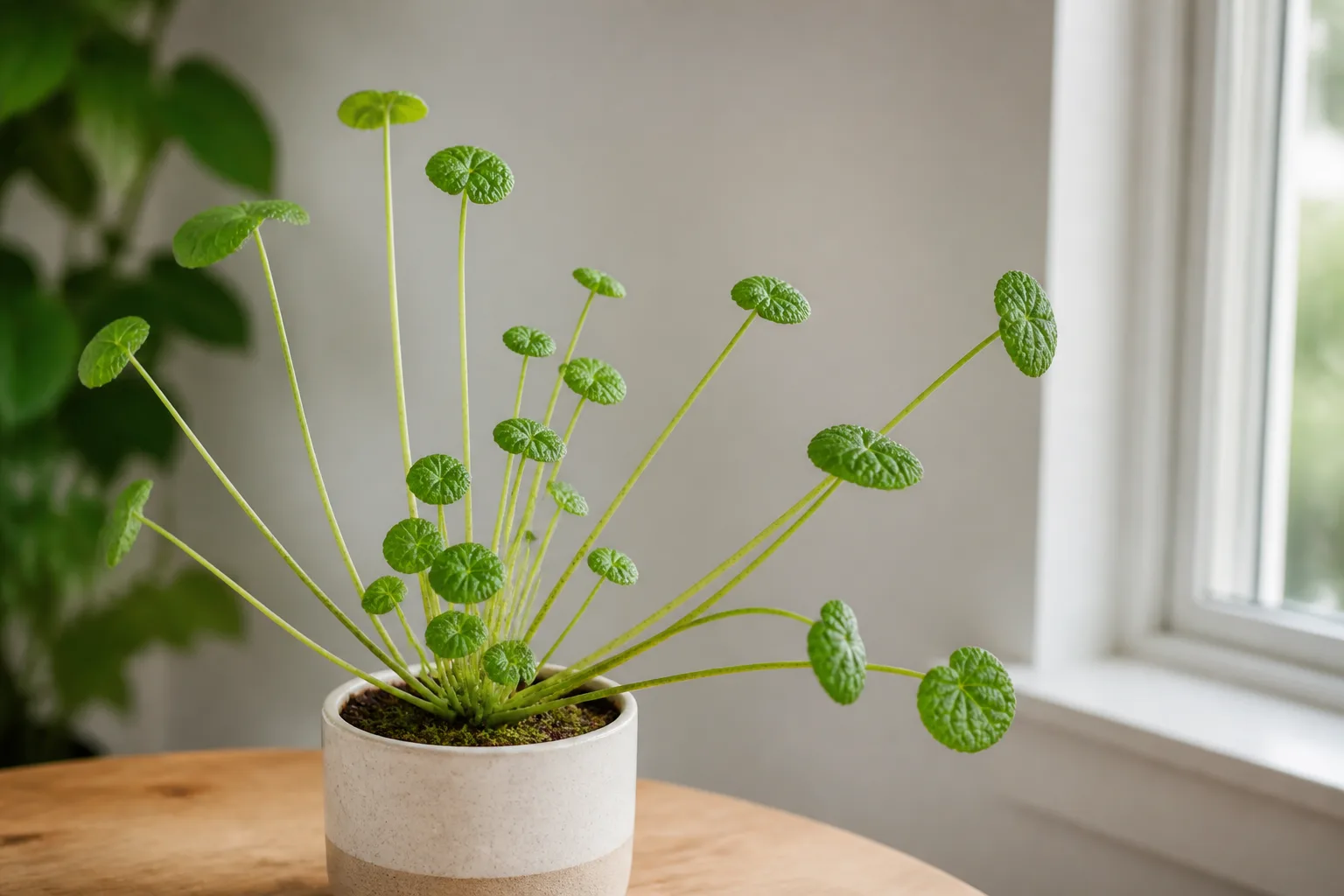
Leggy Growth on Pilea Moon Valley: Causes, Checks & Fixes
This guide covers leggy growth on Pilea Moon Valley. See also the general Leggy Growth guide, watering, and light pages for this plant.
Leggy Growth on Pilea Moon Valley: Causes, Checks & Fixes
Quick answer
Leggy growth on Pilea Moon Valley (Pilea mollis ‘Moon Valley’) means etiolation: the upright mound stretches internodes and produces long thin stem sections because the leaf surface is not receiving enough light to maintain its natural compact quilted habit. A healthy Moon Valley forms a dense mound roughly one foot tall with deeply puckered bronze-green leaves spaced closely along firm stems-not one stretched shoot with tiny pale foliage at the tip.
First step: move the pot to bright indirect light today, then wait for firmer puckered new growth before pinching or propagating bare sections. Existing elongated internodes will not shorten; the next quilted leaf from the crown-with tighter spacing and stronger texture-is your proof the fix worked.
Leggy growth vs. not enough light vs. light guide - which page to use
Moon Valley light problems overlap, but your primary symptom determines which guide fits best:
| Your main complaint | Start here | Why |
|---|---|---|
| Long gaps between quilted leaves; one dominant stretched tip | This guide (leggy growth) | Internode stretch and sparse mound architecture are the defining pattern |
| Faded bronze-green color, wet soil for weeks, stalled growth in a dim room | Not enough light | Broader dim-room syndrome beyond stretch alone |
| Window placement, grow lights, seasonal light limits | Light guide | Ongoing brightness requirements and warning signs |
Many Moon Valley specimens show both stretch and color fade. If internode gaps and a one-stem silhouette are your clearest signals, stay on this page for confirmation, trim timing, and propagation. If growth has stalled for months with constantly wet mix and yellow lower leaves, read the not enough light guide for the full six-step confirmation and watering correction.
What leggy growth looks like on Pilea Moon Valley
Leggy Moon Valley is easy to spot once you know what compact growth should look like. Missouri Botanical Garden describes an upright mounding cultivar with strongly puckered bronze-green leaves-stems stay short and bushy, not climb toward the ceiling.
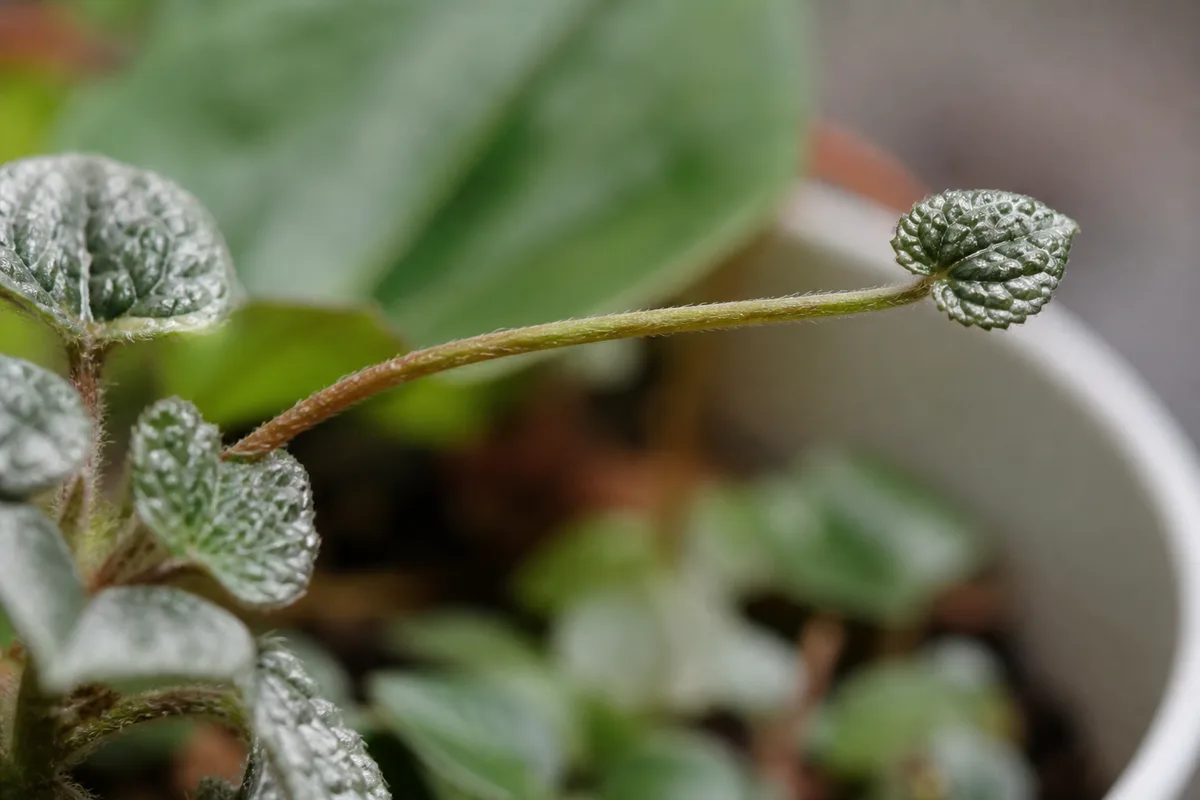
Leggy Growth symptoms on Pilea Moon Valley - compare with healthy tissue on the same plant.
Signature signs of etiolation on this species:
- Long thin stems with wide gaps between opposite quilted leaf pairs-classic etiolation as the plant stretches toward brightness
- Smaller, paler new leaves with flattened puckering-the crater-like ridges and bronze-green margins that define Moon Valley look less pronounced on weak new growth
- One dominant shoot shading the rest of the mound when pinching was skipped; new growth clusters only at one stretched tip
- Strong lean toward glass, a lamp, or the brightest corner-a common one-sided light response
- Open mound silhouette instead of a tight textured dome-every centimeter of reach is visible on this upright species, unlike trailing pileas that hide stretch along hanging stems
Moon Valley is often sold as an “easy terrarium plant,” which is partly why specimens linger on interior shelves looking superficially green while gradually losing density. By the time only one stretched tip carries tiny leaves, light has been insufficient for weeks or months-not days.
What leggy growth is not: Firm short stems close to the soil with only slight lean-that is normal mounding anatomy. Sudden yellowing with sour-smelling wet soil is not etiolation alone; it points to root stress in shade and may need crown inspection.
Why Pilea Moon Valley gets leggy
Low light and etiolation on a mounding cultivar
Moon Valley evolved in filtered tropical forest brightness, not a dim hallway. Its compact mounding habit and textured foliage are built for bright indirect light with moderate humidity, not a spot six feet into a south-facing living room where the room looks bright but the leaves receive almost no photons.
When daily light falls below what the plant needs, it stretches internodes and shrinks new leaves as it reaches toward brightness. Light intensity drops sharply with distance from windows; a pot more than six feet from the brightest glass is usually too dim for compact Moon Valley growth, even in a well-lit room.
Common indoor triggers:
- Decorative placement on interior shelves, terrarium corners far from glass, or pots blocked by furniture
- Winter short days when the same sill that worked in June delivers marginal brightness in December
- Skipping pinch stem tips during active growth, letting one dominant shoot extend and shade lower nodes
- Dust on quilted leaves, which reduces the light ridged tissue can intercept even when placement is otherwise correct
Wet-soil compounding in dim corners
A dim Moon Valley transpires slowly, so mix stays damp after your normal soak. Yellow lower leaves, soft stems at the crown, and fungus gnats often trace back to that wet-dry mismatch rather than a mysterious disease. If the pot feels heavy for weeks while stems stretch, suspect light before reaching for fungicide-and read overwatering if soil never dries within two weeks.
Over-fertilizing in shade
Nutrients cannot replace missing photons. Fertilizing a dim Moon Valley to “force bushiness” often produces soft floppy stretch rather than compact quilted foliage-the plant has building blocks but not enough light to assemble firm tissue.
How to confirm the cause
Work through these checks before repotting, fertilizing, or heavy pruning:
- Internode spacing - Measure bare stem between two adjacent quilted leaf pairs on the most stretched shoot. Gaps consistently wider than the spacing on mature foliage near the crown point to etiolation.
- Light at the plant, not the room - Stand at the pot at midday. Hold your hand between the leaves and the window. A soft, diffuse shadow means usable indirect light; no shadow suggests too dim; a sharp dark shadow means direct sun on leaves-a different problem.
- Window distance and direction - Note how many feet the pot sits from glass and which exposure it faces. More than six feet from the brightest window commonly produces leggy reach on Moon Valley.
- New-growth texture read - Compare the newest quilted leaf to mature foliage. Smaller, paler leaves with flattened puckering while roots feel firm and mix is moist (not sour) points to light, not rot.
- Soil moisture rhythm - Stick a finger into the top 2–3 cm of mix per the watering guide. If it stays damp two weeks after watering while stems stretch, metabolism is too slow-often because light is low.
- Rule out lookalikes - Firm crowns with only stretch point to light. Mushy crowns with sour wet soil point to root rot. Bleached crispy patches on window-facing leaves suggest too much direct sun. Fine webbing in leaf craters suggests spider mites-inspect textured surfaces with a hand lens.
If four or more checks confirm dim placement and internode stretch-and the plant is not receiving harsh direct sun that could also scorch textured leaves-you have enough evidence to fix light first.
The first fix to try
Move the pot to the brightest indirect location you can sustain-an east windowsill, a bright north exposure, or one to two feet back from filtered south or west glass with a sheer curtain.
Make one change: placement. Do not simultaneously repot, fertilize, or soak heavily. Moon Valley already stalls when stressed; stacking variables hides whether light was the real issue.
If the plant lived in deep shade for months, acclimate over seven to fourteen days rather than jumping straight onto an unfiltered west sill. Start farther from the window or behind a sheer curtain, then move closer every few days while watching for pale halos or midday leaf wrinkling on sun-exposed tissue. Avoid full sun through south or west glass-direct beams can scorch quilted pilea foliage faster than they solve stretch.
When natural light is insufficient-interior offices, north rooms that stay dim at midday, or short winter days-add a full-spectrum LED grow light 12 to 18 inches above the crown for 10 to 12 hours daily on a timer. Combine artificial light with the best window you have when possible; see the light guide for placement detail.
Do not change watering on the same day. Wait at least one week after the light move, then adjust to match how fast the top 2–3 cm of mix dries in the brighter spot.
Step-by-step recovery after the light move
Once the pot is in brighter indirect light, follow this order:
- Hold watering steady for one week - Note how fast the top 2–3 cm dries compared with the old spot. Brighter light usually means faster dry-down; dim corners meant slower use.
- Rotate the pot a quarter turn weekly - Mounding stems lean quickly. Even exposure helps new growth fill around the crown instead of only on one side.
- Wipe dust from quilted leaves monthly - Clean ridged foliage intercepts more usable light than dusty matte surfaces.
- Wait for new growth before pinching - Give the plant two to four weeks in improved light. If new leaves are firmer, more puckered, and closer spaced, pinch the top two nodes on long shoots to encourage branching.
- Skip fertilizer until growth looks stable - Feed stresses roots still rebalancing water use after a light change. Resume half-strength monthly feeding only when new quilted leaves look healthy for two weeks during spring or summer growth.
- Root check only if soil smells sour or stems soften at the base - Low light plus chronic wetness can progress to rot. If the crown feels firm and mix dries normally after the move, leave roots alone.
Pruning and propagating stretched stems
Light correction stops new leggy growth; it does not reverse existing bare sections. Elongated internodes on old stems are fixed once formed-they will not compact backward even in perfect light.
After at least one compact new leaf confirms the brighter placement is working-usually two to four weeks in the warm season-cut long bare stems just above a healthy leaf pair with clean shears. Moon Valley has opposite leaves on square stems; cut at the node-like junction where the leaf pair meets the stem, not through the middle of a leaf. For one severely leggy shoot, shorten it to a lower leaf pair at the height of the surrounding mound. Full technique lives in the pruning guide.
Spring and early summer are the safest windows for corrective cuts. Stem cuttings from pruned sections root easily in bright indirect light if you want to fill a sparse mound-but cuttings taken from a still-dim parent will stretch again. Fix light first, then propagate.
Recovery timeline and what improvement looks like
Expect two to four weeks before you can judge whether light correction worked, measured by new growth texture and spacing, not by old stems shortening.
- Weeks 1–2: The plant may look unchanged. Soil should dry slightly faster as photosynthesis increases. Avoid fertilizing.
- Weeks 2–4: New quilted leaves should emerge rounder, closer together, and more textured than the most recent pale growth. Side buds may break within days after pinching in good light.
- One to three months: Mound density improves as side shoots develop from nodes after optional pinching. A plant that looked open and sparse should tighten if you rotate weekly.
What will not recover: Elongated internodes on old stems, dropped leaves on bare crown sections, and any tissue damaged by secondary rot. Those stay as history while new growth carries the plant forward.
Worsening signs: Continued yellowing with sour-smelling wet soil, soft stems at the soil line, or new leaves that stay tiny and flat after six weeks in bright indirect light. Those point to root damage or a spot that is still too dim-recheck distance from glass and consider a grow light.
Lookalike symptoms to rule out
| What you see | Likely cause | Why it is not pure leggy stretch |
|---|---|---|
| Yellow leaves and soft crown with sour wet mix | Overwatering / root rot | Stems fail structurally; stretch may be secondary-see root rot |
| Limp quilted leaves, very light pot, dry mix throughout | Underwatering | Deep soak once; do not move farther from light-see underwatering |
| Bleached, crispy, or silvery patches on window-facing leaves | Too much direct sun | Damage is one-sided; internodes often stay compact |
| Fine webbing and stippling in leaf craters | Spider mites | Inspect textured surfaces; pests drain vigor on thin new shoots-see spider mites |
| Brown crisp edges on otherwise firm leaves in bright light | Low humidity | Stems are not elongated; puckering may still be strong-see low humidity |
| Slower growth in short days only | Normal winter slowdown | Supplement light or wait for longer days; do not overwater to “wake up” a dim winter plant |
Yellow leaves in a dim corner with wet soil are a common overlap: low light slows water use, chronic wetness stresses roots, and foliage yellows while stems may also stretch. Fix light and reduce watering frequency together.
Mistakes to avoid
- Jumping from a dark shelf to unfiltered south or west sun to fix stretch quickly-scorch risk on textured leaves is real
- Fertilizing heavily in the same dim corner instead of moving closer to a window
- Pruning before light correction-you remove photosynthetic surface while conditions are still dim
- Judging success by old stretched stems-only new crown growth tells you the fix worked
- Assuming terrarium placement equals enough light-closed glass helps humidity but does not replace brightness at the leaf surface
- Propagating cuttings from a still-dim parent-new plants will stretch again until light is adequate
How to prevent leggy growth next time
Place Moon Valley where bright indirect light reaches the crown and upper stems, not only where the pot looks good decoratively. East windows, bright north sills, and filtered south or west rooms are the long-term targets-not interior walls far from glass.
Rotate the pot weekly. Re-check exposure at the spring equinox when sun angle increases on windows that were safe all winter. Clean leaves and windows when grime cuts intensity. In dark homes, run a grow light on a timer through winter rather than accepting etiolation until February.
Pair light awareness with dry-down watering per the watering guide. When you move the plant brighter, expect faster moisture use; when you must keep it in medium light, stretch the interval between soaks. The checkpoint that prevents repeat problems: firm puckered leaves on short new internodes and a pot that dries on a predictable rhythm.
When to worry
Escalate when low light and wet soil overlap: yellowing that spreads up the stem, fungus gnats, soft tissue at the crown, or mix that never dries within two weeks of watering. That pattern can become root rot quickly on Moon Valley’s compact root system.
Slow stretch alone-firm stems, no smell, soil drying normally-is not an emergency. Move to better light this week and adjust water next. Sudden leaf bleach after a placement change needs immediate shade, not more brightness.
Related Pilea Moon Valley guides
- Overview - species context, terrarium use, humidity
- Light - window placement and grow-light detail
- Not enough light - full dim-room confirmation and watering correction
- Pruning - pinching technique and division timing
- Propagation - rooting leggy cuttings after light fix
- Watering - top 2–3 cm dry-down rhythm
Conclusion
Leggy Pilea Moon Valley is a light problem expressed as architecture-long internodes, a sparse mound, and flattened puckering on weak new growth. Move to bright indirect light as the first fix, acclimate if the plant lived in deep shade, wait for firmer quilted new leaves over two to four weeks, then pinch or propagate the stretched sections. Old bare stems will not revert; the next textured leaf from the crown is your proof the fix worked. If stretch is only part of a wider dim-room picture-wet soil, stalled growth, yellow lower leaves-continue with the not enough light guide; if stems are mushy or collapsing, use the root rot guide instead.