Leggy Growth on Peace Lily: Causes, Checks & Fixes
Quick answer
Leggy growth on Peace Lily is etiolation-long petioles and wide gaps between leaves as the clump reaches for light. First step: move to bright indirect light 30–60 cm back from an east window, rotate weekly, then prune the longest stretched petioles at the base after two to three compact new leaves confirm the brighter spot works.
Leggy Growth on Peace Lily: Causes, Checks & Fixes
This guide covers leggy growth on Peace Lily. See also the general Leggy Growth guide, watering, and light pages for this plant.
Leggy Growth on Peace Lily: Causes, Checks & Fixes
Quick answer
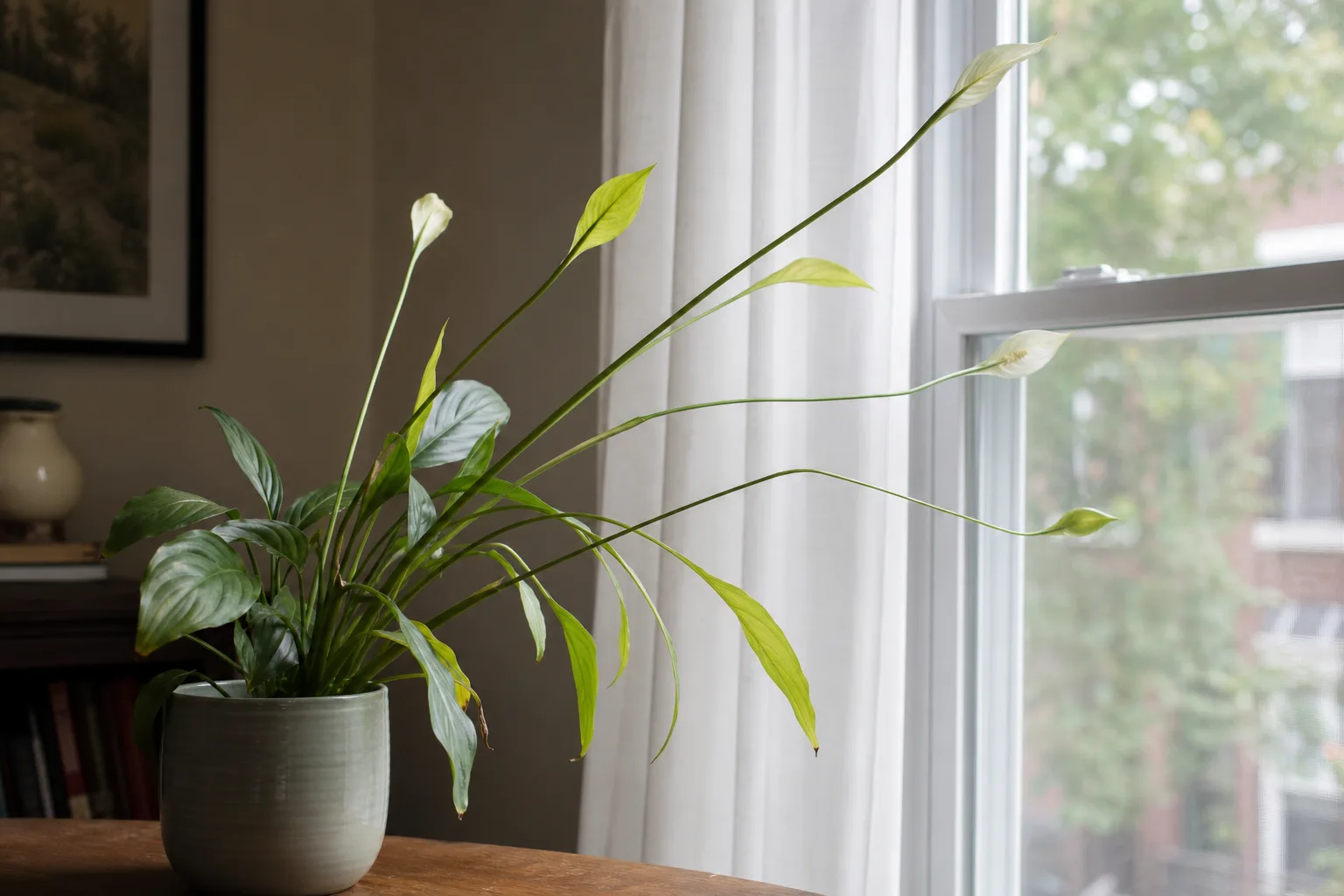
Leggy growth on Peace Lily (Spathiphyllum wallisii and common hybrids) is etiolation-the clump stretching toward photons when light is too weak for compact architecture. Long petioles (leaf stalks), wide gaps between blades, smaller pale new leaves, and a lean toward the brightest window are the signature pattern. White spathes usually stop entirely while the plant survives on dark green foliage.
First step: relocate to bright indirect light 30–60 cm (12–24 inches) back from an east-facing window, or filtered south/west glass at 1–2 metres-and rotate the pot weekly. Do not fertilize heavily on the same day. Old stretched petioles will not shorten on their own; plan to prune the longest stems at the base after two to three compact new leaves confirm the brighter spot works.
Scope note: This page is your etiolation morphology, pruning, and division-recovery guide. For placement diagnostics-shadow tests, foot-candle targets, grow-light shopping, and window-by-window relocation-use not enough light. For everyday light ranges and window orientation, see the Peace Lily light guide.
Leggy growth vs not enough light vs thin clumps on Peace Lily
All three problems often share insufficient photons, but owners search them for different reasons. Use this page when long petioles, wide leaf spacing, pruning depth, or division after stretch are the headline.
| Your main question | Start here | Also check |
|---|---|---|
| Long petioles with wide gaps; plant leans hard toward glass | This page - etiolation and pruning | Not enough light if you have not confirmed placement |
| Pale leaves, no spathes, wet soil in a dim corner | Not enough light - placement audit | This page once light is corrected but stems stay long |
| Even spacing but thin slow growth in a bright window | Propagation - division | Crowded clump, not relocation |
| Soft floppy dark green stems in already-bright light | Reduce fertilizer | Light deficit ruled out first |
| Yellow lower leaves on wet soil in dim corner | Overwatering | Low light slows dry-down-fix both |
Improving light addresses stretch and missing spathes together. Prune elongated petioles after brightness increases, not before-you need compact new growth to judge success.
What leggy growth looks like on Peace Lily
Etiolation on Spathiphyllum reads as architecture first-structure tells you light is marginal even when older leaves still look dark green.
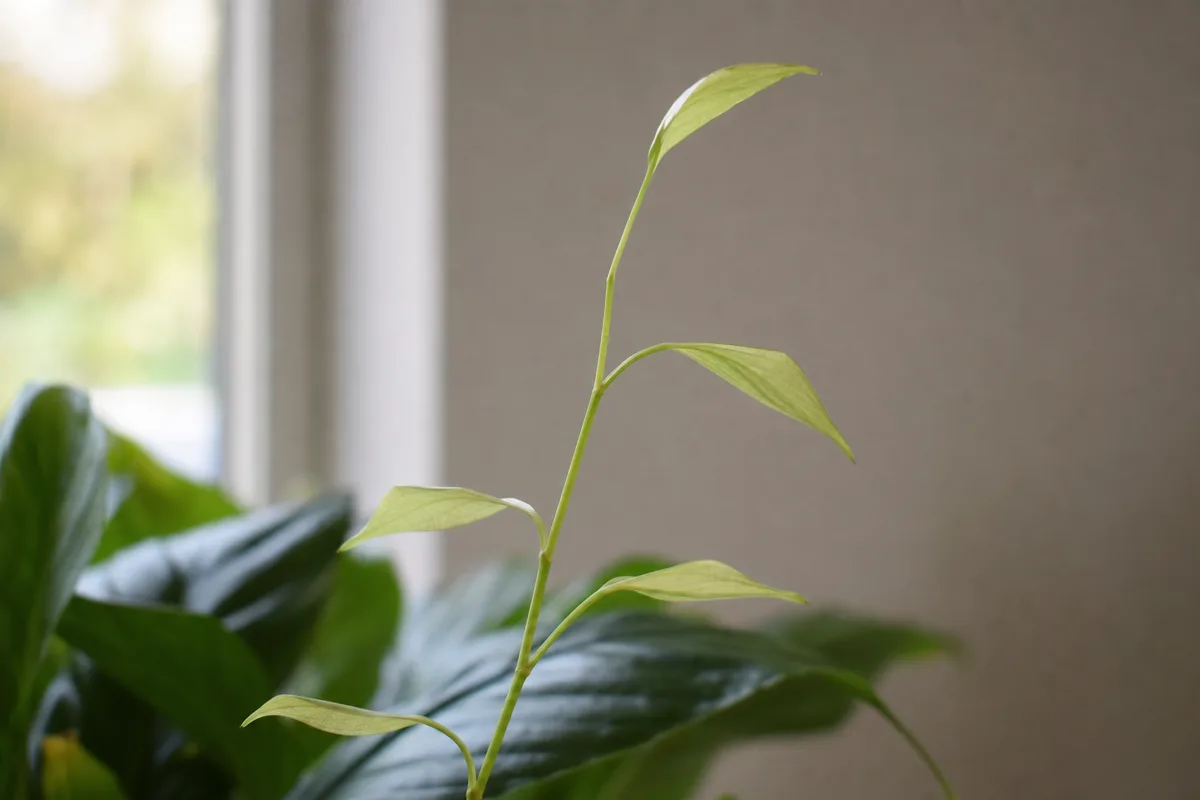
Leggy Growth symptoms on Peace Lily - compare with healthy tissue on the same plant.
Primary peace-lily-specific signals:
- Long thin petioles pushing leaves farther from the crown toward the brightest direction
- Wide gaps between leaf blades at the crown-spacing that widens on each new leaf
- Smaller, paler new blades compared with older foliage formed in better light
- Directional lean toward one window, doorway, or desk lamp
- No white spathes for months-even when foliage looks lush
- Lower leaves yellowing and dropping as the plant sheds shade leaves it can no longer support
- Soil staying wet one to two weeks after watering because transpiration slowed in dim light
What compact healthy growth looks like for comparison:
- Moderate petiole length with blades clustered reasonably tight at the crown
- Glossy dark green leaves roughly proportional to the pot size
- Occasional white spathes on mature clumps in bloom-reliable light
- Top 3–5 cm of mix drying within a predictable rhythm for your room
What winter slow growth looks like-different urgency:
- Growth pauses or slows uniformly in short days without dramatic new petiole stretch
- Existing leaves may age normally-lower senescence is not etiolation
- Concern is warranted when new growth keeps spacing out on the same sill through winter while the plant leans
Peace lilies in survival mode often stay dark green and large as the plant expands chlorophyll capture area. That can look healthy while spathe production stops entirely-a distinction the light guide calls bloom-capable versus bloom-reliable low light.
Why Peace Lily gets leggy
Spathiphyllum evolved on tropical forest floors where tree canopy filters harsh midday sun into steady diffuse light. These understory tropical aroids tolerate dim rooms better than most flowering houseplants-but tolerance is not the same as enough light for compact growth.
Phototropism and etiolation. When photon supply falls below what the species needs for tight architecture, stems and petioles elongate toward the brightest source. Warm rooms plus weak light accelerate stretch because metabolism runs on limited energy while cells keep reaching.
Forest-floor biology indoors. Clemson HGIC notes peace lilies tolerate low light but grow best in bright indirect exposure-and should not sit in direct sun because heat scorches foliage. Far from windows, petioles elongate toward glass. The plant survives; it does not stay compact.
Over-fertilizing in low light. Nitrogen pushed into a dim clump often produces soft floppy dark green growth rather than bushiness-stems that lean and feel weak without the tight spacing bright light provides. Do not feed heavily until light improves and new leaves look firm.
Crowded clump vs genuine etiolation. A root-bound peace lily in already-bright indirect light may show thin interior stems with even spacing-not lean toward the window. That pattern points to division rather than relocation. Chronic lean with small pale new leaves confirms active light searching.
The dim-room overwatering trap. A stretched peace lily in a back shelf transpires slowly. Owners who keep a bright-window watering rhythm see yellow leaves and sour soil-symptoms labeled overwatering that start when light slows metabolism.
Winter light drop. Shorter days and lower sun angle reduce usable light at the same window coordinates. Growth that was compact in summer may come out stretched from late fall through early spring unless you move the plant closer or add supplemental lighting.
Case note (March 2026 grower log): A peace lily moved from a north-facing interior shelf to 45 cm back from an east window showed new petioles roughly one-third shorter within three weeks. Old stretched stems remained until trimmed at the base; the first white spathe appeared 10 weeks after relocation on a mature clump.
How to confirm the cause
Work through these checks before Peace Lily repotting guide, fertilizing, or heavy pruning:
-
Petiole length on newest growth - Compare the last two to three leaves at the crown. Petioles noticeably longer than older foliage formed in better light point to ongoing etiolation.
-
Lean direction - Rotate the pot; new growth should lean toward the brightest side. Chronic lean with small pale new leaves confirms phototropic stretch.
-
Shadow test at leaf height - At midday, hold your hand between the top leaves and the window. A soft, fuzzy shadow with indistinct edges suggests moderate usable light. Almost no shadow means too dim for compact growth; a sharp dark shadow means direct sun strong enough to burn peace lily leaves (UF/IFAS home guidance lists bright indirect with no direct sun as the baseline).
-
Foot-candle reading (optional) - A meter or app at leaf height toward the window: 150–300 fc supports healthy foliage and regular spathes; 50–100 fc often means survival with stretch; below 50 fc growth stalls (UF/IFAS EP161 commercial production targets far higher under shade cloth, confirming bloom initiation needs a real energy threshold).
-
Spathe history - No white flags for 12+ months in a dim corner strongly supports light as the limiter on a mature clump.
-
Dry-down rhythm - Note how many days until the top 3–5 cm feel dry. Continued wet soil for 10+ days in the same dim spot pairs low light with root-stress risk.
-
Rule out lookalikes - Confirm mix is not waterlogged, roots are not mushy, and spacing is not even-but-thin in bright light before blaming etiolation alone.
Confirmation test: Move to brighter indirect light for two weeks without changing fertilizer or pot size. If the next leaf opens on a shorter petiole with darker green color, light was the limiter. If spacing stays wide in a confirmed bright window with no lean, consider division.
First fix for Peace Lily
Relocate to the brightest indirect spot available-30–60 cm back from an east-facing window, or filtered south/west glass at 1–2 metres-and rotate the pot weekly.
The RHS recommends keeping peace lilies near a window but out of direct summer sun for strong growth and flowering. Missouri Botanical Garden describes Spathiphyllum as plants that do well in lower light indoors but prefer bright filtered light for compact growth.
Do not jump from a dark corner onto a hot south sill in midday sun. Shade-adapted leaves need gradual acclimation or tissue bleaches and crisps. Wipe dust from glossy leaves so they capture more light after the move.
If no suitable window exists, add a full-spectrum LED grow light 15–30 cm above the foliage for 12–14 hours daily. Center the lamp over the crown, not off to one side.
Make this one change first. Wait two to three weeks before heavy pruning so you can read the plant’s response on new leaves clearly.
Step-by-step recovery: light, then prune
After choosing the brighter spot, follow this sequence:
-
Move in stages if light increase is large - Step closer to the window over 7–14 days, or hang sheer curtains before removing them, when the plant formed leaves in very low light.
-
Monitor the next two to four new leaves - Look for shorter petioles, darker green color, and tighter spacing at the crown. This is your proof the fix worked.
-
Prune stretched petioles at the base - Once compact new growth appears, cut the longest horizontal stems at the soil line or crown junction with clean sharp scissors. Remove roughly one-third of the most elongated foliage per session, not the entire clump at once. See pruning guidance for tool hygiene and crown access on dense clumps.
-
Adjust watering immediately - Brighter light means faster dry-down. Recheck the top 3–5 cm before every drink instead of following a calendar tied to dim-corner metabolism.
-
Rotate weekly - Quarter-turn the pot so growth does not permanently lean toward one pane.
-
Hold fertilizer - Do not feed to “force” bushiness. Light drives compact architecture; nutrients support processes the plant already has energy to run.
-
Divide if crowded - When spacing is even but thin in bright light with roots circling the pot, split the clump per the propagation guide rather than relocating again.
Pet safety: Peace Lily is toxic to cats and dogs if chewed. Wear gloves when pruning if you have sensitive skin; keep cut debris and bright window sills out of pet reach. Contact your veterinarian if a pet ingests any part of the plant.
Recovery timeline
Expect shorter petioles and darker new leaves within two to three weeks after light improves. White spathes on mature plants typically return two to three months later-not on the first new leaf after a move.
Old stretched petioles and pale blades do not shorten or re-green-trim them at the base if they spoil the silhouette, or leave them until replaced naturally. Judge success by the next two or three leaves and the first new spathe.
After pruning, the clump may look sparse for one to two weeks before new compact foliage fills the crown. That bare period is normal-do not overwater or overfeed to compensate.
Winter corrections may show little until day length and warmth increase-plan on six to ten weeks after conditions improve before deciding the fix failed.
Worsening signs: continued small pale leaves with yellowing on wet soil, soft stems, or sour-smelling mix mean the diagnosis is incomplete-re-check roots and watering rather than only adding light.
Lookalike symptoms to rule out
| Pattern | Petiole spacing | New leaf color | Soil / roots | First fix |
|---|---|---|---|---|
| Etiolation (this page) | Long new petioles; lean toward light | Smaller, paler blades | Often slow dry-down in dim rooms | Brighter indirect light, then prune |
| Low light placement | Long petioles, no spathes | Pale or dark green survival foliage | Wet soil weeks in dim corner | Not enough light - relocation audit |
| Overwatering in dim corner | May stretch if light also low | Yellowing lower leaves | Wet mix 10+ days; soft roots | Dry-down correction + light |
| Root-bound clump | Thin slow growth despite bright window; even spacing | Normal color; no lean | Roots circling pot | Division or repot |
| Nitrogen excess | Soft floppy growth in bright light; no lean | Dark green, weak stems | Normal dry-down | Reduce feed; rule out light deficit first |
| Sunburn after sudden move | Not primary | Bleached or crisp patches on window side | Normal dry-down | Pull back; acclimate gradually |
| Normal winter pause | Little new growth; old spacing unchanged | No new leaves to compare | Seasonal dry-down | Wait for spring; optional grow light |
Use new growth as the tiebreaker. If the youngest leaves keep arriving on longer petioles while the plant tilts toward glass, etiolation is active-not dormant winter rest or a feeding shortage.
Mistakes to avoid
Do not prune heavily before fixing light. Cutting a stretched clump in the same dim corner often produces another round of elongation within weeks.
Do not assume fertilizer creates bushiness in low light. Over-feeding in dim rooms produces soft floppy stems, not compact clumps.
Do not move instantly from deep shade to unfiltered south glass. Acclimate over one to two weeks to prevent scorch on shade-formed leaves.
Do not ignore wet soil in a dark corner. Slow growth plus damp mix is a common path to root rot on Peace Lily on desk and shelf specimens.
Do not expect old petioles to shorten after relocation. Only new leaves emerge compact; trim old tissue or wait for natural replacement.
Do not confuse dark green survival foliage with proof of adequate light-large chlorophyll-rich leaves in dim corners often mask years without spathes and ongoing stretch.
Do not place bright-window pots within pet reach. Peace Lily contains insoluble calcium oxalates that irritate mouth and GI tract if chewed.
Peace Lily care cross-check
Light interacts with every other variable on a clumping tropical aroid:
- Watering - Water when the top 3–5 cm dries or leaves first droop on dry soil-not on wet soil. After a bright move, check more often per the watering guide.
- Humidity - 50–60% helps leaf margins in dry heating seasons; low light is not fixed by misting alone.
- Temperature - MOBOT lists 68–85°F as ideal; cold drafts near windows in winter stall growth even when light looks adequate.
- Pruning hygiene - Sterilize blades between cuts on yellowed or mushy tissue; discard debris away from pets.
- Foot-candle target - Aim for 150–300 fc at the leaf canopy for bloom-reliable compact growth, aligned with the light guide and overview.
How to prevent leggy growth next time
Place peace lilies where the leaf canopy sees the window, not just where the decorative pot fits the room layout. For floor specimens, shorten the display stand or move the pot forward into the light cone.
Rotate the pot every one to two weeks. Clean window glass and sheer curtains seasonally; grime blocks more photons than many owners realize.
Audit rooms seasonally-winter light at the same coordinates can drop below compact-growth threshold even when you have not rearranged furniture.
Use grow lights in offices, north-facing rooms, and during short winter days. Aim for 12–14 hours of supplemental light when natural levels drop per the light guide.
Divide overcrowded clumps every two to three years before interior stems compete for the same dim center of a dense crown.
Choose placement before buying a heavy cachepot you cannot easily move-peace lilies outgrow dim spots within a season when otherwise healthy.
When to worry
Leggy etiolation alone rarely kills Spathiphyllum. Investigate promptly when stretch pairs with:
- Wet soil for weeks and spreading yellow leaves
- Soft stems at the soil line or sour-smelling mix
- Complete stall in new growth for two months after corrected light and warm temperatures
- Bleached or crisp patches after a sudden bright move-sunburn, not etiolation
In those cases, unpot and inspect roots before assuming more light or more pruning will solve everything.
How this page fits the Peace Lily cluster
| Your question | Best page |
|---|---|
| Long petioles after light is fixed; how far to prune | This page |
| Is my room too dim? Window placement audit | Not enough light |
| Foot-candles, windows, grow lights long term | Light guide |
| Wet soil in a dim corner | Overwatering |
| Crowded clump; when to divide | Propagation |
When to use this page vs other Peace Lily guides
- Peace Lily watering guide - Use for routine moisture checks before assuming leggy growth is the main issue.
- Peace Lily problems hub - Browse all 4 common issues on this species.
- Yellow Leaves on Peace Lily - Different entry point when symptoms overlap with leggy growth.
Related Peace Lily guides
- Peace Lily overview
- Peace Lily watering
- Peace Lily light
- Peace Lily soil
- Yellow Leaves on Peace Lily
- Peace Lily problems
- Brown Tips on Peace Lily
- Root Rot on Peace Lily
Related tool
Use the Plant Problem Diagnosis Tool to narrow causes for leggy growth on this plant before changing multiple variables at once.