Oxalis Triangularis Soil: Mix, Depth & Drainage
Oxalis Triangularis Soil: Mix, Depth & Drainage
Oxalis Triangularis Soil: Mix, Depth & Drainage
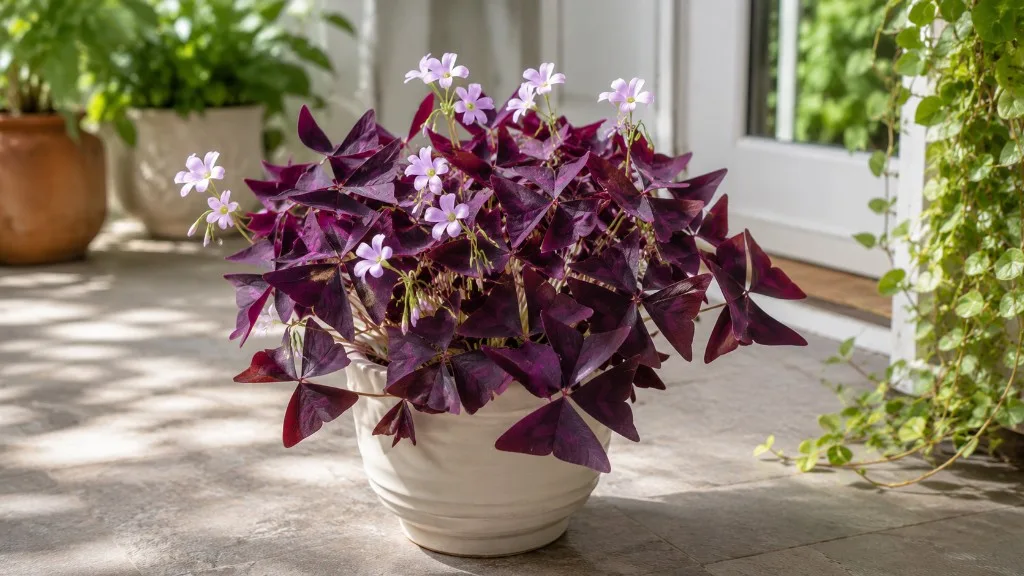
Oxalis triangularis - the purple shamrock or false shamrock sold in almost every houseplant aisle - is not struggling because you forgot a magic ingredient. It is struggling because the soil system around its corms is either too wet, too deep, or too compacted for too long. The corm is a condensed underground stem that stores energy and pushes up those triangular purple leaves; it tolerates brief dryness far better than it tolerates sitting in a waterlogged bulb mix. Get the substrate right - a well-draining peat-perlite blend, a shallow planting depth, and a pot that actually drains - and watering, light, and dormancy care become predictable. Get it wrong, and you will chase yellow leaves and collapsed growth while the corm rots quietly below the surface.
This guide covers what Oxalis triangularis needs from soil, why saturated mix kills corms, the exact peat-perlite recipe that works indoors, how deep to plant corms, which pots cooperate with fast drainage, when pH matters, how to refresh mix at repot, and the mistakes that cause most purple shamrock failures.
What Oxalis triangularis actually needs from its soil
Oxalis triangularis is a bulbous perennial in the Oxalidaceae family, native to parts of Brazil and neighboring South America, where it grows in freely draining forest-floor conditions with regular moisture but strong aeration. Indoors, your job is not to recreate a rainforest floor that stays damp for days. Your job is to build a mix that holds enough moisture for fibrous feeder roots while never trapping the corm in a wet zone after you water. That is a narrower target than most foliage houseplants need, and it is why generic “indoor potting soil, straight from the bag” fails so often with Oxalis Triangularis overview.
The useful mental model is a two-zone root system: fine roots explore the upper and middle mix for water and nutrients, while the corm sits slightly below them in a zone that should dry noticeably between waterings. If the entire pot profile stays evenly moist for four or five days in a typical bright room, the mix is too retentive for Oxalis triangularis, no matter how beautiful the plant looked at the nursery.
Corms, not fibrous roots - why that changes the mix
People call them bulbs, rhizomes, or tubers depending on the label, but Oxalis triangularis grows from corms - short, scaly, pine-cone-shaped structures that are technically condensed stems. NC State Extension describes the underground structure as rhizomes with scale leaves that store water and nutrients, functionally like an elongated bulb. Corms do not behave like the thick, woody root crowns of a peace lily or the fine, fragile net of a fern. They are storage organs that can shrivel safely during dormancy but swell and split apart when rot pathogens move in.
That anatomy changes soil priorities in three practical ways. First, the corm itself is more rot-prone than fibrous roots when oxygen is low. Second, new shoots emerge from the top of the corm, which means burying it too deep delays emergence and keeps the growing point in colder, wetter mix longer. Third, Oxalis triangularis multiplies by producing new corms near the soil surface; a dense, waterlogged profile discourages that healthy colony behavior and replaces it with a single rotting mother corm and a few weak stragglers.
The moisture balance that keeps corms alive
Oxalis triangularis is often described as liking “evenly moist” soil, which is accurate only if you translate it correctly. Evenly moist does not mean continuously wet. It means the mix should never bone-dry so hard that the corm desiccates during active growth, but the top 2–3 cm (about an inch) should dry before the next thorough watering. The corm zone should approach dryness on a rhythm your room supports - typically a few days in bright active growth, longer in cool dormancy.
A peat-perlite houseplant mix hits this balance well because peat (or peat-free coco coir substitutes) holds water in thin films around particles where roots can access it, while perlite creates non-capillary pores that let excess water drain and air refill the spaces. Pure peat alone is a mistake for this plant in most homes: it stays wet too long on the bottom even when the surface looks acceptable. Pure perlite or straight cactus mix is the opposite mistake - it dries so fast that you are constantly chasing moisture stress unless you water very frequently and watch the plant closely.
Why waterlogged mix is the fastest path to corm rot
If there is one soil rule for Oxalis triangularis, it is this: avoid waterlogged mix at all costs. New York Botanical Garden warns that wet soil is a quick way to kill a false shamrock plant - waterlogging means the pore structure of the mix cannot drain and aerate fast enough for the volume of water your watering style and environment deliver. A perched water table forms at the bottom of the pot - a saturated layer that does not drain away because capillary forces hold it in place - and corms sitting in or just above that layer are in the danger zone.
This is why a drainage hole is non-negotiable for long-term indoor culture, and why “I am careful with water” does not save a plant in dense, composted, peat-heavy mix inside a tall cachepot with no exit for runoff. NC State Extension recommends a loamy potting mix with good drainage - the problem is structural, not moral.
What happens when corms sit in saturated mix
When corm tissue stays in low-oxygen, wet conditions, cells begin to break down. Soft, mushy corms smell sour or musty when you unpot - a sharp contrast to the firm, plump feel of a healthy dormant corm. Common opportunistic pathogens associated with wet houseplant mix - Pythium, Phytophthora, Fusarium, and various bacterial soft rots - do not need a dramatic flood to colonize tissue; they need persistent moisture and reduced airflow.
The damage often shows up late in the leaves. By the time stems collapse or new growth fails to emerge after dormancy, the corm may already be gone. You might see yellowing, wilting despite wet soil, or a plant that folds its leaves on schedule but does not reopen them with morning light. Those are leaf-level alarms for a root-zone problem that started in the soil profile days or weeks earlier.
Early warning signs your soil is holding too much water
You do not need to unpot every week to read the soil. Surface cues tell you a lot. Water that sits on top and will not infiltrate means the mix has become hydrophobic or compacted. A green algae or moss crust on the soil surface usually means the top stays wet too long. A sour, swampy smell when you press your finger into the mix is anaerobic activity - roots and corms are losing the oxygen race.
Weight cues matter too. If a pot still feels heavy three or four days after a thorough watering in a bright room during active growth, the mix is too retentive or the pot is too large for the root mass. Growth cues include persistent yellow leaves on older stems while the soil remains damp, new shoots that emerge pale and stunted, or a plant that goes dormant early because the corm is stressed rather than following a natural seasonal rhythm. Any of these should trigger a soil and drainage audit before you change fertilizer, light, or humidity.
The best peat-perlite bulb mix recipe for indoor Oxalis
The most reliable Oxalis triangularis soil mix for indoor growers is a well-draining bulb mix built from a quality houseplant potting base amended heavily with perlite. Think “standard potting mix plus aeration,” not “desert cactus mix” and not “moisture-retentive African violet blend.” The goal is a loose, chunky profile that water moves through in seconds, not minutes.
For a single 15–20 cm (6–8 inch) pot, this baseline recipe performs well across a wide range of homes:
| Component | Proportion | Role |
|---|---|---|
| All-purpose peat-based or peat-free houseplant potting mix | 60–70% | Structure, baseline nutrients, moderate moisture retention |
| Perlite | 25–30% | Drainage, aeration, reduces compaction |
| Optional: fine orchid bark or coarse horticultural sand | Up to 10% | Extra drainage in humid rooms or dense base mixes |
Mix dry in a bucket until the perlite is evenly distributed. The finished texture should look speckled and feel light in your hand. When you squeeze a handful, it should hold together briefly and then fall apart when you open your palm - not form a tight mud ball.
Standard proportions: potting mix, peat, and perlite
If you are mixing from raw components rather than a bagged houseplant blend, a classic peat-perlite bulb mix for Oxalis triangularis is two parts peat moss (or coco coir) to one part perlite, with a small amount of compost or worm castings - no more than 10% of the total volume - for baseline fertility. That ratio mirrors what many commercial “seed starting” and “bulb” mixes aim for: enough organic matter to buffer moisture, enough perlite to keep the corm zone breathable.
Using a pre-made houseplant potting mix plus 25% perlite by volume is usually simpler and perfectly adequate. Measure by volume, not weight. A scoop of potting mix and a quarter scoop of perlite per scoop is the easiest kitchen-scale method. Do not eyeball “a handful” across an entire pot; uneven perlite distribution creates wet pockets that rot corms while the rest of the pot looks fine.
Can you use regular potting soil alone? Only if it is a genuinely light, modern blend and you are a disciplined checker of moisture - and even then, amending with perlite is cheap insurance. Most mass-market indoor mixes are designed for moisture-loving foliage plants and will stay wet too long at the bottom of a pot sized for Oxalis triangularis.
Optional amendments for humid homes and heavy-handed waterers
If you live in a humid climate, keep plants in a steamy bathroom, or tend to water when in doubt, push drainage further. Add up to 10% coarse horticultural sand or fine orchid bark to the recipe above, or bump perlite toward the top of the 30% range. Bark creates large pores that break capillary continuity - water drains faster, and the mix dries more evenly from top to bottom.
In very dry, heated winter air, pulling back toward 20–25% perlite is reasonable, but do not eliminate it. Oxalis triangularis still needs aeration; dry air does not justify a soggy bottom. Pumice can substitute for part of the perlite if you want a heavier mix that stays more stable in top-heavy pots, though it is optional, not required.
Avoid mixing in garden soil, heavy compost, or water-retaining crystals. Each of those pushes the profile toward waterlogging. Slow-release fertilizer can be incorporated lightly at repot - follow label rates - but liquid feeding during active growth is usually enough for a plant this size.
Shallow planting depth - getting corm depth right
Soil recipe and planting depth work as a pair. A perfect peat-perlite blend still fails if the corm is buried like a tulip bulb in a deep cold frame. Oxalis triangularis corms need shallow planting depth so the growing point sits close enough to warmth, light, and air to emerge quickly, and so the upper mix dries on the schedule this plant expects.
How deep to plant Oxalis triangularis corms
Plant corms with the narrow, pointed end facing up and the broader base down. If you are unsure, place them on their side; shoots still find their way, but upright is faster. Cover with mix so the top of the corm sits roughly 2.5–4 cm (1 to 1.5 inches) below the finished soil surface. Horticultural references commonly cite 3–5 cm (about 1–2 inches) total cover from the pot surface to the corm top; both ranges converge on the same practical point: shallow, not buried deep.
Space corms 3–5 cm (1–2 inches) apart if you want a full pot quickly, or slightly wider if you are starting with large mature corms that will multiply on their own. After covering, water lightly to settle the mix without saturating it. Keep the pot in Oxalis Triangularis light guide and wait; emergence can be slow at first, then surprisingly fast once shoots anchor.
When Oxalis Triangularis repotting guide an established plant, replant divisions at the same depth they grew before, not deeper. The crown where stems meet soil should remain visible or only lightly covered. Burying established corms deeper at repot is one of the most common ways people turn a healthy division into a stalled, rot-prone clump.
Why deep planting slows growth and raises rot risk
Below about 5 cm (2 inches) of cover, emergence slows markedly in most indoor conditions. The growing point spends more time in cool, low-light, high-moisture mix before it reaches air and light. That extra time is rot opportunity. Deep planting also mimics a deeper water table in the pot: the corm sits in a layer that stays wet longest after each watering, exactly where oxygen is lowest.
Shallow planting does not mean leaving corms exposed on the surface. A thin cover protects against desiccation and temperature swings. The target is just enough mix to anchor the corm and hide it from direct sun on the surface, not enough to simulate a bulb lasagna layered for outdoor frost protection.
Pot choice and how it affects soil performance
Soil cannot drain in a pot that will not let water leave. Every Oxalis triangularis container needs a drainage hole in the bottom. Decorative cachepots are fine only if you lift the growing pot out to water and empty runoff - never let the inner pot sit in a permanent puddle.
Shape matters as much as holes. Oxalis triangularis has shallow feeder roots and a corm zone near the surface, not a deep taproot. A wide, shallow pot dries more evenly and matches corm architecture better than a tall, narrow cylinder that holds a deep column of wet mix below a small root mass. This is the same logic that makes bulb pans work for crocus indoors.
Size discipline is critical. Choose a pot only slightly larger than the corm mass and attached roots - often 10–15 cm (4–6 inches) wide for a single starter corm, moving up one size at repot. An oversized pot holds excess mix that the roots cannot use quickly; that unused mix stays wet and becomes the rot reservoir people blame on “overwatering on Oxalis Triangularis” when the real issue is excess soil volume.
Terracotta is a useful ally in humid homes because it breathes through the walls and accelerates drying on the sides. Glazed ceramic is fine with a good mix and careful watering. Plastic is forgiving for beginners if you amend aggressively with perlite and respect dry-down checks. Whatever material you choose, match it to how fast your room dries pots, not to how the pot looks on the shelf.
pH, minerals, and when soil chemistry actually matters
Oxalis triangularis tolerates a slightly acidic to neutral pH range, roughly 6.0–7.0, which is where most peat-based and peat-free houseplant mixes already land - matching NC State Extension guidance of neutral to slightly acid soil pH. For typical indoor culture, you do not need a pH meter or sulfur amendments. Fresh, well-draining mix refreshed on a sensible repot cycle keeps chemistry in the usable band.
Where chemistry does intrude is salt buildup from hard tap water or heavy fertilizer use in a small pot. Leaf edge burn, whitish crust on the soil surface, and stalled growth despite good light can all point to elevated soluble salts. Flush the pot with water equal to several pot volumes, let it drain fully, and empty the saucer. If crust returns within weeks, refresh the mix at the next repot and reduce fertilizer strength rather than chasing individual mineral tweaks.
Oxalis triangularis contains oxalates - the same class of compounds that give the genus its name - which is relevant to pet safety but not to soil choice directly. The ASPCA lists Oxalis spp. as toxic to cats, dogs, and horses due to soluble calcium oxalates. Wash hands after handling damaged tissue, and keep the plant out of reach of curious pets.
Repotting and refreshing the mix without stressing the plant
Even a good peat-perlite blend breaks down over 12–24 months. Organic components decompose, perlite does not but the fine fraction compacts around it, and repeated watering collapses air pores. When water runs straight down the sides without wetting the root ball, when the pot dries in uneven patches, or when the mix smells earthy-sour instead of neutral, it is time to refresh the soil, not to fertilize harder.
Repot when you see roots at the drainage holes, corms crowding the surface, or a plant that dries out in a day despite a formerly stable rhythm - often a sign the root mass outgrew the volume. Gentle division of crowded corm clusters is a bonus of repotting; each division with roots and a healthy corm can become a new pot.
Best timing relative to dormancy and active growth
The easiest window is early active growth, when new shoots are appearing and the plant is entering its bright-season rhythm. Mix is warm, days are lengthening, and roots repair quickly in fresh, airy substrate. Repotting a plant in full leafy display is fine if you minimize root tearing and water lightly afterward.
Dormancy - when Oxalis triangularis dies back or slows sharply, often in cooler, dimmer months - is a acceptable time for a soil refresh if the mix is clearly failing (sour smell, chronic wetness). Keep the corm nearly dry during dormancy regardless; a fresh, fast-draining mix helps you avoid the winter overwatering trap. Do not repot solely because leaves folded at night; that nightly fold is normal. Repot when the root-zone conditions justify it.
After repot, place the plant back in the same light level or slightly lower for a week, water lightly once to settle mix, then return to your normal moisture checks. Hold fertilizer until you see clear new growth.
Common soil mistakes that kill purple shamrock
Most purple shamrock losses trace back to a short list of soil errors that are easy to fix once you name them.
Using unamended heavy potting mix is the leader. It looks fine for a month, then the bottom third stays wet while you respond to dry-looking surface leaves.
Planting corms too deep turns a fast-emerging corm into a slow, rot-vulnerable buried stem. Stick to the 2.5–4 cm cover rule.
Oversized pots create a water reservoir the roots cannot empty. Size up one step at a time.
Cachepots without drainage convert every watering into a partial flood. Always remove runoff.
Gravel or pottery shards at the bottom do not improve drainage the way intuition suggests; they can raise the perched water table into the root zone. Use a hole and a well-mixed peat-perlite profile instead.
Reusing old, compacted mix from another plant invites pests, pathogens, and poor structure. Fresh mix is cheap relative to replacing corms.
Confusing dormancy dry-down with “never water again” starves corms in bone-dry, dusty peat. Dormant corms want near-dry, not desiccated; a barely damp core is safer than dust.
Quick diagnostic checks before you change the mix
Before you tear a plant out of its pot, run three checks that take less than five minutes and often pinpoint soil without a full repot.
The infiltration check: Water slowly from the top. If water races down the inside wall and out the hole while the center stays dry, you have channeling from compacted or shrunken mix - refresh is due. If water pools on top for more than a few seconds, the surface has crusted or the mix is too fine.
The weight-and-dry-down check: Note how heavy the pot feels right after watering, then again three days later in active growth. If it is still noticeably heavy and the top 2 cm is cool and dark with moisture, your mix or pot size is too retentive.
The emergence check after dormancy: When bright season returns, healthy corms in good soil produce shoots within a reasonable window. If peers in the same light wake up and yours does not, gently brush away the top centimeter of mix and assess corm firmness. Mushy means rot; firm and shriveled means past drought - adjust watering, not depth.
If two or more checks fail, repot into fresh well-draining peat-perlite bulb mix, correct depth, and a right-sized pot with a hole. If checks pass but leaves still look wrong, look next at light and Oxalis Triangularis watering guide - but always rule out the soil system first, because that is where corms live.
Conclusion
Oxalis triangularis soil success comes down to three linked decisions: a well-draining peat-perlite bulb mix that aerates as reliably as it holds moisture, a shallow corm planting depth of roughly 2.5–4 cm below the surface, and a right-sized pot with a real drainage hole that lets excess water leave the profile entirely. Avoid waterlogged mix - not just overwatering, but any substrate or container setup that keeps the corm zone saturated - and you remove the single biggest cause of corm rot indoors.
Mix 60–70% quality houseplant potting base with 25–30% perlite, plant pointed-end up at shallow depth, water when the top 2–3 cm dries during active growth, and refresh the mix when it compacts or smells sour. Get those habits in place and Oxalis triangularis rewards you with rhythmic leaf folds, clean purple foliage, and steady corm multiplication - the kind of boring, repeatable root-zone health that makes the rest of plant care feel easy.
When to use this page vs other Oxalis Triangularis guides
- Oxalis Triangularis overview - Start here for whole-plant context before deep-diving this topic.
- Oxalis Triangularis problems hub - Jump to symptom-specific fix guides when this care topic does not resolve the issue.
- Root Rot on Oxalis Triangularis - Escalate here when soil adjustments are not enough.
- Mold on Soil on Oxalis Triangularis - Escalate here when soil adjustments are not enough.
Related Oxalis Triangularis guides
- Oxalis Triangularis overview
- Oxalis Triangularis watering
- Oxalis Triangularis light
- Oxalis Triangularis propagation
- Oxalis Triangularis fertilizer
- Oxalis Triangularis repotting
- Root Rot on Oxalis Triangularis
- Mold on Soil on Oxalis Triangularis
- Oxalis Triangularis problems
Related tool
Try the Soil Mix Calculator with oxalis-triangularis pre-selected to estimate needs for your setup.