No Drainage Hole on Mint: Causes, Checks & Fixes
Quick answer
Mint in a pot with no drainage hole traps water at the rhizome zone and rots spreading roots faster than drought kills the plant. First step: drill drainage holes or move mint into a nursery pot with open holes-then empty any standing water in outer cachepots after every watering.
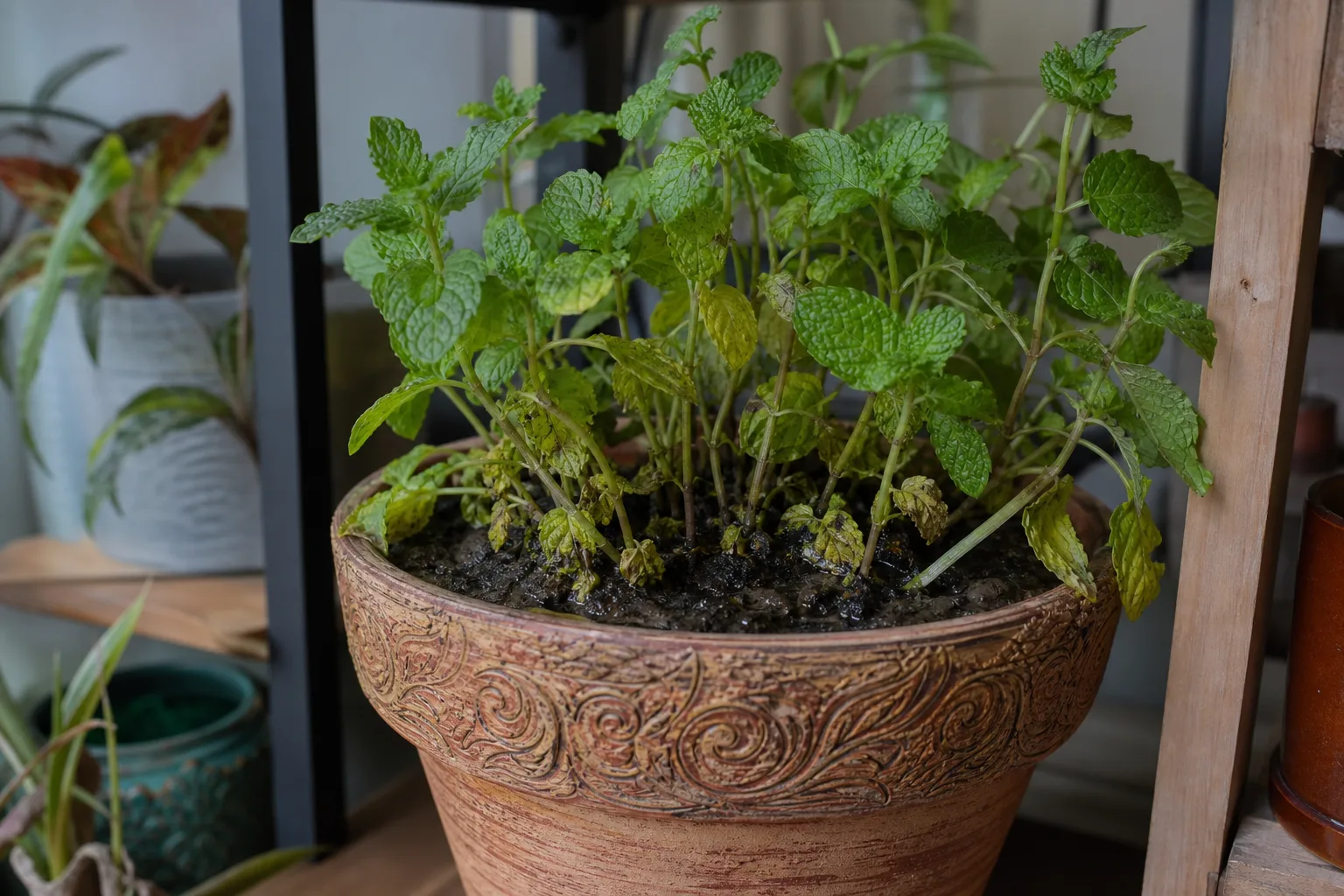
No Drainage Hole on Mint: Causes, Checks & Fixes
This guide covers no drainage hole on Mint. See also the general No Drainage Hole guide, watering, and light pages for this plant.
No Drainage Hole on Mint: Causes, Checks & Fixes
Quick answer
Mint (Mentha spp.) in a pot with no drainage hole traps water at the rhizome zone. Even generous watering and moisture-loving herb habits cannot compensate when excess water has nowhere to exit-spreading rhizomes sit in low-oxygen, stagnant soil where wet soils favor root rot. First step: drill drainage holes in the container bottom or move mint into a standard nursery pot with open holes set in a saucer-not a sealed outer shell.
Pretty kitchen pots, glazed desk planters, and cachepot setups are common mint killers. Mint earns a reputation for tolerating wet ground along stream margins, but that toughness masks sealed-pot failure for weeks. A kitchen-sill rescue I tracked last winter: mint looked fine for three weeks in a glazed cachepot until lower leaves yellowed overnight-the outer shell held two centimetres of standing water the grower never saw from above.
Scope on this site: This page covers zero-hole or sealed containers-decorative pots, cachepots, and blocked exits. For heavy mix or clogged holes in an otherwise holed pot, see poor drainage on mint. For watering schedule mistakes into an airy holed pot, see overwatering on mint.
Why mint fails in hole-less pots
Mint evolved for stream margins and moist ground where water moves through soil and roots access air between flows. In a sealed container, water accumulates at the bottom with nowhere to exit. Rhizomes-the horizontal stems mint uses to spread-sit deepest in the profile and rot first in saturated anaerobic mix.
The “mint likes water” trap misleads growers. Spearmint prefers medium to wet soil in open ground, and RHS guidance recommends evenly moist compost during active growth-but “moist” means damp after drainage, not a sealed reservoir at the pot base. University of Minnesota Extension warns that constantly wet soil encourages root rots, especially during winter when indoor mint grows slowly and uses little water.
Rhizome architecture spreads damage laterally. Mint fills pots within months. Dense rhizome mats plus organic-rich compost hold water longer than gardeners expect-especially in dim winter rooms where dry-down slows to a crawl inside sealed vessels.
Double-potting without discipline recreates the same failure. An inner nursery pot inside a sealed outer planter works only if you lift the inner pot to water, let it drain completely, and empty the outer shell before returning it. Illinois Extension warns that plants in a pot liner must never stand in water unless they are aquatic-remove the inside pot and drain accumulated water from the outside container every time.
Gravel or pebbles in the bottom of a sealed pot do not create drainage. Illinois Extension calls this a myth: water perches in the soil above the gravel until pore space fills, then excess drains below-stones at the base do little to keep rhizomes out of saturated mix. Mint in a pot with no hole is trapped regardless of pebbles.
Permanently attached saucers that cannot be emptied cause the same functional problem as no holes-roots sit in stagnant liquid. Illinois Extension documents basil leaves turning black when roots waterlogged because overflow from a permanently attached saucer could not be removed.
What no-drainage stress looks like on mint
Without exit holes, damage follows classic waterlogging and rot patterns:
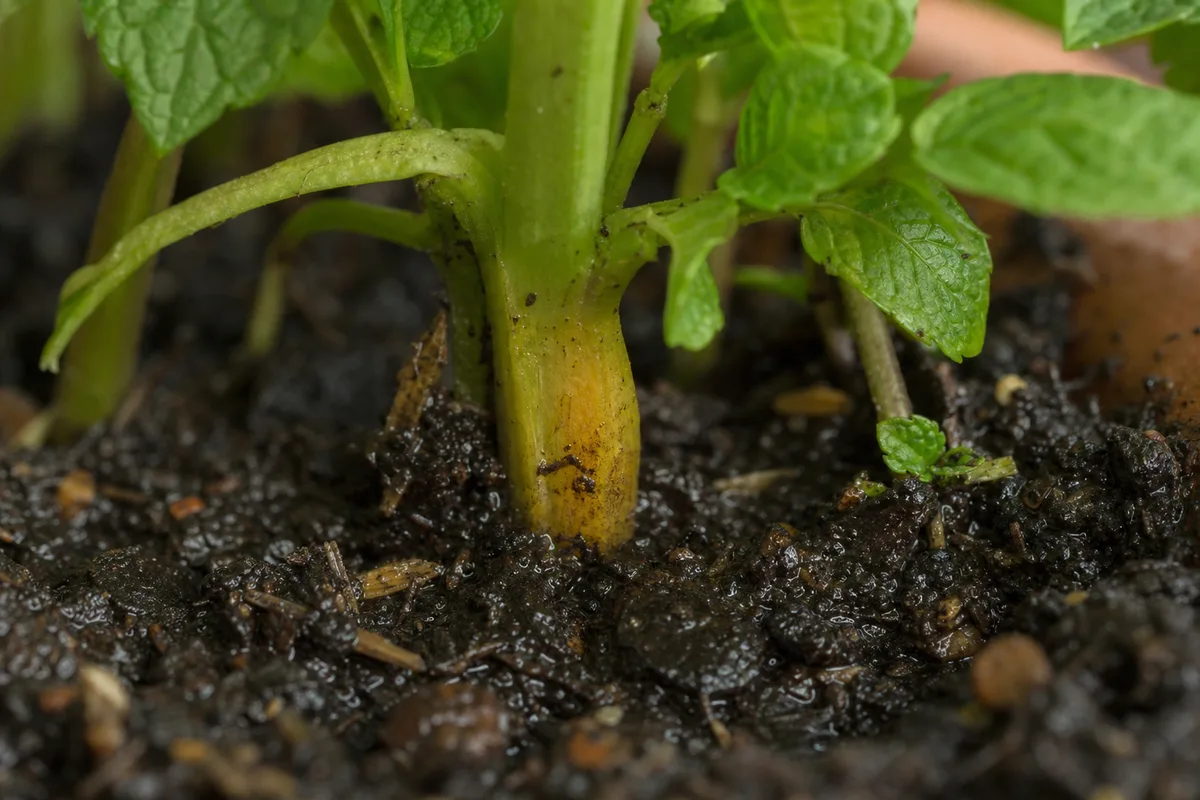
No Drainage Hole symptoms on Mint - compare with healthy tissue on the same plant.
- Soil at 2 cm depth staying wet many days after one watering
- Pot feeling heavy continuously; sour or musty smell when lifted
- Yellow lower leaves spreading while mix remains damp
- Limp, drooping stems despite wet soil-the wilting paradox of failed roots
- Soft or darkening stems at the soil line where rhizomes sit deepest
- White mold or algae on the compost surface from chronic moisture
- Fungus gnats hovering near the pot-larvae thrive in constantly moist peat
- Stalled new shoots while old foliage collapses after weeks in a decorative cachepot
Normal baseline to ignore: A few yellow bottom leaves on a heavily harvested plant in good light, evenly moist (not soggy) soil, and a holed pot can be simple old foliage. Sealed-pot failure is a pattern: persistent wetness, soft bases, smell, gnats, and spreading yellowing in a container with no functional exit.
Firm stems with completely dry mix in a holed pot point away from drainage failure. Crispy edges alone with light, dry soil suggest underwatering on Mint or heat stress-not sealed-pot rot.
How to confirm the cause
Inspect in this order:
- Pot bottom - Are there open holes? Are they blocked by roots, saucer mat, or decorative feet?
- Double-pot setup - Is water sitting in the outer cachepot after watering?
- Gravel layer myth - Is the plant in a sealed pot with only pebbles at the base?
- Moisture at 2 cm - Does the mix stay wet there for many days after your normal watering rhythm?
- Pot weight and smell - Heavy and sour after a modest drink?
- Rhizome bases - Soft at soil level while upper leaves still look green?
- Unpot if unsure - Mushy brown rhizomes confirm rot from trapped water regardless of hole debate.
If holes exist but saucer water is never emptied, the functional problem matches no drainage-roots sit in stagnant liquid. Pour away water that drains into the saucer or outer pot so the plant does not sit in it for long.
Symptom-to-action quick matrix
| What you observe | Likely severity | Do this today |
|---|---|---|
| Sealed pot, damp soil, firm stems, no smell | Prevention | Drill holes or switch to nursery liner before next soak |
| Wet soil 5+ days, yellow lower leaves, firm rhizomes | Mild | Open drainage; withhold water until top 2 cm dry |
| Sour smell, soft stem bases, wilt on wet mix | Moderate | Unpot, trim mushy rhizomes, repot into holed container with airy mix |
| Blackening stems, >50% mushy rhizomes, no new shoots after 4 weeks post-fix | Severe | Take stem cuttings from firm upper growth; discard rotten rhizome mass |
Lookalike symptoms to rule out
| Clue | More likely cause | Where to read |
|---|---|---|
| Holes flow freely; mix stays saturated 48+ hours | Poor drainage mix or compaction | Poor drainage on mint |
| Airy holed pot; watering on calendar | Overwatering schedule | Overwatering on mint |
| Light pot, dry throughout, wilt recovers after soak | Underwatering | Mint watering |
| Mushy roots spreading; sour smell after weeks wet | Advanced root rot | Root rot on mint |
| Sealed pot, pooled cache water, no exit holes | This page | - |
Simple overwatering in a holed pot mimics sealed-pot rot but may fix with schedule change only if mix and holes are adequate. Wrong dense peat in a holed pot still rots rhizomes, but restoring exit holes remains step one.
Severe-case triage: rescue now vs monitor
Use this matrix when symptoms are already advanced:
| Signal | Action window | What to do |
|---|---|---|
| Stems still firm; soil wet but no sour smell | Same day | Drill holes or repot into liner; empty cachepot; let top 2 cm dry before next drink |
| Soft bases, sour smell, <30% rhizomes mushy | Within 24 hours | Unpot, trim rot, repot into holed pot with fresh perlite-amended mix; withhold water 7–10 days |
| Stems blackening from base; >50% rhizomes mushy | Within 48 hours | Salvage stem cuttings from firm upper growth; discard rotten mass; do not wait for leaves to recover |
| Decline continues 10+ days after drainage fix | Escalate | Shift to root rot on mint salvage protocol or restart from cuttings |
Stop and restart rather than rescue when most rhizome tissue is gone, stems collapse from the soil line upward, or no new shoots appear four weeks after correcting drainage in warm light with adequate brightness. Mint cuttings from firm stems root within two weeks-often faster than nursing a mostly dead rhizome mat.
First fix for mint
Move the plant to a container with at least one open drainage hole the same day you confirm sealed conditions-or drill holes in the existing pot if material allows. Unpot if stems are soft at the base or soil smells sour: trim mushy rhizomes with sterile scissors, air-dry cut surfaces, and repot into fresh airy mix with perlite per the mint repotting guide. Do not water for about a week after rot rescue repot.
If the plant is still healthy but sitting in a sealed decorative pot, slip it into a nursery pot with holes that lifts out for watering, or drill the decorative container per Illinois Extension drainage guidance. Decorative foil or plastic wraps without holes should be pierced or removed before watering. Never let the outer pot hold water.
Step-by-step: drill, repot, or cachepot rescue
After you confirm sealed conditions, work through this sequence:
- Choose your hardware fix - Drill the decorative pot (ceramic or plastic), switch to a nursery liner inside the sleeve, or repot mint entirely into a holed container. For fragile heirloom ceramics, use a liner rather than drilling.
- Drill if appropriate - Use a masonry or tile bit on glazed ceramic, or a standard bit on plastic. Illinois Extension stresses that a hole at the bottom is critical-drill enough openings across the base that water can exit freely from a spreading rhizome mat . Set the pot on feet or a saucer so holes stay open.
- Nursery liner method - Keep mint in a plain plastic nursery pot with holes. Water at the sink, let it drain fully, then return it to the decorative outer pot only after the saucer is dry. Lift and empty the outer shell after every watering-never skip this step.
- Rescue rot if present - Remove all brown mushy rhizome tissue; repot firm white sections into dry well-draining mix; withhold water one to two weeks. If most rhizomes are gone but upper stems are firm, take stem cuttings per mint propagation.
- Water correctly after the fix - Soak until water runs from holes; empty saucer within 15–30 minutes. Resume normal mint watering checks only after the top 2 cm dries.
- Monitor weekly for four weeks - Pot weight, soil smell, firm stem bases, and new shoot tips. Chronic sealed-pot moisture may have attracted fungus gnats-let the surface dry slightly between drinks while you fix drainage.
Make drainage correction before fertilizer, pesticide, or upsizing the pot.
Week-by-week recovery signals
Case snapshot - sealed cachepot rescue (indoor spearmint, 20 cm pot):
| Checkpoint | Day 0 (diagnosis) | Day 7 | Day 21 |
|---|---|---|---|
| Visible symptoms | Lower leaves yellow; outer pot held standing water | Yellow leaves unchanged; stems firming | New side shoots at soil line |
| Rhizome check | 20% soft at base | Trimmed rot; firm white tissue | Rhizomes white, no sour smell |
| Soil behaviour | Wet at 2 cm for 6+ days | Dries in 2–3 days between drinks | Predictable dry-down cycle |
| Action taken | Moved to holed nursery liner; emptied cachepot | Withheld water; surface allowed to dry | Resumed normal watering checks |
Mild waterlogging - Soil was wet too long but rhizomes stayed firm. After drainage opens, new side shoots often appear within 10–14 days.
Moderate rot - Some mushy rhizomes trimmed, plant repotted. Foliage may look rough for two to three weeks while new roots form. Judge success by firm new tips, not old yellow leaves.
Severe rot - Most rhizome tissue lost. Recovery from division or cuttings takes two to four weeks for roots, then bushy regrowth after a hard pinch. Old damaged leaves will not green up again.
Signs recovery is working: New shoots emerge, stem bases stay firm, soil dries at a predictable rate between waterings, gnat numbers drop.
Signs it is getting worse: Spreading softness up stems, more yellowing while soil stays wet, sour smell returns after repot, no new growth for three weeks in warm light.
What not to do
Do not add gravel instead of holes. Do not assume mint’s moisture tolerance survives standing water. Do not water on a calendar without checking dry-down after fixing holes. Do not leave full saucers or cachepots for later.
Avoid fertilizing a stressed plant in wet mix. Do not repot into a larger sealed decorative pot for aesthetics. Do not rely on fungicide without fixing drainage and removing mushy tissue. Do not propagate from mushy rhizomes-take stem cuttings from firm upper growth only.
How to prevent drainage problems on mint
Choose only pots with open drainage holes for long-term mint growing, or use the nursery-pot liner method with a dry outer shell. Pair holes with airy potting mix amended with perlite and water only when the top 2 cm are dry per the mint watering guide.
When buying decorative pots, drill before planting or keep the plant in a removable inner pot. Confirm holes stay open as rhizomes grow-matting roots can block drainage over years. Refresh compacted mix every one to two years so water moves through the column, not just out the sides.
For harvest mint on a kitchen sill, treat cachepots as display sleeves only: lift, water at the sink, drain completely, empty the outer pot, then return. Check holes monthly for root or soil blockages.
When to worry
No drainage in a wet rhizome zone is high severity on mint despite its forgiving label. Escalate immediately if:
- Stems collapse or blacken at the soil line
- Soil smells sour while the pot is heavy
- Soft tissue spreads up stems from the base
- More than one-third of rhizomes are mushy on inspection
- The plant declines within seven to ten days despite surface dry appearance
- Winter rescue keeps mix wet in a dim room with no new growth for three weeks
Early conversion to holed pots prevents most losses; delayed action is how vigorous mint clumps fail in pretty planters. When rot is advanced, shift to the root rot on mint protocol for salvage division criteria.
Decision close: your next move
| If you confirmed… | Your next step |
|---|---|
| Sealed pot, firm rhizomes, no smell | Drill holes or add nursery liner today; empty cachepot after every watering |
| Wet soil + soft bases + sour smell | Unpot, trim rot, repot into holed container-see mint repotting |
| Drainage fixed but wilt persists on wet mix | Check poor drainage mix issues or overwatering schedule |
| >50% rhizomes lost, firm upper stems remain | Propagate from cuttings; discard rotten tissue |
| Decline continues after drainage fix | Escalate to root rot on mint |
Related guides by symptom pathway
- Still wet after fixing holes? → Poor drainage on mint - heavy mix, blocked holes, perched water
- Holed pot but watering too often? → Overwatering on mint - schedule mistakes on otherwise adequate drainage
- Mushy rhizomes spreading after rescue? → Root rot on mint - advanced salvage and division criteria
- Gnats appeared during chronic wetness? → Fungus gnats on mint - break the moisture cycle after drainage opens
- Need repot steps after rot trim? → Mint repotting - fresh mix and division timing
- Rhizomes mostly gone, stems still firm? → Mint propagation - restart from cuttings
- General mint context → Mint overview - spreading habit and harvest rhythm
- Watering checks after drainage fix → Mint watering - when to resume normal drinks
When to use this page vs other Mint guides
- Mint watering guide - Use for routine moisture checks before assuming no drainage hole is the main issue.
- Mint problems hub - Browse all 40 common issues on this species.