Leggy Growth on Marble Queen Pothos: Causes, Checks & Fixes
Quick answer
Leggy growth on Marble Queen Pothos is etiolation-stretched internodes and bare vines reaching for light while white marbling fades. First step: move within 1–2 m of an east or west window for bright indirect light, or add a grow lamp 25–45 cm above the canopy for 12–14 hours daily. Prune bare stems only after two to three compact marbled leaves confirm the brighter spot works.
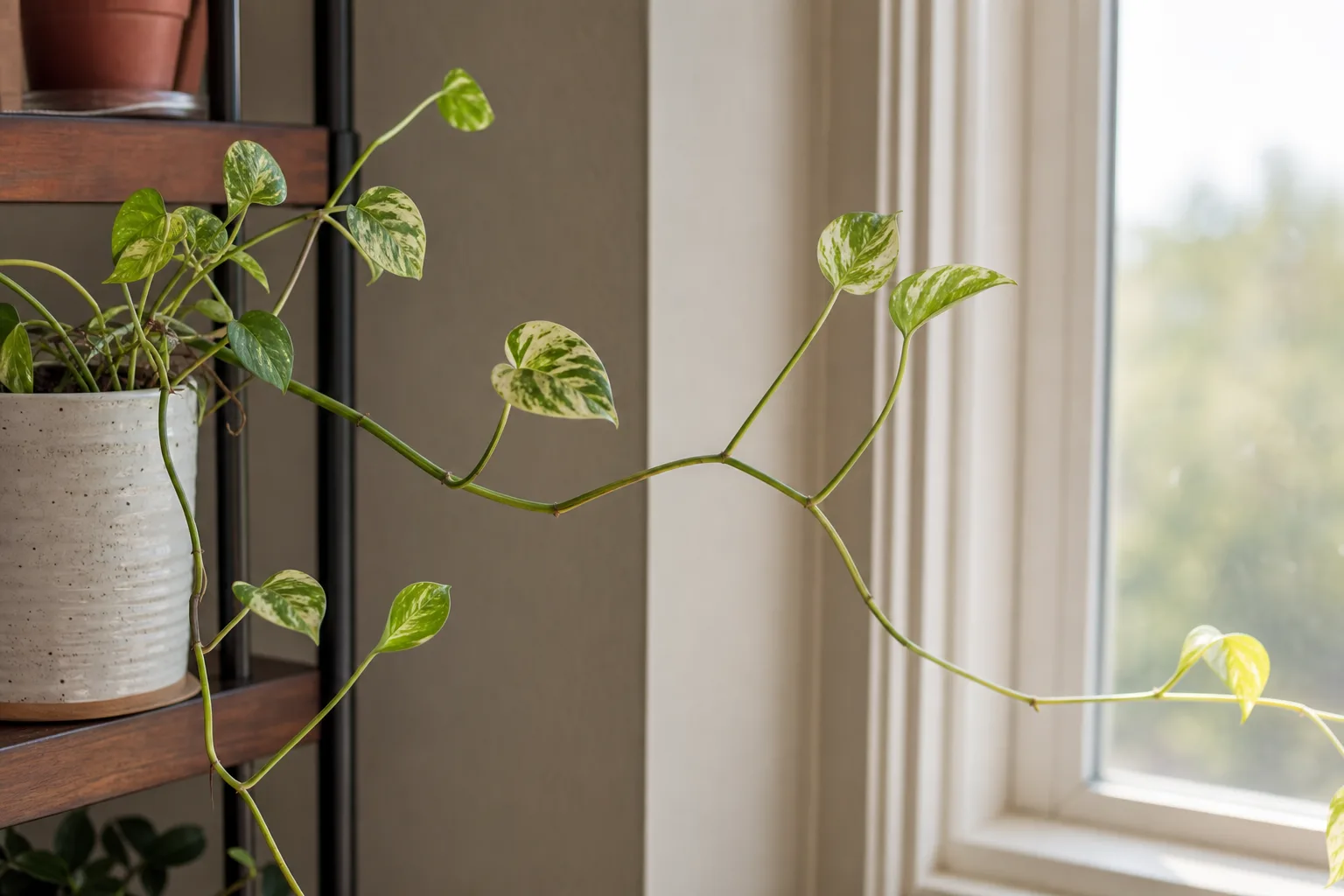
Leggy Growth on Marble Queen Pothos: Causes, Checks & Fixes
This guide covers leggy growth on Marble Queen Pothos. See also the general Leggy Growth guide, watering, and light pages for this plant.
Leggy Growth on Marble Queen Pothos: Causes, Checks & Fixes
Quick answer
Leggy growth on Marble Queen Pothos (Epipremnum aureum ‘Marble Queen’) is etiolation-the vine stretching toward photons when light is too weak for compact architecture. Stems develop long bare internodes, smaller mostly green new leaves, and a lean toward the brightest window as the plant sacrifices white marbling for chlorophyll. Variegated pothos needs more light than solid-green forms because pale leaf sections photosynthesize less; Marble Queen grows slower than Golden Pothos even in good light, so dim placement hits this cultivar harder.
First step: move the pot to bright indirect light-typically within 1–2 m of an east- or west-facing window, or add a full-spectrum grow lamp 25–45 cm above the canopy for 12–14 hours daily. Stretched sections will not compact on their own; plan to pinch or cut back bare stems above a variegated node after two to three compact marbled leaves confirm the brighter spot works. This page covers internode stretch, pruning recovery, and lookalike triage; our not enough light guide goes deeper on placement mistakes and variegation fade when color loss is your main concern. For proactive window targets, see the Marble Queen light guide.
Leggy growth vs not enough light vs slow growth
All three problems often share the same root cause-too few photons-but owners search them for different reasons. Use this page when long bare stems, wide internode gaps, or pruning and support are the headline.
| Your main question | Start here | Also check |
|---|---|---|
| Vines are long with wide gaps between heart leaves | This page - etiolation and internode stretch | Light guide for foot-candle targets |
| New leaves losing white marbling or turning solid green | Not enough light - variegation fade | This page if stems also stretched |
| Plant grows slowly but internodes stay moderate | Slow growth - metabolism and season | This page if new growth keeps spacing out |
| Bare lower stems with foliage only at vine tips | This page - prune after light fix | Pruning guide for cut placement |
| Wet soil + droop in a dim corner | Overwatering | Low light slows dry-down-fix both |
Improving light addresses stretch, fade, and weak growth together. Prune elongated vines after brightness increases, not before-you need compact new growth to judge success.
What leggy growth looks like on Marble Queen Pothos
Etiolation on Marble Queen reads as architecture first, marbling second. The vine may still trail for meters while the structure already tells you light is marginal.
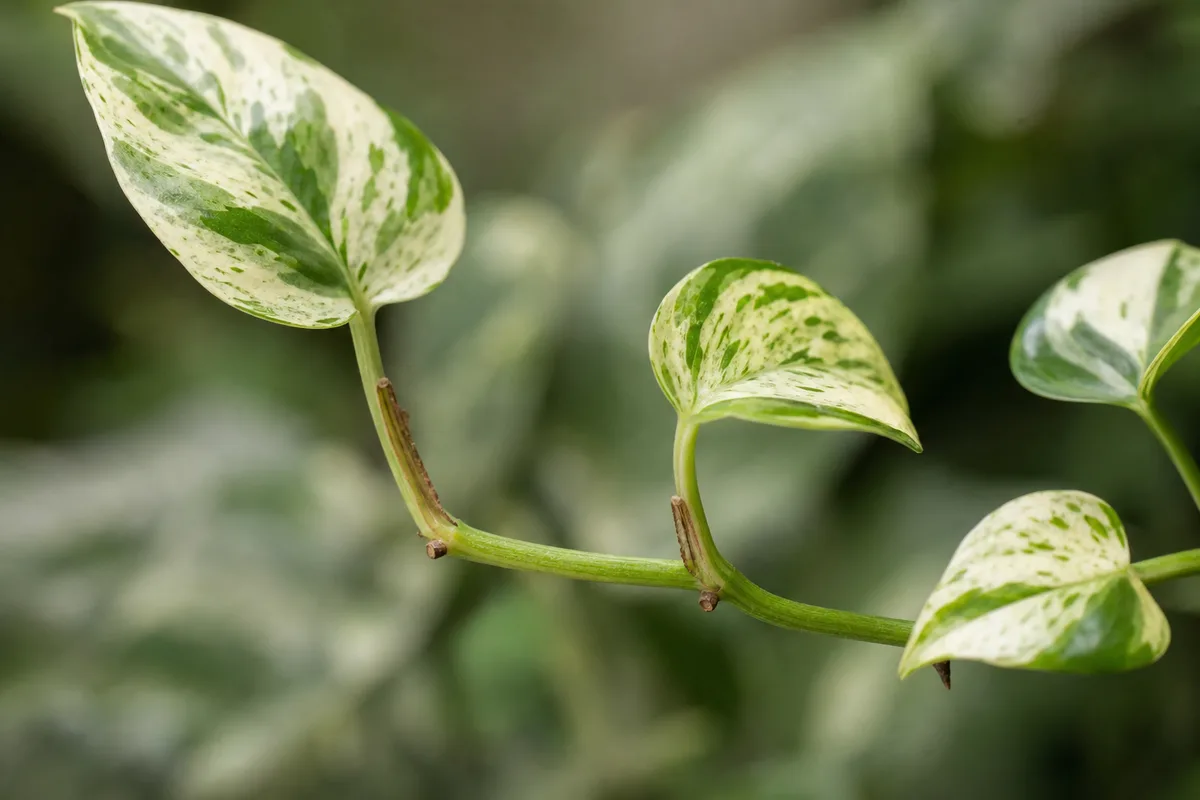
Leggy Growth symptoms on Marble Queen Pothos - compare with healthy tissue on the same plant.
Primary Marble Queen signals:
- Internodes noticeably longer than earlier growth on the same runner-gaps between leaves widen on new sections
- Smaller or mostly green new leaves where white marbling used to dominate on fresh growth
- Stems leaning strongly toward one window or lamp; hanging baskets often show dense foliage on the bright side only
- Lower leaves shed, leaving long naked trailing sections between sparse foliage clusters
- Soil that stays wet longer than expected because photosynthesis-and water uptake-drop in dim light
- “Palm tree” silhouette on old plants: bare lower stems with leaves clustered at vine tips
What healthy trailing length looks like for comparison:
A well-lit Marble Queen produces dense marbled foliage along the vine, not sparse leaves on long naked stems. Moderate internode spacing, visible white sectors on most new leaves, and predictable pot dry-down between waterings signal adequate light-not etiolation.
What winter slow growth looks like-different urgency:
Growth may pause uniformly in short days without dramatic new internode stretch. Concern is warranted when new growth keeps spacing out on the same sill through winter while the plant leans.
Why Marble Queen Pothos gets leggy
In dim light, pothos vines elongate internodes and lean toward light-the horticultural term is etiolation. Marble Queen is less forgiving than solid-green pothos because white and cream patches contain little chlorophyll and cannot photosynthesize as efficiently. It can survive in low light for quite some time, but will eventually lose desirable leaf qualities such as variegation.
Marble Queen also grows slower than Golden Pothos even in good conditions-pale sections contribute less energy-so low light compounds stretch, reversion, and bare-stem accumulation faster than on a solid-green vine in the same corner. All pothos prefer bright, indirect light, and low light can cause loss of variegation on cultivars like Marble Queen.
Common triggers beyond “wrong room”:
- Hanging a basket high in a bright room but far from glass-the ceiling zone is often dim even when the floor feels sunny
- Keeping the pot on a north sill in a deep room where daylight never reaches leaf level
- Letting bookshelves, heavy sheers, or dirty windows cut intensity more than expected
- Ignoring winter daylight drop while leaving the pot in the same decorative spot year-round
- Watering on a summer schedule in shade-wet soil in dim corners raises overwatering risk while the plant looks “leggy” rather than obviously thirsty
How to confirm the cause
Work through these checks before fertilizing, repotting, or spraying for pests:
- Window distance and direction - Is the pot more than 1.5–2 m from the brightest window? Light intensity decreases rapidly with distance from the glass.
- Hand-shadow test at leaf level - On a clear day, hold your hand about 30 cm above the foliage. A soft, defined shadow suggests bright indirect light suitable for Marble Queen; a faint or absent shadow means etiolation will continue. Retest in late autumn-winter sun angle drops intensity sharply on the same sill.
- New growth vs. old growth - Compare the newest leaf on each runner to leaves produced when you first got the plant. Fading marbling plus stretch on fresh growth confirms current light is too low.
- Lean and internode length - Does the vine reach toward one side? Long bare stem sections between leaves point to etiolation, not normal trailing.
- Soil dry-down speed - Stick a finger 4–5 cm into the mix. If it stays damp far longer than before and the plant is not actively growing, low light may be slowing water use-cross-check watering rhythm.
- Pest screen - Inspect leaf undersides for spider mites, mealybugs, and sticky residue. Spotting or mushy stems suggest overlapping problems, especially root rot from wet mix in dim conditions.
If stems are firm, pests are absent, and yellowing appears only on lower leaves while new growth is solid green and stretched, insufficient light is the most likely primary cause.
First fix for Marble Queen Pothos
Move the plant to bright indirect light-typically within 1–2 m of an east- or west-facing window, or a few feet back from south glass behind a sheer curtain. The goal is strong ambient light on the leaves without direct hot afternoon sun on pale marbled zones.
If natural light is inadequate, run a full-spectrum LED grow lamp 25–45 cm above the canopy for 12–14 hours daily on a timer. Increase exposure gradually if the plant has lived in deep shade for months-shift it closer over several days rather than placing it in unfiltered west sun in one move.
Do not fertilize, repot, or hard-prune on the same day as the move. Light is the engine; nothing else compensates for chronic shade on a variegated pothos.
Step-by-step recovery
Once brighter placement is set, follow this order:
- Relocate and observe - Move to filtered bright light or add the grow lamp. Wait one week before judging results; old leaves do not change overnight.
- Rotate weekly - Turn the pot or hanger so both sides of a trailing vine receive light. One-sided density often means only the window-facing runner was getting enough energy.
- Adjust watering - When growth speeds up in better light, the mix dries faster. Check moisture every few days instead of following an old calendar schedule from the dim corner.
- Prune after confirmation - After two to three new marbled leaves appear at stem tips with tighter spacing, cut back long solid-green or bare sections just above a node that still shows variegation. See Marble Queen pruning for cut placement and tool hygiene.
- Propagate healthy tips - Root variegated cuttings in water or moist mix to fill sparse bases. Full workflow: Marble Queen propagation.
- Hold fertilizer - Skip feed until new growth looks stable for two weeks. Nitrogen pushes green vegetative growth and can burn low-chlorophyll white sections in recovering light.
Critical permanence rule: Existing stretched internodes do not shrink back after light improves. Bare stem sections do not sprout new leaves without pruning or rooting cuttings. Judge success by new growth only-internode length, leaf size, and marbling on the freshest leaves.
Recovery timeline
| Timeframe | What to expect on Marble Queen |
|---|---|
| Week 1 | Lean may lessen slightly; no visible change on old stretched sections |
| Weeks 2–3 | New leaves should show tighter spacing; white marbling may return on fresh growth |
| Weeks 4–6 | Several marbled leaves confirm the fix; prune bare green runners if shape is still sparse |
| Beyond 6 weeks | If new foliage stays solid green or keeps spacing out, light is still too low-move closer or strengthen the grow lamp |
Marble Queen’s slower cultivar pace means recovery can lag Golden Pothos by a week or two in the same brighter spot-do not declare failure at day ten.
Lookalike symptoms
| Pattern | Leaf / stem look | Soil / pot | Likely cause | Next step |
|---|---|---|---|---|
| Long internodes, green new leaves, lean toward window | Firm stems, stretch on new growth | Can be wet or dry | Etiolation / low light | Brighten placement → this page |
| Yellow leaves, limp vines, sour smell | Soft yellow, may drop | Heavy, wet at 3–5 cm | Overwatering / root stress | Stop watering → overwatering |
| Crisp brown patches on white zones | Bleached or scorched pale tissue | Any moisture | Too much direct sun | Filter light → light guide |
| Slow growth, stable marbling on new leaves | Normal internode spacing | Normal dry-down | Seasonal pause or root-bound | Slow growth if pattern persists |
| Stippling, webbing, dusty undersides | Patchy damage, not whole-vine stretch | Any | Spider mites | Inspect and treat before assuming light alone |
Overwatering in dim light is the most common overlap: stretch plus wet soil that will not dry. Key difference: overwatering often smells sour and shows mushy roots on inspection, while pure light stress usually has firm stems and delayed-but not permanently saturated-dry-down.
What not to do
- Fertilizing heavily in dim light - That does not replace photons and can burn white leaf sections. Fix light first.
- Assuming long vines equal health - Bare stems mean the plant is searching for light, not thriving.
- Hard-pruning before light improves - Cut tips often stretch again within weeks if photons stay low.
- Moving instantly into direct south or west sun - Acclimate over days. Unfiltered hot sun scorches white zones that formed in softer light.
- Watering on the old schedule - Dim light slows uptake. Continuing summer-frequency watering in a dark corner invites root rot.
- Ignoring solid-green runners - Reverted stems grow faster than variegated ones and can dominate the pot if not pruned after light improves.
How to prevent leggy growth next time
Treat Marble Queen as a display cultivar, not a low-light filler. Best grown in bright indirect light with weekly rotation. Prune routinely so branching stays full rather than one long etiolated whip. Match watering to how fast the pot dries in its actual light level-a brighter plant drinks more; a dim plant needs longer dry intervals.
In rooms with weak natural light, plan a grow lamp before the vine spends six months stretching-not after. For window-by-window targets and foot-candle bands, use the Marble Queen light guide.
When to worry
Leggy growth is usually gradual, but act promptly if:
- Stems soften at nodes while soil stays damp-possible early root rot layered on light stress.
- Several leaves yellow and drop within a week without pest signs.
- The pot smells sour or roots feel mushy on a gentle tug-unpot and address rot before chasing more light alone.
- New growth stays solid green after four to six weeks in a spot you believed was bright-your placement or grow lamp is still too dim.
- White marbling disappears on every new leaf while the whole plant declines-light and watering both need correction.
Marble Queen rarely dies from shade alone, but chronic low light plus overwatering can kill roots. Light correction and watering adjustment together prevent that slide.
When pruning stressed vines or handling cuttings, keep debris away from cats and dogs. All Epipremnum aureum cultivars, including Marble Queen, are toxic to cats and dogs via insoluble calcium oxalate crystals that irritate the mouth if chewed. Call ASPCA Animal Poison Control at (888) 426-4435 if you suspect ingestion.
Related Marble Queen guides
- Marble Queen overview - cultivar baseline and Golden Pothos comparison
- Not enough light - placement mistakes and variegation fade deep dive
- Marble Queen light - foot-candle targets, windows, and grow-lamp setup
- Marble Queen watering - dry-down rhythm when light changes
- Marble Queen pruning - where to cut bare runners
- Marble Queen propagation - root tip cuttings after cutback
- Overwatering on Marble Queen - wet soil in dim corners
- Root rot on Marble Queen - mushy roots when stretch meets wet mix
- Slow growth on Marble Queen - when pace is slow but internodes stay normal
Leggy Marble Queen Pothos is a light-and-architecture problem first. Brighter indirect exposure restores compact marbled growth on new leaves; pruning bare stems after recovery-and rooting healthy cuttings-keeps the basket full. If new leaves stay solid green, light is still too low.
How we wrote and verified this guide: Recommendations were checked against Clemson Cooperative Extension, NC State Extension, Missouri Botanical Garden, Penn State Extension, University of Maryland Extension, and ASPCA references cited inline. Author: sai-ananth. Reviewer: LeafyPixels Review Board. Methodology: plant problem guidance is reviewed against botanical references, extension resources, and LeafyPixels plant-care data before publication. Claims validation: claims-validator-v1 pass with inline external links documented below. Last reviewed: 2026-06-16.