Nitrogen Deficiency on Lavender: Causes, Checks & Fixes
Quick answer
True nitrogen deficiency on lavender is uncommon and usually appears as pale, weak growth in old exhausted potting mix after light, drainage, and root health are confirmed. Use one light early-season feed or a lean mix refresh-not repeated high-nitrogen feeding.
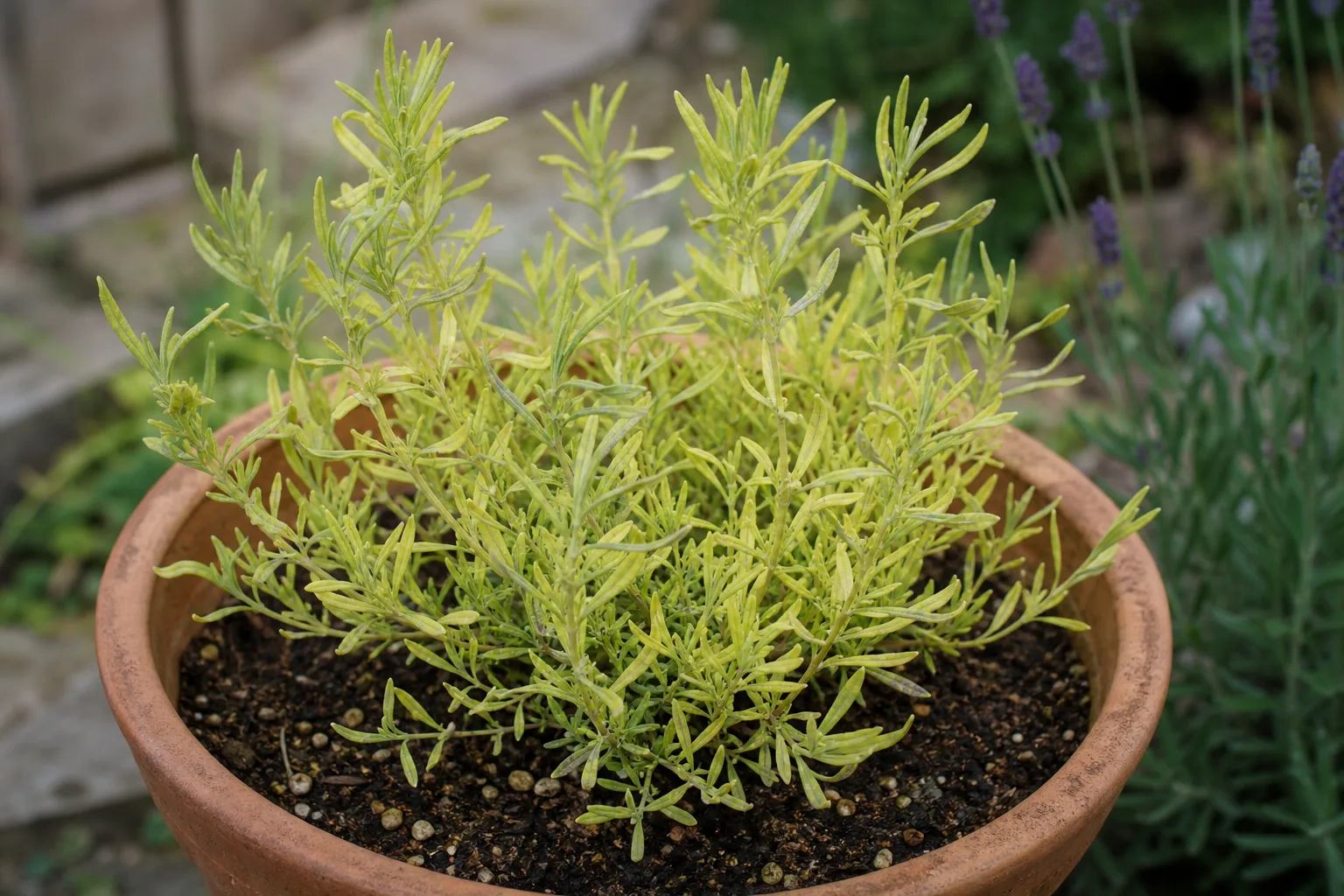
Nitrogen Deficiency on Lavender: Causes, Checks & Fixes
This guide covers nitrogen deficiency on Lavender. See also the general Nitrogen Deficiency guide, watering, and light pages for this plant.
Nitrogen Deficiency on Lavender: Causes, Checks & Fixes
Quick answer
Nitrogen deficiency on lavender is a diagnosis of exclusion-not the first explanation for pale foliage. English lavender (Lavandula angustifolia) and most cultivars grow best in full sun and lean, free-draining soil with little routine fertilizer. Before any feed, confirm six or more hours of direct sun, dry-down watering, and firm roots.
If culture is correct and a second- or third-year container still shows uniformly weak, pale growth with older leaves fading before new tips, mild nitrogen depletion in exhausted mix becomes plausible. First fix: one lean correction-either refresh into gritty lean mix or apply one half-strength low-nitrogen feed at the start of active growth, then stop and reassess.
This page owns true nitrogen shortage on established lavender after shade, wet roots, and micronutrient lookalikes are ruled out. For general lime-green washout, see pale leaves. For feeding schedules and NPK ratios, see the lavender fertilizer guide. For stretch without nutrient depletion, see not enough light.
Symptom pattern - when nitrogen deficiency is likely (and unlikely)
True deficiency on lavender is uncommon in garden beds with correct alkaline, gritty soil. It appears most often in containers where nutrients leach through drainage holes season after season and organic matter breaks down without refresh (Illinois Extension notes lavender tolerates poor soil but container culture changes that equation).
What deficiency looks like
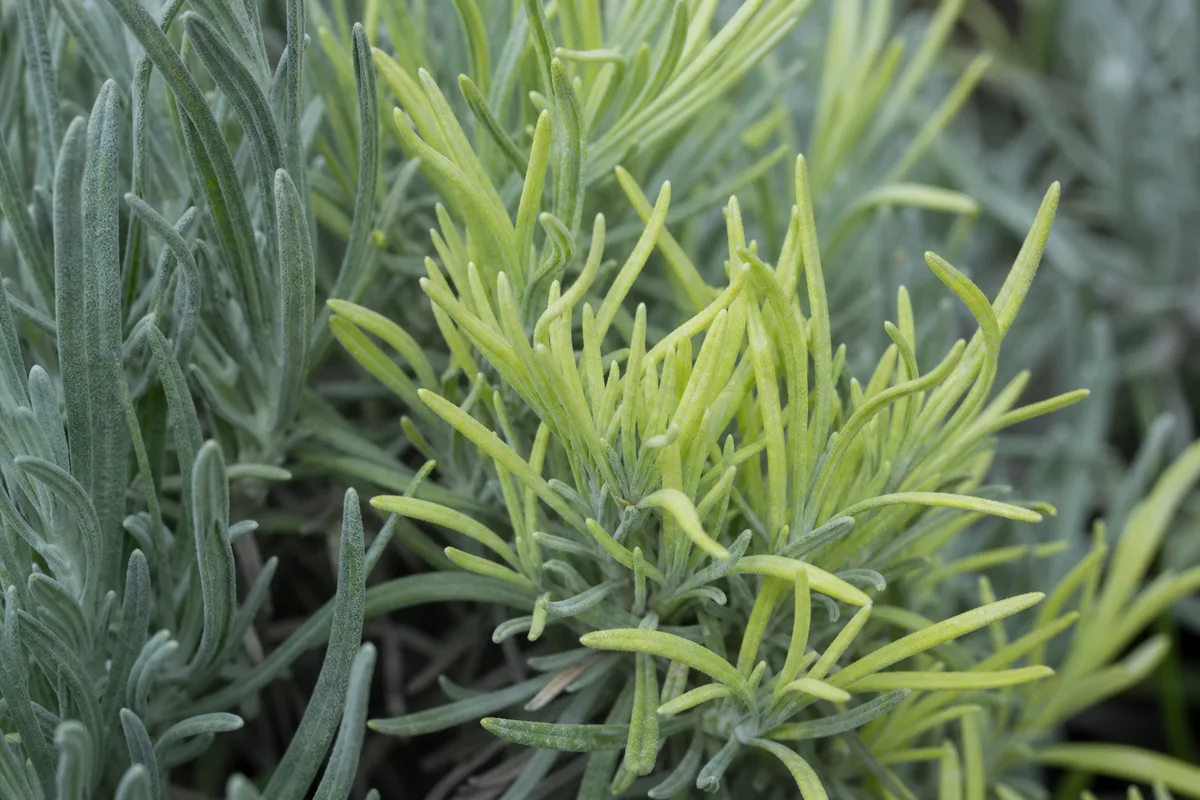
Nitrogen Deficiency symptoms on Lavender - compare with healthy tissue on the same plant.
On genuine cases, the mound looks generally underpowered: shorter internodes, thin wiry stems, and broad paling across foliage compared with the compact silver-green norm for English lavender (Missouri Botanical Garden). Classic nitrogen mobility means older, lower leaves pale or yellow first while the plant salvages nitrogen for newer tissue (Iowa State Extension). Growth may stall even in spring when light and drainage are already adequate.
What it usually is instead
- Too little sun - pale, elongated wands; see not enough light
- Wet roots - pale or yellow leaves with limp texture and heavy wet pot; see overwatering
- Healthy lean growth - compact silver mound in poor soil is normal, not deficiency
- Iron or pH problems - new leaves yellow between green veins on alkaline mix; not mobile nitrogen pattern
- Excess nitrogen history - soft bright green leggy growth is overfeeding, not shortage; see pale leaves and leggy growth
If only fresh top growth pales while lowers stay green, suspect light, pH, or iron-not nitrogen first.
Rule-out checks before feeding
Work through this sequence in order. Feeding a shaded or waterlogged lavender often worsens decline (USU Extension).
- Sun threshold - Lavender needs full sun. Fewer than six hours of direct sun produces pale stretch that mimics nutrient stress.
- Drainage and root firmness - Mix should dry partially between waterings. Soft crown, wilt on wet soil, or sour smell means root stress first.
- Leaf position pattern - Older-leaf-first paling fits nitrogen mobility; tip-only chlorosis does not.
- Container history - Has the same potting mix supported Lavender overview for two or more seasons without refresh or any nutrient input?
- Growth response - After light and drainage are corrected for two weeks, is new growth still uniformly weak and pale?
Decision threshold: Proceed toward nitrogen correction only when checks 1–2 pass, pattern favors older-leaf paling, and history or stalled recovery supports depleted mix-not when a single yellow leaf appears on an otherwise firm mound.
Differential table - nitrogen vs shade vs root stress vs other chlorosis
Use this matrix before opening a fertilizer bottle. Thresholds reflect common indoor and patio container setups.
| What you observe | Leaf pattern | Pot / roots | Sun exposure | Mix age | Likely cause | First action |
|---|---|---|---|---|---|---|
| Pale wands reaching one direction | New tips pale, wide internodes | Firm roots, dry-down normal | Under 6 h direct | Any | Not enough light | Move to maximum sun |
| Limp pale leaves, heavy pot | Lower yellow first possible | Wet at 7 cm, soft crown risk | Adequate | Any | Overwatering / root stress | Stop water; inspect roots |
| Uniform weak mound, older leaves pale | Lower → upper progression | Firm, dry-down OK | 6+ h direct | 2+ years, no feed | Nitrogen deficiency | One lean correction (below) |
| New leaves yellow between veins | Interveinal on fresh growth | Firm | Adequate | Any pH unknown | Iron / high pH lockout | Soil test pH; do not add nitrogen |
| Soft bright green, long wands | Whole plant lush pale-green | Firm | Adequate | Recent feeding | Excess nitrogen | Stop feeding; see fertilizer guide |
| Compact silver mound, slow but firm | Minimal discoloration | Firm | Full sun | Lean garden soil | Normal low fertility | No feed needed |
Quick decision: Full sun + firm roots + older-leaf-first paling + old container mix → nitrogen correction is reasonable. Any wilt on wet soil → stop and route to root guides.
Field case - third-year patio pot (composite)
Editorial case note reviewed by LeafyPixels Review Board - composite of common container lavender setups.
A grower brought a ‘Hidcote’ in a 30 cm terracotta pot that had not been repotted since purchase three springs prior. The plant sat in full south patio sun (roughly eight hours direct in summer). Watering followed dry-down; roots were firm and tan when the plant was tipped partway out. Lower needle-like leaves had turned uniformly pale yellow-green over six weeks; new tips were slightly greener but shoots were short and thin compared with a healthy neighbor pot.
Misdiagnosis avoided: The owner nearly applied high-nitrogen liquid feed because the whole mound looked “washed out.” Pattern review showed older-leaf-first paling on exhausted peat-heavy mix that stayed wet longer than gritty lavender mix should. No wilt, no crown softness.
Correction: Repotted into 70% gritty potting base + 30% coarse horticultural grit, with a half-rate sprinkle of low-nitrogen slow-release (5-10-10 class) mixed into the top third only. No further liquid feed that season.
Outcome: New silver-green shoots emerged from nodes within three weeks. Lower pale leaves did not fully re-green (expected-damaged chlorophyll on old tissue rarely reverses). By week six, stem thickness and internode length matched the healthy reference pot. Flowering was modest that year-recovery prioritized structure over bloom.
Lesson: Exhausted container mix plus mobility pattern mattered more than a fertilizer label. One conservative correction beat repeated feeding.
First correction path
When the differential table points to mild nitrogen shortage and roots are healthy, choose one path-not both in the same week.
Option A - Repot into lean gritty mix (preferred for old containers)
Refresh when mix has broken down, drains slowly, or is two or more seasons old. Use fast-draining, alkaline-lean blend per the lavender soil guide-often 10–25% coarse grit by volume (RHS). Optionally incorporate half the label rate of low-nitrogen slow-release into the upper third only. Water thoroughly once, then return to dry-down schedule.
Option B - One light feed (when repot mid-season is impractical)
Apply one half-strength dose of low-nitrogen herb fertilizer (5-10-10 or similar) at the start of active spring growth. Mature lavender often needs little ongoing fertilizer. Water with plain water first, then apply diluted feed until slight runoff-never to bone-dry stressed roots.
Do not stack repot, slow-release, and liquid feed in the same fortnight. Lavender is sensitive to overfeeding; excess nitrogen produces soft foliage and fewer flowers (USU Extension).
Step-by-step recovery
- Complete rule-out checks above; photograph leaf pattern for comparison.
- If Lavender repotting guide: move to lean gritty mix; trim only dead wood, not live pale growth.
- If feeding: one early-season half-strength application only.
- Resume dry-down watering-lavender declines in wet conditions (Missouri Botanical Garden).
- Judge progress on new shoot color and stem strength at two, four, and six weeks-not old leaf re-greening.
- Reassess before any second feed; most recovered plants need no further nitrogen that year.
Recovery timeline and what success looks like
| Week | What to expect | Red flag |
|---|---|---|
| 0–1 | No visible change; roots acclimate | Wilt on wet soil after correction |
| 2–3 | New tips slightly greener, firmer | Tips browning, crown softening |
| 4–6 | Clearer silver-green on fresh shoots | No new growth in full sun |
| 8+ | Improved mound density; old pale leaves may persist | Continued uniform chlorosis |
Older discolored leaves often stay pale-nitrogen correction does not repaint old chlorophyll. Success means healthier new growth, stable form, and resumed seasonal vigor. Bloom may be light the first recovery year.
When to escalate - soil testing and deeper intervention
Soil-test triggers
Send a sample or use a quality home kit when:
- Full sun, firm roots, and proper dry-down are confirmed
- Differential table still suggests deficiency after one conservative correction
- New growth shows interveinal yellowing (possible pH / iron issue, not nitrogen)
- Mix is relatively fresh but plant remains uniformly chlorotic
Target pH roughly 6.5–7.5 for garden lavender (lavender soil guide); production research often cites 5.8–6.2 in controlled substrates-very high pH induces iron chlorosis on young leaves that mimics nutrient stress. Let test results guide pH adjustment or micronutrients, not repeated nitrogen.
Immediate escalation (not nutrient shortage)
- Collapse, persistent wilt, or blackened crown → crown rot / root rot
- Sour anaerobic mix → repot and root inspection regardless of leaf color
- Pale foliage spreading after multiple nitrogen feeds → stop feeding; suspect overwatering or lockout
Persistent symptoms after first correction
If new tips stay chlorotic four to six weeks after one lean fix and culture is correct, test before a second feed. Compare magnesium deficiency and potassium deficiency only when test or pattern supports them-lavender rarely shows isolated macro shortages in good garden soil.
What not to do
- High-nitrogen lawn or balanced 10-10-10 on a schedule - risks leggy growth and reduced flowering
- Feeding late season - tender growth is vulnerable to cold injury (USU Extension)
- Feeding shaded or waterlogged plants - fixes the wrong problem
- Judging recovery by old leaves - use new shoots only
- Automatic repeat feeding - reassess; lavender thrives lean
Prevention for low-fertility lavender systems
Grow lavender in maximum direct sun and fast-draining lean mix year-round (RHS). In containers, refresh mix every two to three seasons rather than relying on heavy feeding. When nutrition is needed, one small early-season application beats routine fertilizer. Pair with light placement and gritty soil so fertility stays a rare correction-not a monthly habit.
Related guides - where to go next
| Your situation | Read next |
|---|---|
| Lime-green washout, not sure if N | Pale leaves |
| Lower yellowing, wet pot | Yellow leaves / overwatering |
| Feeding schedules and NPK | Lavender fertilizer |
| Mix ratios and pH | Lavender soil |
| Stretch toward window | Not enough light |
What to do next - branch outcomes
If sun or drainage failed checks: Fix culture only. No nitrogen this month.
If old container + older-leaf paling + firm roots: One lean repot or one half-strength spring feed, then wait four weeks.
If new-tip interveinal chlorosis: Soil test pH before any nitrogen.
If wilt or crown softness: Root guides immediately-nutrient feeding can wait or harm.
If recovered: Skip routine feed unless the fertilizer guide criteria for your setup say otherwise.
This guide owns confirmed mild nitrogen depletion on lavender after differential diagnosis. Horticultural claims were checked against extension and botanical garden references before publication.
When to use this page vs other Lavender guides
- Lavender watering guide - Use for routine moisture checks before assuming nitrogen deficiency is the main issue.
- Lavender problems hub - Browse all 51 common issues on this species.
- Yellow Leaves on Lavender - Different entry point when symptoms overlap with nitrogen deficiency.
- Slow Growth on Lavender - Different entry point when symptoms overlap with nitrogen deficiency.