Magnesium Deficiency on Lavender: Causes, Checks & Fixes
Quick answer
On lavender, true magnesium deficiency usually shows as interveinal yellowing on older lower leaves while veins stay green. Because lavender declines fastest from wet roots, confirm roots are firm and mix is draining before any nutrient correction. If signs fit and roots are healthy, use one conservative Epsom drench at 1 teaspoon per gallon (or 1 teaspoon dry for a 3-gallon pot), then reassess new growth over the next month.
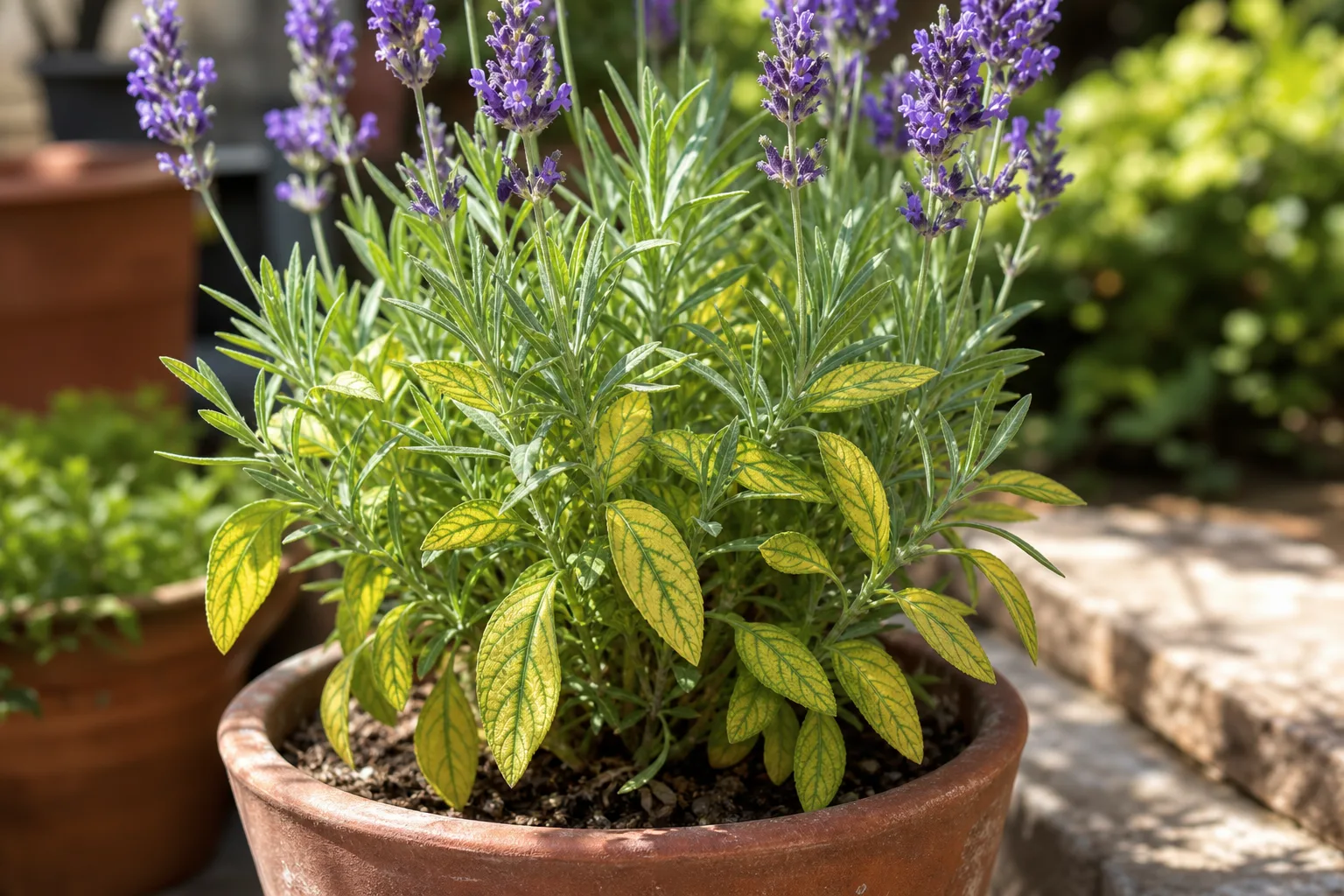
Magnesium Deficiency on Lavender: Causes, Checks & Fixes
This guide covers magnesium deficiency on Lavender. See also the general Magnesium Deficiency guide, watering, and light pages for this plant.
Magnesium Deficiency on Lavender: Causes, Checks & Fixes
Quick answer
On English lavender (Lavandula angustifolia), magnesium deficiency is usually an older-leaf problem first: yellow patches between greener veins on lower silvery foliage, while newer tips stay comparatively better for a while. This happens because magnesium is a mobile nutrient that plants reallocate to young tissue under shortage.
Your first action is still to rule out wet-root stress, because lavender performs best in sharply draining conditions and commonly declines when roots stay wet (RHS growing guide). If roots are firm and drainage is good, one conservative Epsom drench can be appropriate.
This page is the interveinal old-leaf deep-dive for container English lavender-not general yellow-leaf triage. For any yellowing pattern you cannot classify, start on yellow leaves on lavender. For chronic wet-soil decline, see overwatering and root rot.
When yellow lavender is NOT magnesium deficiency
Growers often reach for Epsom salt at the first hint of yellow-but on lavender, wet roots outrank micronutrient shortage as the cause of decline. Adding a magnesium drench to saturated, rotting mix can worsen salt stress without fixing uptake failure.
Skip magnesium correction and pivot to rot or watering guides when you see:
- Overall limp wilt with constantly wet media
- Soft crown or sour root-zone smell
- Rapid whole-plant collapse despite cool weather
- Uniform yellowing without a clear green-vein network
Those patterns belong on overwatering or root rot-not here.
What magnesium deficiency looks like on lavender
Look for a pattern, not just “yellow leaves.” Typical magnesium shortage shows interveinal chlorosis on older leaves first: the blade between veins fades yellow or pale green, while the vein network stays greener. On lavender’s narrow silvery foliage, the contrast can be subtle until you inspect lower leaves in good light.
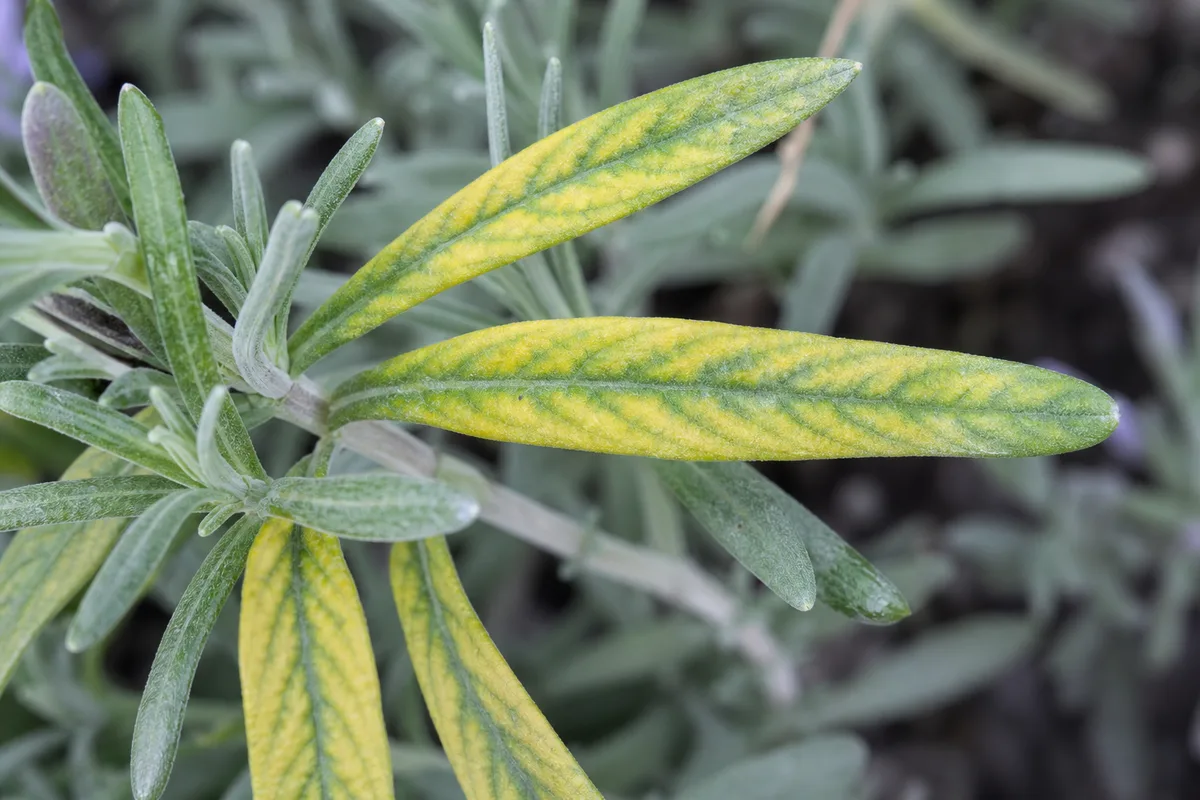
Magnesium Deficiency symptoms on Lavender - compare with healthy tissue on the same plant.
Interveinal chlorosis vs. nitrogen pale tips vs. rot wilt
| What you see | Leaf age | Vein color | Root/crown | Likely cause | Urgency | Read next |
|---|---|---|---|---|---|---|
| Yellow between green veins, lower leaves first | Older lower | Veins stay green | Firm, dry-down OK | Magnesium deficiency | Low–medium | This page |
| Uniform pale yellow, weak overall growth | Often older first | Fades with blade | Firm | Nitrogen deficiency | Low | Nitrogen deficiency |
| Yellow between veins on young tips | Young upper | Veins may stay green | Firm | Iron chlorosis | Medium | Yellow leaves |
| Yellow + wilt on wet mix | Any | N/A | Soft, sour smell | Root rot / overwatering | High-same day | Root rot |
| Inner lower leaves dull, plant compact in Lavender light guide | Oldest interior | Even silver-grey | Firm | Normal aging | None | No action |
Severity tiers: Mild cases show scattered interveinal patches on a few lower leaves with firm roots and stable new silver tips. Advanced cases show chlorosis climbing upward through the canopy over weeks-still investigate drainage and potassium history before a second Epsom dose.
Signs that support magnesium deficiency:
- Older lower leaves affected before newer growth
- Interveinal yellowing more than uniform all-over paling
- No severe stem-base collapse
- Symptoms in long-used container media or after heavy potassium feeding
Signs that point away:
- Fresh tip-only pale growth (iron or nitrogen path)
- Limp wilt with wet media (rot path)
- Normal compact silver mound in full sun with only a few inner leaves aging out
Why lavender gets magnesium deficiency
Mobile-nutrient biology and container grit depletion
Lavender naturally prefers sun, lean fertility, and free-draining soil, and does poorly in wet heavy ground. In containers, deficiency risk rises when media gets old and nutrient balance drifts over multiple seasons without refresh. Magnesium is mobile-under shortage, the plant moves magnesium from older leaves to support new growth, which is why symptoms appear on lower foliage first.
Potassium excess and magnesium uptake competition
Another trigger is nutrient antagonism: excessive potassium can suppress magnesium uptake, even when magnesium is present in the root zone. Interveinal yellowing sometimes appears after aggressive “bloom booster” style feeding rather than from absolute magnesium absence. If you recently fed high-potassium products, review potassium deficiency scope and pause bloom boosters before correcting magnesium.
Container pH note: Lavender prefers lean alkaline gritty mix. Repeated Epsom applications in confined pots can accumulate soluble salts and disturb calcium–magnesium balance-extension guidance for potted plants emphasizes starting with less, not more, because magnesium toxicity is harder to reverse than deficiency.
How to confirm the cause
Use this order before treating:
- Leaf-age pattern: Did symptoms begin on older leaves first?
- Vein pattern: Is yellowing mostly between veins, not uniform?
- Root check: Are roots pale-firm instead of mushy-brown?
- Moisture rhythm: Is mix drying between waterings?
- Feeding history: Any recent high-potassium products?
- Potting age: Same mix for multiple seasons?
If root condition or moisture is wrong, correct those first. Lavender can fail from drainage problems even when nutrients are technically adequate.
Confirmation decision table
| Pattern | Crown | Mix moisture | Severity | First action |
|---|---|---|---|---|
| Lower interveinal chlorosis, firm roots, dry-down OK | Firm | Drying between waterings | Low | One Epsom drench at named rate below |
| Uniform pale weak growth, old exhausted mix | Firm | Normal | Low | Check nitrogen deficiency |
| Young-tip interveinal yellow, firm roots | Firm | Normal | Medium | Iron/pH path-see yellow leaves |
| Yellow + wilt, wet mix, sour smell | Soft | Stays wet | Urgent-same day | Stop water; root rot protocol |
| Chlorosis after bloom booster, firm roots | Firm | Normal | Medium | Pause K feed; one Epsom drench only if pattern fits |
Soil-test option: If interveinal yellowing persists after culture correction and one conservative Epsom drench, a lab soil test confirms whether magnesium is truly low before any repeat application. Your local cooperative extension office can help interpret results for container media.
First fix for lavender
First fix: correct root-zone conditions before adding anything.
Move the plant into stronger light and airflow if needed, and ensure the container drains freely. If media is staying wet, adjust watering immediately and consider repotting into a grittier mix per the lavender soil guide.
When roots are firm and the symptom pattern still matches magnesium shortage, apply one conservative magnesium sulfate correction:
| Container size | Epsom rate | Application |
|---|---|---|
| Small pot (under 2 gallons) | 1 teaspoon Epsom salt in 1 gallon water | Single soil drench until slight drainage; empty saucer within 30 minutes |
| Typical 3-gallon pot | 1 teaspoon dry Epsom salt dissolved in 1 quart to 1 gallon water (NC Extension container rate) | Same drench protocol once per season maximum |
| Larger containers (5+ gallons) | 1 tablespoon Epsom salt in 1 gallon water (SDSU Extension side-dress rate) | One drench only when deficiency pattern and root health align |
Extension sources treat Epsom salt as a targeted remedy for confirmed deficiency, not a routine tonic. Potted plants need smaller doses than garden beds because salts accumulate in confined mix-do not exceed one application per growing season unless a soil test supports it.
Do not Epsom drench when the crown is soft and soil is wet. That is a rot pathway-fix drainage first.
Step-by-step recovery
- Stabilize environment first: full sun exposure and faster dry-down per the watering guide.
- Inspect roots: if rot signs are present, treat as root stress on root rot-not deficiency.
- Apply one magnesium correction only if deficiency pattern and root health align, using the rate table above.
- Pause additional feeding for 2–4 weeks, especially high-potassium products.
- Track only new growth quality (color, vigor, symptom spread)-not old leaf re-greening.
- Repot if needed into lean, coarse, fast-draining media when substrate is old or compacted-see lavender repotting and soil guide.
Do not stack repotting, relocation, heavy pruning, and Epsom on the same day. Fix the water pathway first, then reassess after two weeks.
Recovery timeline
If magnesium shortage was the main issue, improvement usually appears as cleaner new silver-green growth over the next 3–6 weeks. Previously chlorotic older leaves often remain marked and may eventually shed-they rarely return to full color. Judge success by healthier new shoots and stopped upward spread, not by expecting damaged lower foliage to fully recover.
If symptoms keep spreading despite better drainage and one correction, reassess for mixed causes: root stress, pH drift, iron chlorosis, or broader nutrient imbalance. Persistent cases may need a soil test before any second drench.
Causes to rule out
- Overwatering / root stress: the top mimic on lavender in containers.
- Nitrogen deficiency: tends toward uniform pale yellow rather than vein-preserving interveinal chlorosis.
- Iron chlorosis: often appears first on younger leaves, unlike magnesium’s older-leaf tendency.
- Potassium excess: can lock magnesium uptake after bloom-booster feeding.
- Natural inner aging: older interior leaves can dull and drop without nutrient deficiency in an otherwise compact mound.
Mistakes to avoid
- Treating every yellow leaf as magnesium shortage-start on yellow leaves when the pattern is unclear.
- Applying repeated Epsom doses without confirming diagnosis or soil-test need.
- Feeding high potassium while interveinal symptoms are active.
- Ignoring drainage issues because foliage looks nutrient-related.
- Expecting old chlorotic leaves to re-green-recovery shows in new growth only.
How to prevent magnesium deficiency next time
Use a lean, airy potting blend and refresh aging container media before it breaks down-full mix guidance lives in the map on the lavender soil guide. Avoid nutrient stacking, especially products that push potassium without a clear need.
When deficiency symptoms appear, verify first, then correct once and observe. Extension sources emphasize that magnesium sulfate works best as a targeted response to confirmed symptoms rather than routine use. Schedule periodic mix refresh on repotting rhythm instead of quarterly Epsom “tonics.”
When to worry
Escalate quickly if yellowing is paired with crown softness, persistent wilt, or rapid canopy decline. That pattern usually indicates root or crown health failure-not a simple magnesium shortage-and recovery odds drop if wet-root stress continues.
True magnesium shortage alone is slow-moving. Urgent same-day action belongs to rot and overwatering paths, not micronutrient correction.
Related lavender problems
- Yellow leaves on lavender - General yellow-leaf triage when pattern is unclear
- Nitrogen deficiency - Uniform pale growth in exhausted lean mix
- Potassium deficiency - Scorch and K–Mg antagonism context
- Overwatering - Top mimic for yellowing on wet mix
- Root rot - Mushy roots and rescue before any Epsom
- Lavender soil - Gritty alkaline mix for prevention
- Lavender repotting - Refresh depleted container media
- Lavender overview - Sun, drainage, and Mediterranean culture hub
FAQs
How much Epsom salt should I use on lavender in a pot?
For a typical 1–2 gallon container, dissolve 1 teaspoon Epsom salt in 1 gallon of room-temperature water and apply once as a soil drench until slight drainage, then empty the saucer. NC Cooperative Extension recommends about 1 teaspoon dry Epsom salt for a 3-gallon pot as a ceiling reference-more is not better in confined pots. Do not repeat the same season without confirming the pattern still fits magnesium deficiency.
How is magnesium deficiency different from nitrogen deficiency on lavender?
Magnesium shortage usually starts on older lower leaves with yellow tissue between green veins (interveinal chlorosis). Nitrogen deficiency also affects older leaves first because both are mobile nutrients, but nitrogen tends toward uniform pale yellowing rather than vein-preserving chlorosis. If new tips stay silver-green while only lower leaves show the interveinal pattern, magnesium moves up the suspect list-use the comparison table above and the nitrogen deficiency guide for side-by-side checks.
Can too much potassium cause magnesium deficiency on lavender?
Yes. Excess potassium can suppress magnesium uptake even when magnesium is present in the mix, which is why interveinal yellowing sometimes follows aggressive bloom-booster feeding. Pause high-potassium products, confirm drainage and root health, then consider one conservative magnesium correction only if the leaf pattern still fits.
Is interveinal yellowing always magnesium deficiency on lavender?
No. Interveinal patterns can mimic nutrient stress, but on container lavender the top mimics are chronic overwatering, root rot, and iron chlorosis on young leaves. Wet mix with a soft crown and sour smell is rot-not a cue for Epsom. Start with moisture and root checks, then use the confirmation table before treating.
When is magnesium deficiency urgent on lavender?
True magnesium shortage is usually slow-moving and low urgency. Urgent action is needed when yellowing pairs with wilting, crown softness, or sour wet media smell-that pattern points to root failure, and nutrient drenches can worsen rot. Fix drainage and inspect roots same day before any Epsom application.
Conclusion
Magnesium deficiency on lavender is real but secondary to watering-related stress. When to Epsom: lower-leaf interveinal chlorosis, firm roots, good dry-down, and one named drench at 1 teaspoon per gallon (or 1 teaspoon dry for a 3-gallon pot)-then judge new growth over 3–6 weeks. When to repot: old compacted mix after culture is corrected-see soil and repotting. When to skip nutrients entirely: wet mix, soft crown, or sour smell-escalate to root rot rescue. For any pattern you cannot classify, start on yellow leaves before reaching for Epsom.
When to use this page vs other Lavender guides
- Lavender watering guide - Use for routine moisture checks before assuming magnesium deficiency is the main issue.
- Lavender problems hub - Browse all 51 common issues on this species.
- Yellow Leaves on Lavender - Different entry point when symptoms overlap with magnesium deficiency.
- Brown Tips on Lavender - Different entry point when symptoms overlap with magnesium deficiency.