Jasmine Light Requirements: Bright Light for Blooms
Jasmine Light Requirements: Bright Light for Blooms
Jasmine Light Requirements: Bright Light for Blooms
Jasmine is not a foliage plant you park in a dim corner and forget. It is a bloom-driven climber whose entire reputation rests on fragrant white flowers - and flowers are expensive. They demand strong light, stable moisture, and seasonal rhythm. Jasminum officinale (common jasmine, poet’s jasmine, true jasmine) is the species most growers mean when they say “jasmine,” and NC State Extension classifies it for full sun (six or more hours of direct sunlight daily) or partial shade (direct sun only part of the day, two to six hours). That range sounds forgiving until you realize tolerance is not the same as blooming well. A jasmine vine can stay green in mediocre light for months and still produce almost no buds.
The single most common jasmine light mistake is giving enough brightness for survival but not enough for floral initiation. Leaves may look fine. New shoots may appear. Then spring arrives and the plant offers lush foliage with bare stem tips - no clusters, no perfume, no payoff. NC State Extension notes that jasmines need full sun for optimal health or at least bright light, and that flowers are borne on old growth - so light must be adequate well before buds form.
This guide focuses on placement decisions that turn green vines into flowering ones: how much light jasmine actually needs, why brightness controls blooms more than fertilizer, where to put the pot by window direction, how to handle direct sun safely, when grow lights become necessary, and how to read warning signs before legginess or scorch becomes permanent.
How Much Light Jasmine Actually Needs to Flower
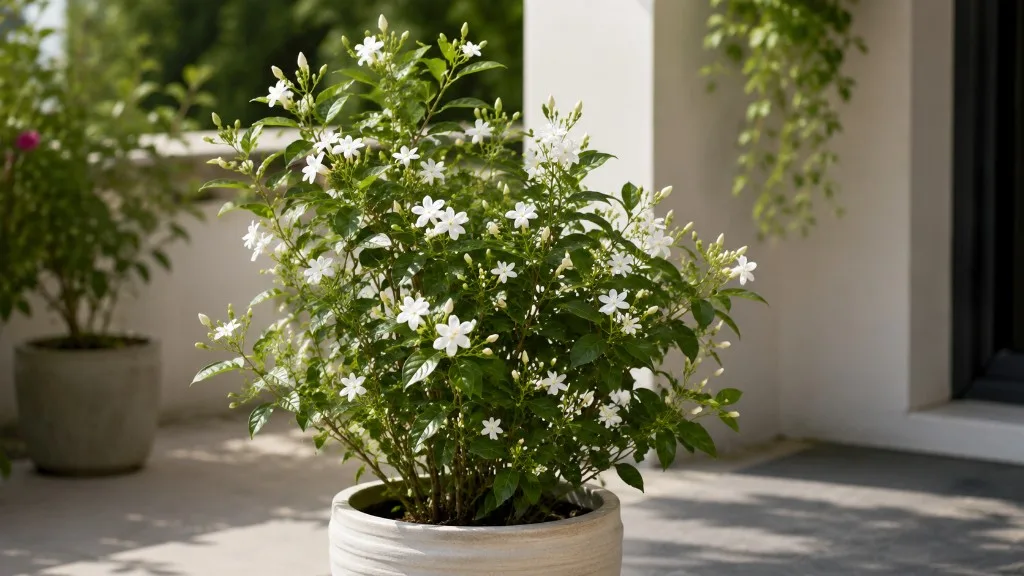
Jasminum officinale is a vigorous twining vine in the Oleaceae family, native from Turkey through the Trans-Caucasus to southern central China and widely naturalized across warm temperate and subtropical regions. Outdoors it can climb 20–30 ft (6–9 m) on a trellis; in a container with support it typically behaves as a 60–90 cm (2–3 ft) shrubby climber unless you deliberately train longer stems. That climbing habit matters for light placement: the growing tips where buds form must sit in the brightest zone, not the base of the pot tucked under a windowsill.
For reliable flowering, target full sun to partial shade with a strong bias toward sun. In practical grower terms:
- Full sun: six or more hours of direct, unfiltered sunlight on the foliage during the active growing season (spring through fall)
- Partial shade: roughly four to six hours of direct sun, or bright open shade where sky brightness remains high all day
- Bright indirect only: acceptable for short-term adjustment or propagation, but poor for sustained blooming indoors
NC State Extension lists common jasmine for full sun to partial shade, with more sun supporting heavier flowering and too much shade leading to fewer blooms and looser, leggier stems. NC State adds that flowering appears on old growth from spring through fall, responding well to pruning after blooms fade - which means light must be adequate before bud set, not only during open flowers.
Light also sets the pace for water use, nutrient demand, and pest pressure. A jasmine in strong sun dries its pot faster, metabolizes fertilizer more actively, and supports denser foliage and more flower clusters. A dim plant grows slowly, stays wet longer, and becomes vulnerable to root stress if you keep a bright-window Jasmine watering guide. Treat light as the throttle for the whole care system.
The Short Answer for Bloom-Focused Growers
If you only remember four rules, use these. Minimum for blooms: six hours of direct sun daily on the growing tips during the active season - outdoors in open sun, or indoors at the strongest south or east window you have, supplemented with a grow light if needed. Partial shade works, but blooms lighten: four to six hours of direct sun or very bright open shade can sustain the plant with moderate flowering, not peak fragrance. Low light fails long-term: jasmine may survive in dim rooms but typically becomes leggy, budless, and slow. Judge by buds and new growth: firm, correctly colored new leaves plus visible bud formation at stem tips mean the current light works; long internodes, pale leaves, and empty tips mean move brighter before changing fertilizer.
Give any placement change two to three weeks before declaring failure. Old damaged leaves do not recover - only new shoots and bud initials tell the truth about the current spot.
Why Light Controls Jasmine Blooms More Than Fertilizer
Growers often reach for bloom booster fertilizer when jasmine refuses to flower. That impulse is understandable and frequently wrong. Floral bud initiation depends first on the plant capturing enough photosynthetic energy to shift resources from vegetative growth to reproduction. Without adequate light, nitrogen-rich feeds mainly produce longer stems and larger leaves - lush, green, and flowerless.
The distinction that saves months of frustration is surviving versus blooming. A jasmine in partial shade or bright indirect light can maintain healthy green foliage because leaves operate at low metabolic cost. Bud formation is a higher-energy commitment. The plant allocates carbohydrates to flower primordia only when light income reliably exceeds baseline maintenance. That is why a vine against a bright south-facing wall outdoors often perfumes the entire garden while an identical plant in a shaded porch corner stays mute all summer.
Bloom troubleshooting guides from NC State Extension consistently rank too little sun among the first causes of jasmine not flowering - jasmines need full sun for optimal health or at least bright light. Light also interacts with pruning timing, water stress, and temperature cues, but you cannot fertilizer your way past a photon deficit. Fix exposure first; then evaluate feeding, cooling periods (required by some species), and root space.
Surviving in Shade vs Blooming in Bright Light
Survival in reduced light means jasmine keeps existing leaves, may produce thin new shoots with long gaps between leaves, and shows few or no buds even when the rest of the care routine looks correct. Watering must drop because transpiration falls. Fertilizer should wait until new growth proves the plant is actively metabolizing.
Blooming requires stepping into the full sun to strong partial shade band where growing tips receive direct rays for a large part of the day. In this band, jasmine forms clusters of buds on mature stems, opens fragrant white flowers from late spring through summer and often into fall, and maintains tighter internodes with firmer leaves. The Missouri Botanical Garden notes jasmine blooms from spring to fall when kept warm, evenly moist, and given enough bright sun exposure - the conjunction matters, but sun is the non-negotiable input most indoor growers lack.
The trade-off is explicit: lower light demands lower water and no aggressive feeding. Overwatering in dim conditions - not darkness alone - kills many indoor jasmines when growers interpret green leaves as proof the spot works.
What Happens When Jasmine Gets Too Little Light
Below the blooming threshold, jasmine does not die quickly. It retreats. New stems etiolate - pale, thin, and stretched toward the nearest window. Internodes lengthen. Leaves emerge smaller and lighter green. The plant leans dramatically toward glass. Flower buds, if any appear, are small and drop prematurely because the plant cannot sustain them.
Chronic under-lighting also couples to root stress: slow transpiration keeps soil wet, anaerobic conditions favor root decline, and the grower often responds by watering on schedule because the top inch dried while the core stayed soggy. Yellow lower leaves in low light are therefore not purely a nutrient signal - check moisture, light, and root health together before stacking interventions.
If you cannot raise light immediately, adjust expectations: reduce water sharply, stop fertilizer until new growth firms up, and consider a grow light rather than accepting a permanently budless vine. Jasmine in a dark room is a foliage experiment, not a flowering plant.
Full Sun and Partial Shade - Finding the Sweet Spot
Full sun is the target for heaviest bloom on Jasminum officinale and most summer-flowering true jasmines. Outdoors, that means an open trellis, pergola, or fence face with unobstructed sky from mid-morning through mid-afternoon. Indoors, it means the strongest south or east window available, with the growing tips within the direct beam for a substantial part of the day - not merely “in a bright room.”
Partial shade is the workable compromise when climate or glass intensity would otherwise scorch leaves. In hot-summer regions, light afternoon shade on a west exposure can reduce heat stress while preserving enough total daily light for moderate flowering. In cool-summer climates, partial shade may unnecessarily limit blooms - push toward full sun when temperatures stay moderate.
Indoors, partial shade often translates to:
- An east window with four to six hours of direct morning sun plus bright ambient light afterward
- A south window with the plant set back a few feet or behind sheer diffusion so leaves receive strong brightness without continuous harsh beam contact
- A bright conservatory where glass raises total light but ventilation prevents heat buildup
The mistake is labeling any spot “bright indirect” and expecting jasmine to bloom like an outdoor vine. Bright indirect may keep leaves alive. It rarely delivers the photon flux flowering vines expect.
Reading New Growth as Your Light Report Card
Jasmine tells you whether light works on the newest stems and bud initials, not on leaves from last season. Old stretch and old scorch do not heal. Evaluate:
- Internode length: healthy bright light produces short gaps between leaf pairs; long empty stem between clusters means stretch
- Leaf size and color: new leaves should be firm, medium to dark green, and proportionate; small pale leaves signal deficit
- Bud presence: during bud-setting season, look for swelling at stem tips; bare tips through the flowering window mean insufficient light or wrong seasonal cues
- Directional lean: strong lean toward glass means insufficient total light or one-sided exposure; rotate weekly and step brightness up
- Flower persistence: buds that form but drop before opening may indicate light improvement needed, or heat stress - but light is the first check
Run this assessment 14–21 days after any move. If new growth compacts and buds appear, the change succeeded even if older stems still show old damage. If stems keep stretching with clean but empty tips, move one step brighter - closer to glass, clearer line of sight to sky, or supplemental LED - before Jasmine repotting guide or feeding.
Direct Sun - What Jasmine Can Handle After Acclimation
Jasmine is a sun-loving vine, not a shade houseplant. Direct sun - solar rays striking leaf tissue - is exactly what drives heavy bloom outdoors. The nuance is dose and acclimation, not avoidance. Leaves formed in lower light lack the photoprotective pigments and structural toughness of sun-grown tissue. Move a shade-grown jasmine into unfiltered midday south or west glass without transition and you get bleached patches, crisp margins, and sudden leaf drop within days.
That failure makes growers swear jasmine “cannot take sun,” when the real error was rate of change. Acclimated jasmine on an outdoor trellis in full sun is the reference standard. Indoor jasmine should approach that intensity gradually, not abandon it.
Hot window glass magnifies risk: a pot touching a south pane in summer can burn leaves that would tolerate the same compass direction outdoors with air movement. Reflected heat from white walls and dark furniture also counts. Monitor the leaf surface facing the window during peak hours.
Gradual Acclimation and the Morning-Sun Advantage
Acclimation means increasing direct exposure gradually so new leaves form under higher light before old shade-grown tissue is stressed. A practical protocol:
- Start from the plant’s current exposure - do not assume prior nursery sun
- Add 30–60 minutes of direct sun per week, preferably morning rays through east glass or early outdoor shade transition
- Watch newest leaves only; old cosmetic damage is irrelevant
- Step back immediately if young tissue bleaches or crisps
- Pair brighter light with more frequent moisture checks - transpiration rises
Morning sun is the best acclimation tool because it is cooler and shorter than afternoon sun. An east window giving two to four hours of gentle direct light, expanded over weeks toward six or more, often succeeds where a sudden jump to west afternoon exposure fails. Once acclimated, many container jasmines handle full south exposure in spring and fall; in peak summer heat, sheer diffusion or slight afternoon shade prevents bud drop from leaf overheating.
Never move a jasmine from a dim interior straight to a west patio or unfiltered south window in July. Rehab in stages over two to three weeks minimum.
Best Window Placement for Indoor Jasmine
Compass direction is a starting guess, not a verdict. A “south window” deep under a porch roof may deliver less usable light than an open east window. What matters is hours of direct sun on growing tips and total daily brightness.
Place the pot where stems and buds receive light, not where the room looks bright when you stand in the doorway. Jasmine is a climber - if you train it on a small trellis or hoop, top growth must sit in the window’s brightest zone. A pot on the floor below the sill often starves the very tissue that should flower.
Rotate the plant a quarter turn weekly to prevent permanent lean. One-sided exposure in marginal light exaggerates tilt and uneven leaf size. Keep humidity moderate (40–60%) and temperatures roughly 15–32°C (60–90°F); extreme heat plus strong sun accelerates bud drop.
East, South, West, and North Windows Compared
An east-facing window is the best default for many indoor jasmines. Morning sun is cool and direct, supplying several hours of beam intensity without the heat load of afternoon glass. East exposures often deliver full sun in the practical blooming sense when the plant sits within 0.6–1 m (2–3 ft) of the pane. This is the first placement to try if south scorches or north fails.
A south-facing window is the strongest indoor option for bloom when managed correctly. Place jasmine close enough that growing tips receive long direct beams in winter and spring. In summer, use sheer curtains or pull back slightly if leaf temperature spikes or buds drop. South light through clean glass often replaces outdoor trellis conditions in cool-climate apartments.
A west-facing window is high risk, high reward: strong afternoon rays plus heat. Jasmine can bloom well here in spring and fall when temperatures stay moderate. In summer, diffuse or setback the plant so it receives brightness without continuous scorching afternoon beams. Watch for wilting on moist soil at midday - a heat-stress signal.
A north-facing window is usually insufficient for blooming jasmine without grow-light supplementation. North light may sustain slow foliage in summer at high latitudes but rarely delivers six hours of direct sun. If north is your only option, plan on a full-spectrum LED rather than expecting fragrance.
Outdoor Trellis and Patio Exposure
Outdoors, jasmine belongs on a sturdy trellis, pergola, or fence in full sun for maximum bloom. NC State Extension notes common jasmine is drought and pollution tolerant once established and can perfume an entire garden from a single vine - but that performance assumes open sky exposure, not foundation shade under eaves.
Container jasmine summered outdoors should sit where it receives direct sun most of the day. Acclimate indoor plants over one to two weeks by increasing outdoor hours gradually. Avoid dark patio corners that receive reflected brightness to human eyes but little direct sky to leaves. Bring pots indoors before frost in zones colder than USDA 7b, or treat as a seasonal outdoor plant.
Jasmine Species and How Light Needs Differ
“Jasmine” in commerce covers multiple species with different bloom seasons and slightly different light tolerances. Light principles overlap, but copying one plant’s window plan without checking species causes confusion.
Jasminum officinale (common / poet’s jasmine): Large twining vine; full sun to partial shade; flowers late spring through summer into fall; six or more hours direct sun for best indoor bloom. The focus of this guide.
Jasminum sambac (Arabian jasmine, motia): Shrubbier habit; highly prized for fragrance; needs strong light - often cited as minimum four to six hours direct sun with heavier bloom at six plus. Tolerates indoor culture better than officinale when light is managed, but still fails in dim rooms.
Jasminum polyanthum (pink jasmine): Vigorous cool-season bloomer; needs bright light and a cool autumn period to set buds; indoor bloom without cooling fails even with perfect summer sun.
Jasminum nudiflorum (winter jasmine): Yellow flowers on bare stems in late winter; tolerates more shade than summer jasmines; different aesthetic and care calendar.
Trachelospermum jasminoides (star jasmine): Not a true Jasminum; often sold as jasmine; similar need for bright light to bloom, but pruning and hardiness differ. Verify genus on the tag before applying true-jasmine light rules.
When species is unknown, use new growth and bud behavior as your guide. If the plant stays green but never sets buds in a spot with fewer than four hours of direct sun, brightness is still the bottleneck.
Grow Lights When Natural Light Falls Short
Northern winters, obstructed windows, and apartment layouts force many growers to supplement natural light. That is normal, not failure. Jasmine accepts full-spectrum LED grow lights when setup respects intensity, distance, and photoperiod.
The Spruce and multiple indoor bloom guides converge on a practical baseline: position a full-spectrum LED 30–45 cm (12–18 in) above the canopy and run it 12–14 hours daily when natural sun falls below the six-hour direct threshold. Cheap decorative “grow bulbs” often lack the red-to-far-red balance flowering plants need; choose a fixture rated for vegetative and flowering use.
Start conservatively. Leaf bleaching under LEDs means the fixture is too close or too long daily. Healthy jasmine foliage under supplemental light stays deep green and waxy, not lime-pale. Raise the light or reduce hours until color stabilizes, then increase gradually.
Avoid night-interrupting light near the plant during bud-setting periods for species that respond to day length. A living-room lamp that keeps jasmine artificially “awake” can disrupt floral cues even when daytime sun seems adequate.
Setting Up a Full-Spectrum LED for Indoor Blooms
A workable indoor bloom setup:
- Place the jasmine so natural window light and LED light combine on growing tips
- Mount the fixture 12–18 inches above the highest stems
- Run 12–14 hours on a timer, aligned with daytime (e.g., 7 a.m. to 9 p.m.)
- Check leaves weekly for pale bleaching; adjust height first, then duration
- Increase watering slightly - light plus supplemental photons raises transpiration
- Hold fertilizer until new growth shows the plant is responding
Grow lights replace missing sun; they do not replace species-specific cooling periods for jasmines like J. polyanthum. If light is corrected and buds still fail, investigate autumn temperature cues next - but light remains the first fix for green, flowerless vines.
Seasonal Light Shifts and Winter Sun Angles
Light is not static. Winter lowers sun angle, shortens photoperiod, and reduces intensity at north and east windows. A placement that bloomed reliably in June may underperform in January even though you never moved the pot. Watch for renewed stretching each winter and add LED hours or move the plant to the brightest available glass from October through March in mid- to high-latitude homes.
Spring brings rapid angle change. Buds initiated under winter cool-and-bright conditions may open as sun strengthens. Avoid sudden relocation during active bud swell - stable conditions prevent drop.
Summer intensifies south and west glass. Sheer diffusion beats moving jasmine to a dim room. Bud drop during heat waves often reflects leaf temperature stress, not root failure. Improve airflow, shade the hottest afternoon hour, and maintain even moisture.
Outdoors, deciduous tree shade changes through the season. A trellis site under bare branches in March may become too dark by August. Reassess canopy shade annually.
Warning Signs Your Jasmine Has the Wrong Light
Jasmine symptoms overlap with watering and pest issues, but pattern and sidedness separate light problems from other failures. Read newest growth first.
Too little light typically shows:
- Long, thin stems reaching toward the window
- Small, pale new leaves with wide gaps between them
- No buds during the normal flowering window despite healthy older foliage
- Lower leaf yellowing on chronically dim plants, often coupled with slow dry-down and overwatering risk
- General lean toward the brightest direction
Too much sun (or sudden exposure without acclimation) typically shows:
- Bleached, tan, or gray-white patches on the sun-facing leaf side
- Crisp brown margins appearing soon after a move to harsher glass
- Leaf curl or fold at midday on the window-facing side while soil is moist
- Sudden leaf drop after relocation to unfiltered south or west summer sun
- Bud drop when heat spikes even though roots are healthy
Fixes for too little light: move closer to south or east glass, prune leggy waste growth after relocation, add a grow light for 12–14 hours, and reduce water until new compact growth proves metabolism increased. Fixes for too much sun: sheer curtain, setback from glass, shift to east, acclimate only in stages, and never punish the plant by hiding it in a dark room - that swaps scorch for permanent budlessness.
Too Little Light vs Too Much Sun - Symptom Breakdown
When both watering and light seem “medium,” use this split:
| Signal | Likely too little light | Likely too much sun |
|---|---|---|
| New stem length | Very long internodes | Normal or stunted after scorch |
| New leaf color | Pale, small | Bleached patches on young tissue |
| Buds | Absent or never form | Form then drop in heat |
| Damage side | Lean toward window | Window-facing leaf faces only |
| Soil moisture | Stays wet longer | Dries fast; wilt at midday on wet soil |
| Timing | Worsens over months in same dim spot | Appears days after sudden move to harsh sun |
If symptoms conflict - yellow lower leaves plus soggy soil in a dim room - suspect overwatering amplified by low light before sun stress. If crisp patches appear only on the window side in summer - suspect direct exposure before root disease.
Conclusion
Jasmine light requirements are not ambiguous once you separate keeping leaves green from earning flowers. Jasminum officinale and most summer-blooming true jasmines want full sun to strong partial shade, with six or more hours of direct sun daily as the practical indoor bloom target. Partial shade can sustain the plant; it rarely delivers the fragrance-heavy show you bought the vine to produce. Low light is a long-term failure mode - leggy stems, pale leaves, and empty tips - even when watering and fertilizer look perfect.
Place jasmine east or south by default, filter harsh west summer sun, keep growing tips in the brightest zone rather than the pot base in shadow, and acclimate any jump in exposure over weeks, not hours. When windows fail, a full-spectrum LED at 12–18 inches for 12–14 hours is a legitimate bloom strategy, not a cheat. Read new growth and buds, not room brightness. Pair stronger light with more frequent moisture checks; pair dim sites with longer dry-down. Get the photons right and jasmine repays you with the white, star-shaped flowers and perfume that made this vine famous; miss them and even expert feeding produces only another houseplant that grows without blooming.
When to use this page vs other Jasmine guides
- Jasmine overview - Start here for whole-plant context before deep-diving this topic.
- Jasmine problems hub - Jump to symptom-specific fix guides when this care topic does not resolve the issue.
- Not Enough Light on Jasmine - Escalate here when light adjustments are not enough.
- Sunburn / Scorched Leaves on Jasmine - Escalate here when light adjustments are not enough.
Related Jasmine guides
- Jasmine overview
- Jasmine watering
- Jasmine soil
- Jasmine propagation
- Jasmine fertilizer
- Jasmine repotting
- Not Enough Light on Jasmine
- Sunburn / Scorched Leaves on Jasmine
- Jasmine problems
Related tool
Try the Plant Problem Diagnosis Tool with jasmine pre-selected to estimate needs for your setup.