Mold on Soil on Hoya Kerrii: Causes, Checks & Fixes
Quick answer
Surface mold on Hoya Kerrii soil is a warning that the top layer stays damp-risky for an epiphytic plant with succulent leaves. First step: stop watering and let the top half of the mix dry completely before you water again.
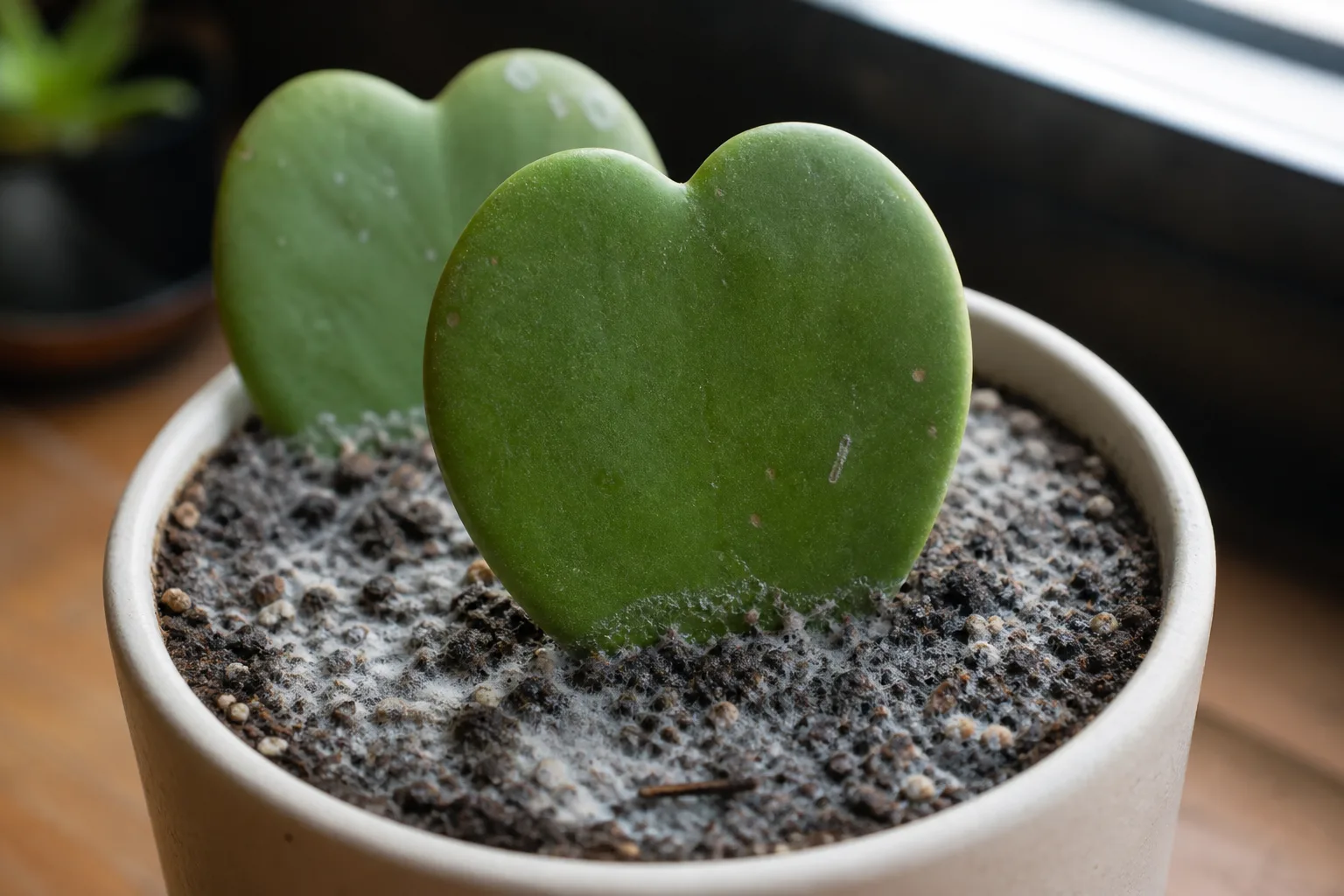
Mold on Soil on Hoya Kerrii: Causes, Checks & Fixes
This guide covers mold on soil on Hoya Kerrii. See also the general Mold on Soil guide, watering, and light pages for this plant.
Mold on Soil on Hoya Kerrii: Causes, Checks & Fixes
Quick answer
White or gray fuzz on the soil surface of your Sweetheart Hoya (Hoya kerrii) usually means the top layer has stayed damp too long. Hoya Kerrii overview is an epiphytic vine with thick, water-storing leaves, so it needs a dry-down rhythm rather than constantly moist media. The mold is often saprophytic fungal growth feeding on organic matter, but it warns that root-zone moisture is off.
First fix: stop watering immediately and do not resume until the top half of the mix is dry and the pot feels noticeably lighter. Only after that dry-down should you scrape off any remaining fuzzy layer if it bothers you.
What mold on soil looks like on Hoya Kerrii
On Sweetheart Hoya pots, mold most often appears as a thin white, gray, or occasionally yellowish fuzzy film across the top of the mix. It may show up in patches near the stem base or cover the entire surface. Sometimes you notice it alongside a musty smell, waterlogged-looking soil, or small flies hovering when you disturb the pot.
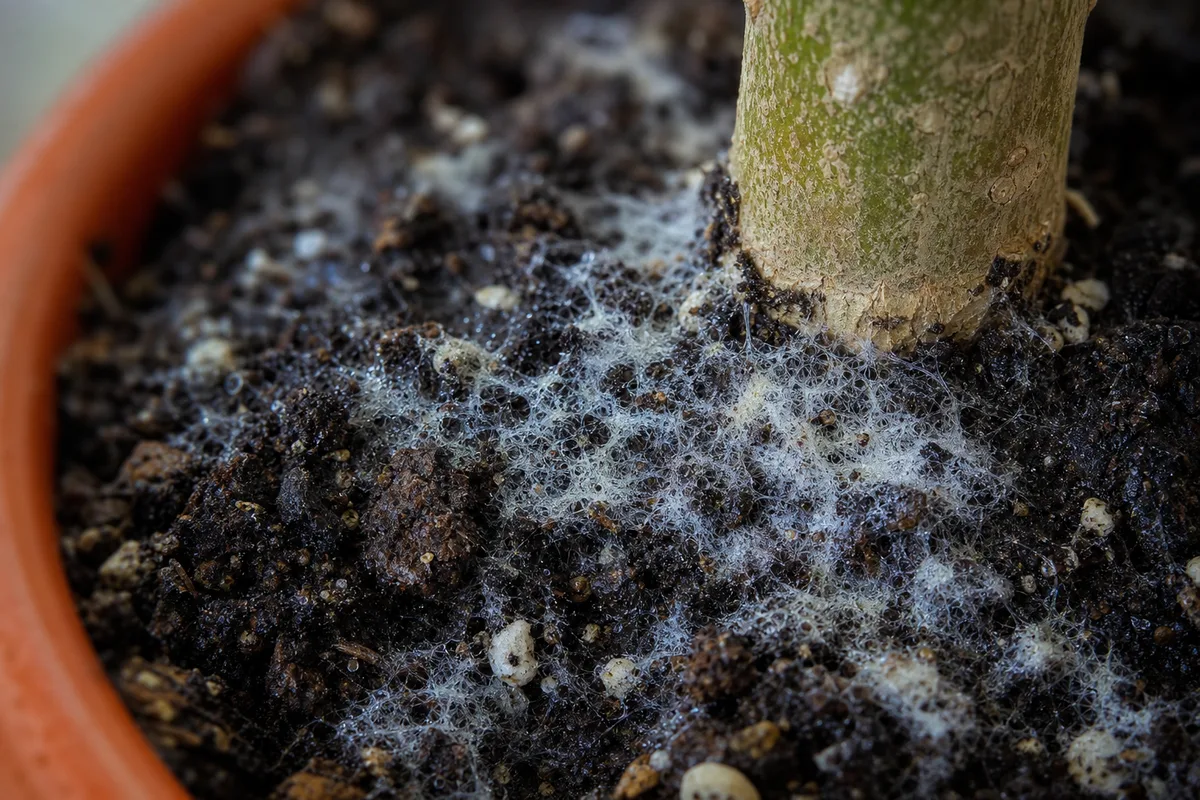
Mold on Soil symptoms on Hoya Kerrii - compare with healthy tissue on the same plant.
Healthy Hoya Kerrii should have a dry or lightly dusty soil surface within several days of watering. If the top stays dark, cool, and soft to the touch for a week or more, mold is a predictable follow-up. The thick heart leaves may still look plump at this stage-that is why surface mold catches growers off guard. The risk is not the fuzz itself but the wet conditions feeding it.
Single-leaf gift plants are a common mold scenario: one rooted leaf in a decorative pot with minimal root mass and slow water uptake. A full vine in a pot that is too large for its root ball shows the same pattern-the extra soil volume stays wet at the surface while the leaves look fine.
During winter, when growth slows and watering drops to every three or four weeks, a single generous drink in a dim corner can leave the mix damp for weeks.
Why Hoya Kerrii gets mold on soil
Hoya Kerrii is an epiphytic vine from Southeast Asia that performs best in free-draining media and careful watering cycles, not soggy compost (NCSU, RHS). When the mix holds moisture for days, fungal growth on the surface becomes much more likely.
Several care patterns trigger this on Sweetheart Hoya more than on thirsty foliage plants:
overwatering on Hoya Kerrii because leaves look fine. The succulent-textured hearts store water visibly. Owners see plump leaves and keep watering on a calendar while the mix below stays wet. Hoya Kerrii needs depth checks-the top half dry before the next drink-not a weekly schedule regardless of season.
Heavy or peat-rich mix without bark. Standard indoor potting soil retains water at the surface long after the leaf has had enough. A chunkier blend with bark and perlite dries more predictably for hoyas (Clemson HGIC).
Low light and poor airflow. Hoya Kerrii light guide helps the pot dry predictably. A Sweetheart Hoya on a dark shelf or crowded windowsill slows evaporation. Closed terrarium lids and decorative pot covers trap humidity above the soil.
Winter watering mistakes. Hoyas need less water in their cooler, semi-dormant period (RHS). One generous watering in winter can keep a small pot damp for weeks.
Oversized pots and full saucers. A tiny root system in a large decorative pot means a big wet zone that never dries. Water pooling in a saucer re-wets the mix from below.
Sealed cachepots after gift season. Many single-leaf Valentine’s setups sit in ceramic cover pots with no airflow and no drainage path. Even if you water lightly, trapped runoff keeps humidity high at the soil surface and mold returns.
How to confirm the cause
Work through these checks before Hoya Kerrii repotting guide or spraying fungicide:
- Leaf and petiole firmness. Pinch the heart leaf gently. Firm and solid is reassuring. A soft, mushy petiole where it meets the soil suggests rot-not just surface mold.
- Soil moisture at depth. Push your finger or a bamboo skewer halfway into the mix. If it comes out dark and clinging, the problem is wet soil throughout, not a harmless surface bloom.
- Pot weight and drainage. Lift the pot. Heavy days after you thought you watered lightly means water is not exiting. Confirm drainage holes are open and the saucer is empty.
- Light and season. Is the plant in bright indirect light or a dim corner? Are you still on a summer schedule in winter?
- Companion signs. Fungus gnats, yellowing heart leaves on an otherwise firm plant, or green algae on the rim point to the same root-zone moisture issue.
If yours is a single-leaf gift plant, add one more check: un-nest the nursery pot from any decorative cover pot and look for standing water below. Finding runoff trapped there explains repeated mold in otherwise “careful” watering routines.
If leaves are firm, the petiole is solid, and only the top centimeter is fuzzy after one overwatering episode, you likely caught it early. Mushy petiole plus wet deep soil means escalate to root-rot protocol, not just scraping.
The first fix to try
Stop watering and let the top half of the mix dry completely.
Do not scrape, repot, or spray on day one. Pausing irrigation gives you a clear read on whether the plant was simply overwatered. In warm active growth with good light, a small Hoya Kerrii pot often dries in one to two weeks. During winter rest, it may take longer-and that is acceptable.
Once the mix is dry at depth:
- Scrape off the top 1–2 cm of fuzzy soil with a spoon and discard it in the trash (not the compost pile indoors).
- Move the pot to brighter indirect light with space around it for airflow.
- Resume watering only when the dry-down test passes-then water thoroughly until it runs from drainage holes, and empty the saucer.
That single correction resolves most first-time mold cases on Sweetheart Hoya.
Step-by-step recovery
- Pause irrigation fully. Wait until the top half of the potting mix is dry and the pot weight drops clearly.
- Remove only the moldy surface layer. Scrape 1-2 cm from the top and discard it.
- Improve drying conditions. Give brighter indirect light and better spacing for airflow.
- Restart watering by moisture, not calendar. Rewater only after your depth check and weight check say “dry enough.”
- Escalate only if needed. If mold recurs quickly, refresh the top layer with airy mix or repot into a better-draining medium.
If mold comes back within a week
Recurring fuzz means the environment still favors fungus. After the dry-down cycle:
- Top-dress with a thin layer of dry airy mix (perlite and orchid bark) to replace the removed surface layer.
- Bottom-water once if you tend to wet the surface every time-roots absorb from below while the top stays drier.
- Repot in spring if the mix is peat-heavy, smells sour, or takes more than two weeks to dry in summer light. Use an epiphytic blend and a pot only slightly larger than the root ball.
Repotting is a second-step fix, not an emergency response to a single mold patch on an otherwise healthy plant.
Lookalike symptoms
Green algae on the pot rim or soil surface also signals persistent moisture and low airflow, and is managed the same way (UMD Extension).
Fungus gnats share the same wet-soil habitat. Adults are mostly a nuisance; larvae can stress fine roots on weak plants. Drying the mix treats both.
Mealybugs leave white waxy patches on leaf axils and undersides-not a uniform fuzz across bare soil. If the white is on the heart leaf itself, inspect for insects before assuming soil mold.
Powdery mildew on leaves is a separate foliage issue tied to humid stagnant air. Mold confined to soil with dry leaves points to watering and mix, not leaf fungus.
Salt or mineral crust can look white but feels hard and gritty, not fuzzy. Flush concerns are different from organic mold.
Mistakes to avoid
Do not drench with fungicide or cinnamon as a substitute for drying the soil-Hoya Kerrii roots need oxygen, not another wet treatment.
Do not increase watering because a heart leaf looks slightly thin while the soil is still damp. Wrinkling with wet mix means root stress, not thirst.
Do not keep a slow-growing Sweetheart Hoya on the same summer Hoya Kerrii watering guide through winter.
Do not assume mold is harmless and ignore a softening petiole. Surface saprophytes and root rot share the same cause: too much moisture for too long.
Do not repot a single-leaf gift plant on day one for surface mold alone-dry the mix first unless roots are clearly mushy on inspection.
Recovery timeline and warning signs
With firm leaf tissue and corrected watering, new vine growth or a second leaf node is the best sign you are clear. Surface mold should not return once the top dries between drinks.
Improvement usually shows within one dry-down cycle (roughly one to two weeks depending on pot size and season). Watch for:
- Good: Firm heart leaves, dry soil surface before each watering, no new fuzz, new stem or leaf growth in warm months on multi-node plants.
- Bad: Mushy petiole, yellowing heart leaf, sour smell from drainage holes, mold returning within days of scraping.
Rotten root tissue does not firm up again. Overwatering can kill roots by depriving them of oxygen, and damaged roots then decay (Missouri Botanical Garden).
When to worry
Escalate quickly if you notice any of these:
- Petiole tissue softening at the soil line
- Persistent sour smell from the pot
- Mold returning within a few days despite proper dry-down
- Yellowing leaves while the mix remains damp at depth
- Visible root mush when you unpot and inspect
At that point, switch to a root-rot workflow and inspect roots directly. Use the dedicated guide at /plants/hoya-kerrii/plant-problems/root-rot/ for full rescue steps.
If the case is unclear after inspection, get local diagnosis help from an extension master gardener program rather than trialing multiple treatments at once.
If you are handling moldy media directly, wear gloves and wash hands after cleanup. Hoya is listed as non-toxic to cats and dogs, but moldy potting media can still irritate sensitive skin or airways.
How to prevent mold next time
Match watering to Hoya Kerrii’s rhythm: thorough drinks followed by a full dry-down of the top half, with much less in cool months. Pair that with an airy epiphytic mix, bright indirect light, a right-sized pot, empty saucers, and enough space between plants for air movement.
Remove fallen leaves and debris from the soil surface promptly-they can feed fungal growth when moisture remains high (PSU Extension).
Treat the first patch of white fuzz as a moisture alarm, not just a cosmetic issue.
Hoya Kerrii care cross-check
- Watering: Follow a moisture check, not a weekly calendar. For full technique, see
/plants/hoya-kerrii/watering/. - Soil: Use an airy mix and drainage-first pot setup. See
/plants/hoya-kerrii/soil/. - Overwatering signs: Compare symptoms with
/plants/hoya-kerrii/plant-problems/overwatering/. - Gnats + wet media: If flies appear, check
/plants/hoya-kerrii/plant-problems/fungus-gnats/. - Repot timing: If mix quality is the core issue, plan a proper refresh at
/plants/hoya-kerrii/repotting/.
When to use this page vs other Hoya Kerrii guides
- Hoya Kerrii watering guide - Use for routine moisture checks before assuming mold on soil is the main issue.
- Hoya Kerrii problems hub - Browse all 16 common issues on this species.
- Fungus Gnats on Hoya Kerrii - Different entry point when symptoms overlap with mold on soil.
- Overwatering on Hoya Kerrii - Different entry point when symptoms overlap with mold on soil.
- Root Rot on Hoya Kerrii - Different entry point when symptoms overlap with mold on soil.