How to Prune Haworthia: When, Where, and What to Cut
How to Prune Haworthia: When, Where, and What to Cut
How to Prune Haworthia: When, Where, and What to Cut
First, run a finger around the outer ring of the rosette and remove only leaves that are fully dry - papery, brown or tan, and loose enough to pull downward without resistance. That single cleanup step is what most healthy Haworthia need. If a leaf still shows green at the base or bends with moisture, leave it. Once dead tissue is cleared, decide whether a spent flower stalk needs a gentle pull or a clean cut - never force anything at the crown.
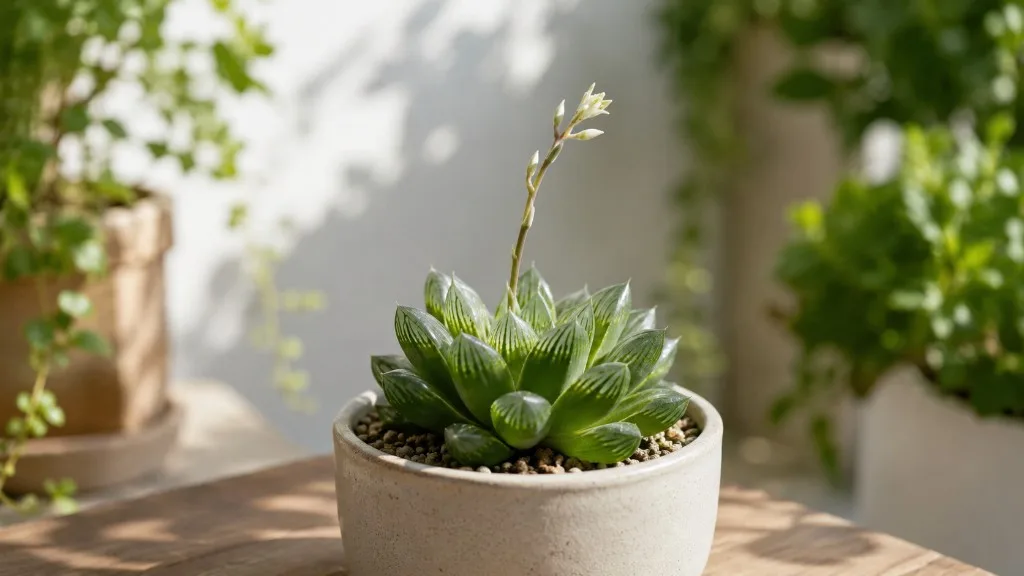
Haworthia (Haworthia spp.) is a slow rosette succulent from dry regions of South Africa, not a branching vine or woody shrub. New leaves emerge from a central crown; older leaves die on the outside. The plant does not branch from cut nodes, respond to tip pinching, or need scheduled cutbacks to survive indoors. BBC Gardeners’ World summarizes the entire pruning job in one line: remove yellowing or dead leaves with clean tools to avoid infection. For most growers, that plus occasional flower stalk removal is the full scope.
What Pruning Means for a Haworthia Rosette
On Haworthia, pruning is grooming, not shaping. The realistic tasks are:
- Dead leaf cleanup - removing fully desiccated outer leaves that trap moisture or pests
- Spent stalk removal - cutting or pulling dry flower stems after bloom
- Optional offset separation - dividing pups for propagation, not for making the mother rosette bushier
Tasks that do not apply: pinching tips for bushiness, cutting above nodes, shearing the rosette, or removing one-third of healthy foliage. Haworthia stores water in thick leaves and a tuberous root system; stripping green leaves steals reserves from a plant that already grows slowly. Fuller clumps come from offsets and good light - not from cutting living tissue.
Popular forms such as Haworthiopsis fasciata (zebra haworthia), Haworthia cooperi with windowed leaf tips, and Haworthia truncata with truncated rows all follow the same grooming logic even when leaf shape differs.
Inspect the Rosette Before You Touch It
Walk the plant in good light before choosing a tool.
Outer ring: Which leaves are papery and brown throughout? Partial yellow on the tip with firm green at the base may still be aging normally - wait until the whole leaf desiccates.
Crown: Press lightly near the center. Firm, appropriately colored tissue means the growing point is healthy. Soft, translucent, or foul-smelling center tissue means rot - stop grooming and address moisture and roots first.
Flower stalks: A stalk is a separate inflorescence, not a leaf. Green and firm during bloom stays unless you deliberately sacrifice flowers. Tan, dry stalks after bloom are grooming targets.
Pests: Mealybugs hide in tight axils and around old stalk bases. The British Cactus and Succulent Society (BCSS) notes fluffy white patches between leaves are best removed with a small brush dipped in methylated spirits - spot treatment, not drenching the rosette.
Soil and stress: Wet mix, recent Haworthia repotting guide, or severe etiolation (stretched, pale growth) are reasons to delay anything beyond one dry leaf - not a signal to strip foliage for a “fresh start.”
When to Groom Haworthia
Year-Round Dead Leaf Removal
Fully dead outer leaves can go any time you notice them. There is no required season for tissue that has already finished drying. Leaving crisp brown bases piled against the rosette for months traps humidity after watering and gives mealybugs cover - a quick check every one to two weeks during active growth, monthly in slower months, is enough.
After Bloom for Flower Stalks
Remove stalks after flowering finishes, when the stem yellows, browns, or dries along its length - often in spring or summer indoors, though timing varies. BBC Gardeners’ World notes many Haworthia flower in summer on a long stem when conditions are right. You do not need to wait for a calendar date once bloom is clearly over.
When to Delay Heavy Work
Batch offset separation, repeated cuts on partially attached leaves, or grooming a recently repotted plant fits best in warm, bright months when wounds callus quickly. In late fall and winter, when growth slows, stick to dry-leaf pulls only. Light dead-tissue removal still works in winter; skip forceful stalk pulls and multi-cut sessions on a plant already stressed by low light or reduced watering.
Tools and Sterilization
Keep the kit small:
- Sharp scissors, floral snips, or small bypass pruners for stalks and stubborn leaf bases
- 70% isopropyl alcohol and a cloth to wipe blades before starting, between plants, and after diseased tissue
- Soft dry brush for dust and mealybug fluff in crevices
- Bag for debris - especially if pests were present
Work in bright light. Windowed species such as H. cooperi show crown damage clearly when backlit. You do not need wound sealant or cinnamon on succulent cuts - those products can trap moisture. A clean cut left to air-dry heals best.
The First Cut: Fully Dry Outer Leaves
Start at the outside and move inward only while tissue is clearly dead.
Hold the pot steady and grasp a dry outer leaf near its base. Pull downward and slightly outward along the natural attachment angle. A ready leaf releases with minimal force and leaves no open wound. Remove one layer at a time; confirm each leaf is fully desiccated before the next.
Pull When Crisp and Loose
Pulling is preferred for completely senescent leaves because it avoids a fresh cut surface. Many growers use fingers alone on the driest leaves. If several outer layers are equally crisp, clear them in one session - that is still low risk because no living tissue is involved.
Cut When Partially Attached
Cut when a leaf is mostly dead but still firmly attached, or when pulling would tear neighboring green leaves. Use sterilized scissors and trim as close to the base as you can without nicking the crown or healthy neighbors. If only the tip is dry but the base is green and firm, wait - the leaf may still be photosynthesizing.
Never twist side to side; torque transfers to the crown. Never force a pliable or green attachment point.
Removing Spent Flower Stalks
After bloom, the stalk may stay green briefly, then tan from the tip downward. Once flowers are finished and the stalk is clearly drying, remove it so the plant redirects energy to leaves, offsets, and roots.
Test the base with light downward pressure. If the stalk releases cleanly, pull carefully. If it resists, stop pulling. The BCSS warns explicitly: remove old flower stems during routine maintenance, but do not pull old flower stems if they do not come away easily, because forcing them can damage and mark new leaves at the center.
When pulling fails, hold the rosette steady and cut the stalk with sterilized scissors, leaving roughly 1–2 cm (about half an inch) above the emergence point if a flush cut risks nicking inner leaves. Do not bend the stalk repeatedly to snap it, and do not yank while gripping only the outer leaves.
Some growers cut stalks as soon as flowers fade to prevent seed formation or keep a compact silhouette; others wait until fully dry. Either works if the crown stays intact.
How Much You Can Safely Remove
There is no one-third rule here because you should not be removing healthy green leaves at all. In one session, clear all fully dead outer leaves that release cleanly - that may be several layers on an older rosette and still be safe because no living tissue is lost.
Limits apply to living tissue: do not cut green leaves for shape, do not behead a healthy rosette like some echeveria recovery guides suggest unless you are deliberately propagating and accept rerooting risk, and do not separate many offsets from a weak plant at once. If you made multiple fresh cuts on leaves or stalks, treat that as enough for one day.
What Not to Cut
Hard boundaries prevent crown injuries:
- Healthy green outer leaves for aesthetics or “size control”
- The center of the rosette - the only source of new leaves
- Green, firm flower stalks during active bloom unless you accept losing the display
- Roots during a leaf-grooming session
- Partially yellow leaves whose bases are still firm and green
Haworthia does not produce side branches from random leaf cuts. Each removed green leaf is a permanent loss until the rosette slowly expands from the center - often over months.
Offsets: Propagation, Not Routine Pruning
Clump-forming Haworthia produce offsets (pups) at the base. The RHS notes clump-forming types are easy to propagate by separating smaller rosettes and potting them individually. Leaving pups creates a natural specimen clump many growers prefer.
Removing offsets is propagation, not pruning for shape. Separate pups when they have their own roots or are roughly one-third to half the mother size, ideally in spring. Cut or twist free with minimal base damage, callus in dry shade one to two days, then pot in fast-draining mix. Removing pups does not make the mother rosette branch or fill in faster the way pinching works on herbs.
Step-by-Step Grooming Routine
- Inspect in good light - crown firmness, stalk status, pests, offset growth.
- Sterilize blades with alcohol; let dry.
- Clear fully dry outer leaves - pull downward when loose; cut only when necessary.
- Address spent stalks - pull if dry and loose; otherwise cut without forcing.
- Brush the crown lightly - dust and mealybug fluff only; do not rinse the rosette.
- Stop when only healthy tissue remains - no green-leaf shaping.
- Bag debris and clean tools before touching other plants.
If you made fresh cuts, delay watering one to three days so wounds callus. Resume normal soak-and-dry rhythm when the mix is dry at depth. Hold fertilizer for two weeks after any session with cuts beyond simple dry-leaf pulls - Haworthia needs little feed indoors anyway.
Aftercare and Recovery Timeline
Haworthia prefers boring stability after grooming. Keep Haworthia light guide steady; do not jump to harsh direct sun the same day you removed outer leaves that were shading inner tissue. Maintain normal room temperatures and avoid cold drafts on freshly cut plants.
Watering: dry-leaf pulls alone do not require a schedule change. Fresh cuts on leaves or stalks mean waiting one to three days before the next soak. Recovery expectations are modest - cosmetic improvement is immediate when brown debris is gone. New center leaves or offset growth may take weeks to months because Haworthia is slow. Winter grooming may show no visible response until spring; that is normal.
Signs grooming worked: cleaner rosette profile, firm crown, no spreading blackness at cut sites, gradual new inner leaves over time.
Signs something went wrong: black soft tissue at the crown days after forcing a stalk or leaf, spreading rot, or sudden leaf collapse - reduce moisture, inspect roots, and stop cutting until the plant stabilizes.
Mistakes That Damage the Crown
Most Haworthia pruning disasters are force and timing errors, not wrong scissors.
Removing green leaves for shape permanently thins the rosette without triggering bushier growth. Forcing stalks or partially attached leaves causes the crown tears the BCSS warning targets - growers often report a black soft center days after yanking a resistant flower stem. Watering immediately after cutting keeps wounds wet. Pruning a rotting or severely etiolated plant adds injury when it needs light or drainage fixes first.
Copying pothos logic - one-third cutbacks, node cuts, tip pinching - produces shock without side shoots. Ignoring pests during grooming wastes the best moment to spot mealybug between leaves. Using dull blades crushes succulent tissue and slows callusing.
Pet households should know Haworthia is non-toxic to cats and dogs per the ASPCA, but trimmings and soil are still not food - dispose of debris where pets cannot chew it.
When Grooming Cannot Fix the Problem
Pruning has clear limits. Leggy, pale rosettes need more light, not fewer leaves. Mushy bases signal overwatering on Haworthia or root rot on Haworthia - unpot, trim black roots, repot dry, and wait before cosmetic cleanup. Never flowering is unrelated to stalk removal; bloom needs maturity and adequate light. Hard-water crust on leaves wipes off gently with a damp cloth on a dry day - do not peel living epidermis.
When overcrowded offsets fill the pot, divide or repot rather than stripping green leaves off the mother. When in doubt, do less - Haworthia tolerates a dusty outer leaf far better than a crown tear.
Conclusion
Haworthia pruning is minimal grooming: pull or cut fully dead outer leaves, remove spent flower stalks when they release safely or cut cleanly without force, and keep tools sterile while you inspect for pests and crown health. Skip node cuts, tip pinching, green-leaf shaping, and one-third cutbacks - those belong to other plants, not slow South African rosettes. Protect the crown above all else, let fresh cuts callus before watering, and treat offset removal as optional propagation rather than routine shaping. Done with that restraint, pruning stays a quick hygiene task that keeps Haworthia tidy for years.
When to use this page vs other Haworthia guides
- Haworthia overview - Start here for whole-plant context before deep-diving this topic.
- Haworthia problems hub - Jump to symptom-specific fix guides when this care topic does not resolve the issue.
- Leggy Growth on Haworthia - Escalate here when pruning adjustments are not enough.
- Slow Growth on Haworthia - Escalate here when pruning adjustments are not enough.
- Brown Tips on Haworthia - Escalate here when pruning adjustments are not enough.