Haworthia Fertilizer: When, How, and Mistakes to Avoid
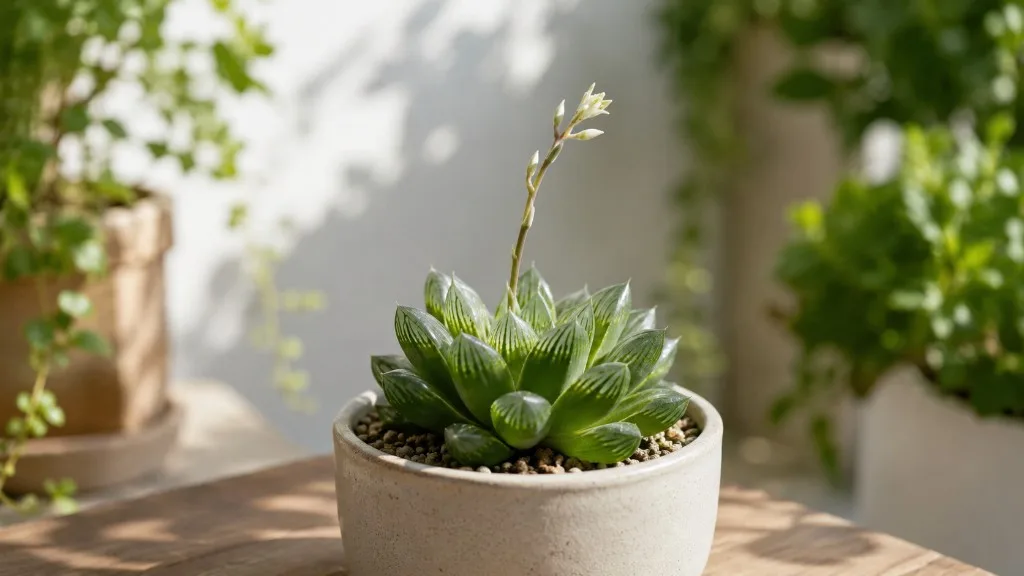
Haworthia Fertilizer: When, How, and Mistakes to Avoid
Haworthia Fertilizer: When, How, and Mistakes to Avoid
Haworthia fertilizer decisions are simpler than the internet makes them sound - and more consequential than most growers realize. Haworthia species are compact, slow-growing succulents from semi-arid South Africa, prized for tight rosettes, translucent leaf windows, and tolerance of low light. They are not heavy feeders. A light, diluted succulent feeding during the growing season only supports healthy offsets and firm new leaves; full-strength doses, winter feeding, or fertilizer on dry roots cause the problems that bring most Haworthia to troubleshooting forums: brown leaf tips, white salt crust on the soil, stunted growth, and root damage that looks like overwatering on Haworthia but traces back to excess nutrients.
The practical goal for most home growers is straightforward: use a water-soluble cactus or balanced houseplant fertilizer at one-quarter to one-half the label strength, apply it every four to six weeks from spring through early fall while the plant is actively growing, and pause entirely in late fall and winter. Water onto moist soil, never onto dry roots. Skip feeding after Haworthia repotting guide, during drought stress, or when the plant shows salt buildup. When in doubt, do not feed - Haworthia tolerates a lean soil far better than a salty one.
This guide covers when to fertilize, how much to dilute, which formulas work best, how to read deficiency versus burn, and the mistakes that cause more damage than skipping a season ever would.
Why Fertilizer Matters for Haworthia
Haworthia is a slow-growing rosette succulent, typically reaching 4–6 inches tall with a 4–8 inch spread in cultivation. That modest pace does not mean the plant ignores nutrition. Even slow growers continuously replace leaf tissue, extend roots, and produce offsets (pups) at the base of the mother rosette. Each of those processes draws nitrogen, phosphorus, potassium, and trace elements from the potting mix. Watering leaches some nutrients downward and out of the drainage holes. Root activity and microbial breakdown of organic matter consume others. Over one to two years in the same small pot, even a lean mix can leave a Haworthia running on reserves.
Fertilizer replaces what the plant uses - but only up to the point its roots can absorb without salt damage. For Haworthia, light, water, and temperature set the ceiling long before fertilizer becomes the bottleneck. Feed a plant sitting in too little light or chronically wet soil and the salts accumulate while growth stays flat - a recipe for tip burn.
Think of feeding as maintenance for a healthy, actively growing Haworthia - not a rescue tool for a plant that is pale because it sits in deep shade, dries out repeatedly, or struggles in waterlogged mix. Fix light and water first, then add nutrients on a conservative schedule. Diluted liquid feeding during the growing season and occasional salt flushing match how Haworthia handles nutrition in small containers far better than full label rates or slow-release pellets dropped into a 3-inch pot.
Haworthia can survive years without fertilizer in fresh mix - many growers rely on repotting alone. Light feeding during active growth helps established plants maintain vigor and push offsets. It will not fix etiolation from low light or compensate for chronic overwatering.
When to Fertilize Haworthia: Growing Season Only
Timing is the first decision, and it follows the plant’s metabolism more than the calendar on your wall. Feed Haworthia when it is actively producing new leaves or offsets, and stop when growth slows sharply. Indoors, that rhythm usually tracks the warm, bright months - spring through early fall - when longer days and comfortable room temperatures keep the rosette expanding. Haworthia is not a tropical foliage plant that benefits from year-round feeding under average home conditions.
A Haworthia on a windowsill often keeps its leaves through winter and looks “alive,” which tricks growers into feeding on a summer schedule through December. In practice, lower light and cooler room temperatures reduce new leaf production even when old foliage stays plump. Unused nutrients then accumulate as soluble salts while roots absorb water more slowly - a common path to brown tips and weak spring growth. Growing season only is not a suggestion for Haworthia; it is the default that prevents the most frequent feeding errors.
Some species show a secondary fall growth pulse in their native climate; advanced collectors may feed lightly then. For typical indoor Haworthia - H. fasciata, H. attenuata, H. cooperi, and common hybrids - a spring-through-early-fall window with a winter pause covers most home setups safely.
Spring and Summer Feeding Window
Start feeding when you see fresh growth - a new leaf emerging from the center of the rosette, a pup forming at the base, or roots visibly active if you gently check the drainage hole. Indoors in temperate climates, that usually means mid-spring through late summer, roughly April through September depending on your light and whether the plant sits near a heating vent that extends warmth into early fall.
During this active window, a quarter- to half-strength liquid feed every four to six weeks works for most container plants. Haworthia in Haworthia light guide on a south or west window may sit at the four-week end if it is actively offsetting. A plant in moderate office light with slow leaf turnover may need feeding only every six to eight weeks - or not at all if the mix was refreshed at repotting within the past year. Both are reasonable if leaves stay firm, the rosette stays compact, and the soil surface stays free of heavy salt crust.
| Month (temperate indoor climate) | Growth phase | Feeding guidance |
|---|---|---|
| March–April | Waking up, first new leaves | Start diluted liquid if active center growth visible |
| May–August | Peak rosette and offset production | Every 4–6 weeks at quarter to half strength |
| September | Slowing slightly | Reduce to every 6–8 weeks or taper off |
| October | Wind-down | Final light feed if still growing, then pause |
| November–February | Low growth, winter rest | No fertilizer for typical indoor setups |
The table is a framework, not a law. A Haworthia under grow lights that runs warm all year may keep producing new tissue longer than one on a north window in an unheated room. Watch the plant: if the center is pushing leaves steadily and offsets are forming, the timing is right. If the rosette is static for weeks, solve light and water before adding food.
Fall Taper and Winter Pause
Taper feeding in early to mid-fall as day length drops and room temperatures cool. One practical approach: give a final half-strength feed in early fall only if you still see center growth, then stop entirely from late fall through winter. Most indoor Haworthia do fine with no fertilizer from November through February, especially in cooler rooms or lower light.
Winter rest is not full dormancy like a deciduous tree, but metabolic demand drops sharply. University of Maryland Extension notes that excessive or frequent fertilizer use is a primary cause of high soluble salts in indoor plants, with symptoms including brown leaf tips and marginal necrosis. Winter feeding on a plant that is not using nutrients is an easy way to create exactly that problem in a succulent that was already salt-sensitive.
Exception: if you grow under strong supplemental grow lights and the plant keeps producing new center leaves all winter, you can feed lightly - still at quarter strength - but extend the interval to eight weeks and watch closely for salt crust. Even then, skipping winter feeds is safer than forcing growth with nutrients the roots cannot process. The growing-season-only rule exists because unused fertilizer in a small pot is more dangerous than a missed month in spring.
Best Fertilizer Type for Haworthia
The best haworthia fertilizer for most homes is a complete, water-soluble cactus and succulent formula or a balanced houseplant liquid with moderate nitrogen and phosphorus kept low to moderate. You want nitrogen for leaf tissue and chlorophyll, phosphorus for root function at modest levels, and potassium for overall vigor and drought tolerance. Micronutrients on the label - iron, magnesium, manganese, boron - matter because pale new growth on otherwise well-watered plants sometimes traces to trace-element gaps rather than macronutrient hunger.
Avoid shopping by the word “haworthia” on the bottle unless you already trust the brand’s dosing guidance. A standard diluted succulent or balanced indoor formula used conservatively outperforms most specialty products applied at label strength.
Diluted Succulent Formulas and NPK Ratios
A cactus and succulent water-soluble fertilizer diluted to one-quarter to one-half strength is the default recommendation for slow succulents in small pots. The Almanac suggests feeding Haworthia once or twice during the growing season with liquid fertilizer diluted to one-quarter strength. You do not need a chemistry set to succeed: half the label’s recommended houseplant or succulent dose lands in the safe zone for most setups.
Can you use cactus fertilizer on Haworthia? Yes - that is the intended product category. Dilute it. Cactus formulas are not automatically safe at full strength; the label assumes outdoor cactus in bright desert light and large soil volumes, not a 3-inch zebra Haworthia on a desk.
Liquid formulas win for control. You mix, dilute, and apply a known dose to moist soil. That matters in small pots where a concentrated pellet or undiluted splash creates localized hot spots of salts. For a typical Haworthia in a 4- to 6-inch pot, mix fertilizer at half the label’s recommended strength for houseplants or succulents, then apply until a modest amount drains from the bottom. Discard saucer water so roots are not sitting in concentrated runoff.
Synthetic Liquids vs What to Skip
Synthetic water-soluble fertilizers dissolve immediately and deliver predictable nutrient levels in small pots. The BBC recommends feeding every three months with cactus fertiliser during active growth - a conservative schedule that suits slow Haworthia. Organic options - fish emulsion, compost tea, worm casting tea - can work at quarter strength or weaker if you already use them, but decomposition rates vary with temperature and moisture, making the dose less predictable in a small indoor pot.
Avoid urea-heavy fertilizers when possible. Haworthia prefers a slightly acidic root zone, and urea conversion to plant-available nitrogen slows in low-pH conditions - another reason balanced synthetics with nitrate nitrogen are easier to manage than some organic blends.
Slow-release granules are a poor fit for small Haworthia pots. Pellets release over weeks or months regardless of whether the plant is growing, which stacks salts during winter rest and after repotting when roots are sensitive. If slow-release is already mixed into a commercial succulent soil, skip liquid feeding for at least two to three months.
Skip foliar feeding for routine Haworthia care. These plants do not absorb nutrients efficiently through leaf surfaces the way some tropical foliage plants do, and fertilizer solution on leaves can leave marks on the translucent windows of species like H. cooperi. Skip fertilizer combined with pesticide products unless you have a specific pest issue and understand the combined stress on roots.
Pet note: The ASPCA lists Haworthia as non-toxic to cats and dogs (ASPCA - Haworthia). That does not make concentrated fertilizer solution safe to ingest. Keep bottles, mixed solution, and crusty saucers out of reach.
How Much Fertilizer to Use on Haworthia
If you remember one number, make it half strength - and for cautious growers or plants in pots under 4 inches, quarter strength is the safer default. Never apply full label strength to a container-grown Haworthia unless you have experience leaching salts regularly and the plant sits in bright light with excellent drainage.
Houseplant and succulent fertilizer labels assume a range of species, pot sizes, and light levels. Haworthia sits firmly in the light feeder category - far closer to a cactus than to a fast-growing pothos. Cutting the label rate to one-half is the standard advice across extension-style indoor plant guidance for salt-sensitive succulents. Cutting to one-quarter is reasonable for monthly feeding on a plant in moderate light with a history of tip burn, or for a newly established offset still rooting in.
A concrete example: if the label says 1 teaspoon per gallon of water for houseplants, use ½ teaspoon per gallon for a routine Haworthia feed, or ¼ teaspoon if you are feeding every four weeks in a small pot. Apply enough solution to moisten the root zone thoroughly - typically until a small amount drains - without flooding a shallow-rooted succulent repeatedly in one session.
Hard tap water adds another layer. Water high in calcium and magnesium already supplies some minerals; pairing it with aggressive feeding doubles the salt load. If your tap water is very hard or you see white mineral deposits on pot rims, lean toward quarter strength and flush the pot with plain water between feeds.
Most hobbyists grow healthy Haworthia in peat-free cactus compost without chasing specific pH numbers when dilution is conservative.
How Often to Fertilize Haworthia
How often to fertilize Haworthia depends on growth speed, pot size, and light - but the safe range for most indoor plants during the active season is every four to six weeks. That is roughly two to four feeds total across spring and summer, not twelve monthly doses stretched across the year.
Haworthia does not need fertilizer every watering. For the typical windowsill grower, scheduled diluted feeds separated by plain-water waterings are easier to control and far less likely to end in burn than constant low-dose feeding.
Use this frequency map as a starting point:
- Bright indirect light, active offsetting, 4–6 inch pot: every 4 weeks at half strength during spring and summer
- Moderate light, slow center growth, established rosette: every 6 weeks at half strength, or every 4 weeks at quarter strength
- Fresh repot within the last 6 months in new succulent mix: skip liquid feed unless growth is strong and mix was inert - many commercial mixes contain starter fertilizer
- Winter (November–February): no feed for typical indoor setups
- After over-fertilizing or visible salt crust: pause 4–8 weeks, flush, then resume at quarter strength
Feeding more often than every three weeks at half strength in a small pot is rarely justified for Haworthia. If you want faster offset production, improve light and confirm the Haworthia watering guide before increasing nutrient frequency. Nutrients do not replace photons.
Step-by-Step: How to Feed Haworthia Safely
A safe Haworthia feeding session takes five minutes. Confirm growing-season center growth, run the pre-feed checklist below, mix fertilizer at quarter to half label strength, pour slowly around the base until a small amount drains, and discard saucer runoff. Log the date and use plain water until the next scheduled feed - do not top up early.
Pre-Feed Checks and the Moist-Soil Rule
Before every feed, run three checks in order:
Soil moisture first. The moist-soil rule is non-negotiable for Haworthia: never apply fertilizer to dry roots. Water the plant with plain water one day before feeding, or feed only when the pot was watered within the last 48 hours and the mix is evenly moist - not sopping wet, not dust-dry. Fertilizer on dry succulent roots creates osmotic shock; salts pull water out of root tissue faster than the plant can compensate.
Salt crust second. Look at the soil surface and inner pot rim. White or yellowish crust means soluble salts are already high. Skip the feed. Flush with plain water (see recovery section) and pause fertilizer for at least a month.
Plant stress third. Skip feeding if the plant was recently repotted, shows root rot on Haworthia symptoms, suffered sun scorch, or is recovering from severe underwatering on Haworthia. Roots under repair cannot handle additional salts.
If all three checks pass, proceed with diluted solution. If any check fails, fix that problem before thinking about nutrients.
Signs Your Haworthia Needs More Nutrition
True nutrient deficiency in Haworthia is less common than over-fertilizing - but it happens, especially in plants kept two or more years in the same depleted mix without repotting or feeding. Deficiency signs are also easy to confuse with too little light or irregular watering, so read them in context.
Pale center leaves with adequate light and consistent watering may indicate low nitrogen. Stretching with pale, thin new growth is usually a light problem, not hunger. Slow offset production in bright light may improve with light seasonal feeding, but one pup per year is normal for many species. Stunted center growth after years without repotting suggests exhausted mix - fresh succulent soil often helps more than heavy feeding. If you suspect deficiency, try one half-strength feed, wait six weeks, and evaluate new center leaves. Repotting every one to two years addresses depletion more reliably than escalating fertilizer.
Signs of Over-Fertilizing and Salt Buildup
Over-fertilizing is the most common Haworthia feeding mistake, and the symptoms often appear days to weeks after the damaging application - sometimes after several small doses that seemed harmless individually.
Watch for these signs:
- Brown or crispy leaf tips on otherwise plump leaves - classic salt burn margin
- White, yellow, or crusty deposits on the soil surface, pot rim, or saucer
- Sudden leaf softness or collapse after a feed on dry soil - root damage
- Slowed center growth despite warm weather and good light - roots struggling in salty mix
- Leaf reddening or browning at the base that spreads upward after repeated feeding
- Offsets failing to establish or shriveling after a feed - young roots are especially salt-sensitive
University of Maryland Extension describes high soluble salts causing marginal leaf necrosis, stunted growth, and wilting even when soil moisture is adequate (University of Maryland Extension - Fertilizer Toxicity). On Haworthia, tip burn is usually the first visible clue because the compact rosette has little leaf area to dilute the visual impact.
Important distinction: brown tips from fertilizer versus brown tips from fluoride or chlorine in tap water can look similar. If you never feed but use untreated tap water, consider water quality. If tips appeared within two weeks of a feed - especially on dry soil - fertilizer is the prime suspect.
How to Flush Haworthia After Over-Feeding
When you recognize over-fertilizing, stop all fertilizer for four to six weeks. Flush the pot with plain water until it drains freely; repeat two to three times over one week, letting the mix approach dry between flushes. Confirm the soil is fast-draining succulent mix, not heavy peat. Resume at quarter strength only when the center pushes a healthy new leaf. Badly burned tips will not green up - judge recovery by new tissue. If white crust returns within days of flushing, repot into fresh mix and wait two to three weeks before feeding.
Seasonal and Situational Adjustments
The growing-season schedule is a baseline. Several situations demand a lighter hand or a full pause.
Late summer taper: Stretch the interval to six or eight weeks as growth slows, or skip the last autumn feed if center growth has stopped. Heat waves: Skip scheduled feeds if the rosette is static during midsummer heat. Propagation: Wait four to six weeks after potting offsets before feeding. Leaching routine: Flush with plain water once per growing season to prevent gradual salt creep from light feeding and hard water.
After Repotting, Stress, and Container Size
After repotting: Wait two to three weeks minimum before the first feed. Fresh roots are vulnerable, and many commercial succulent mixes include starter nutrients. If you repotted into a quality mix and the plant is not aggressively growing, you can skip feeding until the next growing season.
During stress: Drought stress (wrinkled leaves from underwatering), sun scorch, pest treatment, or recent root disturbance all warrant a feeding pause. Fertilizer is for maintenance during vigor, not triage.
Container size: A Haworthia in a 2–3 inch pot has almost no soil volume to buffer salts. Use quarter strength and feed no more than every six to eight weeks, or rely on repotting for nutrition. A plant in a 6-inch pot with a larger root mass tolerates half strength on a four- to six-week schedule more forgivingly - still conservative by houseplant standards.
Multiple Haworthia in a shared dish garden share the same salt load. Feed lightly or not at all if the arrangement was recently assembled.
Fertilizer and Other Haworthia Care
Fertilizer only works when light, water, and soil are already in range. Haworthia in bright indirect light uses modestly more nutrients than one in a dim corner, but the dim plant should not be pushed with extra fertilizer to compensate for low light - that creates salts without compact growth.
Etiolated rosettes need more light, not more nitrogen. Fertilizer fits the soak-and-dry rhythm when applied to already moist soil - never to dry roots before a long absence. Fast-draining succulent mix flushes salts more easily than heavy peat; compacted old mix holds salts even when the surface looks dry. Many growers pair light spring feeding with annual or biennial repotting and never exceed half strength.
Common Haworthia Fertilizer Mistakes
These mistakes cause more damage than skipping fertilizer for an entire year.
The costliest errors: full label strength in small pots, winter feeding when growth has stopped, fertilizing dry soil, feeding right after repotting, and slow-release pellets in containers under 4 inches. Extra nitrogen will not deepen window translucency or zebra banding - color is genetic and light-dependent. Pale, mushy plants need diagnosis, not nutrients. White crust on the soil means flush and pause. When in doubt, skip the feed.
Conclusion
Haworthia fertilizer is not about maximizing growth - it is about supporting slow, steady rosette development during the months when the plant is actually growing. Use a water-soluble cactus or balanced formula at one-quarter to one-half strength, feed every four to six weeks from spring through early fall, and pause completely in winter. Water onto moist soil, flush salts once a season or after mistakes, and hold off after repotting or stress.
The best-fed Haworthia on a windowsill is the one whose light and watering rhythm are already dialed in - fertilizer is the light final touch, not the engine. Watch center growth and soil crust more than the calendar. When tips stay firm, offsets appear, and the mix stays clean, your dilution and timing are right. When in doubt, less is more. Haworthia has survived lean karoo soils for millennia; it will survive a skipped spring feed far better than a winter dose at full strength.
When to use this page vs other Haworthia guides
- Haworthia overview - Start here for whole-plant context before deep-diving this topic.
- Haworthia problems hub - Jump to symptom-specific fix guides when this care topic does not resolve the issue.
Related Haworthia guides
- Haworthia overview
- Haworthia watering
- Haworthia light
- Haworthia soil
- Haworthia propagation
- Haworthia repotting
- Haworthia problems
Related tool
Try the Fertilizer Dilution Calculator with haworthia pre-selected to estimate needs for your setup.