Haworthia Light Requirements: Bright Indirect and Window
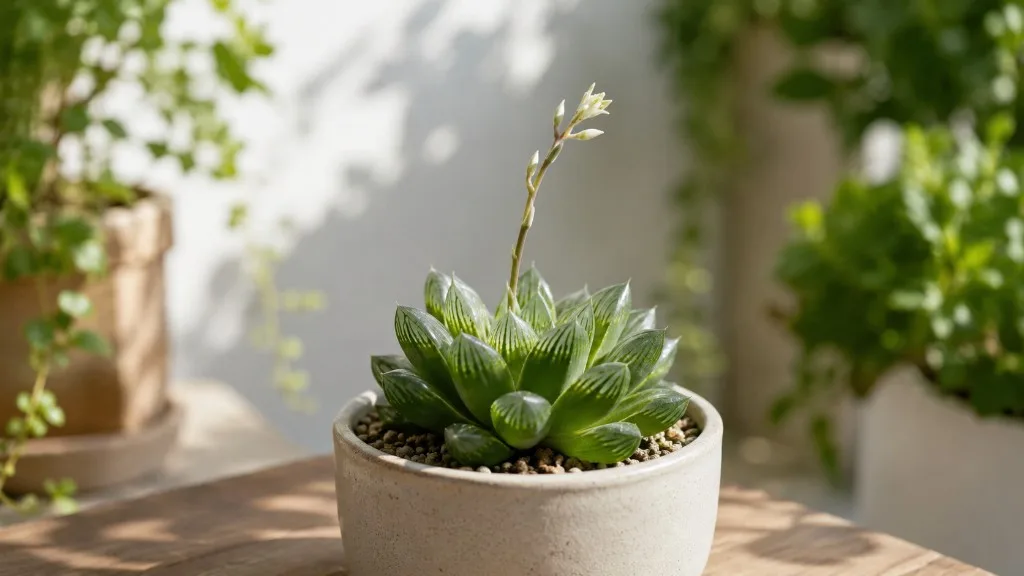
Haworthia Light Requirements: Bright Indirect and Window Placement
Haworthia Light Requirements: Bright Indirect and Window Placement
Haworthia looks like a tough little succulent, and in some ways it is - but its light appetite is closer to a shade-adapted forest dweller than to a sun-baked desert agave. Haworthia spp. evolved under rocks, shrubs, and taller plants in semi-arid South Africa, where brightness is high but direct rays are filtered for much of the day. Indoors, that translates to one clear target: bright indirect light for most of the day, with harsh midday and afternoon sun avoided unless you are deliberately acclimating a mature plant to gentle morning exposure.
Get this wrong in either direction and the plant tells you quickly. Too little light produces stretching, pale leaves, and slow recovery from watering mistakes. Too much direct sun - especially sudden exposure through hot window glass - produces bleached patches, red or purple stress color, crisp leaf tips, and in bad cases rot after leaf collapse. The useful question is not “Can Haworthia survive here?” but “Does new growth stay compact, firm, and correctly colored for the species?”
This guide covers how much light Haworthia actually needs, why filtered brightness beats full sun, where to place pots by window direction, how to acclimate safely, when grow lights make sense, and how to read warning signs before a light mistake becomes a care spiral.
How Much Light Haworthia Actually Needs
The practical baseline for most Haworthia indoors is bright indirect light - strong ambient brightness where you could read comfortably near the plant without a lamp, but without sustained direct sunbeams landing on the rosette for hours. Specialist collections sometimes target roughly 6,000 to 12,000 lux (lx), noting that intensity above that band increases sunburn risk and that plants stretched from low light need gradual increases rather than sudden jumps.
That lux band is not something most hobbyists measure daily, but it gives you a useful mental model. A Haworthia sitting within a foot of an east window or a few feet back from a bright south or west window with a sheer curtain often lands in the right zone. A plant on a desk more than six feet from any window usually does not, even if the room feels bright to your eyes. Human vision adapts to dim interiors; Haworthia does not.
BBC Gardeners’ World recommends growing Haworthia on an east- or west-facing windowsill in bright light, explicitly advising growers to avoid direct sunlight because it can scorch leaves. (BBC Gardeners’ World) The RHS similarly places Haworthia in bright, indirect light and warns that harsh sun can damage leaves. Those sources align on the core idea: Haworthia wants brightness without heat-loaded direct rays.
Light also sets the pace for everything else in the care system. A Haworthia in correct bright indirect light dries its pot on a predictable rhythm, produces firm new leaves at the rosette center, and tolerates the soak-and-dry watering pattern succulents need. A dim plant grows slowly, stays wet longer, and becomes vulnerable to root problems if you water on a schedule copied from a sunny windowsill. Treat light as the throttle, not a separate checkbox.
The Short Answer for Busy Growers
If you only remember five rules, use these. Default placement: bright indirect light near an east window, or a filtered west/south window where the rosette never sits in a hot sunbeam for hours. Avoid harsh midday sun, especially through south or west glass in warm months - that is the fastest route to scorch and stress color. Judge by new growth: compact, firm leaves at the center mean the current light works; long gaps between leaves, upward lean, or pale weak tissue mean increase brightness gradually. Acclimate changes over 7 to 14 days, moving the pot a few inches every few days rather than jumping from a nursery shelf to a blazing sill. Link light to water: brighter placement means faster dry-down; dimmer placement means longer waits between drinks.
Give any placement change two to three weeks before declaring failure. Old damaged leaves do not repair; only the newest leaves report the truth.
Why Haworthia Prefers Filtered Light Over Full Sun
Haworthia is often shelved with “easy succulents” in garden centers, which leads many growers to assume it wants the same full-sun bench as echeveria or sedum. That assumption causes a lot of burned rosettes. Haworthia shares succulent water storage, but its native light environment is filtered, not exposed. Understanding that mismatch prevents the two most common failures: keeping a plant alive in dim corners while wondering why it never looks like the photo, and blasting a shaded nursery plant with afternoon sun because “succulents need sun.”
The genus includes dozens of species and cultivars with different leaf thickness, window transparency, and color - Haworthia truncata and H. emelyae with thicker leaves generally tolerate slightly more intensity than paper-thin shade forms when acclimated - but none of them are built for all-day unfiltered equatorial sun on a windowsill. The safe default remains bright indirect light with direct rays limited and monitored.
What South African Habitat Teaches Indoor Growers
Wild Haworthia from the Eastern Cape Province and surrounding semi-arid biomes grow among rocks, grasses, and shrub cover. They receive plenty of ambient light, but much of it is reflected, dappled, or short-duration direct sun rather than relentless overhead exposure. When sun is strong in habitat, plants are often partially recessed below rock lips or shaded by neighboring vegetation - a natural version of the sheer curtain or pulled-back placement you should imitate indoors.
That habitat also explains summer behavior. Haworthia can enter dormancy or semi-dormancy when temperatures rise, while daylight intensity peaks. The BBC advises avoiding direct sunlight that scorches leaves during warm months - pull Haworthia back from hot glass in summer rather than pushing it into stronger sun because days are long.
The indoor takeaway is not “put Haworthia in a dark corner because it lives under rocks.” Rocks in full desert glare still receive enormous ambient brightness. The takeaway is bright yes, harsh direct no - mimic open shade, not cave shade and not parking-lot sun.
Translucent Leaf Windows and Light Absorption
Several popular species - notably Haworthia cooperi (cooper’s haworthia, sometimes called cathedral window haworthia) and related windowed forms - have translucent leaf tips that act as light guides to chlorophyll deeper in the leaf. The RHS describes these translucent tips as an adaptation that lets partially buried plants photosynthesize in native habitat.
That efficiency is a clue, not a loophole. Windowed Haworthia can photosynthesize well in moderate bright indirect light without needing blasting sun. In fact, strong direct rays on windowed leaves can overheat translucent tissue faster than opaque succulent leaves, showing damage as whitened windows or collapsed tips. If you grow cooperi-type plants, prioritize steady filtered brightness over “more sun for more growth.” They are already optimized to harvest light conservatively.
Best Window Placement for Haworthia Indoors
Compass direction is a starting guess, not a verdict. Trees, nearby buildings, tinted glass, overhangs, and hemisphere all change the result. A labeled “south window” blocked by a balcony may deliver less usable light than an open east window three feet away. The plant’s response - firm new center leaves, no lean, no scorch - is the final test.
Place the pot close enough that light lands on the rosette, not just on the floor around it. Within 12 inches (30 cm) of the glass on a suitable exposure is a common sweet spot. Rotate the pot a quarter turn every week if growth leans toward the pane. If one side bleaches while the other stretches, the plant is getting uneven exposure and needs repositioning, diffusion, or both.
East, North, and West Windows Compared
An east-facing window is the easiest default for Haworthia in most homes. Morning sun is bright but relatively cool compared with late-day sun, giving one to three hours of gentle direct light many acclimated plants tolerate well, followed by strong indirect brightness through the day. BBC Gardeners’ World specifically recommends east (and west) exposures for bright light without scorch risk. (BBC Gardeners’ World) If you are unsure where to start, start east.
A north-facing window (in the northern hemisphere) usually avoids harsh direct sun - which is good - but may be too dim in winter or in rooms shaded by other structures. Haworthia can survive on a bright north sill in summer at higher latitudes, but expect slower growth, softer color, and occasional stretching if the plant sits far from the glass. Treat north as workable when you verify compact new growth; otherwise add a grow light rather than assuming “no sunburn” equals “enough light.”
A west-facing window delivers strong afternoon rays - the highest scorch risk for unacclimated plants. West can work when the pot sits back from the glass, a sheer curtain diffuses peak hours, or the plant receives bright indirect light without sitting in the sunbeam. Watch west exposures closely in late spring and summer when leaf temperature spikes. If leaves redden or crisp on the window side, pull the plant back or filter the light before reducing water or Haworthia repotting guide.
South-Facing Windows and Sheer Curtain Fixes
South-facing windows (northern hemisphere) provide the strongest winter sun and can be excellent for Haworthia from fall through early spring when rays are weaker and glass is cooler. In summer, south glass becomes a magnifier. The BBC warns that direct sunlight can scorch leaves in warm months.
If south is your brightest option, use these guardrails:
- Hang a sheer curtain or partially closed blind during 11 a.m. to 4 p.m. in warm months.
- Sit the pot slightly off-center so it receives bright ambient light without continuous direct beam contact.
- Never move a nursery-shaded Haworthia directly onto a south sill in June without acclimation.
- Watch for stress reddening - a sign to reduce intensity, not a healthy “sun blush” to chase.
In the southern hemisphere, swap the strong-sun caution to north-facing glass while east and west behavior patterns remain similar relative to morning vs afternoon sun angle.
Direct Sun Tolerance and Acclimation Rules
Haworthia is not a full-shade plant, and the answer to “Can it take direct sun?” is sometimes, briefly, when acclimated - not “yes, it’s a succulent.” Gentle early morning direct sun on an east windowsill is the most forgiving exposure. Midday and afternoon direct sun, especially through west or south glass, is where most indoor burns happen.
Acclimation means increasing light intensity gradually over 7 to 14 days: move the pot a few inches closer to the window every two or three days, or introduce one hour of early direct sun before extending exposure. Leaves formed in low light are physiologically adapted to that level; sudden jumps shock tissue before new hardened growth replaces it. If you see bleaching or red-black stress color during acclimation, step back immediately and hold the current level until new leaves emerge clean.
Thicker-leaved species like H. truncata and H. emelyae can accept slightly stronger acclimated exposure than thin, dark green shade forms, but the process is still incremental. Do not use species toughness as permission to skip acclimation.
Morning Sun vs Harsh Midday and Afternoon Rays
The distinction that saves Haworthia is time of day plus heat load, not just “direct vs indirect.” Morning sun on east glass delivers photons without the leaf-heating infrared buildup common on west-facing panes at 3 p.m. A rosette that tolerates two hours of cool morning sun may burn in thirty minutes of hot afternoon sun through the same glass thickness.
Practical rules:
- Morning direct (east): often acceptable for acclimated plants; watch windowed species closely.
- Midday direct (overhead south/north depending on hemisphere): usually too strong in summer; diffuse or pull back.
- Afternoon direct (west): highest scorch risk; filter or relocate unless the plant is far back in bright ambient light only.
Outdoor summer placement follows the same logic: open shade, bright porch with roof cover, or east exposure beats a west-facing railing where reflected heat cooks the pot. If you summer Haworthia outside, harden it off gradually the same way you would indoors - shade first, then slightly brighter open shade, never straight to pavement-level west sun.
Low-Light Limits and Stretching Risk
Haworthia has a reputation for tolerating office desks and dim rooms, and that reputation is half true. It can survive lower light longer than many flowering houseplants, which makes it popular in cubicles and north-facing apartments. Survival, however, produces elongated leaves, widened rosette gaps, pale color, and weak tissue that marks every subsequent watering mistake more severely. The RHS notes that without a winter rest period in cooler, drier conditions, Haworthia forms thin, weak growth that spoils rosette shape - a risk that rises in dim, overwatered rooms. For most indoor growers, the goal is compact ornamental rosettes, not bare minimum survival - which means low light is a temporary compromise, not a long-term plan.
If you must keep Haworthia in a dim spot, reduce watering frequency because the plant uses less water when photosynthesis is limited. overwatering on Haworthia in low light is one of the fastest paths to root rot on Haworthia. Do not compensate for dim conditions with extra fertilizer; that does not replace photons and can salt-stress roots in a wet mix.
What Haworthia Tolerates vs What Keeps It Compact
Tolerates: medium indirect light with slower growth; north windows in bright summer rooms; short periods on a desk if rotated to a brighter window weekly.
Compact and healthy: bright indirect light with 6,000–12,000 lux for much of the day; firm new leaves opening from the center with short internodes; species-appropriate color without persistent lean.
Fails over time: deep interior shelves more than six to eight feet from windows; rooms relying only on ceiling fixtures; bathrooms with small frosted windows unless supplemented.
The new-growth test resolves most debates. Pick the newest leaf or offset rosette. If it is firm, correctly sized, and opening at a tight angle, current light is adequate even if older lower leaves look slightly stretched from a past dim period. If every new leaf is taller, thinner, or more spaced than the last, increase light - gradually or with a grow light - before touching water or soil.
Grow Lights When Natural Light Falls Short
When windows cannot deliver enough brightness - winter at high latitudes, office cubes, shaded apartments - a full-spectrum LED grow light is the most reliable fix. Haworthia responds well to artificial light because its native environment already favors filtered, steady brightness rather than extreme outdoor peaks. The Almanac notes that south- or west-facing windows may need supplemental grow lights in low-sun homes, and recommends placing fixtures far enough above the rosette to avoid stress reddening. Start farther and move closer in small steps while watching new leaves.
Lux Targets, Distance, and Daily Hours
A practical indoor target is 6,000 to 12,000 lux at the rosette surface for active growth. Consumer grow lights vary wildly in output, so use plant response as calibration: if new growth stays compact after two weeks, distance and duration are likely correct. If leaves redden or blacken, raise the fixture or reduce hours before assuming nutrient deficiency.
Starting protocol for a typical full-spectrum LED panel:
- Mount the light 18 to 24 inches (45–60 cm) above the rosette to start.
- Run 10 to 12 hours daily on a timer for consistency.
- Adjust distance by 2 inches (5 cm) every week only if new growth still stretches downward or upward seeking light.
- Avoid 24-hour lighting; plants need a dark period for normal metabolism.
Desk clip lights can work for a single small pot if the beam covers the entire rosette evenly. A narrow spotlight that lights only one side causes asymmetric stretch even when average lux looks acceptable. Diffuse or reposition until the whole plant receives even illumination.
Seasonal Light Adjustments Through the Year
Window light is not static. Winter lowers sun angle and can increase direct beam entry on east and south glass; summer raises intensity and heat load even when day length peaks. Haworthia care should track seasons, not just compass direction once in January.
In winter, plants near south or east windows may finally receive enough brightness to tighten up after a dim fall. Watch for cold drafts on the sill; light may be good while temperature at the glass is too low. Pull the pot back slightly if leaves look soft from cold, even if light is adequate.
In spring, resist the urge to shove every succulent into the strongest available window as days lengthen. Acclimate into spring brightness the same way you would into summer sun. Many burns happen in April and May when sun strength jumps before growers adjust curtains.
In summer, prioritize heat management: sheer curtains, pulled-back placement, or temporary relocation to bright rooms without direct glass contact. The BBC advises avoiding direct sunlight that scorches leaves during warm months - align that with reducing both light intensity and medium temperature when growth slows. Water less in this phase; extra sun plus extra water is a rot recipe.
In fall, note which plants stretched over summer outdoors or on dim desks. Increase light gradually before winter so rosettes enter the dark season compact, optionally supplemented with a timer-driven LED.
Warning Signs Your Haworthia Has the Wrong Light
Light problems rarely stay isolated. Stretching increases watering error risk; scorch wounds invite rot if water sits in damaged tissue. Reading symptoms early keeps fixes to one variable - placement - instead of a cascade of repotting, fungicide guesses, and fertilizer experiments.
Always diagnose from newest growth first. Lower leaves naturally age, dry, and die in many Haworthia; old blemishes are history. The center rosette and youngest leaves tell you what today’s light is doing.
Too Little Light - Etiolation and Weak Growth
Etiolation is the botanical term for stretching toward light. On Haworthia it shows as longer, thinner leaves, widened gaps in the rosette, upward or sideways lean toward the brightest source, and pale green or yellow-green color even when watering is correct. Offsets may grow leggy before filling out, and the plant feels soft and less resilient to touch.
Fix under-lighting by increasing brightness gradually or adding a grow light on a timer. Move the pot closer to the window in increments over two weeks, or install a full-spectrum LED at the starting distance described above. Do not jump from a dim shelf to unfiltered south sun as a “fix” - that trades etiolation for scorch.
While correcting light, extend the dry-down interval slightly if the plant was overwatered in dim conditions. More light will increase water use later, but during recovery the root system may still be recovering from past soggy mix.
Too Much Light - Sunburn, Red Stress Color, and Collapse
Too much light on Haworthia rarely looks like instant brown crisps alone. Early signs include bleached or whitened patches on sun-facing tissue, red, purple, or brown stress pigmentation spreading from tips or windows, downward curling during brightest hours, and sudden softness or collapse after a recent move to a stronger window. The BBC notes that direct sunlight can scorch leaves - treat dark red or black stress color as a signal to reduce intensity immediately.
Do not misread red stress as “healthy sun color” the way some outdoor succulents develop pigment. On Haworthia, persistent darkening often means photoprotective crisis, especially if texture softens or growth stalls.
Fix over-lighting by reducing intensity before reducing hours when possible: sheer curtain, move off the sunbeam while staying in a bright room, or shift to east from west. Hold that level until two to three new leaves open without further bleaching. Remove fully collapsed leaves with sterile tools only if mushy; otherwise let dry scar tissue callus. Avoid watering into open wounds on recently burned plants.
If a plant collapsed after one hot afternoon on a south sill, treat it as emergency shade plus dry mix check, not as a fertilizer deficiency. Light caused the injury; stronger sun will not heal it.
Conclusion
Haworthia light requirements boil down to a habitat truth translated for windowsills: bright indirect light most of the day, harsh midday and afternoon direct sun avoided, and changes made gradually enough for new leaves to prove the placement works. East windows and filtered bright exposures are the safest defaults; south and west windows demand curtains, distance, and seasonal caution. Low light keeps many plants alive but produces stretched, fragile rosettes that punish every watering mistake - supplement with grow lights when windows fall short, targeting roughly 6,000 to 12,000 lux at the plant and calibrating by compact new growth.
Use the new-growth test as your compass. Firm, tightly spaced center leaves mean the current light is right. Stretching means more brightness; bleaching, red-black stress, or post-move collapse means softer light immediately. Change placement alone, wait two to three weeks, then adjust watering to match the new dry-down rhythm. Haworthia rewards boring consistency more than heroic sun experiments - and compact rosettes under filtered brightness are the proof you got it right.
When to use this page vs other Haworthia guides
- Haworthia overview - Start here for whole-plant context before deep-diving this topic.
- Haworthia problems hub - Jump to symptom-specific fix guides when this care topic does not resolve the issue.
- Not Enough Light on Haworthia - Escalate here when light adjustments are not enough.
- Leggy Growth on Haworthia - Escalate here when light adjustments are not enough.