Spider Mites on Geranium: Causes, Checks & Fixes
Quick answer
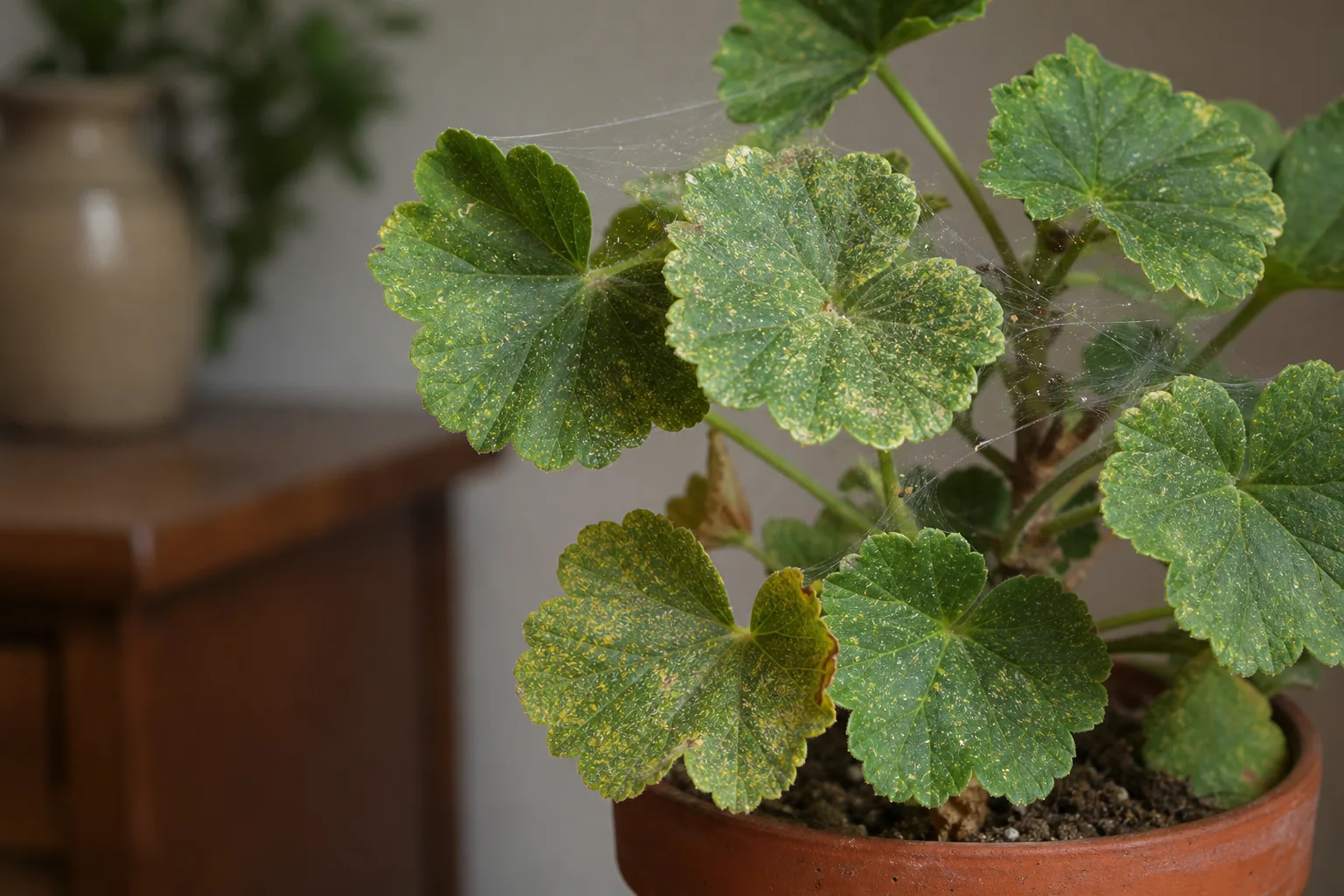
Spider mites on Geranium (*Pelargonium × hortorum*) cause fine yellow stippling on rounded zonal leaves and delicate webbing at leaf bases in warm, dry air-common on overwintered balcony pots near radiators. First step: isolate the pot and rinse leaf undersides with a strong stream of lukewarm water before any spray.
Spider Mites on Geranium: Causes, Checks & Fixes
This guide covers spider mites on Geranium. See also the general Spider Mites guide, watering, and light pages for this plant.
Spider Mites on Geranium: Causes, Checks & Fixes
Quick answer
Spider mites on Geranium (Pelargonium × hortorum) are tiny sap-sucking arachnids that thrive in warm, dry, dusty air-exactly what overwintered balcony pots and sunny window boxes experience near radiators, forced-air vents, and south-facing glass. On zonal geraniums, damage shows as fine yellow stippling across rounded leaves, progressing to bronzing and delicate webbing at leaf bases where stiff petioles meet the bushy crown.
First step: move the pot away from neighbors and rinse every leaf underside with a strong stream of lukewarm water early in the day. That knocks down live mites before you reach for oil or soap. Confirm moving specks with a white-paper tap test after the rinse before starting a spray program.
For dry-air edge crisping without stippling, see low humidity on geranium. For species context and humidity biology, see the geranium overview.
Why Geranium gets spider mites
Pelargoniums spend summer in full sun on balconies and porches, then move indoors or against heated walls for winter storage. That shift concentrates plants in dry, warm microclimates where two-spotted spider mites (Tetranychus urticae) reproduce fast.
Spotted mites are prevalent on geraniums during warm, dry weather, which favors their development. Mites suck plant juices from leaf undersides; foliage takes on a mottled, bleached appearance and the plant makes little new growth when populations build. On a bushy zonal specimen, the rounded upper leaf faces hide damage until stippling spreads across enough blades to notice from across the patio.
Typical geranium mite triggers:
- Winter radiator placement - Overwintered pots on window sills above heat registers lose leaf moisture fast while roots sit in cooler soil
- South- or west-facing glass - Radiant heat plus low winter RH crisp margins and favor mites on leaves pressed against panes
- Balcony groupings - Mites walk or drift between pots on shared railings before you spot stippling on one plant
- Dusty foliage - Outdoor summer dust and indoor heating-season dust weaken leaves and make early colonies harder to see on dark zonal bands
- Neglected dry-down - Chronically dry pots stress roots while mites drain shoots; see wilting on geranium if whole stems collapse
Mites are common on houseplants stressed by low humidity and heat. Geraniums tolerate low to moderate room humidity better than tropical foliage plants-so the problem is usually localized dry heat, not a home-wide humidity failure. Raising ambient RH helps modestly; moving off vents and rinsing undersides matters more than misting leaves, which Clemson geranium guidance discourages because wet foliage invites grey mould on spent blooms.
What spider mites look like on Geranium
Zonal geraniums carry thick, rounded leaves with a darker horseshoe band across the surface. Mites feed on undersides while stippling shows on the upper face-so damage can look mild until you lift leaves and inspect petiole joints.
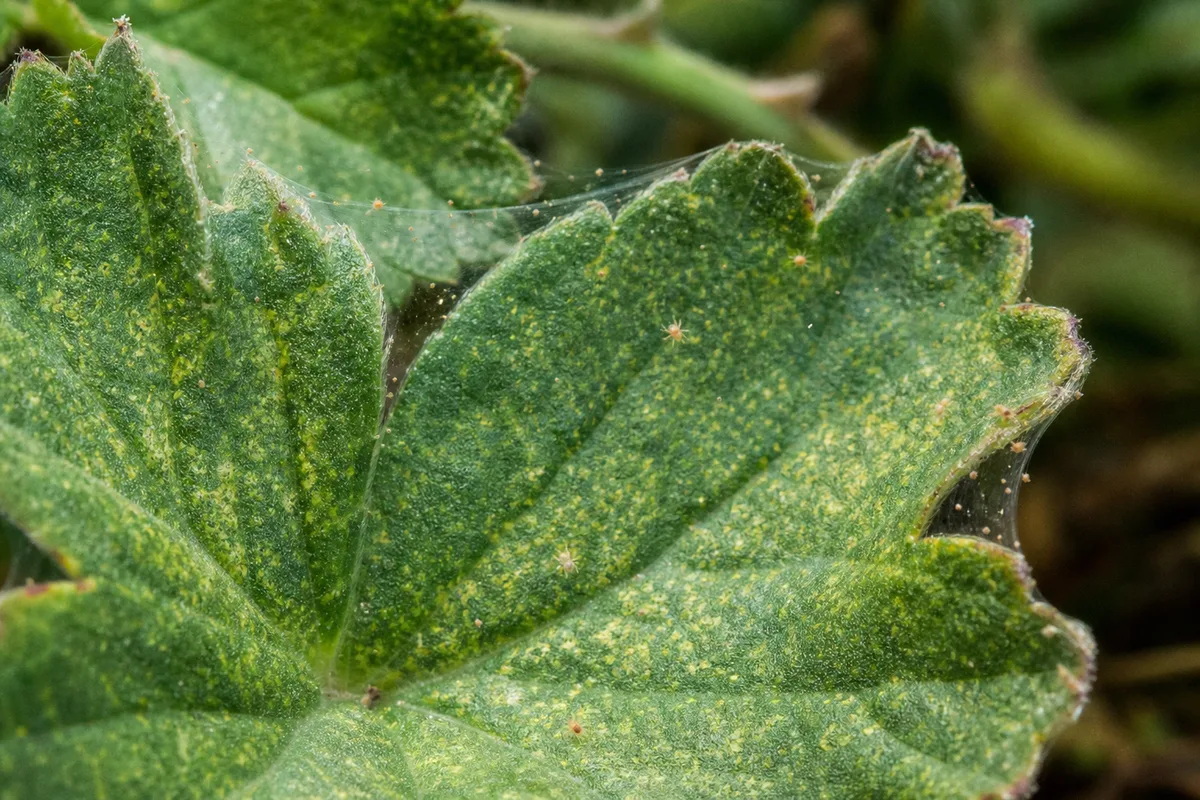
Spider Mites symptoms on Geranium - compare with healthy tissue on the same plant.
Typical mite signs on Pelargonium × hortorum:
- Fine yellow or white pinprick stipples scattered across rounded leaf blades, later merging into bronze patches
- Delicate silken webbing at leaf bases, stem forks, and the central crown on heavy infestations
- Crisp, bleached leaves that drop when feeding is severe; lower leaves often show damage first on bushy specimens
- Slow growth and fewer blooms during active mite pressure-energy goes to damaged foliage, not flower clusters
- Nearly invisible mites without a hand lens; cast skins and webbing are often easier to spot than live adults
Spider mites are tiny arachnids that feed on leaf undersides. On ivy geraniums (Pelargonium peltatum), mite feeding can produce edema-like blisters hugging leaf veins on undersides rather than classic stippling on upper surfaces. Cornell greenhouse guidance recommends using a hand lens to look for spider mites when edema is noted on geraniums-mite populations often go unnoticed until large because edema masks early detection. e-Gro Bulletin 1-17 notes that mild chlorosis on upper surfaces with edema on undersides should trigger a close mite check.
Spider mites vs. low humidity, thrips, edema, and hard-water residue
| Symptom pattern | Spider mites | Low humidity / dry air | Thrips | Edema (ivy types) | Hard-water residue |
|---|---|---|---|---|---|
| Main location | Undersides; stippling on upper face | Leaf edges near vents or glass | Young leaves and buds | Underside blisters along veins | Upper leaf face, wipe-off spots |
| Webbing | Fine silk at leaf bases | None | None | None | None |
| Paper-tap test | Slow-moving specks | No specks | Fast slender insects | No specks | No specks |
| Soil / environment | Warm, dry, dusty air | Heat vent or sunny glass | Any; thrips jump when disturbed | Cool, wet nights, humid air | Tap water spray history |
| LeafyPixels guide | This page | Low humidity | - | Low humidity § ivy exception | - |
Aphids and mealybugs also hit geraniums but leave different signatures-sticky honeydew and soft colonies on tender shoots (aphids) or white cottony wax in leaf axils (mealybugs). Mites rarely produce heavy honeydew; stippling plus webbing is the tell.
Yellow leaves on wet soil point to overwatering or root stress, not mites. See yellow leaves on geranium when lower foliage yellows without stippling.
How to confirm spider mites (six-step checklist)
Work through these checks in order:
- Stippling pattern - Fine yellow dots across the leaf face, not just crisp brown edges. Edge-only browning without undersurface stippling often means dry air; see low humidity on geranium.
- Webbing check - Look at leaf bases and stem forks with a hand lens. Delicate silk threads distinguish mites from thrips or mineral spray residue.
- Paper-tap test - Hold white paper under a suspect leaf and tap sharply. Slow-moving specks confirm mites. Thrips streak or jump; clean paper means investigate edema or hard-water spots instead.
- Underside inspection - Lift rounded zonal leaves and inspect where petioles meet stem. Bushy crowns hide colonies that top-down watering glances miss.
- Ivy-type rule-out - On trailing ivy geraniums, check for vein-hugging blisters on undersides. If present, magnify for mites and cast skins before treating as physiological edema alone.
- Neighbor scan - Inspect every pelargonium on the same balcony railing or windowsill. Shared dry-air placement means shared risk even if only one pot shows bronzing today.
If stippling, webbing, and moving specks align, spider mites are confirmed. Proceed to isolation and rinse before stacking chemicals.
First fix for Geranium
Isolate the pot and rinse all leaf undersides with a strong stream of lukewarm water early in the day.
Move the geranium away from other containers before you rinse so dislodged mites do not drop onto clean plants below. Tilt the pot and spray from below so water hits the backs of rounded leaves and the joints where petioles meet the bushy crown. A strong stream of water can wash light mite infestations off plants when populations are still moderate.
Let foliage dry in bright light the same day. Geraniums tolerate sun and dry air well; the goal is same-day drying-not leaving wet crowns in a cool damp corner overnight during winter storage.
Winter soil caution: Do not shower the pot so heavily that water saturates already-slow winter soil. Target foliage, not the crown. If mix is already wet, skip crown soaking entirely and rinse leaves only-wet winter soil invites root rot while you fight foliage pests. See wilting on geranium if stems soften while soil stays heavy.
Do not apply horticultural oil or insecticidal soap on day one if a thorough rinse removed every visible mite and webbing. Do not deadhead every flower at once unless clusters are coated in webbing.
Do not fertilize during an active outbreak. Tender new shoots from high-nitrogen feeds give mites fresh tissue to colonize.
Step-by-step recovery
After the initial rinse:
- Repeat water rinses every five to seven days until hand-lens checks show no new webbing for two consecutive inspections. UGA Extension notes miticides may need three or four applications at 5- to 7-day intervals when chemical control is required-the same interval applies to rinse-and-spray programs targeting newly hatched mites.
- Apply labeled horticultural oil or insecticidal soap if mites return after several rinses. Cover tops and undersides thoroughly; these products kill only pests contacted during application. Repeat every five to seven days through at least three cycles. Often two to three applications at five- to seven-day intervals are necessary to control heavy populations.
- Patch-test one leaf first on sun-stressed zonal geraniums. Wait 24 hours before spraying the whole plant. Soaps and oils can damage drought-stressed plants or foliage in hot midday sun.
- Remove heavily webbed lower leaves you cannot rinse clean. Snip at a healthy node and bag cuttings-do not compost on a shared balcony.
- Hold isolation until one full week passes with no new stippling on fresh growth after your last treatment.
- Ventilate indoor treatment areas and keep pets away from sprayed plants. Geranium tissue is toxic to cats and dogs if chewed; rinse residue and drying foliage reduce risk on accessible balcony setups.
Schedule sprays for early morning or evening when temperatures stay below 90°F on summer balconies. Open blooms can tolerate careful soap or oil if the label allows ornamental bedding plants-but test one flower cluster first on prize specimens.
Recovery timeline
Stippling stops spreading within one to two weeks of consistent rinse-and-spray cycles when populations were caught early. New leaves should emerge clean if humidity stress and watering stabilize-judge success by unstippled fresh growth at branch tips, not by old bronzed blades re-greening.
Heavily stippled leaves do not fully recover cosmetically. Trim the worst lower foliage once mites are gone if it blocks your view of clean new shoots.
Moderate balcony infestations often collapse within two to three rinse cycles alone. Oil or soap courses typically need two to three weeks with label-interval repeats because in dry, hot locations mites may produce one generation a week.
Mistakes to avoid
Do not assume insecticides labeled for insects will kill mites-mites need miticides, horticultural oils, or insecticidal soaps labeled for mite control. Many pyrethroid sprays miss spider mites entirely.
Do not copy generic “fuzzy-leaved plant” warnings onto zonal geraniums. Pelargonium × hortorum has smooth, rounded foliage-not pubescent leaves. The real risks here are sun-scorch from oil on hot leaves, wet winter soil from repeated rinses, and pet access to toxic tissue during treatment.
Do not mist Pelargonium leaves to fight mites. Geraniums tolerate low to moderate humidity; wet foliage in cool storage invites botrytis on spent flowers.
Do not treat once and stop. Repeat treatments until webbing stops appearing-eggs hatch on a staggered schedule.
Do not return an isolated geranium to a mixed window box after a single rinse. One missed egg mass in a crown axil reinfects the whole display within a week.
Do not stack repotting, heavy deadheading, and pesticide application on the same day. Space stressors so the plant can tolerate soap or oil contact.
Do not confuse underwatering crisp edges with mite stippling. A light, dry pot with edge burn only-no undersurface dots-points to drought; see underwatering on geranium before spraying.
Geranium care cross-check
While fighting mites, keep baseline care stable:
- Light - Full sun to partial shade with at least four to six hours of direct morning sun supports recovery. Dim overwinter corners slow new growth and extend rehab time.
- Water - Water when the top inch of soil dries. Never leave standing water in saucers, especially in winter when geraniums use less moisture. Repeated mite rinses are not an excuse to soak the root ball.
- Humidity - Target low to moderate room humidity (about 30–50% RH). A pebble tray or slight grouping adds modest moisture without crown misting. See low humidity on geranium for when dry air-not mites-is the main issue.
- Airflow - Space balcony pots so leaves do not touch; mites bridge gaps between containers on shared shelves.
- Deadheading - Remove spent blooms during recovery so you inspect fresh stems and leaf bases weekly.
Fixing only the mites while ignoring wet winter soil or dark placement often brings stippling back within a month.
How to prevent spider mites next time
Inspect susceptible plants weekly during hot, dry periods-for overwintered geraniums, that means heating season, not just summer balconies.
Keep pots 30–60 cm off heat vents and away from winter glass that radiates dry heat. Increase humidity modestly and inspect plants regularly in dry indoor air, but skip leaf misting on Pelargonium.
Quarantine new nursery baskets for seven to ten days before placing them beside existing geraniums. Inspect undersides at purchase; reject plants with bronzing or fine webbing at leaf bases.
Wash dust off leaves occasionally during summer balcony season. Clean foliage makes early stippling easier to spot on rounded zonal blades.
When bringing geraniums indoors for winter, scout undersides before they join stored plants in a heated room. Mites hitchhike on plants that looked clean outdoors in humid summer air.
Monitor houseplants for early pest colonies each time you deadhead or water-one crown pass with a hand lens takes minutes once you know where petioles hide mites.
When to worry
Treat as urgent when webbing coats multiple stems, stippling spreads to new growth within days, or blooms abort on an otherwise healthy watering schedule. Heavy infestations on a full blooming balcony geranium may need three to four spray cycles at 5- to 7-day intervals before you see clean new leaves-and even then, lower bronzed foliage may not be worth saving.
Replace severely declining specimens in mixed displays rather than cycling endless sprays on a plant that no longer pushes clean buds. Starting with clean stock is often faster than fighting entrenched mites across every pot on a shared railing.
A few stippled leaves on one lower branch during routine winter scouting is not an emergency. Rinse, isolate, monitor, and escalate only if webbing or bronzing spreads over the next week.
Predatory mites can help in enclosed indoor overwinter collections where beneficials are not eliminated by broad sprays-but contact rinses and labeled oils remain the first line for most home growers.
Conclusion
Spider mites on Geranium exploit the same warm, dry microclimates that make overwintered balcony pots and sunny window boxes thrive-then hide on leaf undersides and crown axils until stippling spreads across rounded zonal blades. Isolate early, rinse undersides before you spray, and repeat on a five- to seven-day schedule until new growth emerges clean. That sequence separates mite damage from dry-air edge crisping, catches ivy-type edema lookalikes before populations explode, and keeps treatment focused on confirmed pests-not every brown edge on a Pelargonium that actually wants better placement and a dry-down watering rhythm.
Related Geranium guides
- Geranium overview - Pelargonium types, light, humidity, and pet safety
- Low humidity - dry winter air vs. mite stippling
- Wilting - collapse vs. mite-related slow growth
- Yellow leaves - wet-soil stress without stippling
- Aphids - honeydew and tender-shoot colonies on the same species
- Mealybugs - wax tufts in leaf axils, not stippling