Leggy Growth on Ficus Tineke: Causes, Checks & Fixes
Quick answer
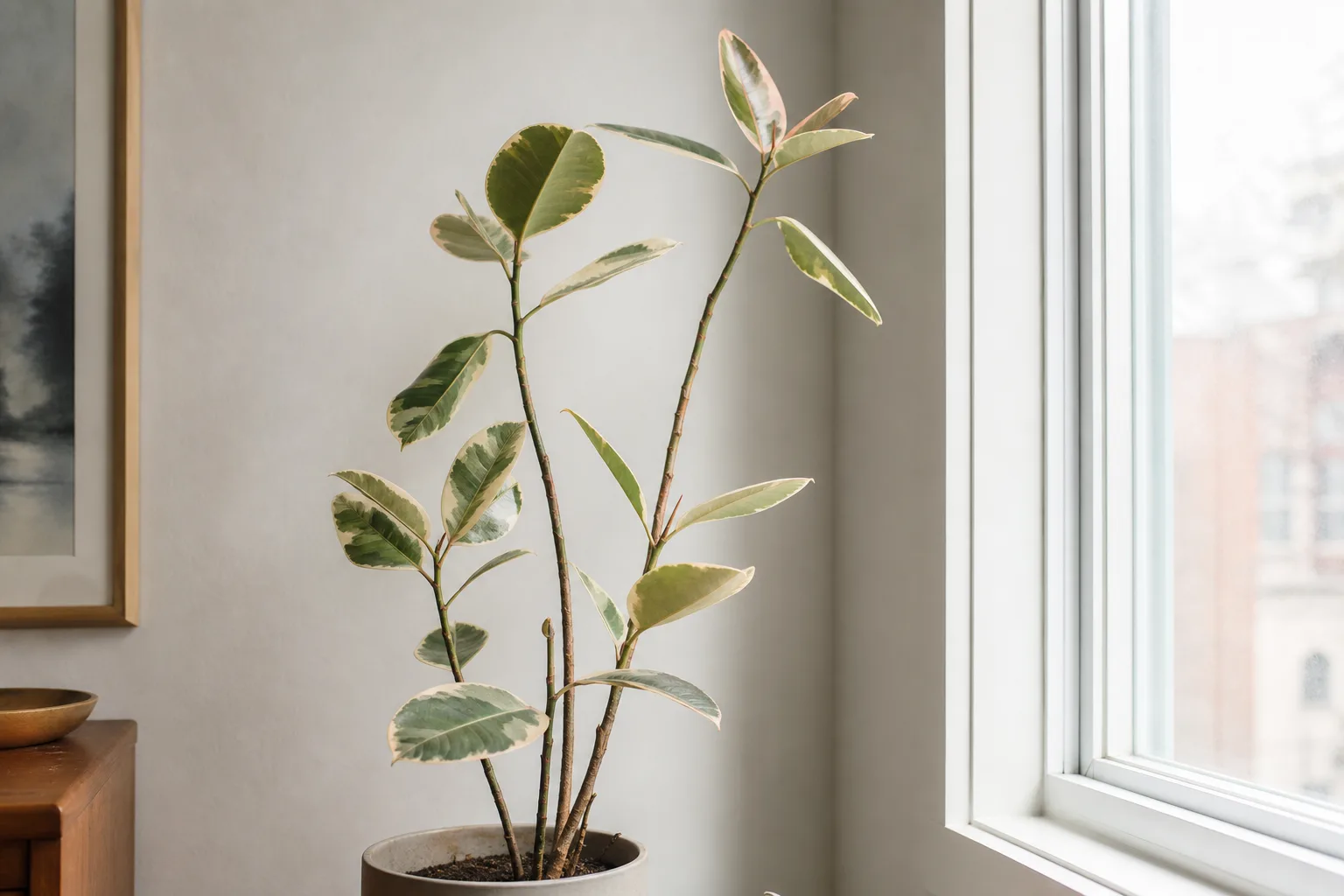
Leggy Ficus Tineke is etiolation: new stems stretch with long gaps between leaves, cream variegation fades on small new foliage, and the trunk leans toward the brightest window. First step: measure internode spacing on the last two leaves and move the pot within one to three feet of your brightest east or filtered south/west window.
Leggy Growth on Ficus Tineke: Causes, Checks & Fixes
This guide covers leggy growth on Ficus Tineke. See also the general Leggy Growth guide, watering, and light pages for this plant.
Leggy Growth on Ficus Tineke: Causes, Checks & Fixes
Quick answer
Leggy Ficus Tineke is etiolation-the plant stretches its upright stem toward usable light, leaving long gaps between leaf pairs, smaller new blades, and fading cream variegation on fresh foliage. Ficus elastica ‘Tineke’ carries green and cream or pale yellow variegated leaves; the pale sectors photosynthesize less efficiently than green tissue, so this cultivar reaches for light sooner than solid-green rubber plants in the same dim corner.
First step: measure internode spacing on the last two or three new leaves and move the pot within one to three feet (30–90 cm) of your brightest east or filtered south/west window. If the next leaf emerges with tighter spacing and sharper cream patterning, light was the limiter. For the full shadow test, wet-soil trap, and broader low-light symptom set, see not enough light on Ficus Tineke-this page focuses on stretch diagnosis, grow-light supplementation, and when to prune elongated stems after light correction.
Leggy growth vs not enough light vs slow growth
These Ficus Tineke problem pages overlap, but each answers a different search question:
| What you see | Most likely issue | Start here |
|---|---|---|
| Long internodes, lean toward window, smaller patterned new leaves, bare lower trunk with stretch at top | Leggy growth (etiolation) | This page |
| Fading cream variegation overall, dull new foliage, dim placement, winter thinning | Not enough light (broader light deficiency) | Not enough light |
| Little new length for weeks, tight spacing but stalled flushes, root-bound pot | Slow growth (roots, season, nutrients) | Slow growth |
| Limp leaves, wet or dry soil extremes, firm stem | Drooping or watering stress | Drooping leaves or overwatering |
Leggy Tineke still pushes new leaves-often on visibly longer internodes-but each blade sits farther from the last and the cream pattern dulls. Slow-growth plants may look stable yet barely add height. Not-enough-light covers the full sparse-frond picture including dull color and the wet-soil trap; leggy growth zeroes in on internode elongation and window lean as the signature stretch pattern and the permanent elongation that light correction alone cannot reverse on old tissue.
What leggy growth looks like on Ficus Tineke
Healthy Tineke grows as an upright architectural tree with broad, glossy leaves spaced at moderate intervals up a firm stem. Leggy etiolation breaks that pattern on new growth from the last month-older leaves may still look patterned from a brighter past.
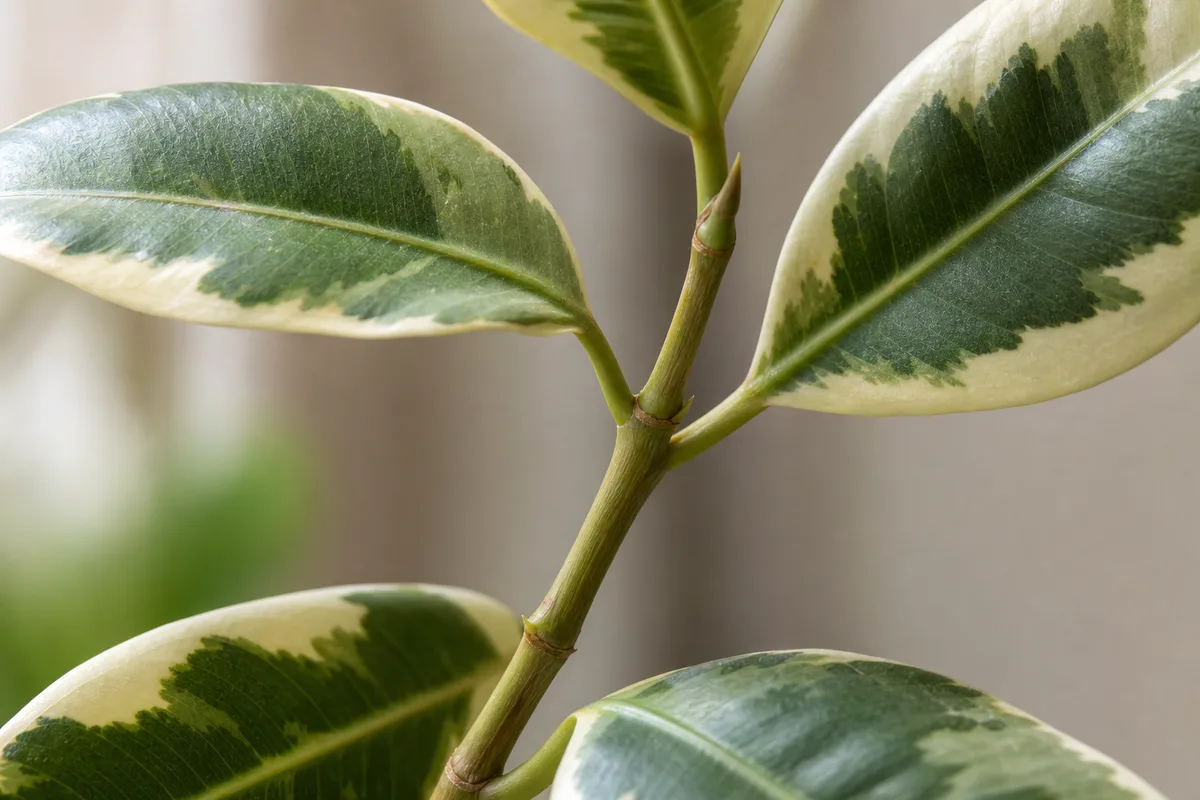
Leggy Growth symptoms on Ficus Tineke - compare with healthy tissue on the same plant.
Watch for these stretch signatures:
- Long internodes - visible gaps between leaf pairs increase on the newest stem section; the plant looks like it is reaching
- Smaller leaf size on the latest flush compared with leaves formed in better light
- Fading or shrinking cream sectors on fresh foliage, trending toward solid green on the most stretched shoots
- Strong lean toward a window, lamp, or hallway opening
- Bare lower stem with stretch at the crown - lower leaves drop as the plant sheds foliage it cannot support while the top keeps elongating
- Slow soil dry-down - dim light reduces metabolism, so the mix stays wet longer even on your normal Ficus Tineke watering guide
Compare the last two or three leaf pairs on the main stem. If internode length has doubled and cream margins have blurred, you are looking at etiolation-not the normal upright habit of a young Tineke that simply has not branched yet. Too little light causes spindly, leggy growth and a lean toward the brightest source.
What leggy usually is not:
- Temporary pink flush on a single brand-new leaf after repot or seasonal flush - normal Tineke color, not stretch
- Crispy brown cream margins only after a sudden sunny move - sun scorch; see Ficus Tineke light needs
- Sudden limp collapse with wet soil - overwatering or root rot, not stretch alone
- Webbing on leaf undersides - spider mites on weakened growth
Why Ficus Tineke gets leggy
Rubber plants evolved in bright, filtered tropical canopy-not deep interior shade. Missouri Botanical Garden recommends bright indirect light or part shade with protection from afternoon sun for indoor Ficus elastica. Tineke adds a variegation penalty: cream and pale yellow zones contain less chlorophyll, so the plant must intercept more total photons to build the same tissue a solid-green Ficus elastica would make in moderate light.
Ranked causes on F. elastica ‘Tineke’:
Insufficient light (most common). Placement for décor rather than brightness, distance beyond three to six feet from the only window, north-facing glass at mid and high latitudes, winter daylight reduction, dust on cream panels, and closed sheers all cut usable intensity at leaf level. Human vision adapts to dim rooms; the plant does not. Clemson Extension classifies rubber plant among medium-light houseplants that do best within several feet of east- or west-facing exposures-not deep in a room interior.
The low-light overwatering trap. Dim Tineke uses less water. Soil that stays wet too long stresses roots, yellows lower leaves, and mimics a watering problem while stretch continues. Fixing water without improving light often fails; the not enough light guide walks through this pairing in detail.
Uneven light exposure. One-sided window light produces leggy stretch on the shaded side while the sunward side stays fuller. Rotation fixes lean but not underlying dim placement.
Relocation shock layered on dim placement. A Tineke moved from a bright nursery into a dim hallway may drop lower leaves and stretch simultaneously-light is still the root cause of etiolation even when adjustment stress is present.
Heavy fertilizing in dim light. Clemson Extension notes foliage plants need at least 200 foot-candles for 12 hours daily before fertilizer shows any benefit. Feed cannot substitute for photon flux on a stretched plant.
How to confirm the cause
Work through these checks before Ficus Tineke repotting guide, fertilizing, or pruning stretched stems:
- Measure internode spacing. Hold a ruler or your finger between the last two leaf pairs. Gaps wider than leaves formed six months ago strongly suggest etiolation.
- Read the newest leaf. Green-dominant, small, or widely spaced new foliage with fading cream pattern-while older leaves still look acceptable-points to light, not a sudden nutrient crisis.
- Stand in the plant’s place. Can you see sky or bright outdoor scenery from leaf level? If the plant faces a wall across a dark room, brightness is probably insufficient for variegated rubber plant culture.
- Shadow test at midday. Hold your hand near the leaves. A soft, fuzzy shadow suggests meaningful indirect light. No shadow at all means the spot is too dim for strong variegated growth.
- Measure distance from glass. Within one to three feet of an east or filtered south/west window is the usual target. Beyond six feet from the same pane is often low-light territory.
- Check soil dry-down. Low-light Tineke pots often stay heavy and damp for days. If soil is chronically wet and the plant stretches, you may have light plus overwatering-fix placement first, then match watering to the slower dry-down rate.
- Rule out lookalikes. Dry soil throughout with slightly limp leaves points to underwatering. Wet soil with soft stems and sour smell points to root trouble. Webbing on leaf undersides points to spider mites.
If you move the plant closer to a brighter window for two weeks and the next new leaves emerge larger with tighter internodes and sharper cream variegation, you have confirmed insufficient light as the driver of leggy growth.
First fix for Ficus Tineke
Move the pot to bright indirect light within one to three feet of your best window-east exposure is the safest default, or south/west with sheer curtain or setback from hot summer glass.
That single placement change is the first fix. Do not stack repotting, heavy pruning, and fertilizer on the same day. Ficus elastica commonly drops lower leaves when several variables change at once. Stabilize light first and let the plant adjust. NC State Extension recommends growing rubber plant indoors under bright indirect light or partial shade with protection from the afternoon sun.
Practical move guidelines:
- Choose the brightest location where cream margins will not sit in harsh afternoon sunbeams for hours on an unacclimated plant-direct sun browns pale sectors before it helps variegation
- Rotate the pot a quarter turn every week or two once growth resumes evenly-Tineke orients toward light sources
- Wipe dust from both green and cream leaf surfaces with a damp cloth so pale panels actually receive the light you moved the plant into
- Hold watering steady for one week, then adjust only if the pot dries faster in the brighter spot
If no window delivers enough brightness-common with north exposure or deep apartments-add a full-spectrum LED grow light 12 to 18 inches (30–45 cm) above the canopy on a timer for 10 to 14 hours daily as a supplement, or 12 to 16 hours in rooms without useful window light. Clemson Extension notes sixteen hours of light and eight hours of darkness are satisfactory for most indoor plants under artificial lighting. Increase brightness there before buying fertilizer.
Step-by-step recovery after you add light
Once placement improves, recovery is about new tissue, not reversing old stretch.
- Wait 10 to 14 days before judging failure unless acute leaf scorch appears on cream margins from too much direct sun-in that case pull back immediately and filter the window.
- Watch the next two or three new leaves for tighter internodes, firmer texture, and return of crisp cream-and-green patterning.
- Adjust watering after you know the new dry-down rate. Brighter correct light usually means faster drying; dim light means less frequent watering. Water when the top 2–3 cm dries-not on a calendar memory from when the plant lived in shade.
- Accept a few lower leaf drops during adjustment if light and watering stabilize afterward. Repeated drop weeks later means something else is still wrong.
- Prune for shape only after new compact growth proves the spot works-spring or summer active growth is the safer window. Pruning does not fix old internode length; it redirects energy to bushier new shoots above the cut. See Ficus Tineke pruning for node placement and sap safety.
If new leaves stay green, small, and stretched after an honest bright-indirect move, the spot is still too dim or the fixture is too weak-move closer to the window or increase grow-light intensity before assuming disease.
Recovery timeline
Leggy stress on Ficus Tineke improves slowly because the plant must grow new leaves to show the fix.
- 10 to 14 days: First new leaf after a move may still reflect old conditions; hold judgment.
- 2 to 4 weeks: Compact spacing, larger blades, and sharper variegation usually appear if brightness is adequate.
- 1 to 2 months: Canopy density improves as multiple new leaves form in better light.
- Old stretched stems: Permanent unless pruned for aesthetics-they do not shorten when light improves.
Judge success by new internode length, leaf size, and variegation sharpness, not by older cream panels re-brightening. A mature leaf that greened in dim light will not regain lost pattern.
Lookalike symptoms to rule out
Several problems mimic “a tired rubber plant” without enough light being the whole story.
| Pattern | More likely cause |
|---|---|
| Stretch + fading cream on new leaves, soil dries slowly | Leggy growth / low light (primary) |
| Drooping with wet soil deep down | Overwatering / root stress |
| Drooping with dry soil and light pot | Underwatering |
| Yellow lower leaves only, firm stem, stable placement | Normal aging or post-move adjustment |
| Yellowing spread with sour smell and soft base | Root rot-common when dim light pairs with heavy watering; overwatering can cause loss of leaves on rubber plants |
| Stippling, webbing, or speckled leaves | Spider mites-inspect undersides |
| Brown crispy cream margins only after a sudden sunny move | Sun scorch-filter light and acclimate gradually |
Overwatering is the most common misread because dim Tineke does stay wet longer. If you increase light but keep watering as if the plant were beside a south window in midsummer, you can solve stretch while creating root stress. Fix light first, then read the pot weight.
Mistakes to avoid
- Pruning leggy stems before light improves - you remove tissue the plant needs while rebalancing and may trigger more stretch on remaining shoots in the same dim spot.
- Treating Tineke like a low-light plant because rubber plants “tolerate” shade. Clemson Extension notes rubber plants prefer bright light while adapting to lower light-variegated cultivars need brighter exposure than solid-green types to hold pattern.
- Fertilizing to “wake up” a stretched plant without fixing light. Feed cannot substitute for photon flux on a stressed plant.
- Jumping to harsh direct west or south sun to fix stretch on a plant from a dim shop or shelf. Cream margins scorch first-acclimate over 7 to 14 days or use morning sun only until new growth stays firm.
- Repotting on day one because growth is slow. Slow growth in low light is expected; unnecessary repotting adds another stress variable.
- Ignoring dust on cream panels-it effectively dims the tissue that already photosynthesizes least.
- Changing water, light, and pot in the same week-a reliable path to Ficus leaf drop without a clear diagnosis.
When to prune stretched stems
Pruning does not shorten existing internodes-it redirects growth. On Tineke, timing matters because every new leaf after a cut reflects current light quality, not just genetics.
Wait until two or three new leaves prove compact spacing in the corrected bright-indirect spot before structural cuts. Clemson Extension recommends spring and summer pruning when rubber plant is actively growing. Cut the main stem or long side branch just above a leaf node, leaving a few millimeters of stem above the node at a slight angle. Remove only one-third of healthy foliage per session on variegated rubber plants.
Do not top a stretched Tineke in November and expect bushy variegated regrowth in a dim winter corner-replacement foliage may emerge greener with less cream pattern. Schedule major cuts when the plant will sit in its brightest stable placement for months afterward.
For full node anatomy, sap safety, and reverted-green shoot removal, see Ficus Tineke pruning.
How to prevent leggy growth next time
Place Ficus Tineke where bright indirect light is realistic most of the day, not only where the pot looks best in the room layout. East windows and filtered south or west exposures are the usual winners; treat persistent north placement as grow-light territory if you want to keep cream variegation.
Seasonal habits that help:
- Move a few inches closer to the brightest window in late fall before winter stretch begins, or add LED hours on a timer
- Clean window glass and open sheers during daylight when glare is not a problem
- Rotate the pot weekly for even growth once the plant is stable
- Wipe leaves monthly so cream and green sectors both receive adequate light
- Reduce watering frequency if you temporarily accept a dimmer winter spot-match drinks to dry-down, not calendar memory
If you cannot provide enough natural light long-term, choose a different species for that shelf. Ficus Tineke in chronic shade will remain alive but will lose the variegated foliage that defines the cultivar.
When to worry
Leggy stretch alone is a slow cosmetic decline, not an overnight crisis. Escalate your response if:
- Soil stays wet for a week or more with leaf yellowing and soft stems-inspect roots for rot before assuming more light alone will fix the plant
- Mass leaf drop continues more than three weeks after one stable placement change-recheck watering, drafts, and pests
- New cream margins bleach or crisp after a move-you may have overshot into direct sun; filter or pull back
A Tineke that fades and stretches but stays firm with reasonable dry-down is telling you the truth: it needs more brightness, not emergency surgery.
Related Ficus Tineke problems
- Not enough light on Ficus Tineke - shadow test, placement trial, wet-soil trap, and full low-light recovery workflow
- Slow growth on Ficus Tineke - when spacing stays tight but new flushes stall
- Ficus Tineke pruning - node cuts, sap safety, and timing after light correction
- Ficus Tineke light needs - preventive window and grow-light placement
- Ficus Tineke care overview - watering, humidity, and variegation basics
When to use this page vs other Ficus Tineke guides
- Ficus Tineke watering guide - Use for routine moisture checks before assuming leggy growth is the main issue.
- Ficus Tineke problems hub - Browse all 16 common issues on this species.
- Not Enough Light on Ficus Tineke - Different entry point when symptoms overlap with leggy growth.
- Slow Growth on Ficus Tineke - Different entry point when symptoms overlap with leggy growth.
- Yellow Leaves on Ficus Tineke - Different entry point when symptoms overlap with leggy growth.