Ficus Tineke Light Needs: Bright Indirect and Reversion
Ficus Tineke Light Needs: Bright Indirect and Reversion Fixes
Ficus Tineke Light Needs: Bright Indirect and Reversion Fixes
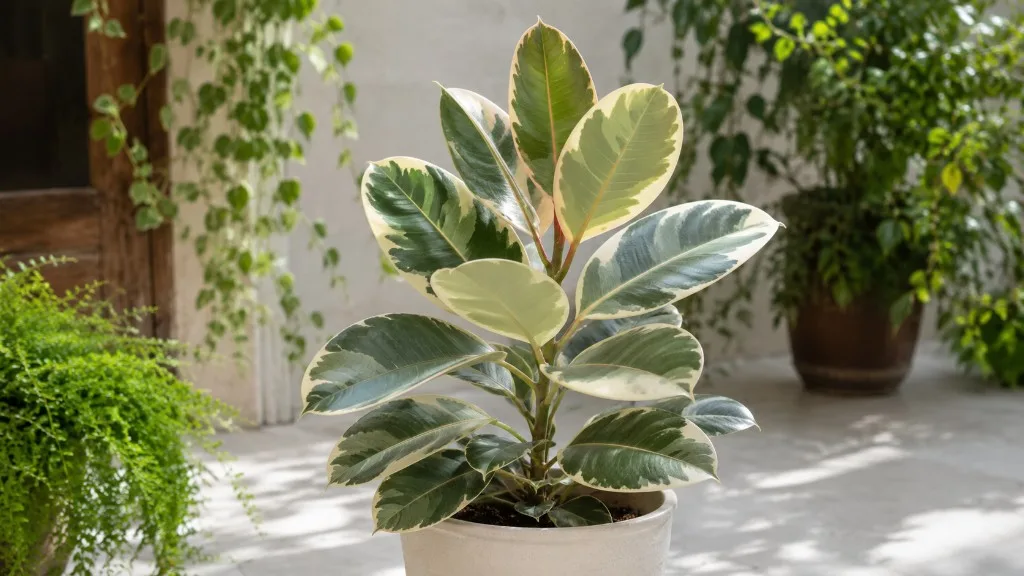
Ficus elastica ‘Tineke’ is sold for its watercolor foliage - broad cream panels, green midribs and margins, and pink-flushed new leaves that read like someone painted over a rubber plant with a dry brush. That pattern is not decoration sitting on top of an easy-care houseplant. It is a photosynthesis compromise baked into every leaf. The pale zones carry far less chlorophyll than a solid-green Burgundy or Decora rubber plant, which means Tineke cannot coast in the medium-bright corners where plain Ficus elastica often looks fine. It needs bright indirect light to hold cream and pink variegation, will revert toward solid green when light is chronically low, and will burn through its pale patches when harsh direct sun hits leaves that developed in softer exposure.
The practical target is not “as much light as possible” and not “keep it out of the sun entirely.” It is the brightest indirect placement you can offer without sustained harsh rays landing on cream and white tissue - usually an east-facing window, or a south- or west-facing spot pulled back a few feet or filtered through sheer curtain. Judge success by new leaves over the next two to three weeks, not by how photogenic the oldest foliage still looks. Old sunburn and old reversion do not reverse; only the next leaf tells you whether the current light is right.
This guide covers how much light Tineke actually needs, why variegation fades or greens out, where to put the pot indoors, how much direct sun is safe, when to add grow lights, and how to read warning signs before a placement mistake becomes a permanent growth habit.
How Much Light Ficus Tineke Actually Needs
Ficus elastica evolved under tropical forest canopies in southeastern Asia, where light is bright but filtered - strong overall illumination with direct sun broken up by leaves and morning mist. Clemson Extension recommends morning light from an east window and notes rubber plants prefer bright light while adapting to lower light. Tineke inherits that baseline and raises the bar because variegation reduces the leaf’s total photosynthetic area.
For most homes, the workable range is bright indirect light for most of the day - enough flux that the plant produces firm, well-spaced new leaves with visible cream and pink patterning, without so much direct radiation that pale tissue scorches. Think of it as one full step brighter than what you would give a solid-green rubber plant in the same room. If Burgundy looks content on a north-facing wall, Tineke probably wants the brightest window you have. If Burgundy already sits within a foot of south glass, Tineke may need the same brightness with diffusion during peak hours because its white and cream zones lack the pigment shielding that green tissue provides.
Distance matters more than compass labels. Indoor light falls off sharply even a few feet from glass. A Tineke on a coffee table in a “bright living room” often receives a fraction of the light hitting the windowsill - enough to survive, not enough to keep variegation crisp. Place the pot close enough that light lands on the leaf surface, not just on the floor around it. Rotate a quarter turn every week or two so the canopy does not lean hard toward the pane.
The Short Answer for Busy Growers
If you only remember four rules, use these. Default placement: brightest bright indirect spot available - east window first, filtered south or west second. More light than Burgundy: variegation costs chlorophyll; Tineke is not a low-light plant. Protect pale patches: gentle morning direct sun can work when acclimated; harsh midday and afternoon rays on cream margins are the fastest route to brown, crispy edges. Read new growth: firm leaves with clear cream-green patterning and pink-flushed young foliage mean the light is working; mostly green new leaves, smaller size, or long gaps between leaves mean brighten gradually. Give any placement change two to three weeks before deciding it failed - and change light alone before you also repot, fertilize, or overhaul watering.
Why Light Drives Cream, Pink, and Green Patterning
Tineke’s variegation is not a stable paint job. It comes from genetic variegation in leaf tissue - pale zones contain less chlorophyll than green margins. NC State Extension lists variegated rubber plant cultivars with cream, gray, and pink-splotched foliage alongside solid-green forms. The green margins do the heavy photosynthetic lifting; the pale zones contribute beauty and very little energy capture.
That structure creates two competing risks. In low light, the plant cannot meet its energy budget through green tissue alone, so it responds by pushing more chlorophyll into new growth - leaves emerge greener, cream patches shrink, and pink flushing dulls. In excess direct light, pale zones that lack chlorophyll cannot safely absorb intense radiation the way green tissue can; Missouri Botanical Garden notes bright indirect light or part shade with protection from afternoon sun for Ficus elastica, which helps avoid scorch on pale tissue. Tineke lives in the narrow band between those failures.
Pink and ruby tones deserve a separate note because growers often treat them as a different problem from cream variegation. On Tineke, pink is most visible on new leaves and sheaths when the plant has adequate light energy to spare on pigments beyond baseline chlorophyll. A well-lit Tineke pushes new foliage with a blush on the leaf reverse and along the central vein; a dim Tineke still grows, but new leaves look paler, greener, and flatter even before full reversion sets in. Clemson Extension notes variegated rubber plants are grown for cream, pink, or white-splotched leaves - insufficient light fades those patterns on new growth.
Chlorophyll, Variegation, and the Photosynthesis Trade-Off
Chlorophyll is the molecule that converts light into chemical energy. More chlorophyll means deeper green and more photosynthetic output per square inch of leaf. Variegated tissue with little or no chlorophyll cannot feed itself; it survives only because neighboring green tissue subsidizes it. That is why variegated rubber plants grow more slowly than solid-green siblings even under identical care - and why they demand brighter overall light to keep the same growth pace and pattern.
Clemson Extension lists variegated rubber plant cultivars with cream, pink, or white-splotched leaves and notes they are grown for those patterned leaves rather than solid green foliage. The practical takeaway is not to compensate for slow growth by hiding the plant in a dim bedroom. Slower growth in adequate light produces beautiful leaves. Normal-speed growth in low light produces green leaves - the plant trades pattern for survival.
Light also governs leaf size and internode length. A Tineke receiving enough brightness produces broad, glossy leaves with tight spacing up the stem. Chronic shade triggers etiolation - stretched stems, smaller new foliage, and a sparse canopy that reads as “unhappy rubber plant” even when the potting mix and water schedule are fine.
Low Light Reversion to Solid Green
Reversion is what happens when a variegated plant prioritizes function over form. Under sustained low light, Tineke produces leaves with more green and less cream because green tissue photosynthesizes efficiently and variegated tissue does not. A stem that starts pushing fully green leaves is not diseased - it is outcompeting variegated growth on the same plant. Left alone, that green shoot often grows faster and stronger than variegated sections because it carries more chlorophyll per leaf.
Reversion shows up in predictable stages. Early stage: new leaves lose pink flush and cream zones narrow, though some pattern remains. Middle stage: new leaves are mostly green with thin cream edges. Late stage: entire stems produce solid green leaves that look like a regular rubber plant branch grafted onto your Tineke. The fix is two-part. Move to brighter indirect light so future growth has the energy budget to support variegation. Prune reverted stems back to a node on variegated tissue - usually visible as a stem segment still showing cream in the leaf axil or on the youngest remaining variegated leaf. If you only move the pot and never cut green shoots, the green growth can dominate the canopy even in a brighter window.
Reversion is easier to prevent than reverse. Once a large section of the plant has gone green, you are pruning for recovery, not tuning placement. That is why the new-growth test matters from the first month you own the plant.
Bright Indirect Light - The Sweet Spot for Tineke
Bright indirect light is the phrase every Tineke care guide repeats and few define in room terms. For Ficus Tineke overview, it means the canopy receives strong, plant-usable illumination for most daylight hours without the leaf surface heating under sustained direct beam exposure. You can read the room with a simple test: at midday, hold your hand between the window and the plant. If a sharp, hot shadow with hard edges falls on the leaves for hours, that is direct sun and needs diffusion or distance for Tineke. If the shadow is soft and the light feels bright but not baking, you are likely in the right zone.
Another usable check is the white paper test. Place a sheet of white paper where the plant’s top leaves sit. If the paper looks clearly illuminated without glare so intense it hurts to look at, you have bright indirect. If the paper looks gray and dim, you have medium or low light - fine for some houseplants, insufficient for holding Tineke variegation long term.
Season matters. A south windowsill that is perfect from October through March can become a sunburn lane from May through August in the northern hemisphere. Tineke does not need to move every season, but it does need you to watch cream margins in late spring when solar angle and intensity jump. Pull the pot back six inches, add a sheer curtain, or shift to an east exposure before brown patches appear - pale tissue damage is permanent on the affected leaf.
What “Bright Indirect” Means in a Real Room
In apartments and offices, these placements usually land in bright indirect territory:
- Within one to three feet of an unobstructed east window - often the best default for Tineke because morning sun is bright but cooler than afternoon rays.
- Three to five feet from a south or west window with open sky view, or one to two feet behind a sheer curtain on those exposures.
- Directly under a skylight in a bright atrium, provided midday beams do not cook the canopy - watch cream edges.
- Under a quality full-spectrum grow light sized for the canopy footprint, with the fixture high enough to spread intensity evenly.
These usually fail the bright indirect test for variegation:
- Across the room from a window, even in a “sunny” room.
- North window only in mid-latitude winters without supplemental light.
- Bookshelf side of a west window where the plant sees bright walls but receives little direct flux.
- Interior office desk lit only by overhead fluorescents eight or more feet from windows.
Tineke is often sold as easy care because it tolerates average indoor humidity and infrequent watering relative to ferns. That ease does not extend to dim corners. Treat Tineke like a plant that wants the same brightness you would offer a fiddle-leaf fig or a large monstera - then subtract harsh direct beams to protect the pale panels.
Best Window Placement for Ficus Tineke
Compass direction is a starting guess, not a verdict. A labeled “south window” blocked by a porch roof may deliver less usable light than an open east window. What matters is how many hours of strong, filtered brightness reach the leaf surface and whether direct beam intensity exceeds what cream tissue can tolerate.
For most growers, the ranking is: east first, sheer-filtered south or west second, north only with grow-light support, and unfiltered west in hot afternoon climates last unless you acclimate carefully and accept some cosmetic edge browning in summer.
East, South, West, and North Exposures Compared
An east-facing window is the most reliable Tineke placement in the majority of homes. Morning sun delivers high brightness at lower heat load than afternoon rays. Cream and pink zones get the photon budget they need without the sustained thermal stress that turns pale margins brown by July. Many growers who struggled with west-window scorch see immediate improvement after shifting to east - not because west is always wrong, but because east forgives more placement errors.
A south-facing window offers excellent winter light in northern latitudes and can be ideal from fall through early spring with the pot one to two feet from the glass. In summer, south panes intensify midday sun. Watch the leaf half facing the glass - if cream edges brown on that side first, add sheer diffusion or pull the plant back rather than assuming the whole room is too bright. South works well when combined with a winter grow-light boost and summer curtain filter.
A west-facing window supplies strong afternoon rays - the highest scorch risk for pale-variegated rubber plants. Tineke can live here if pulled back from the pane, sheer-filtered during peak hours, or acclimated from a prior bright-indirect spot. Expect one-sided stress: leaves facing the glass may bleach while the shaded side still looks fine. Rotate for even growth, but rotation does not undo sunburn - it only prevents permanent lean.
A north-facing window rarely provides enough flux for crisp variegation year-round above roughly 40°N latitude without supplemental lighting. North can maintain a slow, green-leaning Tineke in summer if the window is large and unobstructed, but pink flush and bold cream panels usually fade. Treat north as grow-light territory if you bought Tineke for variegation, not just upright green foliage.
Morning Sun vs Harsh Afternoon Rays on Pale Patches
Not all direct sun is equal. Early morning direct sun - typically the first one to two hours after sunrise on an east exposure - is low-angle, cooler, and often beneficial for Tineke that was grown in a bright greenhouse or nursery. It raises daily light integral without the heat spike of noon beams. Many experienced growers allow gentle morning rays on acclimated plants while still refusing midday and afternoon direct on cream zones.
Afternoon direct sun through west or south glass is where pale patches fail. Cream and white tissue lacks chlorophyll’s protective capacity; it heats and desiccates faster than green margins. Damage shows as tan-to-brown crisping along pale edges, bleached white patches, or sudden collapse of the cream portion while the green midrib survives. Once that tissue dies, the leaf does not repair - you wait for replacement foliage in a safer spot.
If your only bright window is west-facing, prioritize diffusion over distance alone. A sheer curtain that cuts beam intensity often works better than moving the pot four feet into a dim room. The goal is to keep total daily brightness high while lowering peak beam harshness on pale surfaces.
Direct Sun Tolerance and Acclimation
Tineke is not a full-shade plant, and it is not a cactus. It occupies the middle ground common to tropical forest-edge species: it can handle some direct sun when properly acclimated, but it does not need direct sun to thrive. Missouri Botanical Garden recommends bright indirect light or part shade with protection from afternoon sun for Ficus elastica - direct sun is optional enhancement, not a requirement, and it carries asymmetric risk on variegated leaves.
Acclimation matters because leaves are stamped by the light they developed in. Foliage grown under nursery shade cloth or in a dim shop has thin photoprotection relative to leaves grown at a bright windowsill. Moving that plant into two hours of unfiltered south sun on day one often produces bleached cream panels within days, even though a slowly acclimated Tineke might tolerate the same exposure without damage.
When Gentle Direct Sun Helps vs Hurts
Gentle direct sun helps when:
- The plant was already grown in moderate direct morning exposure and you are maintaining that level.
- You are in a cool, bright season (many winters indoors) and the window beam is strong but not hot.
- Total daily light from indirect sources alone is borderline, and one hour of early direct tips the plant into adequate DLI for variegation.
- New growth after acclimation shows stronger pink flush and wider cream panels without edge browning.
Direct sun hurts when:
- Afternoon west or south beams hit cream zones for multiple hours.
- The plant just arrived from a greenhouse, big-box store, or lower-light room.
- Leaves are dust-coated, reducing photosynthesis in green zones while pale tissue still absorbs heat.
- Water stress coincides with high light - dry pots plus harsh sun accelerates margin crisping.
- Heat builds behind glass or against a dark wall, raising leaf temperature above what pigment-free tissue tolerates.
A practical acclimation path over 10 to 14 days looks like this: start in bright indirect only for three to four days after purchase; add 30 to 60 minutes of early direct and watch the newest leaf; if cream edges stay clean, extend morning exposure incrementally; if any pale browning appears, step back to indirect and wait for a clean new leaf before retrying. Never increase direct sun and repot in the same week - Ficus already drops leaves when one variable shifts; stacking changes makes diagnosis impossible.
Low-Light Limits and Warning Signs
Tineke can survive in medium indoor light longer than many variegated tropicals, which is why it ends up in hallways and office corners where it slowly loses the pattern you paid for. Survival is not success. Below a certain brightness threshold, the plant stops being Tineke visually even while the stem still grows.
The Missouri Botanical Garden notes that Ficus elastica prefers bright light and that insufficient light leads to leaf drop and poor growth - effects that show faster on variegated cultivars with less photosynthetic reserve. Low light also slows drying of the potting mix, which invites root problems if you keep watering on a bright-window schedule copied from another plant.
Symptoms of Too Little Light
Watch for these signals on new growth, not old leaves:
- Reversion: new leaves emerge mostly green with narrow or absent cream margins.
- Smaller leaf size: each new leaf is noticeably smaller than the one before it, even when the plant is not rootbound.
- Leggy internodes: visible gaps along the stem between leaves; the plant looks stretched toward the window.
- Dull pink loss: new sheaths and young leaves lack the blush seen on nursery plants in brighter stock.
- Slow unfurling: new leaves take longer to open and feel thin or floppy compared with firm greenhouse foliage.
- Leaf drop at the base: older leaves yellow and fall while the top struggles - common when the canopy cannot photosynthesize enough to support itself.
- Soil staying wet: pot remains damp more than a week in a standard mix because the plant is using little water.
If you see two or more of these signs together, increase brightness before you fertilize. Feed does not replace photons. Move the pot closer to the brightest suitable window or add a grow light, then wait for two new leaves before judging.
Grow Lights When Natural Light Falls Short
North rooms, winter short days, office cubicles, and apartments with deep overhangs are grow-light scenarios even if the space “feels bright” to human eyes. Human vision adapts to low light; Tineke’s variegation does not. A full-spectrum LED grow light is not a crutch for failure - it is a standard tool for keeping cream and pink patterning where window flux is insufficient.
Choose a fixture sized to the canopy - a small desk lamp over a six-inch pot, a wider panel for a three-foot floor specimen. Full-spectrum LEDs in the roughly 3500K to 5000K range support foliage color without the excessive red skew some bloom fixtures carry. Start conservatively: higher fixture, longer duration beats low fixture, hot leaves.
Fixture Distance, Hours, and Adjustment Protocol
A workable starting point for a medium floor Tineke:
- 18 to 24 watts LED grow light or equivalent bar/panel for a single large plant.
- 18 to 24 inches above the top leaves initially.
- 10 to 12 hours daily on a timer for consistency.
- Adjust based on new leaf response, not leaf temperature alone.
If new leaves show stronger variegation and firm texture after two weeks, hold the setup. If cream edges brown under the lamp, raise the fixture six inches or reduce hours by two. If new leaves still green-revert, lower the fixture slightly (six inches) or extend to 12 to 14 hours - variegated rubber plants often sit at the borderline of adequate DLI, and small increases matter.
Combine grow lights with window light when possible. A Tineke on an east windowsill with a winter morning LED boost often holds pink flush better than either source alone. Avoid leaving a grow light so close that the canopy feels warm to your hand - pale tissue overheats before green tissue shows stress.
Clean leaves matter under artificial light too. Dust on glossy rubber-plant foliage cuts the light green zones receive, which pushes the plant toward more chlorophyll in new growth - another subtle reversion pressure in dim, dusty corners.
How to Move Tineke Without Leaf Drop or Shock
Ficus elastica has a reputation for dropping leaves after moves, and Tineke is not exempt. The drop is often a light-transition response, not sudden root death - but growers frequently interpret it as underwatering on Ficus Tineke and make things worse by soaking a dim, shocked plant. When you change placement, change light only and wait.
Move in one-foot or one-window increments when possible: from five feet off a south window to three feet, not from a back hallway to south glass in one afternoon. If you must make a big jump - shop to windowsill - expect some lower leaf drop and hold watering steady until new growth appears. The top bud tells you whether the plant accepted the move; persistent drop from the growing tip means the new spot is still wrong or too abrupt.
Avoid stacking stressors. Do not repot, fertilize, and blast into direct sun the week you bring Tineke home. Let it sit in bright indirect for two weeks, confirm Ficus Tineke watering guide in that light level, then consider gradual morning sun or a grow-light add. Rotate the pot weekly for even exposure, but do not rotate daily - Ficus prefers stable orientation more than fussy constant spinning.
Wipe leaves gently with a damp cloth every few weeks. Pale panels catch dust that blocks scarce photosynthesis in cream zones; clean glossy foliage is a low-effort way to stretch marginal light without moving the pot.
Warning Signs Your Ficus Tineke Has the Wrong Light
Symptoms split cleanly into too little and too much once you look at new growth. Mixed signals usually mean uneven exposure - one side of the canopy scorched, the other reverting - or recent stacked changes you need to untangle.
Too little light:
- New leaves mostly green with shrinking cream pattern (reversion).
- Leggy stems and long internodes.
- Smaller new leaves than previous foliage.
- Loss of pink flush on young leaves and sheaths.
- Slow growth or no new leaves through spring and summer indoors.
- Potting mix stays wet too long relative to your watering habit.
Too much light / harsh direct sun:
- Brown, crisp edges on cream and white zones while green midribs remain intact.
- Bleached patches on pale tissue - paper-white areas turning tan.
- Curling or folding of leaves during brightest hours.
- One-sided damage on the window-facing half of the canopy.
- Sudden leaf collapse after moving to a brighter spot without acclimation.
- Yellowing pale zones that feel dry and papery - distinct from overwatering on Ficus Tineke yellow, which usually hits lower leaves first with soft texture.
When symptoms conflict, trust the youngest leaf. If the newest leaf is green and small, brighten. If the newest leaf shows clean variegation but cream edges are browning, soften peak sun while keeping total brightness. If both reversion and scorch appear on different stems, split the problem: prune reverted green shoots, diffuse harsh rays on variegated stems, and wait for two new leaves before further changes.
Conclusion
Ficus Tineke rewards one clear light decision: bright indirect exposure strong enough to fund cream and pink variegation, with harsh direct sun kept off pale patches that cannot absorb intense radiation safely. It needs more brightness than a solid-green rubber plant because variegation trades chlorophyll for color, and low light answers that trade by reverting to green. East windows, filtered south and west placements, and well-sized grow lights cover most homes; the diagnostic that never lies is the next leaf - firm, patterned, and flushed with pink when the light is right.
Place Tineke close to real brightness, acclimate direct sun slowly if you use it at all, prune green reverted stems before they dominate, and change light alone when troubleshooting. Get that stable bright-indirect band right and the rest of care - watering, humidity, Ficus Tineke repotting guide - becomes simpler because the plant has the energy to recover from ordinary indoor stress instead of sliding into slow decline behind a pretty label.
When to use this page vs other Ficus Tineke guides
- Ficus Tineke overview - Start here for whole-plant context before deep-diving this topic.
- Ficus Tineke problems hub - Jump to symptom-specific fix guides when this care topic does not resolve the issue.
- Not Enough Light on Ficus Tineke - Escalate here when light adjustments are not enough.
- Leggy Growth on Ficus Tineke - Escalate here when light adjustments are not enough.
Related Ficus Tineke guides
- Ficus Tineke overview
- Ficus Tineke watering
- Ficus Tineke soil
- Ficus Tineke propagation
- Ficus Tineke fertilizer
- Ficus Tineke repotting
- Not Enough Light on Ficus Tineke
- Leggy Growth on Ficus Tineke
- Ficus Tineke problems
Related tool
Try the Plant Problem Diagnosis Tool with ficus-tineke pre-selected to estimate needs for your setup.