Mealybugs on Coleus: Causes, Checks & Fixes
Quick answer
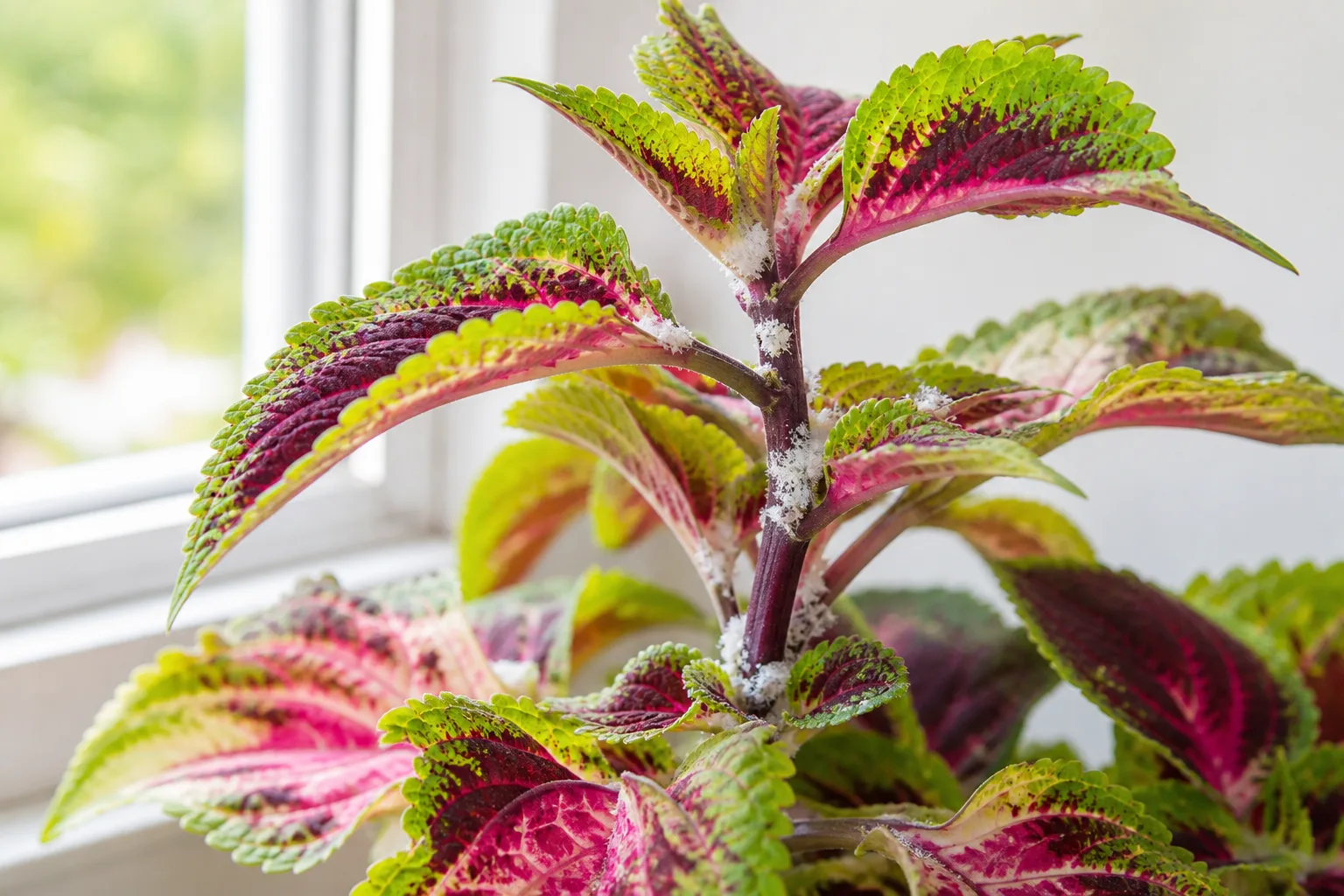
Mealybugs on Coleus show as white cottony masses where opposite leaves meet soft stems. First step: move the plant away from others and dab every visible cluster with a cotton swab dipped in 70% isopropyl alcohol.
Mealybugs on Coleus: Causes, Checks & Fixes
This guide covers mealybugs on Coleus. See also the general Mealybugs guide, watering, and light pages for this plant.
Mealybugs on Coleus: Causes, Checks & Fixes
Quick answer
Mealybugs on Coleus (Plectranthus scutellarioides) are sap-sucking insects that cluster where opposite leaves meet square, soft stems. They look like bits of cotton wool tucked into leaf axils-not dust, variegation, or normal leaf texture.
First step: isolate the plant and dab every visible cluster with a cotton swab dipped in 70% isopropyl alcohol. That direct-contact kill confirms you have mealybugs-not scale, mineral deposits, or edema-and stops crawlers from spreading to your other houseplants before you add sprays.
What mealybugs look like on Coleus
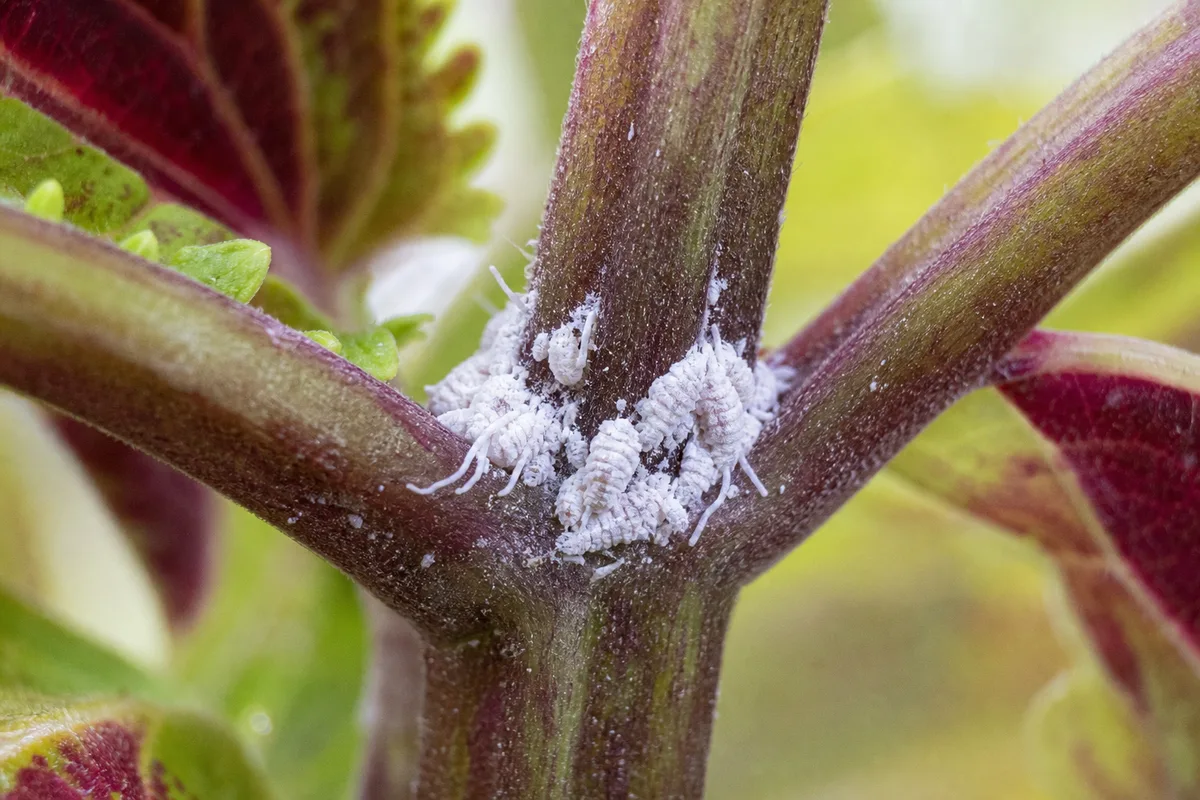
White cottony mealybug cluster tucked into a Coleus leaf axil where opposite petioles meet the stem - wipe with alcohol to confirm pink bodies beneath the wax.
On Coleus, mealybugs favor sheltered feeding sites that casual watering misses:
- White cottony masses in leaf axils where each opposite petiole meets the stem, along branching nodes, and at the base of flower spikes.
- Waxy filaments extending from clusters on soft green or purple stems, especially on fast-growing tips you have not pinched recently.
- Pink or gray bodies visible if you wipe away the wax with a swab-adult females are wingless and slow-moving beneath the fluff.
- Honeydew-a clear, sticky film on leaf surfaces below infested areas, on the pot rim, or on the shelf beneath the plant.
- Sooty mold growing on honeydew as a dark, velvety coating that can dull Coleus’s bright foliage colors.
- Yellowing, curling, or stunted leaves on heavily fed stems, sometimes starting on lower foliage while the plant still pushes new tips.
Coleus carries opposite leaves on soft, succulent stems that grow quickly in warm indoor air. A small colony can stay hidden inside tight axils for weeks, which is why mealybug outbreaks on painted nettle often seem to appear overnight once the wax becomes visible on outer stems.
Less common but worth knowing: some mealybug species feed on roots. If stems and leaf axils look clean but the plant wilts despite appropriate watering and you cannot find firm roots, inspect the soil surface and drainage holes for white waxy patches.
Why Coleus gets mealybugs
Coleus is a common indoor host. UC IPM lists coleus among houseplants that frequently develop aboveground mealybug problems, alongside aglaonema, philodendron, and dracaena. The citrus mealybug is especially common on soft-stemmed, succulent plants such as coleus. The issue is not that Coleus is unusually weak-it grows vigorously when warm and well lit-but that its growth habit gives pests protected hiding places.
Soft stems and constant new growth. Mealybugs feed at stem tips and where leaves meet stems. Coleus pushes tender shoots continuously during warm months, especially after pinching. Colonies settle in the axils of those fresh leaves-areas you do not see when glancing at the colorful tops.
Indoor conditions favor year-round reproduction. Mealybugs thrive in the mild, stable temperatures of heated homes, where natural predators are absent. Crawlers hatch continuously indoors, so populations can rebuild between weekly treatments if any eggs survive.
Introduction from new plants. Most collections pick up mealybugs when an infested nursery plant skips quarantine. Coleus is widely sold in mixed foliage displays, which increases hitchhike risk from neighboring pots.
Moist soil does not cause mealybugs-but stress lowers resistance. Coleus prefers consistently moist, well-draining mix. Chronically soggy soil weakens roots and yellows lower leaves, but mealybugs still had to be introduced. Over-fertilizing with nitrogen produces extra soft shoots that pests prefer for egg-laying.
Lookalike symptoms to rule out
Before treating, distinguish mealybugs from harmless or unrelated marks:
- Mineral deposits or hard-water residue wipe off dry as crusty white dust without a cottony texture and do not smear pink when crushed.
- Natural leaf variegation follows consistent patterns on each cultivar and does not cluster only at stem joints.
- Edema shows as small translucent or brown water-soaked blisters on leaf blades, not waxy cotton along petioles.
- Powdery mildew forms a flat fungal film across leaf surfaces in humid, stagnant air-not discrete tufts in axils.
- Scale insects produce hard brown or tan domes that do not crush to a pink smear; they are more firmly attached than mealybugs.
- Aphids cluster on the newest soft shoots as soft-bodied groups without heavy cottony wax-though honeydew from both pests looks similar.
- Wilting from underwatering on Coleus affects the whole plant evenly and recovers within hours after watering; mealybug damage causes patchy yellowing and stickiness on specific stems.
If clusters smear pink, feel waxy, and sit at leaf-stem junctions, mealybugs are confirmed regardless of watering history.
How to confirm the cause
Work through this inspection in order:
- Isolate the plant on a clean surface away from other pots before handling, so crawlers do not walk to neighboring plants.
- Open each opposite leaf pair and inspect where petioles meet the stem, using a magnifier or phone macro lens.
- Run the swab test-dab a cottony cluster with a dry swab, then crush it on white paper. A pink or reddish streak means mealybug, not dust.
- Check flower spike bases if your Coleus is blooming-mealybugs often hide where spikes emerge from stem tips.
- Feel for stickiness on leaves below infested areas; honeydew confirms active sap feeding.
- Scan nearby plants that share a shelf or were purchased together-mealybugs spread before symptoms show on every pot.
- Look at the soil line and drainage holes if foliage looks clean but growth has stalled; root-feeding mealybugs sometimes hide below the surface.
Confirmed mealybugs show cottony clusters at feeding sites plus either visible insects beneath the wax, pink smear on crushing, or sticky honeydew nearby.
First fix for Coleus
Isolate, then dab-not spray first.
- Move the Coleus to a separate room or closed area away from other houseplants.
- Dip a cotton swab or fine artist’s brush in 70% isopropyl alcohol (standard rubbing alcohol).
- Touch every visible mealybug, egg mass, and cottony cluster directly. University of Maryland Extension recommends dabbing individual mealybugs with a cotton swab dipped in household alcohol for light infestations; the alcohol dissolves the waxy coating and kills on contact.
- Test one leaf first if you have never used alcohol on this cultivar-wait 24 hours and check for leaf burn before treating the whole plant. UC IPM advises testing alcohol solutions on a small plant area before broad application.
- Wipe honeydew from leaves with a damp cloth so sooty mold does not spread while you control the insects.
Do not shower the plant, repot, or fertilize on day one. Coleus recovers best when you remove pests first and keep watering on its normal schedule-water when the top 1–2 cm of soil feels dry.
Step-by-step recovery
After the first alcohol session, follow this sequence based on severity:
Light infestation (a few clusters on one stem tip)
- Repeat alcohol dabs every five to seven days for at least three weeks.
- Inspect leaf axils with a magnifier each cycle; new crawlers are wax-free and harder to see.
- Keep the plant isolated until you find no new cottony masses for two full weeks after the last treatment.
Moderate infestation (multiple stems, honeydew present)
- Continue weekly alcohol dabs on every cluster you can reach.
- Add a thorough insecticidal soap spray on a separate day, covering leaf undersides, petioles, stems, and axils. Insecticidal soaps kill only on contact and require complete wetting of the insect.
- Repeat soap sprays every five to seven days for three to four cycles to catch newly hatched nymphs before they develop heavy wax. Wisconsin Horticulture recommends two to three treatments at 10–14 day intervals for good control.
- Pinch or prune only heavily infested stem tips that are already yellowed-snip with clean scissors and bag the debris. Do not strip the plant bare; Coleus needs remaining foliage for photosynthesis, though it regrows faster than many houseplants once pests are gone.
Heavy infestation (colonies throughout plant, sooty mold, multiple pots)
- Treat every affected plant on the same schedule.
- Consider a 10–25% isopropyl alcohol spray for extensive coverage, but only after a leaf test-UC IPM recommends testing for phytotoxicity before broad alcohol application.
- If stems look clean but the plant keeps declining, unpot and inspect roots for white waxy patches. Root mealybugs require Coleus repotting guide into fresh mix and washing roots-not foliar sprays alone.
- Discard only as a last resort if treatment fails after persistent weekly effort and stems collapse despite firm roots.
Recovery timeline
Expect visible colony reduction within one to two weeks of consistent alcohol dabs. Full clearance usually takes three to four weekly treatment cycles because eggs continue hatching indoors.
Signs the plan is working:
- Fewer cottony clusters at each inspection
- No new honeydew on lower leaves
- Firm new shoots emerging with clean axils and strong color
- Sooty mold stops spreading (existing mold can be wiped off; it does not harm the plant once insects are gone)
Signs the infestation is winning:
- New white masses appearing on previously clean stems between treatments
- Increasing yellowing despite correct watering
- Ants consistently trailing to the pot-often a sign of heavy honeydew production
- Wilting with no root mealybug explanation and soft, collapsing stem tissue
Coleus grows quickly in warm conditions. Even after pests are gone, expect two to four weeks before new foliage makes the plant look full again, especially if you had to pinch back multiple infested tips.
Mistakes to avoid
- Spraying before isolating and dabbing lets crawlers spread while you debate products.
- One treatment and done-mealybug eggs hatch over weeks; a single pass rarely clears a bushy Coleus.
- Using full-strength alcohol on the entire plant without a leaf test can burn sensitive foliage, especially on plants recently moved into brighter light.
- Applying soap or oil in harsh direct sun-Coleus bleaches in strong sun, and wet leaves in heat increase phytotoxicity risk. Treat in indirect light and let foliage dry the same day.
- overwatering on Coleus after pest stress-soggy soil does not kill mealybugs and can trigger root rot on Coleus on an already weakened Coleus.
- Fertilizing during active infestation-produces tender new growth that pests prefer; feed only after two weeks with no new insects.
- Returning the plant to the main collection too soon-two pest-free weeks minimum after the last visible cluster is removed.
- Taking cuttings from infested plants-crawlers hide in axils and will infest your propagation water or new pots.
- Ignoring neighboring pots-mealybugs spread to pothos, ficus, and other shelf mates before those plants show obvious wax.
Coleus care cross-check
While treating mealybugs, keep baseline care steady:
- Light: Coleus light guide to partial shade. Do not move a recovering plant into harsh direct sun-that bleaches colors and stresses foliage during treatment.
- Watering: Water when the top 1–2 cm feels dry. Mealybug damage and overwatering both yellow lower leaves; stick to the finger test so you do not confuse pest stress with rot.
- Humidity: Moderate to high (50–70%) suits Coleus, but raising humidity alone does not eliminate mealybugs.
- Pinching: Resume normal tip pinching only after two weeks with no new insects-pinching during active infestation can spread crawlers if you do not disinfect scissors between cuts.
- Handling: Coleus is toxic to cats and dogs. Keep pets away from alcohol-treated foliage until it dries, and wash hands after handling sap.
How to prevent mealybugs next time
- Quarantine new Coleus purchases for two to three weeks before placing them near existing plants. Inspect leaf axils and stem tips at intake.
- Scout weekly during watering-check where leaves join stems and along protected joints, the same sites mealybugs colonize first.
- Avoid excess nitrogen fertilizer during peak growth; UC IPM notes that over-application combined with regular irrigation stimulates tender new growth where mealybugs prefer to lay eggs.
- Maintain airflow between grouped plants so crawlers cannot walk leaf-to-leaf as easily.
- Inspect pots and saucers when bringing plants indoors from patios-mealybugs hide on container rims and unglazed terracotta bases.
- Buy from sources with visible pest checks-choose plants with clean axils and no sticky residue on lower leaves.
When to worry
Escalate quickly if:
- Cottony masses appear on three or more plants in the same room
- Ants are farming honeydew on or around the Coleus pot
- Sooty mold covers most of the leaf surface and keeps returning within days of wiping
- Stems collapse at the base-soft tissue, foul soil smell, or widespread yellowing with mushy roots suggest root rot overlapping pest stress, which needs separate diagnosis
- Alcohol and soap cycles for six weeks still produce fresh colonies
A single isolated cluster on one stem tip, caught early, is manageable with isolation and repeated alcohol dabs. Coleus rarely dies from light mealybug damage alone when stems stay firm and treatment stays consistent.
Conclusion
Mealybugs on Coleus are a common, treatable pest-not a sign that your painted nettle is the wrong plant for your home. Their cottony wax hides in the same leaf axils that make Coleus bushy and colorful, so thorough stem inspection matters more than any single spray product.
Isolate first, dab every cluster with alcohol, repeat weekly until crawlers stop appearing, and judge success by clean new shoots-not by old yellowed leaves. With consistent treatment, most Coleus recover quickly thanks to their fast growth habit.
When to use this page vs other Coleus guides
- Coleus watering guide - Use for routine moisture checks before assuming mealybugs is the main issue.
- Coleus problems hub - Browse all 16 common issues on this species.
- Yellow Leaves on Coleus - Different entry point when symptoms overlap with mealybugs.
- Slow Growth on Coleus - Different entry point when symptoms overlap with mealybugs.
- Spider Mites on Coleus - Different entry point when symptoms overlap with mealybugs.