Coleus Light Needs: Bright Indirect to Partial Sun
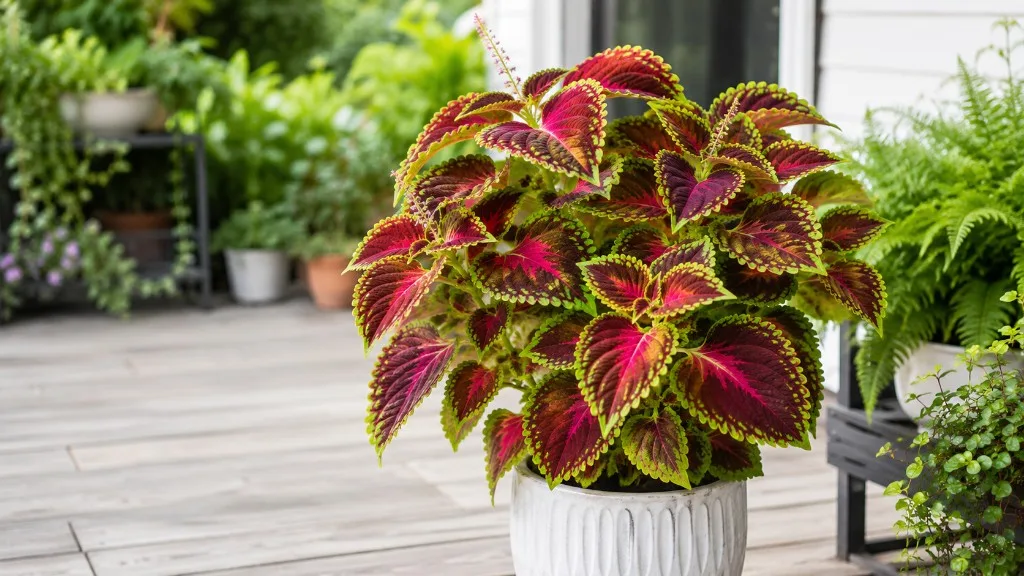
Coleus Light Needs: Bright Indirect to Partial Sun and Color Intensity
Coleus Light Needs: Bright Indirect to Partial Sun and Color Intensity
Coleus is grown for one reason above all others: color. Not flowers, not fruit - the painted leaves that can carry a container, soften a shady corner, or blaze on a sunny patio. Plectranthus scutellarioides will survive in a surprising range of exposures, but survival is not the same as the saturated burgundy, lime, magenta, and gold you bought the plant for. Light is the dial that turns those pigments up or down, and getting it wrong produces either washed-out, bleached foliage or stretched, dull green stems that look nothing like the tag photo.
The practical range for most coleus is bright indirect light to partial sun - strong ambient brightness with direct rays limited to gentle morning exposure or filtered afternoon light, depending on cultivar. That is not a vague “medium light” suggestion. It is a placement target you can test at a window, on a balcony, or under a grow light by reading new leaf color and internode length over two weeks. University of Minnesota Extension notes that modern coleus cultivars are available for full shade, partial shade, and full sun, and that the correct site depends on the specific variety you are growing - not on a one-size-fits-all shade rule left over from older gardening books. (University of Minnesota Extension)
This guide focuses on the decisions that protect color intensity: how much light coleus actually needs, how sun-tolerant and shade-preferring varieties differ, where to place pots indoors and out, when to add supplemental lighting, and how to read warning signs before bleaching or legginess becomes permanent habit.
How Much Light Coleus Actually Needs
Coleus is a fast-growing tropical foliage plant native to Southeast Asia and Malaysia, where it evolved under bright, filtered canopy light rather than all-day desert sun or deep forest floor darkness. That origin explains why the species tolerates a wide band of exposures - but why individual cultivars narrow that band dramatically. A sun-tolerant ColorBlaze® type and a Kong® full-shade type both belong to the same species and will not thrive on the same bench without compromise.
For home growers, the usable baseline is bright indirect light for most of the day, with one to four hours of direct sun for many modern cultivars when acclimated. Proven Winners, whose ColorBlaze® line was trialed in both full sun and shade before release, recommends morning sun and afternoon shade as the optimum placement for foliage color across many varieties - a pattern that delivers intensity without the heat load of late-day rays on hot pavement or window glass. (Proven Winners) Outdoors, that often translates to an east exposure, a bright dappled spot under open trees, or a west/south location with protection after noon in hot climates. Indoors, it means the brightest window you have, with the pot close enough that light lands on leaves rather than on the floor around the pot.
Deep shade is a mistake for most coleus, even types marketed as shade-tolerant. Without enough photons, the plant cannot maintain anthocyanin-rich pigments and reverts toward plain green as it prioritizes photosynthetic area over display color. Too much unfiltered midday sun on the wrong cultivar produces the opposite failure: photobleaching, crisp edges, and faded patterns that make a variegated leaf look sun-bleached laundry.
The Short Answer for Busy Growers
If you only remember four rules, use these. Check the label first: sun-tolerant series (ColorBlaze®, FlameThrower®, Main Street, Heartbreaker) can handle full sun to full shade when acclimated; full-shade series like Kong® need filtered light and burn in harsh direct sun. (University of Minnesota Extension) Default placement: bright indirect light plus morning sun is the safest color-intensity starting point for unknown cultivars. More light often means more vivid color on burgundy, red, and magenta types - but chartreuse, lime, and white-variegated leaves scorch faster and may need softer exposure even on sun-tolerant genetics. Judge by new growth: firm stems, short gaps between leaves, and tag-matching color on the newest leaves mean the current light is working; stretching, pale green new foliage, or bleached patches mean adjust before changing water or fertilizer.
Give any placement change 10 to 14 days before deciding it failed. Coleus responds quickly, but old damaged leaves do not recover - only new ones tell the truth.
Coleus color is not a cosmetic finish applied by fertilizer. It is a pigment balance problem. Red, purple, burgundy, and many magenta tones come largely from anthocyanins, which accumulate when the plant has enough light energy to spare on UV-protective and display pigments without starving basic growth. Chlorophyll greens dominate when light is insufficient and the plant maximizes photosynthetic capture area - which is why a coleus in a dim corner often looks like a different, duller plant even though the potting mix and feed schedule never changed.
Research on coleus cultivars under controlled LED spectra confirms that light quality and intensity shift growth, root development, and physiological activity measurably between varieties - meaning two pots of different cultivars under the same bulb can legitimately need different adjustments. (MDPI Horticulturae) You do not need a laboratory spectrometer to apply the takeaway: light is the primary color control, fertilizer is secondary, and no amount of feed fixes chronic shade or scorch.
Light also sets the pace for water use and heat stress. A coleus in bright, correct light dries its pot faster, branches more willingly after pinching, and holds pattern contrast better through the season. A dim plant grows slowly, stays wet longer, and invites root problems if you water on a sunny-day schedule copied from a brighter windowsill. Treat light as the throttle for the whole care system, not an isolated variable.
Sun-Tolerant vs Shade Coleus Varieties
The single most expensive coleus mistake is planting the wrong genetics in the wrong exposure. Decades of breeding split the market into sun-or-shade modern lines and true shade specialists that still perform best with protection. The tag matters more for coleus than for many houseplants because pigment chemistry and leaf thickness vary by series.
Modern Sun-Loving Series and What Labels Mean
Sun-tolerant coleus are not merely “OK in sun” - many were selected and trialed for stable color across exposures. University of Minnesota Extension lists several series rated good to excellent in recent trials for full sun or shade, including Heartbreaker, Main Street, ColorBlaze®, and FlameThrower®. (University of Minnesota Extension) Proven Winners markets many ColorBlaze® cultivars explicitly as sun or shade, heat-tolerant, and late-to-flower so energy stays in foliage.
Practical implications for sun-tolerant types:
- They can sit in full sun (six or more direct hours) in moderate climates when acclimated - moved up in exposure gradually over 7 to 14 days, not jumped from a nursery shade house to a west-facing brick wall in June.
- Color often intensifies with more sun on dark-toned cultivars. Proven Winners notes that ColorBlaze® Rediculous® coloring becomes more intense with increased sun, while in arid regions the same cultivar may perform better in partial to full shade to limit desiccation stress. (Proven Winners)
- Heat still matters. Sun tolerance is not immunity to leaf temperature on dark containers, reflected heat from pavement, or hot window glass. Afternoon shade or sheer diffusion in heat waves protects color when radiation alone would bleach even tough genetics.
- Chartreuse sun-tolerant types exist - ColorBlaze® Lime Time® and Mini Me™ Chartreuse are bred for sun - but pale and yellow-green tissues remain physically thinner in pigment protection than burgundy leaves. Monitor them closely in the first week of stronger exposure.
When the label says “sun or shade,” read it as flexible within reason, not “impossible to kill in a baking parking lot.” Flexibility still has a heat ceiling.
Traditional Shade Types and Full-Shade Cultivars
Older seed strains and dedicated shade series prioritize large leaves, soft texture, and performance in low direct ray environments. The Kong® series, rated by Minnesota Extension for full shade, produces oversized foliage that reads beautifully in filtered light but scorches quickly in unprotected midday sun. (University of Minnesota Extension)
Shade-preferring coleus share several traits:
- White, cream, or pale pink variegation lacks protective pigment in the lightest zones and shows tan scorch patches first.
- Large leaf surface area heats up faster and loses water more visibly under sudden sun jumps.
- Color may skew greener or more chartreuse in shade even when healthy - which is not automatically a problem if growth is compact and pattern contrast remains. Problems start when internodes stretch and lower leaves yellow from insufficient total light.
The Old Farmer’s Almanac summarizes a useful rule of thumb: dark-leaf varieties tend to be more sun-tolerant, while lighter foliage types need more shade - with the critical caveat that modern breeding has produced pale-leaf sun cultivars, so series name beats leaf color guessing when a label is available. (The Old Farmer’s Almanac)
If you inherited an unlabeled coleus, treat it as shade-leaning until proven otherwise: start in bright indirect light with morning sun only, watch new leaves for ten days, then increase exposure incrementally if no bleaching appears.
How Light Changes Foliage Color Intensity
Coleus is one of the few common ornamentals where the same genotype visibly changes wardrobe with exposure. That is not random stress - it is pigment redistribution. Understanding the direction of change prevents you from “fixing” a plant that was actually showing its sun costume or chasing deeper color on a type that will never produce it in deep shade.
When More Sun Deepens Burgundy, Red, and Magenta
For many cultivars - especially sun-tolerant lines with red, burgundy, purple, or magenta in the pattern - increasing bright light deepens and saturates those tones. MU Extension notes that newer sun-tolerant coleus cultivars show best leaf color with full morning sun and afternoon shade, because afternoon heat can bleach pigments.
The mechanism matches what you see in other anthocyanin-heavy foliage: higher light flux up to a cultivar-specific limit raises pigment production and improves contrast between zones. Proven Winners explicitly ties increased sun to richer ColorBlaze® Rediculous® red - a marketing claim backed by the breeding goal of stable outdoor performance, not just greenhouse perfection.
How to use this practically:
- If your burgundy coleus looks muddy or overly green in a shady porch, increase brightness first - move toward morning sun or open filtered shade - before assuming it needs feed.
- Increase exposure one step at a time: bright indirect only → one hour early direct → three to four hours morning direct → full sun only if the cultivar label supports it and heat is manageable.
- Compare new leaves only. Old leaves will not re-darken after a move; they are historical records of the old spot.
There is an upper limit. More sun stops helping and starts bleaching once the cultivar’s photoprotective capacity is exceeded. Color intensity peaks in a band, not on a straight line to noon on asphalt.
When Too Much Sun Bleaches or Washes Out Color
Too much light - or the wrong kind of direct light on the wrong cultivar - does not always look like crisp brown scorch immediately. Early signs are often subtle washout: patterns look faded, lime zones turn yellow-white, and contrast between margin and center flattens as chlorophyll and anthocyanins degrade under excess photon load and leaf heat.
NC State Extension notes that even full-sun coleus varieties may wilt in harsh direct sun, and that crispy or bleached leaves mean too much sun even on tolerant genetics.
Common washout and scorch triggers:
- Sudden exposure jumps from indoor shelf to unfiltered patio without acclimation
- Hot window glass magnifying afternoon rays on indoor pots
- Dark containers on reflective surfaces that cook roots while leaves bleach
- Water stress plus high light, which accelerates edge crisping even when the cultivar is labeled sun-tolerant
If color washes out, reduce intensity before reducing hours when possible: shear curtain, shift to east, pull pot back from glass, or add afternoon shade cloth outdoors. Only after washout stops should you reconsider whether you actually wanted the deeper sun-saturated palette - some growers prefer the softer shade look and should choose placement accordingly rather than fighting genetics.
Best Window and Outdoor Placement for Coleus
Compass direction is a starting guess, not a verdict. A labeled “south window” blocked by a porch roof may lose to an open east window. Coleus placement succeeds when canopy-level light matches cultivar tolerance for enough hours daily.
Outdoors, space plants with airflow and match exposure to label: sun-tolerant series in beds and containers that receive morning sun and bright afternoon brightness; Kong® and shade specialists under high canopy, north-facing walls with open sky, or east exposures with protection after midday. Minnesota Extension recommends spacing about 12 inches apart depending on cultivar and ensuring well-drained soil - root health affects how boldly a plant can handle light stress. (University of Minnesota Extension)
Indoors, put the pot within 12 inches (30 cm) of the glass on the brightest suitable exposure, not on a table across the room where the plant sees sky brightness but receives little usable flux. Rotate a quarter turn every few days to prevent hard lean.
East, South, West, and North Exposures Compared
An east-facing window is the most versatile coleus default indoors and on balconies. Morning sun is bright but cooler than late-day sun, which supports color intensity on sun-tolerant types without the heat spike that bleaches chartreuse zones. Many coleus that fail on west windows thrive east.
A south-facing window delivers the strongest winter sun in the northern hemisphere and can be excellent for sun-tolerant coleus close to the pane from fall through spring. In summer, south glass can overheat leaves; use a sheer curtain or pull the pot back slightly when bleaching appears on the glass-facing side. South is ideal when you combine window light with a small overhead LED in winter.
A west-facing window provides strong afternoon rays - high risk for shade-preferring and variegated types, high reward for acclimated sun cultivars in cool seasons. Watch for one-sided fade on leaves facing the glass. If west is your only bright option, diffuse peak hours and favor dark-leaf sun series.
A north-facing window rarely supplies enough brightness for vivid coleus color long-term. North can maintain survival green for shade-tolerant types in summer at high latitudes, but expect stretching, smaller new leaves, and muted pattern unless you add a grow light. Treat north as supplemental-light territory if color is the goal.
Morning Sun and Afternoon Shade Sweet Spot
The morning-sun, afternoon-shade pattern mirrors Proven Winners’ optimum foliage-color guidance and maps cleanly to real homes: east patios, east windows, and west/south locations protected by awnings, taller plants, or light shade cloth after noon. (Proven Winners)
This sweet spot works because coleus gets high-intensity early photons that drive pigment without the combined heat + low-angle glare that west exposures deliver in late afternoon. On hot days, afternoon shade also reduces irrigation demand spikes - Minnesota Extension notes that coleus in full sun needs more frequent water than shaded plants, and container plants dry faster still. (University of Minnesota Extension) Matching light to water capacity prevents the wilt-and-recover cycle that further stresses leaf color.
If you only have harsh afternoon sun outdoors, create artificial “morning” by placing pots where they receive direct sun before noon and open bright shade afterward - a east-side fence line, the east end of a pergola, or the shadow edge of a deciduous tree with high canopy.
Indoor Light vs Outdoor Sun for Coleus
Indoor coleus is harder than outdoor coleus because human eyes adapt to dim rooms and because window glass cuts intensity and shifts the day-length curve. A spot that feels bright while you drink coffee may still produce etiolated stems - long internodes, small leaves, leaning toward glass - within three weeks.
NC State Extension classifies indoor coleus as tolerating partial shade to full sun depending on cultivar, with many varieties handling some direct morning sun through glass when leaves do not touch hot panes. Summer windows often suffice for sun-tolerant types; winter commonly requires supplementation to prevent legginess and color fade when outdoor photoperiod and intensity both drop. daily light totals and natural UV and temperature cycles that indoor glass filters. A coleus that colors beautifully on a June porch may lose saturation indoors even in the “same” south window because total photons per day are lower and the plant receives light from one direction only. That is normal, not a sign the plant is diseased - but it is a sign you need either a brighter window position or an LED.
Why Deep Shade Indoors Produces Dull, Leggy Plants
Deep indoor shade - far from windows, obstructed shelves, or north rooms without supplemental light - forces coleus into survival morphology: stems stretch, leaves shrink, patterns simplify toward green, and internode length increases visibly each week. This is the same etiolation response shade-forest plants use to reach a light gap, but indoors there is often no gap to reach, only endless dim distance.
Oklahoma State Extension notes that full shade can lead to leggy growth on coleus, and that modern varieties often lose vibrant color in too much shade, reverting toward plain green as they struggle to photosynthesize efficiently. The fix is not fertilizer; it is moving toward bright filtered light or adding a lamp.
Indoor deep shade also slows dry-down, which couples to root stress when watering habits do not adjust. If you must keep coleus in a lower-light guest room for design reasons, choose shade-tolerant genetics, accept softer color, reduce water frequency, and skip aggressive feeding - or install a 12–14 hour LED and keep the vivid palette.
Winter hits coleus twice: lower intensity through shorter days and weaker sun angle, and shorter photoperiod that reduces total daily light even when the window direction is unchanged. Overwintered cuttings on a south windowsill often stretch toward glass by January, lose lower leaves, and fade pattern contrast - classic signs the daily total is below what the cultivar needs for display quality.
Do not fix winter stretch by overwatering on Coleus or heavy nitrogen feeds. Add light first - a full-spectrum LED on a timer - then reduce water to match slower growth. If a plant is already woody and leggy with bare lower stems, taking fresh cuttings under a light often produces a better-looking display than rehabbing the parent in the same dim spot.
Grow Lights When Natural Light Falls Short
When windows cannot deliver enough brightness for compact growth and saturated color, a full-spectrum LED grow light is the most reliable indoor upgrade. Coleus responds well to artificial light in propagation and overwintering setups; research on coleus cultivars under white LEDs at 3000 K, 4100 K, and 6500 K shows measurable differences in growth and root development between color temperatures, with 6500 K white supporting strong performance in tested cultivars. (MDPI Horticulturae)
You do not need exotic spectra for home display coleus. A horticultural full-spectrum white LED - not a standard room bulb optimized for human lumens - provides the PAR coleus uses for leaf and pigment development.
Fixture Height, Hours, and Spectrum for Vivid Foliage
A workable starting setup for indoor coleus:
- Position the fixture 12 to 18 inches (30 to 45 cm) above the top of the canopy - close enough for intensity, far enough to avoid leaf heat spots on small pots.
- Run the light 12 to 14 hours daily on a timer to approximate long-day brightness; coleus is not a short-day flower-forcing crop for foliage display, and consistent photoperiod beats irregular manual switching.
- Choose 5000–6500 K white full-spectrum LEDs unless you are experimenting; avoid “bloom-only” red-heavy spectra for foliage color work.
- Combine overhead LED with a bright window when possible so the plant receives multidirectional light and does not lean hard toward a single source.
Adjust using new-growth signals. After two weeks, if stems still stretch and new leaves pale, lower the fixture 2 inches or add one hour to the timer - not both at once. If leaf edges bleach or cup upward only under the lamp, raise the fixture 2 to 3 inches or reduce hours slightly. Heat from modern LEDs is lower than older HID systems, but small enclosed shelves can still overheat; monitor leaf temperature with your hand at midday lamp-on.
For overwintered sun-tolerant coleus you plan to return outdoors in spring, keep light bright but not hotter than natural winter sun would be - the goal is compact holding, not forced July growth in December. Transition back outside with the same 7–14 day acclimation you would use for any sun move.
Warning Signs Your Coleus Has the Wrong Light
Coleus reports light problems on new tissue first. Old bleached or stretched leaves will not revert; watch the youngest leaves and the next node after pinching. Make one light change, then wait 10 to 14 days before also changing water, fertilizer, or pot size - overlapping edits make diagnosis guesswork because wilt, fade, and edge crisping overlap across stress types.
Too Little Light - Dull Color, Leggy Stems, Lean
Long internodes and visible stretching toward the window or bulb mean the plant is escaping shade. Smaller, thinner new leaves confirm chronic deficit, not a temporary bad week. Loss of red, purple, or magenta contrast with a drift toward plain green often indicates insufficient photon flux for anthocyanin maintenance - especially on cultivars known to color up in sun. Hard lean to one side shows directional starvation common on single-window placements without rotation or supplemental overhead light. Slow recovery after pinching - side shoots emerge weak or not at all - means the plant lacks energy reserves for branching. Yellowing lower leaves on moist soil in dim cool rooms often couples low light to overwatering; fix light and dry-down together.
Fixes: move closer to glass, remove obstructions, rotate pots, shift to a brighter exposure, add or lower a grow light, extend photoperiod on the timer, and pinch tops after light improves so new branches emerge compact. Choose shade-tolerant genetics only if the location truly cannot be brightened.
Too Much Light - Bleach, Scorch, Washout, Cupping
White or tan patches on sun-facing leaf zones indicate photobleaching, especially in variegated or chartreuse tissue. Crisp, dry leaf margins appearing suddenly after a move outdoors or closer to hot glass suggest scorch or heat stress, not necessarily drought. Flattened or washed-out pattern contrast - the plant looks like a faded print - often precedes crisping on sun-sensitive types. Downward cupping or curling during peak hours can be a protective response to excess light or leaf temperature load. Wilting on moist soil at midday in full sun may signal root-zone heat in dark containers on pavement, not underwatering on Coleus. Sudden leaf drop after relocation to harsh exposure without acclimation is a common acclimation failure, not a mysterious disease.
Fixes: pull back from glass, add sheer diffusion, shift to east or filtered shade, use afternoon shade cloth outdoors, acclimate gradually over 7–14 days rather than jumping from indoor shelf to full patio sun, and avoid dark pots on hot surfaces. For sun-tolerant cultivars that still bleach in your climate, treat afternoon protection as part of the cultivar’s needs, not as failure.
Conclusion
Coleus light needs are not a single sentence - they are a cultivar-specific contract between genetics and placement. The practical band for most types runs from bright indirect light to partial sun, with morning sun and afternoon shade as the safest color-intensity default when labels are missing or ambiguous. Sun-tolerant modern series can take full sun when acclimated and often deepen burgundy, red, and magenta tones with more brightness; shade specialists and pale-variegated leaves need softer exposure and punish harsh midday rays with bleach and scorch.
More light equals more vivid color for many cultivars - but only until heat and photon load exceed that cultivar’s ceiling. Read new leaves, not nostalgia for old ones. Move exposure in steps, pair light changes with adjusted watering, and use a 12–14 hour full-spectrum LED when windows cannot carry the plant through winter or back-room placements. Get the light band right and coleus becomes one of the easiest high-impact foliage plants you can grow; miss it and even perfect soil and feed produce a leggy green impostor of the tag photo you remember.
When to use this page vs other Coleus guides
- Coleus overview - Start here for whole-plant context before deep-diving this topic.
- Coleus problems hub - Jump to symptom-specific fix guides when this care topic does not resolve the issue.
- Not Enough Light on Coleus - Escalate here when light adjustments are not enough.
- Leggy Growth on Coleus - Escalate here when light adjustments are not enough.