Leggy Growth on Coleus: Causes, Checks & Fixes
Quick answer
Leggy Coleus grows as a single tall stem with long bare sections and colorful leaves clustered at the tips-usually from skipped pinching and apical dominance, sometimes worsened by low light or flower spikes. First step: pinch each growing tip just above a leaf node, then reassess light if new side shoots stay weak or pale.
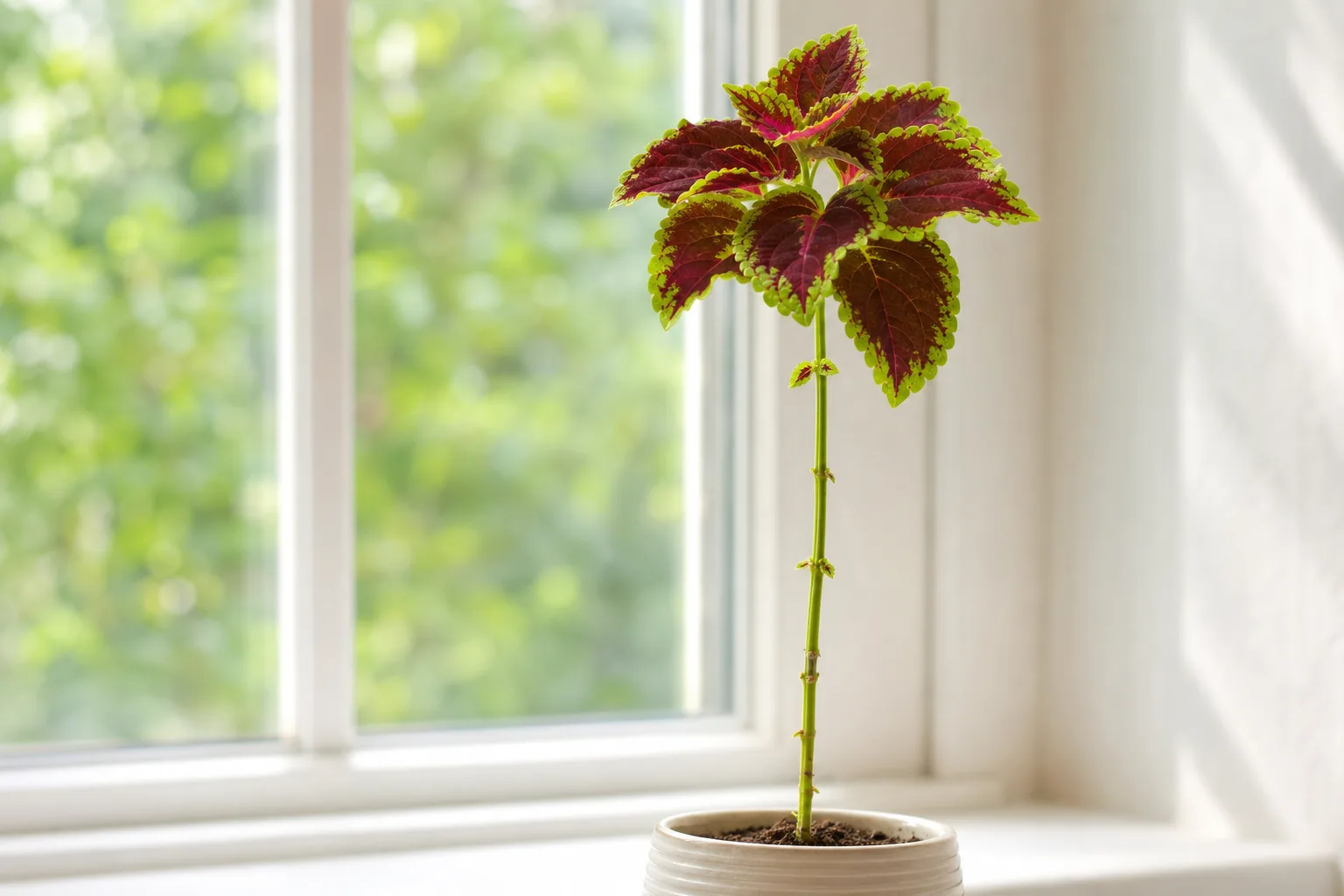
Leggy Growth on Coleus: Causes, Checks & Fixes
This guide covers leggy growth on Coleus. See also the general Leggy Growth guide, watering, and light pages for this plant.
Leggy Growth on Coleus: Causes, Checks & Fixes
Quick answer
Leggy Coleus is a shape problem before it is a mystery disease. Healthy young plants should branch low and carry color along multiple stems. When you skip pinching, a fast-growing Coleus puts all its energy into one or two upright shoots-long bare internodes below, vivid foliage only at the tips.
First step: pinch every active growing tip just above a leaf node with clean fingers or scissors. That breaks apical dominance and tells dormant side buds to wake up. If side shoots emerge pale, thin, or far apart within two weeks, light is still limiting-see our not enough light on Coleus guide before you pinch again.
This page covers maintenance legginess-neglected pinching, flower spikes, and lanky form even when light is borderline-adequate. If your main symptom is washed-out color, window lean, and a dim-room placement, start with the not-enough-light guide instead; pinching in deep shade cannot produce bushy color.
Leggy growth vs not enough light vs slow growth on Coleus
| What you see most | Urgency | First action | Start here |
|---|---|---|---|
| Bare lower stems, tip-heavy shape, no pinching in weeks | Low - cosmetic shape | Pinch all active tips above nodes | This page |
| Washed-out color, lean toward window, dim room placement | Low–medium - energy deficit | Improve light placement first | Not enough light |
| Almost no new growth for weeks in warm weather | Low - stall, not stretch | Audit temperature, roots, and light | Slow growth |
| Wet soil 5+ days, yellow lower leaves, soft stem base | High - inspect roots same day | Stop watering; unpot if base softens | Overwatering |
| Pinching technique, flower removal, one-third rule | Low - maintenance | Follow pruning workflow | Coleus pruning |
Both leggy-growth and low-light pages can apply to the same plant. Work light first when color and lean scream “dim,” then pinch once brighter growth proves the plant has energy to branch.
What leggy growth looks like on Coleus
Leggy Coleus is easy to spot once you know you are looking at form, not a single damaged leaf.
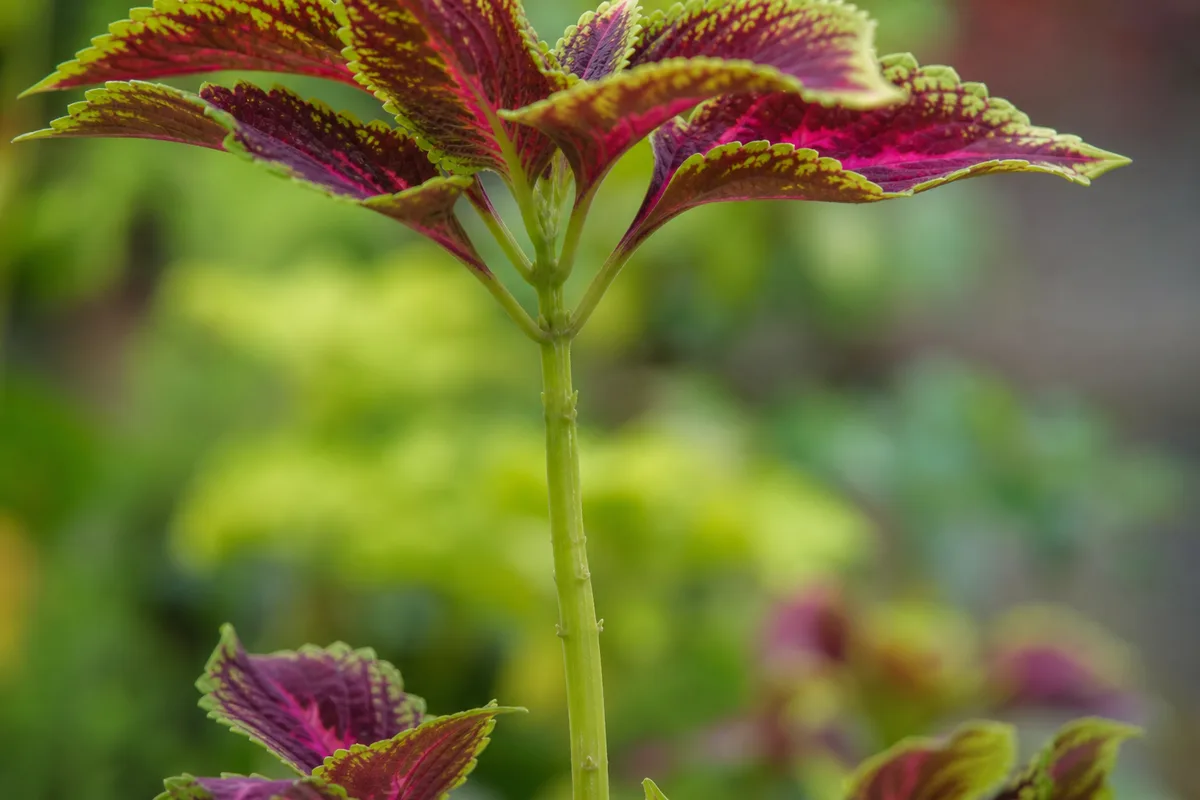
Long bare internodes with 3–6 cm gaps between leaf pairs on a Coleus stem, with vivid foliage concentrated at the tip - compare with compact branching lower on a well-pinched plant.
Typical leggy-growth signs:
- One dominant vertical stem (or two) with little or no branching below the top third
- Long bare internodes-gaps of 3–6 cm or more between leaf pairs on new growth
- Color concentrated at tips while lower stems stay green and leafless
- Top-heavy silhouette that may lean or need staking even near a window
- Flower spikes at stem ends if blooms were left on-energy leaves the foliage canopy
- Fast upward growth that outpaces lateral shoots when pinching stopped weeks ago
Compare with not enough light on Coleus: low light usually adds washed-out patterns, strong lean toward glass, and smaller dull new leaves across the whole plant. Leggy growth from skipped pinching can happen in a reasonably bright east window-the plant simply never branched.
Leggy form is also different from slow growth on Coleus: a stalled plant produces almost no new tissue. A leggy Coleus may grow vigorously upward while refusing to bush out.
Recovery snapshot: east-window Coleus after two pinch cycles
A common indoor pattern: a compact nursery Coleus sits in a bright east window through spring but never gets pinched after purchase. By week six the plant has one 25 cm bare stem with color only at the top. After pinching all tips above nodes, two lateral shoots appear per stem within ten days at room temperatures above 18°C (65°F). A second pinch when those laterals reach three leaf pairs-roughly three weeks later-produces a noticeably bushier silhouette. The old bare internodes from weeks one through five never shorten; only new branching lower on the stem proves recovery worked.
Why Coleus gets leggy
Skipped pinching and apical dominance (most common on this page)
Coleus is a fast-growing foliage plant whose natural habit is to push one strong tip unless you intervene. NC State Extension notes that pinching stem tips can make Coleus bushier by redirecting growth from the dominant apical bud to lateral shoots at nodes below the cut.
Clemson HGIC recommends pinching growing shoots of young plants frequently to encourage branching and maintain dense foliage. Without that routine, a single stem races upward-especially in warm bright conditions where the plant has energy to grow but no reason to branch.
Indoor growers often buy a compact potted Coleus, place it in good light, and never pinch again. Within four to six weeks the plant looks like a small tree with a colorful pom-pom on top.
Coleus stretches faster than slow-growing houseplants when pinching stops because it is bred for rapid summer foliage expansion-energy that would fuel lateral buds instead fuels one dominant shoot until you remove the tip.
Flower spike energy diversion
Clemson HGIC notes that Coleus flower spikes appear in late summer on many cultivars, and if spikes are allowed to go to seed, the plant will decline. Even before seed set, blooming diverts energy from leaves. UF/IFAS Gardening Solutions recommends removing flowers to keep plants from going to seed and declining.
A Coleus allowed to bloom often looks leggier afterward-longer stems, fewer side branches, duller color at the base. Pinch spikes as soon as you see them forming.
Low light as a co-factor-not always the whole story
NC State Extension states that full shade may lead to leggy growth on Coleus. Dim light absolutely stretches internodes. On this page we treat light as a co-factor when pinching has been neglected: you can pinch a dim plant and still get weak side shoots.
Pinching in deep shade often produces thin pale laterals that never thicken because photosynthesis cannot support dense branching-fix light, then pinch once compact new growth appears. When color fade, window lean, and wet soil in a dark corner dominate, read not enough light on Coleus first.
Phosphorus-heavy fertilizer
Clemson HGIC warns that fertilizer formulated for flowering-with higher phosphorus-can cause Coleus to become leggy and bloom. Coleus is grown for foliage, not flowers. Bloom-booster feeds push stretch and flowering at the expense of bushy leaf cover.
Review whether a recent “flower fertilizer” application coincided with sudden upward growth and fewer side branches. See our Coleus fertilizer guide for balanced ratios that support foliage without encouraging bloom.
Single-stem starts never pinched at planting
South Dakota State Extension recommends pinching out shoot tips before planting, especially when each plant has only a single stem, removing the top half-inch or so to encourage branching from the start. A one-stem liner potted and left alone will look leggy within weeks even in good light.
Sun-tolerant vs shade cultivars - stretch behaves differently
Not every Coleus needs identical pinching pressure. UF/IFAS notes that newer sun-tolerant cultivars developed at the University of Florida were selected for prolific lateral branching and late flowering, so they may stay bushier with less maintenance than older seed-grown types. Clemson HGIC lists sun-tolerant lines such as Redhead and Wasabi alongside shade-preferring Kong series cultivars that reach up to 20 inches tall and prefer full shade.
Sun-tolerant types can still stretch if you skip pinching entirely-but shade-preferring cultivars in a dim corner may go leggy faster and produce thinner laterals even after a pinch. Check your plant label or retailer tag before assuming one pinch schedule fits every Coleus on the shelf.
How to confirm the cause
Run this Coleus-specific checklist before you repot or fertilize:
- Pinch history - When did you last remove growing tips above a node? If the answer is “never” or “not since purchase,” skipped pinching is the prime suspect.
- Internode pattern - Measure the newest stem section. Gaps longer than older compact growth below confirm ongoing stretch; compare with photos from when the plant was bushy.
- Light sanity check - Is the pot within one to three feet of an east or west window, or under a grow light? If it sits on a distant shelf with faded color, confirm light before blaming pinching alone.
- Flower spikes - Look for budding spikes at stem tips. Remove one and watch whether the stem redirects energy to side shoots within a week.
- Fertilizer review - Note whether bloom-booster or high-phosphorus feed was used recently.
- Soil moisture in dim spots - Wet mix for many days while stems stretch can mean low light is slowing water use. Firm roots and normal dry-down support a pinching-first approach.
- Pest scan - Aphids and spider mites on weak tips can stall branching. Tap a leaf over white paper before assuming pure legginess.
Confirmation test: Pinch all active tips above nodes. In warm bright conditions, you should see two new shoots per pinched tip within one to three weeks. If side growth stays pale and sparse, move to the not-enough-light guide before the next pinch round.
First fix: pinch growing tips above nodes
Pinch every active growing tip just above a leaf node-about 5–10 mm above the point where leaves attach to the square stem. Use clean fingers for soft tips or sharp scissors for woody lower stems.
That single action breaks apical dominance and is the correct first response when light is adequate but form is not. Do not hard-prune the entire plant to stubs on day one; limit each session to about one-third of living foliage if you also need to shorten long bare stems.
After pinching:
- Remove flower spikes if present-snap or cut just above the top leaf node below the cluster.
- Rotate the pot weekly so all sides receive even light and branch symmetrically.
- Hold fertilizer for one week unless you know the plant is actively growing in warm bright conditions.
- Reassess light if new side shoots are thin, pale, or widely spaced-upgrade placement or add grow lights before pinching again.
For cut placement diagrams, sterilizing tools, and the one-third rule, see our full Coleus pruning guide.
Step-by-step recovery
Once tips are pinched:
- Wait one to three weeks for lateral buds to break. Warm rooms above ~65°F (18°C) speed branching.
- Pinch again when new tips reach two to three leaf pairs-repeat every two to three weeks during active growth to keep the plant compact.
- Shorten severely bare stems after side shoots establish-cut back to a node above healthy leaves, not into naked internodes with no buds.
- Root tip cuttings from pinch trimmings if you want backup plants; Coleus cuttings root easily in water or clean potting soil.
- Upgrade light if needed after two weeks of weak side growth-pinching cannot substitute for photosynthesis.
- Switch to foliage-appropriate fertilizer only after new compact growth is obvious; use balanced or higher-nitrogen feeds per our fertilizer guide, not bloom formulas.
Make one major change at a time when diagnosing. Pinch first when form is the issue; move the pot first when color fade and window lean dominate.
Recovery timeline
Expect the first side shoots to appear within one to three weeks after pinching in warm bright conditions. A second pinch round at two to three weeks keeps the plant from reverting to a single dominant tip.
Old bare internodes never shorten. Stretched stem sections stay long; success means new branches emerging lower on the plant and a fuller silhouette from the top down.
If no side shoots appear after three weeks in a bright spot, revisit light placement or check for root stress in wet soil. If side shoots are pale and widely spaced, read not enough light on Coleus before another pinch cycle.
When three pinch cycles in a clearly bright location produce no improvement, unpot and inspect roots for rot or compaction before assuming pinching alone will fix the plant.
Lookalike symptoms to rule out
Not enough light - Faded cultivar color, pronounced lean toward glass, and smaller new leaves across the plant. Fix light before repeated pinching. See not enough light on Coleus.
Slow growth - Little or no new tissue for weeks in warm weather. Different from vigorous upward stretch. See slow growth on Coleus.
Overwatering in dim corners - Yellow lower leaves, soggy mix, soft stem base. Leggy stretch can coexist, but root trouble needs separate treatment. See overwatering on Coleus if wet soil and decline continue after light and pinching corrections.
Nitrogen excess - Soft rapid stretch even in decent light after heavy feeding. Review fertilizer type and pause feeding until form stabilizes.
Pests on weak tips - Stippling, honeydew, or fine webbing on new growth can stall branching. Treat pests before expecting pinching alone to restore shape.
What not to do
Do not skip pinching because the plant “looks healthy” at the top-a colorful tip on a bare stem is still leggy.
Do not pinch repeatedly in a dark corner hoping for bushiness. Side shoots need light to thicken.
Do not use bloom-booster fertilizer to “fix” leggy Coleus-that encourages more stretch and flowering.
Do not hard-prune more than one-third of foliage in one session on an indoor plant; stage severe rejuvenation over two to three weeks.
Do not relocate a shade-adapted Coleus to harsh direct south-window sun the same day you prune-acclimate over one to two weeks to avoid bleaching.
Do not stack Coleus repotting guide, heavy pruning, and pesticide on the same day. Give the plant one stress at a time.
How to prevent leggy Coleus next time
Pinch on a schedule-every two to three weeks during active growth, not only when the plant already looks like a palm tree.
Remove flower spikes early so energy stays in foliage branching.
Start pinching at purchase if the plant is a single stem; SDSU Extension recommends tip removal at planting for fuller form.
Rotate pots weekly for even branching on all sides.
Reassess light each autumn when daylight shortens-neglected pinching and seasonal dimming often combine. For windowless or north-facing rooms, run a full-spectrum LED grow light 30–45 cm above the canopy for 12–14 hours daily from September through March so side shoots have enough energy to thicken after pinching. See our Coleus light guide for placement detail.
Use foliage-appropriate fertilizer during summer growth; avoid high-phosphorus bloom formulas on Coleus grown for leaves.
Match pinching to cultivar type-sun-tolerant UF lines may need less aggressive pinching than shade-preferring Kong or Fishnet Stockings types in dim corners.
Keep technique reference handy in our Coleus pruning guide for node placement and tool hygiene.
When to worry
Pure legginess is a cosmetic and maintenance issue-your Coleus is not dying because it looks like a lollipop.
Low urgency: Tip-heavy shape with firm stems, normal dry-down, and adequate light-pinch on schedule and judge lateral shoots within two to three weeks.
Medium urgency: Autumn stretch combining skipped pinching with shorter daylight-add grow lights or move closer to glass before lower stems go fully bare.
High urgency - inspect roots the same day when:
- The plant topples or stem bases crack under top-heavy weight
- Wet soil, yellow leaves, and soft stems on Coleus suggest root trouble layered on stretch
- Pest populations explode on weak new tips after prolonged neglect
- No side shoots after three to four weeks of pinching in a clearly bright location with firm roots-reassess light, roots, or pests before another pinch round
Gradual tip-heavy growth over weeks is fixable with pinching and light checks-no panic, but do not wait until lower stems are completely bare wood.
Conclusion - escalation summary
| Situation | Action path |
|---|---|
| Bare lower stems + no recent pinching + adequate light | Pinch all tips above nodes - remove flower spikes; second pinch in 2–3 weeks |
| Washed-out color + window lean + dim placement | Fix light first - then pinch once compact new growth appears; see not-enough-light |
| Leggy + wet soil 5+ days + yellow lower leaves | Stop watering and inspect roots - see overwatering if base softens |
| Three pinch cycles fail in bright light | Unpot and check roots/pests - not more fertilizer or harder pruning |
| Need cut placement and one-third rule | Pruning guide - Coleus pruning |
Leggy Coleus is usually telling you the pinching schedule lapsed, not that the plant needs a miracle product. Old bare stems will not shrink-new branching lower on the plant is the proof the fix worked.
Related Coleus problems
- Coleus overview - species context and baseline care
- Not enough light - color fade, window lean, and energy-deficit stretch
- Slow growth - stall vs vigorous upward stretch
- Overwatering - wet-soil decline layered on stretch
- Coleus pruning - node placement, flower removal, one-third rule
- Coleus light - window placement and grow-light specs
- Coleus fertilizer - balanced feeds vs bloom-booster stretch
FAQs
Is leggy Coleus the same as not enough light?
Not always. Leggy growth from skipped pinching can happen in a reasonably bright east window-the plant simply never branched, with bare lower stems and color at the tips but without washed-out color across the whole plant. True low light adds faded cultivar patterns, strong lean toward glass, and smaller dull new leaves everywhere. Use the decision table at the top of this page: fix light first when color fade dominates; pinch first when form is the main issue in adequate light.
Will old bare Coleus stems ever fill in?
No. Stretched internodes on existing stems do not shorten or refill with leaves after you pinch or improve light. Judge recovery by fresh lateral shoots emerging from nodes below the pinch within one to three weeks in warm bright conditions. Once side branches establish, you can shorten severely bare upper sections to reshape the silhouette.
How often should I pinch Coleus indoors?
During active growth-typically spring through early fall indoors-pinch stem tips every two to three weeks, or whenever new shoots reach two to three leaf pairs after the last pinch. Remove flower spikes as soon as they form. Sun-tolerant UF cultivars may need slightly less aggressive pinching than shade-preferring types, but no Coleus stays bushy indefinitely without some tip removal.
When is leggy growth urgent on Coleus?
Legginess alone is low urgency-a shape problem, not an emergency. Escalate when a top-heavy plant topples, soil stays wet for many days with yellow lower leaves and a soft stem base, pests explode on weak new tips, or three pinch cycles in bright light produce no lateral shoots. Those patterns suggest root trouble, pests, or chronic low light layered on stretch-not pinching alone.
Can I fix leggy Coleus without moving it to a brighter window?
Only if light is already adequate. Pinching breaks apical dominance and forces side shoots when the plant has enough photosynthetic energy. In a dim corner, pinching produces thin pale laterals that never thicken-upgrade placement or add a grow light 30–45 cm above the canopy for 12–14 hours daily, then pinch once new growth looks firm and colorful. See not enough light on Coleus for the full light-correction workflow.
When to use this page vs other Coleus guides
- Coleus watering guide - Use for routine moisture checks before assuming leggy growth is the main issue.
- Coleus problems hub - Browse all 16 common issues on this species.
- Not Enough Light on Coleus - Different entry point when symptoms overlap with leggy growth.
- Slow Growth on Coleus - Different entry point when symptoms overlap with leggy growth.
- Yellow Leaves on Coleus - Different entry point when symptoms overlap with leggy growth.