Not Enough Light on Cast Iron Plant: Causes, Checks & Fixes
Quick answer
Cast iron plant below its useful light minimum grows slowly, produces smaller new leaves, and keeps soil wet too long-raising root-stress risk in dim corners. First step: move the pot within a few feet of a north or east window, or add a moderate grow light, before changing water or fertilizer.
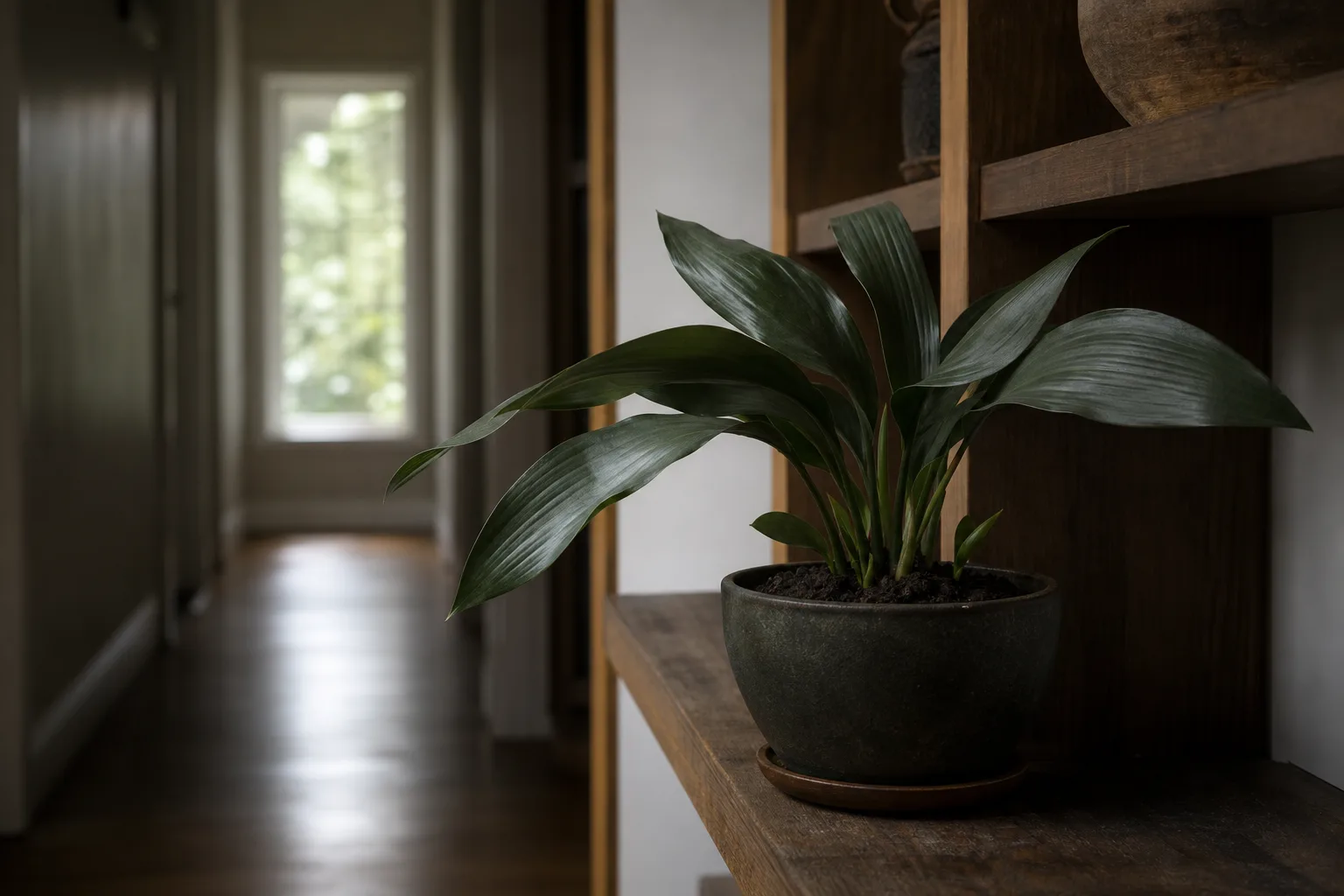
Not Enough Light on Cast Iron Plant: Causes, Checks & Fixes
This guide covers not enough light on Cast Iron Plant. See also the general Not Enough Light guide, watering, and light pages for this plant.
Not Enough Light on Cast Iron Plant: Causes, Checks & Fixes
Quick answer
Cast iron plant (Aspidistra elatior) is marketed as indestructible in dim corners-and it often survives there longer than almost any other foliage plant. Survival is not the same as enough light. When photosynthesis drops below what the rhizome needs to replace leaves, growth stalls, new foliage shrinks, and the same watering schedule that worked in a brighter room leaves roots sitting in wet mix-a combination that invites root stress in dim, cool corners.
This page is the diagnostic and recovery guide-confirm low light, fix placement, and read new rhizome growth over three to six weeks. For proactive window choice and grow-light setup before symptoms start, use the light guide. If the rhizome is firm and you are unsure whether pace is normal temperament, see slow growth on cast iron plant. If petioles are visibly elongated with clump lean, compare leggy growth.
First step: move the pot to the brightest safe indirect spot in your home-typically within a few feet of a north- or east-facing window where no direct sunbeam hits the leaves. If no window reaches the plant, add a moderate full-spectrum grow light on an 8–12 hour timer before you repot, fertilize, or water more.
Do not “fix” a dark corner by placing the plant on a south-facing sill in direct sun. Aspidistra leaves scorch quickly in harsh light; that swap trades slow growth for permanent bleached tissue.
Decision shortcut: If soil stays wet two or more weeks between waterings and no new leaf has appeared in many months, fix light before you adjust fertilizer or repot-dim metabolism is slowing water use, and yellow leaves may trace to wet roots, not nutrients alone.
What not enough light looks like on Cast Iron Plant
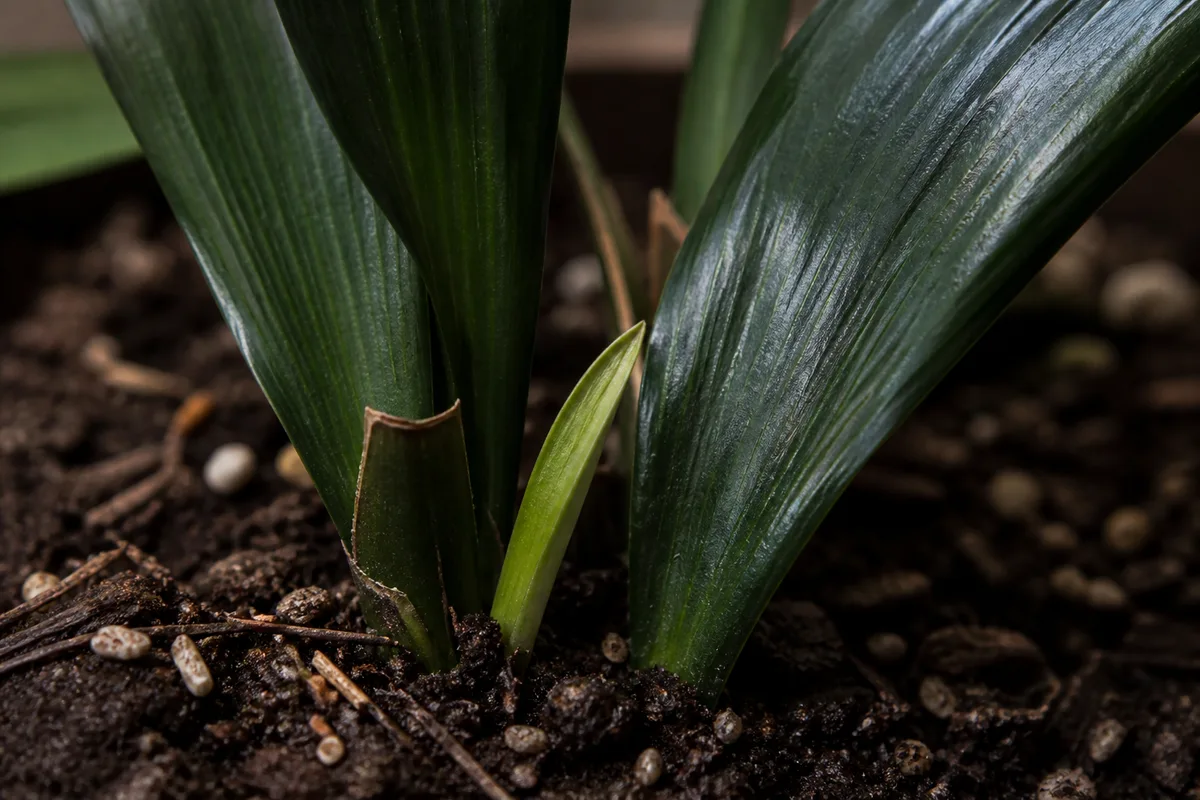
Undersized new leaf emerging at soil level next to full-sized older blades - read new rhizome growth, not decades-old glossy foliage.
Low-light stress on aspidistra is quiet. The plant rarely collapses the way a fiddle-leaf fig does in a hallway. Instead, you notice a flat clump that never grows:
- No new leaves for many months during spring and summer, when moderate indirect light would produce occasional rhizome shoots
- Smaller new leaves compared with older ones at the base of the clump
- Slightly longer, weaker leaf petioles with a softer arch-not dramatic legginess, but visible if you compare photos from a year ago
- Uniform dullness across the clump rather than bleached patches on one sun-facing side (that pattern points to too much light)
- Loss of white striping on variegated forms such as Aspidistra elatior ‘Variegata’ as the plant reverts toward plain green
- Soil that stays moist week after week because the plant is using little water
- A slight lean toward the brightest wall or window, especially if the pot is rarely rotated
Cast iron plant leaves are thick and long-lived, so old foliage can look fine while the rhizome barely produces replacements. Always read new growth at soil level, not the glossy leaves from three years ago.
Why Cast Iron Plant runs out of light indoors
Aspidistra evolved on forest floors in Japan, Taiwan, and southern China, where light is diffuse and direct sun is rare. That history makes it one of the most shade-tolerant houseplants-but every species has a floor below which growth slows to a crawl.
Interior rooms without window sightlines are the most common trigger. A pot on a deep shelf, behind a sofa, or in a bathroom that only has a frosted skylight may receive less usable light than a north window would. University of Maryland Extension classifies cast iron plant among low-light species that tolerate roughly 25–100 foot-candles-bright enough to read by with effort, not a lamp-only closet.
Distance from the glass matters as much as direction. Light intensity drops sharply even a few feet from a pane. A cast iron plant six feet from a north window may survive but produce almost no new leaves.
Winter daylight shortening can push a borderline placement below the useful minimum without any move on your part. The same east window that carried the plant through summer may deliver too few hours in December.
Variegated cultivars need more total light than plain green plants because they carry less chlorophyll per leaf area. In very poor light, striping fades as the plant prioritizes green tissue.
Misplaced confidence in the “low-light plant” label leads owners to keep watering on a summer schedule while growth has stopped. Slow photosynthesis means slow water use-and wet soil in dim, cool conditions invites root problems in waterlogged compost that look like a watering mistake but started with light. Cross-check rhythm on the watering guide after you improve placement.
Not enough light vs slow growth vs leggy growth on Cast Iron Plant
These three pages overlap because Aspidistra responds slowly in every scenario. Use this table to pick the right guide:
| What you are seeing | Most likely page | Key difference |
|---|---|---|
| No new leaves for months, small new foliage, wet soil in a dim corner | Not enough light (this page) | Placement is below useful minimum; fix light first |
| Firm rhizome, occasional leaf every few months, acceptable size on new leaves | Slow growth | Temperament, not crisis-Aspidistra is a slow grower |
| Longer weak petioles, clump lean, fading variegation-but some new leaves still push | Leggy growth | Visible etiolation stretch; light fix plus optional rhizome-level prune later |
Practical rule: If you cannot read at plant level without a lamp during daytime and soil stays damp for weeks, start here. If light is adequate but pace feels glacial with full-sized new leaves, read slow growth. If the plant still produces leaves but they arrive on stretched petioles, read leggy growth.
How to confirm the cause
Work through these checks before changing multiple variables:
- Window test - From the pot’s position, can you see sky through a window without turning the plant? If not, natural light is probably insufficient for active growth.
- Read-by test - During daytime, could you read a book at plant level without switching on a lamp? If not, assume you are at or below the low-light range unless a grow light is running. Maryland Extension groups cast iron plant in the 25–100 foot-candle band for low-light placements.
- Lux spot-check (optional) - A phone lux meter at the crown reading roughly 250–1,000 lux during daytime often supports slow but real growth for plain green aspidistra. Far below that range in a windowless room confirms supplemental light is needed.
- New leaf size - Compare the newest leaf to one from the outer ring of the clump. Smaller or absent new leaves with no pest damage on undersides supports low light.
- Dry-down speed - Stick a finger 3–5 cm into the mix. If it stays damp for two weeks while the plant produces no new growth, the root zone is idle-common in dim spots.
- Directional damage - Bleached or crisp patches on the window-facing side mean too much light, not too little. Uniform slow growth without scorch points the other way.
- Season - Has growth stalled only since late autumn? Note whether winter light alone explains the pause before moving the plant to direct sun.
If the pot is light, mix is dry throughout, and leaves look slightly limp with firm rhizomes at soil level, underwatering may fit better than light stress-do not assume every stalled aspidistra needs a brighter window.
First fix for Cast Iron Plant
Move the pot to brighter indirect light in one deliberate step.
Place it within roughly **1–2 m (3–6 ft) of a north- or east-facing window where leaves receive diffuse daylight but never direct sunbeams. If the only available window is south or west, set the plant several feet back from the glass or behind a sheer curtain so intensity drops. NC State Extension notes cast iron plant is intolerant of direct sun, which causes leaf bleaching.
If the plant currently lives in a windowless room, do not relocate it to direct afternoon sun. Instead, install supplemental lighting (details below).
Wait three to four weeks before repotting, fertilizing, or increasing water. Cast iron plant responds slowly; stacking changes hides whether light was the real limiter.
Grow-light backup for windowless rooms
When no window reaches the pot, a desk lamp or ceiling downlight is not enough. Use a full-spectrum LED or fluorescent grow lamp sized for low-light foliage-not a high-intensity bloom fixture.
Practical indoor targets for cast iron plant:
- Distance: 30–60 cm (12–24 in) above the foliage, same range Clemson HGIC recommends for houseplant culture
- Duration: 8–12 hours daily on a timer; Maryland Extension notes most plants need a dark period and should not receive more than 16 hours total light per day when combining natural and artificial sources
- Intensity: Moderate output aimed at low-light foliage-roughly the brightness of a well-lit north room, not a seed-starting rack. A 15–32 watt LED grow bulb or two-tube T5 fluorescent over a single floor pot is usually sufficient ; raise the fixture if leaf surfaces feel warm
- Spectrum: Full-spectrum or balanced white LED labeled for houseplants; red and blue wavelengths matter for development, but harsh purple “blurple” panels are unnecessary at this light level
Indoor plants become spindly and fade when light is inadequate-artificial light replaces what the window cannot supply. Product distance and hour targets are expanded in the light guide.
Step-by-step recovery
Once the plant is in brighter indirect light or under a grow light, support recovery in this order:
- Adjust watering to match slower or faster growth - In dim light, let the top 2 to 3 inches dry before watering again; in brighter indirect light, check more often because transpiration increases. Never leave the pot in a full saucer. See the watering guide for depth-based checks.
- Rotate the pot a quarter turn each time you water so leaves do not lean permanently toward one window.
- Hold fertilizer until you see a new leaf opening at normal size. Feeding a stalled plant in weak light adds salt stress without fueling growth.
- Trim only dead or fully yellow leaves at the base for appearance. Do not mass-prune healthy older leaves hoping to force new ones-aspidistra replaces leaves slowly from the rhizome.
- For variegated plants, keep the slightly brighter placement permanently; striping returns only on new leaves if light is adequate.
- Re-check after seasonal light shifts - A spot that worked in March may need a grow-light boost by January if new growth stops again.
Recovery example
A plain green cast iron plant on a hallway shelf six feet from a north window showed no new leaves for eight months and soil that stayed damp eighteen days between waterings. On January 8, the owner moved it to within three feet of the same north window, installed a 20-watt full-spectrum LED running 10 hours nightly because winter daylight was weak, and stopped calendar watering. By March 3-eight weeks later-a new spear appeared at the rhizome at roughly the same width as healthy older leaves. Soil then dried on a predictable ten-to-fourteen-day rhythm. Older small leaves stayed unchanged; only the new leaf proved recovery.
Recovery timeline
Cast iron plant does not bounce back in a week. After a light correction, expect three to six weeks before a new leaf bud appears at the rhizome in warm months. Two to three months without any new growth in winter can still be normal if the plant is cool and dormant-judge spring emergence, not December pace.
Success signs: the next one or two leaves are at least as large as healthy older foliage, soil dries on a predictable rhythm, and variegation holds steady on striped cultivars.
Old leaves do not expand after a move. Stunted or pale existing foliage stays as-is; only new leaves show improvement.
Worsening signs: yellowing that spreads while soil stays wet, sour smell from the pot, or soft rhizome tissue-those suggest root stress from overwatering in dim conditions and need dry-down and inspection per the root-rot guide, not more light alone.
Lookalike symptoms
| What you see | Likely cause | How to tell apart |
|---|---|---|
| Flat clump, no new leaves, wet soil in dim room | Not enough light (this page) | Read-by test fails; soil slow to dry; uniform dullness without sun-side bleach |
| Firm rhizome, one leaf every few months, full-sized new foliage | Slow growth | Acceptable pace for Aspidistra; light and watering otherwise sound |
| Longer petioles, clump lean, some new leaves still opening | Leggy growth | Stretch visible on newer leaves; brighter light is still the first fix |
| Yellow leaves, sour soil, soft rhizome | Overwatering / root rot | Often paired with low light-fix light so the plant uses water, then dry down |
| Bleached patches on window-facing side only | Too much light (overcorrection) | Follows move to unfiltered south or west sill; retreat to indirect light |
| Temporary pause after division | Repotting shock | Firm rhizome, appropriate moisture; hold changes four weeks |
What not to do
Do not move a dim-grown plant into direct south or west sun to force growth-aspidistra leaves lack sun tolerance and burn within days.
Do not water more because growth is slow while soil already stays moist; that deepens the most common failure mode in dark corners.
Do not fertilize heavily to compensate for weak light; salts accumulate when roots are inactive.
Do not expect old leaves to green up or lengthen after a fix-only new rhizome growth tells the story.
Do not repot and relocate on the same weekend unless the mix is clearly failing; cast iron plant prefers one stress at a time.
How to prevent not enough light next time
Match placement to how aspidistra actually lives in homes: steady indirect daylight or supplemental LED hours, not the darkest corner you can find.
- Default to a north or filtered east window within a few feet of the glass for plain green plants
- Give variegated forms one step brighter-still without direct sun
- Add 8–12 hours of grow light in windowless offices or north rooms that go dim in winter
- Rotate the pot regularly so the clump stays symmetrical
- Lengthen watering intervals whenever you move the plant to a dimmer spot, and shorten them when you move it brighter
- Judge long-term health by annual new leaf count and size, not by how glossy decades-old leaves still look
When light and watering align with actual growth rate, cast iron plant earns its reputation: quiet, durable, and genuinely low-maintenance-not a plant fighting starvation in a hallway you forgot had a window.
Related Cast Iron Plant guides
- Cast iron plant overview - species context and baseline care
- Light - proactive placement, foot-candle targets, and grow-light specs
- Slow growth - when stalled pace is normal temperament
- Leggy growth - elongated petioles and clump lean
- Watering - dry-down rhythm after a light move
- Root rot - wet-soil lookalike in dim corners
- Overwatering - yellow leaves when soil stays wet in low light
- Yellow leaves - dim-corner yellowing overlap
- Repotting - when to repot after light stabilizes