Cast Iron Plant Light Needs: Window, Low Light & Signs
Cast Iron Plant Light Needs: Window, Low Light & Signs
Cast Iron Plant Light Needs: Window, Low Light & Signs
Aspidistra elatior earned the common name cast iron plant because it survives conditions that would wreck most foliage houseplants: dim hallways, irregular watering, cool rooms, and the kind of neglect that turns a pothos into a compost candidate. That reputation is deserved. It is also easy to misread. Low-light tolerance does not mean light is irrelevant, and “indestructible” does not mean immune to sunburn on a south-facing sill.
The practical goal is simpler than the mythology suggests: place the plant where leaves receive steady, indirect light for much of the day, never direct sunbeams on the foliage, and enough brightness that new leaves open at a pace you can notice over weeks-not years. The Royal Horticultural Society notes that aspidistras cope in very poor light where most houseplants fail, but ideally enjoy low or filtered light well away from direct sun, which can scorch leaves. (RHS Growing Guide for Aspidistras) Clemson University’s Home & Garden Information Center recommends a north-facing window or a low-light area away from south-facing glass for indoor cast iron plants. (Clemson HGIC) Missouri Botanical Garden lists the species as part shade to full shade, best in bright indirect light but tolerant of full shade, with a clear warning to avoid direct sun. (Missouri Botanical Garden Plant Finder)
This guide focuses on the decisions you can make today: which window, how dark a corner can realistically be, when a grow light earns its shelf space, and how to read warning signs before bleached or stunted foliage becomes the new normal.
How Much Light Aspidistra elatior Actually Needs
Cast iron plant light needs sit at the shade-loving end of the houseplant spectrum. Outdoors in USDA zones 7–11, it grows in dappled to full shade; too much sun scorches the leaves. Indoors, the usable translation is low to medium indirect light-think the bright side of a shaded room, not the spotlight of a sunny afternoon.
Unlike high-light tropicals that stretch and collapse without strong sun, aspidistra slows down when light is weak rather than dying quickly. That slow response is both a gift and a trap. The plant can look fine for months in a dim corner while you gradually overwater it because the soil never dries. Light is the throttle for growth, water use, and how fast the plant replaces damaged leaves.
The Short Answer for Busy Growers
If you only remember four rules, use these. Default placement: a north-facing window or an east-facing window where the plant receives indirect daylight but no direct sunbeams hit the leaves. South or west windows: only with sheer curtains or placement several feet back from the glass so intensity drops. Never: afternoon sun directly on the foliage, especially through clear glass in summer. Judge success by new growth: firm, full-sized leaves opening from the rhizome-not by how green the room looks to your eyes.
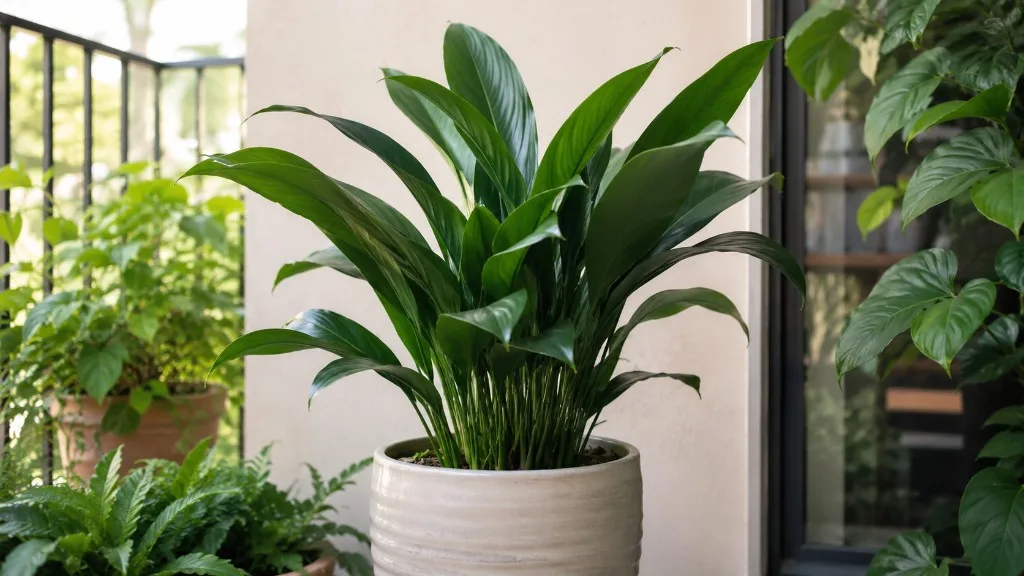
A cast iron plant in the right light looks boring in the best way: upright dark green leaves, slow steady clump expansion, no bleaching on the sun-facing side.
What “Low Light Tolerant” Really Means in Practice
“Low light tolerant” describes survival and basic photosynthesis, not peak performance. Aspidistra can persist in a poorly lit hallway where a fiddle-leaf fig would drop leaves within weeks. RHS guidance is explicit that in very poor light, plants grow more slowly, and variegated forms may revert toward plain green as the plant reduces pigment complexity to capture more usable light. (RHS Growing Guide for Aspidistras)
That tolerance has a floor. A room with zero daylight-a windowless bathroom, a basement corner, a closed interior office with only a ceiling downlight-is not low light; it is artificially dark. Cast iron plants may linger there longer than competitors, but they will not thrive indefinitely without supplemental lighting. If you cannot read a book comfortably without turning on a lamp during daytime hours, assume the plant is below its useful minimum unless you add a grow light.
The middle ground most homes offer-filtered daylight from one or two windows-is usually perfect. You do not need to chase brightness for a plain green cast iron plant. You need to avoid direct sun and avoid confusing room ambiance with plant-facing light.
Why Cast Iron Plants Thrive in Shade Better Than Most Houseplants
Understanding why aspidistra handles shade helps you stop fighting its biology-and stop treating it like a snake plant that happens to have wider leaves.
Forest-Floor Origins and Leaf Structure
Native to Japan, Taiwan, and southern China, Aspidistra elatior evolved on forest floors beneath deciduous and evergreen canopy. In that habitat, light arrives as dappled shade: brief bright flecks, long periods of diffuse green-filtered illumination, and almost no sustained direct beam on a single leaf surface. The plant’s thick, leathery, lance-shaped leaves are built for low photosynthetic rates spread across a durable surface. They are not thin, high-transpiration sun collectors like basil or succulents.
Missouri Botanical Garden describes the species as tolerant of a wide indoor temperature range, low humidity, irregular watering, and low light-traits that mirror its understory ecology. (Missouri Botanical Garden Plant Finder) The same leaf architecture that resists drought stress also stores damage. Old scorch marks do not heal away; they remain visible while new leaves tell the current story. That is why light troubleshooting always starts with the newest foliage, not the oldest battle scars.
Best Window Placement for Indoor Cast Iron Plants
Indoor placement fails most often for one reason: the pot sits where the room feels acceptable rather than where the plant receives diffuse daylight for enough hours. Cast iron plants do not need sunbeams crossing the leaves, but they do benefit from knowing which direction the sky is.
Place the pot where it can “see” the window-not tucked behind a sofa back or deep on a shelf with the window behind it at a sharp angle. Aspidistra grows from a rhizome at soil level; leaves emerge individually on long petioles. All leaves compete for the same light vector. If one side of the clump faces the window and the other side faces a wall, rotate the pot a quarter turn every two to three weeks to keep growth even.
North, East, West, and South Windows Compared
A north-facing window is the classic recommendation and still the safest default in the northern hemisphere. North light is consistent, cool, and indirect through much of the day. It rarely produces the harsh afternoon intensity that burns aspidistra leaves. Clemson HGIC specifically suggests north windows for indoor cast iron plants. (Clemson HGIC) If your north window is unobstructed and the plant sits within a few feet of the glass, you may never need to think about light again.
An east-facing window is equally workable and sometimes preferable in cold climates. Morning sun is gentler than afternoon sun. A cast iron plant on an east sill typically receives a short period of low-angle direct light early in the day, then bright indirect light afterward. Most plants tolerate that pattern if leaves are not pressed against hot glass. If you see pale patches on the outermost leaf tips after an east-window summer, pull the pot 12–18 inches (30–45 cm) back or add a sheer curtain during the brightest weeks.
A west-facing window demands more caution. Late-afternoon sun carries heat and intensity. West can work when the plant sits three to six feet (0.9–1.8 m) back from the pane, when a sheer curtain diffuses the beam, or when outdoor trees or buildings cut the harshest rays. If the sun-facing side of leaves turns bleached or crisp every summer on a west sill, the window is too strong-not “good bright light” the plant is failing to appreciate.
A south-facing window is the highest-risk orientation for aspidistra. South delivers the longest duration of strong light in winter-which sounds helpful-but summer south glass concentrates direct sun and heat on leaves that cannot acclimate to it. South can work only when the plant is well back in the room, behind filtered curtains, or on a wall perpendicular to the window where it receives bright ambient light without sitting in the beam. If someone tells you their cast iron plant “loves” a south window, look for filtration, distance, or a plant that was already sun-damaged and you normalized the look.
Distance From the Glass and Seasonal Adjustments
Window direction labels are shortcuts. A south window blocked by a neighboring building may be weaker than an open east exposure. What matters is irradiance at the leaf surface and duration.
Keep the pot within roughly 6 feet (1.8 m) of the window in most rooms if that window is the primary light source. Beyond that distance, light falls off sharply, and a cast iron plant may survive but grow glacially. In very bright, filtered south or west rooms, moving farther from the glass is often the fix for scorch-not adding shade cloth to the plant like a greenhouse tomato.
Seasonal shifts change the calculus. Winter lower sun angles can make south and west windows suddenly beam directly onto a plant that sat safely in summer. Summer high angles may reduce direct penetration but increase heat at the glass. Check placement at both solstices if your plant sits near a large pane. A spot that was perfect in March may scorch in July.
Reflected glare is an under-discussed indoor hazard. White walls, glossy floors, and glass tables can bounce intense light onto leaves even when the pot is not in the window beam. If damage appears on the side facing a bright wall rather than the window, move the plant away from the reflection path or soften the wall surface with a matte object.
Can a Cast Iron Plant Take Direct Sun?
Short answer: treat direct sun as incompatible with healthy aspidistra foliage indoors. Missouri Botanical Garden is blunt: avoid direct sun; direct exposure bleaches leaves. (Missouri Botanical Garden Plant Finder) RHS repeats that direct sun scorches leaves and recommends filtered light instead. (RHS Growing Guide for Aspidistras)
Outdoors in warm climates, the same rule applies: dappled to full shade, not open sun. Clemson HGIC notes that outdoor plants in too much sun develop scorched leaves. (Clemson HGIC)
When Filtered Morning Sun Might Work
Garden forums occasionally show cast iron plants tolerating very early morning sun through sheer fabric or tree shade outdoors. That is not the same as a south-window afternoon bake. Indoors, do not interpret “might survive filtered morning sun outdoors” as permission for a sunny sill.
If you are experimenting, acclimate gradually over two to three weeks, move at the first sign of bleaching, and accept that most indoor direct sun exposures will still fail. Aspidistra leaves formed in shade lack the photoprotective capacity to handle sudden full sun. Unlike some ficus species, you cannot harden cast iron plant leaves into sun lovers. You can only reduce damage by retreating to indirect light.
Low-Light Limits and How Dark Is Too Dark
The cast iron plant’s superpower is functioning where others quit. The limit is not “darkness” in an absolute sense but darkness without compensating adjustments to watering, expectations, and-when necessary-light supplementation.
Growth Slowdown Versus True Starvation
In deep shade, aspidistra slows rhizome activity. New leaves may take months to emerge. Existing leaves persist for years, which makes the plant look stable even when it is barely growing. That is acceptable if your goal is a low-maintenance green sculpture in a difficult hallway.
Problems begin when slow growth meets fast watering. A plant using little energy keeps soil moist longer. Roots in wet, cold, dim conditions invite root rot on Cast Iron Plant-a failure mode often blamed on water when light was the underlying throttle. If your cast iron plant sits in a dim spot, extend the dry-down interval between waterings and skip fertilizer unless new growth is visible.
True light starvation shows up over many months: smaller new leaves, longer petioles with slightly weaker arch, uniform paleness not confined to one sun-struck side, and a clump that never increases leaf count. If those signs appear in a spot with genuine daylight, the plant may still be too far from the window. If they appear in a windowless room, add a grow light rather than moving the plant to direct sun as an overcorrection.
Extra Light Needs for Variegated Cultivars
Aspidistra elatior ‘Variegata’ and other striped forms carry less chlorophyll per leaf area. They survive low light but lose striping faster than plain green plants when light is insufficient. RHS specifically warns that variegated aspidistras in very poor light may revert toward green. (RHS Growing Guide for Aspidistras)
Give variegated plants one step brighter than you would a plain green cast iron plant: closer to an east or north window, or supplemental LED hours in winter. They still cannot take direct sun-the white sections burn first-but they need more total diffuse light to keep pattern crisp.
Grow Lights When Natural Light Falls Short
Natural light is not available in every desirable spot. Entry tables, interior offices, and basement apartments can still host aspidistra if you add steady supplemental light that mimics bright shade-not midday sun.
Fixture Choice, Hours, and Placement
A full-spectrum LED grow light or quality T5/T8 fluorescent shop light works well. Cast iron plants do not need the intense red-blue ratios some flowering crops demand; they need moderate intensity over enough hours to replace missing window light.
Practical starting points for a plant without meaningful window exposure:
- Distance: 12–24 inches (30–60 cm) above the leaf canopy for most household LED panels; adjust if leaves feel warm to the touch after an hour
- Duration: 8–12 hours daily on a timer; aspidistra does not require long-day photoperiod tricks
- Intensity target: bright enough to read by at plant level without squinting-not tanning-lamp bright
Office overhead fluorescents several feet above the desk often sustain cast iron plants for years because they provide long-duration moderate light similar to understory consistency. The plant does not care about fixture aesthetics; it cares about total daily light and heat stress. If leaves yellow only on the side nearest a hot desk lamp bulb, move the lamp or the plant.
Grow lights also solve winter window drop in north rooms without moving the plant to a risky south exposure. Add hours in November through February; reduce or remove supplementation when spring daylight lengthens if window light becomes adequate again.
How Light Changes Affect Watering and Care
Light and water are linked on every houseplant; aspidistra hides the link better than most. A bright plant transpires more and dries its pot faster. A dim plant sits in wet soil longer even when you pour the same volume on the same calendar schedule.
When you move a cast iron plant brighter-closer to a window or under a new grow light-check soil moisture more often for the first three weeks. When you move it dimmer, stretch the interval between waterings and pause fertilizer until you see whether new growth continues.
Fertilizer should follow growth, not the calendar, in low light. An aspidistra producing one leaf every two months does not need monthly feeding. A plant with steady new leaves in moderate indirect light can take dilute houseplant fertilizer during spring and summer at half label strength.
Humidity is secondary for Cast Iron Plant overview. Missouri Botanical Garden notes it does not require high humidity indoors. Light mistakes still matter more than misting bottles in most homes.
Moving a Cast Iron Plant Without Shock
Aspidistra reacts slowly, which makes light moves deceptive. You may not see damage for two to four weeks after a bad placement change. That delay causes growers to blame the wrong variable when leaves bleach or new growth stalls.
When changing light exposure, change one variable at a time. Move the pot; wait three to four weeks; read the newest leaf before adjusting water or Cast Iron Plant repotting guide. If moving from a very dim spot to a brighter indirect location, shift in two steps a week apart rather than jumping from a hallway to an east sill edge.
If moving away from too much sun, relocate immediately-continued exposure only adds permanent bleaching. Trim severely scorched leaves at the base for appearance once the plant is stable in shade; the rhizome will produce replacements over time if light and watering are now correct.
Do not repot, fertilize heavily, and move light on the same weekend. Cast iron plants forgive neglect better than stacked interventions.
Warning Signs of Too Much or Too Little Light
Aspidistra communicates quietly. These are the patterns worth acting on, separated by cause because the fixes differ.
Too much light and sun scorch usually appear on the sun-exposed side or the leaf surface facing the window. Watch for bleached white or pale yellow patches that feel dry and papery, crisp brown tips or margins developing quickly after a move to a brighter sill, curling or folding during the brightest hours as the leaf reduces exposed surface, and uniform yellowing on leaves touching hot glass. RHS and Missouri Botanical Garden both tie direct sun to bleached leaves. (RHS Growing Guide for Aspidistras; Missouri Botanical Garden Plant Finder)
Fix over-lighting by increasing distance from the window, adding sheer curtains, or moving to north or east indirect exposure-not by watering more. Old burned tissue will not green up again; judge recovery by undamaged new leaves.
Too little light over time shows different signals: smaller new leaves compared to older ones, slow or absent new leaf emergence over a full growing season, loss of variegation in striped cultivars, slightly elongated petioles with softer arch, and soil staying wet week after week because the plant is not using water. These symptoms overlap with overwatering on Cast Iron Plant, which is why you check light and moisture together.
Fix under-lighting by moving closer to a window while still avoiding direct beams, or adding a grow light with an 8–12 hour timer. Do not “fix” slow growth in a dark corner by moving to direct south sun-that trades one problem for scorch.
Use the new-growth test after any change: the next one to two leaves should look at least as large and dark as healthy older leaves. If they do, placement is workable even if older cosmetic damage remains.
Conclusion
Cast iron plant light needs are forgiving but not meaningless. Aspidistra elatior wants what its forest-floor ancestry prepared it for: steady indirect light, protection from direct sun, and enough brightness that the rhizome keeps producing full-sized leaves over time. For most homes, that means a north or east window, a filtered bright room, or-when windows are inadequate-a moderate grow light on an 8–12 hour timer.
Treat “low light tolerant” as flexibility, not as a challenge to find the darkest possible corner. Watch new leaves after every move, slow watering when growth slows, and treat bleaching and crisp edges as urgent signals to reduce intensity-not as proof the plant needs more fertilizer or a bigger pot. Get light directionally correct, and the cast iron plant lives up to its name: quiet, durable, and genuinely low-maintenance.
When to use this page vs other Cast Iron Plant guides
- Cast Iron Plant overview - Start here for whole-plant context before deep-diving this topic.
- Cast Iron Plant problems hub - Jump to symptom-specific fix guides when this care topic does not resolve the issue.
- Not Enough Light on Cast Iron Plant - Escalate here when light adjustments are not enough.
- Leggy Growth on Cast Iron Plant - Escalate here when light adjustments are not enough.