Brown Tips & Melting on Cabomba: Causes, Checks & Fixes
Quick answer
Brown tips on Cabomba are browning or melting feathery segments on submerged stems-not dry houseplant leaf margins. Fanwort sheds lower whorls from low PAR, buried stem rot, dirty water, transition shock, or copper medications. First step: trim mushy or translucent sections, then check PAR at the lower stem before changing fertilizer.
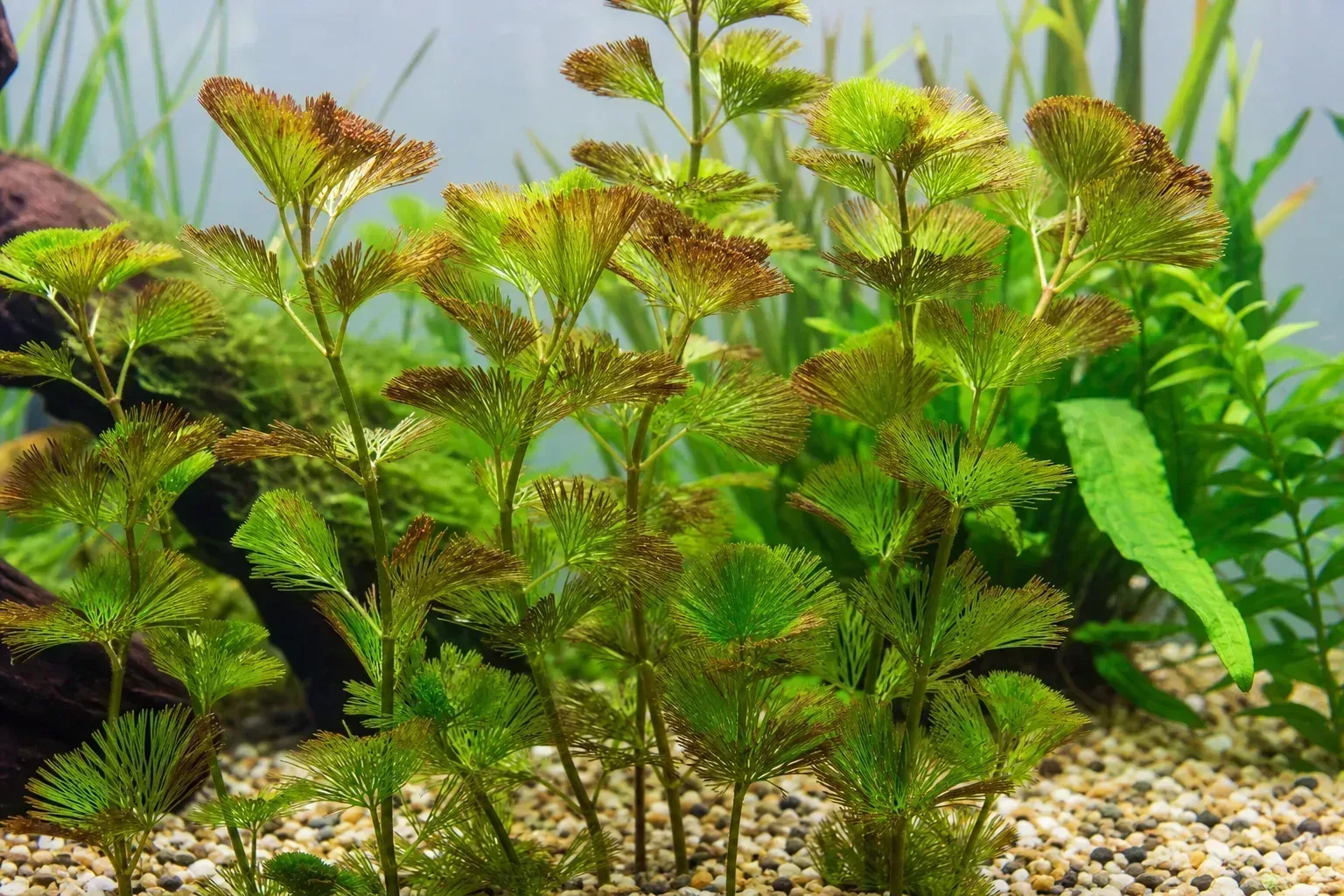
Brown Tips & Melting on Cabomba: Causes, Checks & Fixes
This guide covers brown tips on Cabomba. See also the general Brown Tips guide, watering, and light pages for this plant.
Brown Tips & Melting on Cabomba: Causes, Checks & Fixes
Quick answer
Brown tips on Cabomba (Cabomba caroliniana, fanwort) are browning or melting feathery segments on submerged stems-not crispy margins on potted houseplant leaves. Cabomba is a fully submersed freshwater plant with fan-shaped underwater leaves arranged in opposite pairs along slender stems. When aquarists search “brown tips,” they usually mean segment melt, lower-whorl shedding, or brown mushy stem bases-not dry potting mix or low room humidity.
First step: trim away mushy, translucent, or detached segments, then check PAR at the height where lower leaves attach. Green Cabomba abandons shaded lower whorls when light drops below roughly 30 to 40 µmol m⁻² s⁻¹; buried stems rot when planted too deep; copper medications and dirty water accelerate the same needle-cloud collapse. Fix the pattern you confirm before stacking fertilizer, substrate overhauls, or longer photoperiods alone.
Brown tips on Cabomba are not houseplant leaf margins
Terrestrial brown-tip guides discuss humidity, salt buildup, and “water when the soil surface dries.” None of that applies to fanwort. Cabomba never grows in potting soil, never needs misting, and cannot be diagnosed with root-ball or drainage checks. Its photosynthetic tissue lives entirely underwater (or floating at the surface film), absorbing nutrients from the water column rather than from houseplant mix.
That distinction drives diagnosis. Houseplant tip burn creeps down dry leaf margins from the farthest point from roots. Cabomba browning clusters at lower stem whorls, translucent melting segments, or mushy buried bases while upper tips may still look green briefly. Treating fanwort like a windowsill foliage plant sends you toward wrong checks and delays tank-parameter fixes that actually work.
What browning and melt look like on Cabomba
Learn these patterns before reaching for iron or longer light hours.
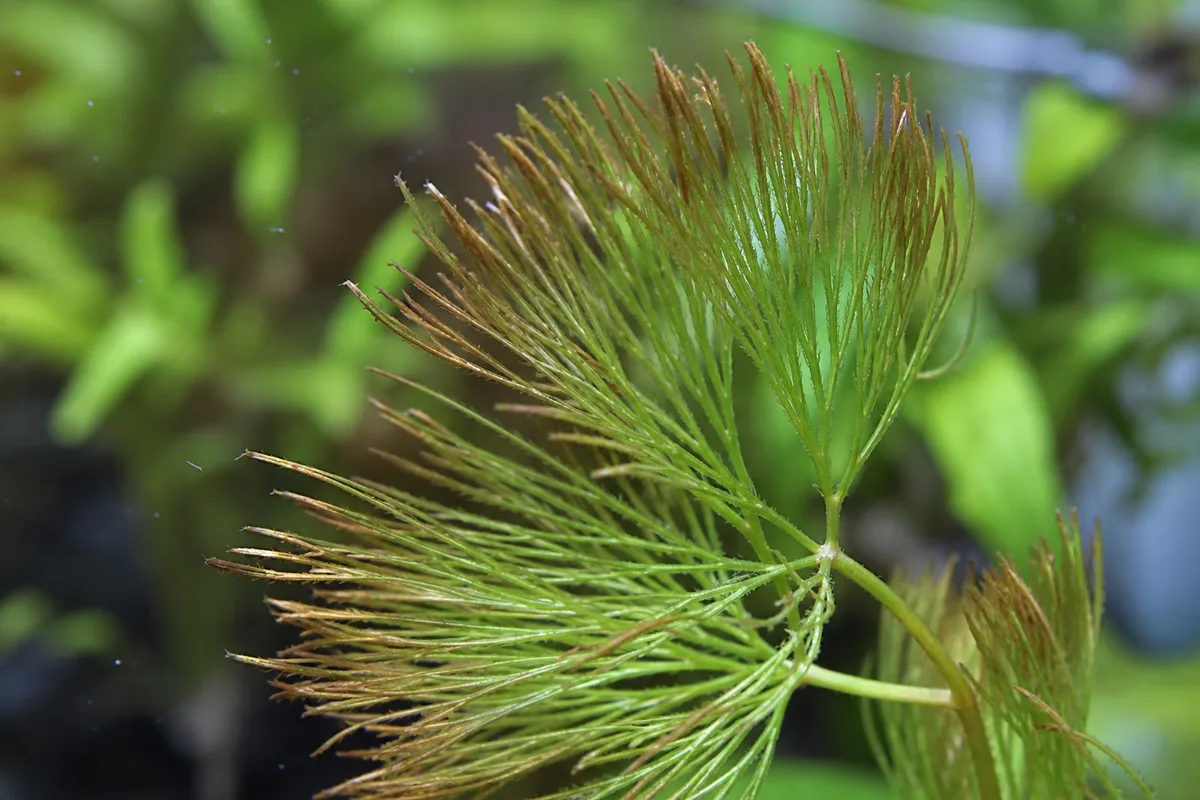
Brown Tips symptoms on Cabomba - compare with healthy tissue on the same plant.
Brown or translucent segment melt
Individual fan segments turn olive-brown, translucent, or slimy and detach as fine needle debris that clouds the water and clogs filter sponges. Melt often starts on lower whorls and climbs the stem if the stress continues. Tissue feels soft underwater-not dry and brittle like air-exposed hornwort. In tank photos, healthy whorls show dense green fans roughly 2 inches across; melting whorls look sparse, stringy, and litter the substrate within days.
Bare lower stem with green crown (light stress)
The classic green Cabomba failure: long bare brown stem with a small tuft of feathery leaves at the top. Lower sections shed completely while tips stretch toward the strongest light. Internodes lengthen and stems look like telephone poles. This bottom-up pattern almost always means insufficient PAR at depth or self-shading from an untrimmed canopy-not nutrient deficiency as the first suspect.
Mushy brown stem base (burial rot)
Stems planted too deep develop a brown, mushy base in substrate while upper whorls still appear green until the connection fails. Cabomba roots at buried nodes but remains primarily a column feeder-1 to 2 inches of bare stem is the safe burial depth with the first leaf whorl just above the gravel line. Deeper burial traps decaying tissue in low-oxygen substrate and rot travels upward.
Rapid whole-plant bronze-out (copper or chemical shock)
After copper-based ich treatments, algaecides, or some liquid-carbon overdoses, fine leaves bronze or brown across the entire bunch within days, often with simultaneous needle rain. Copper-based aquatic herbicides kill submerged plants by disrupting photosynthesis. Hobbyist medications containing copper produce the same response in display tanks. This pattern is urgent-remove surviving firm tops immediately and stop the chemical exposure.
Transition melt on new purchases
Store fanwort is often grown for aquarium trade use under conditions different from your tank. Emersed farm leaves differ structurally from submerged leaves; after planting, the plant sheds old growth while regenerating underwater foliage. Gradual shed with firm green stem tips over one to two weeks is normal acclimation. Mushy bases plus climbing melt after day seven usually signals parameter mismatch, outlet blast, or chronic under-lighting-not patience alone.
Healthy contrast: Compact whorls with short internodes, foliage retained on most of the stem length in the lower third of the tank, and new finely divided leaves emerging from tips within days of stable conditions.
Green Cabomba vs. red Cabomba: different browning thresholds
Most shops sell green Cabomba (C. caroliniana) and red Cabomba (C. furcata) under similar names, but they fail for different reasons.
Green Cabomba tolerates moderate-to-high light without CO₂ in clean water-roughly 40 to 80 PAR at stem height keeps lower whorls attached. It browns primarily from low PAR, dirty water, deep burial, transition shock, or copper-not from missing CO₂ alone in a bright low-tech tank.
Red Cabomba demands high PAR (often 80 to 100+ at stem height) and CO₂ injection for long-term compact, red growth. Without both, stems green out, elongate, and melt within weeks rather than months. If your kit LED delivers under 40 PAR at the background and you run no CO₂, red Cabomba browning is an equipment mismatch-not a mystery disease.
See the Cabomba light guide for species-specific PAR targets and the overview for CO₂ expectations.
Why Cabomba turns brown or sheds segments
Insufficient PAR and self-shading
Light is the primary driver for green Cabomba melt. Fine submerged leaves need strong, consistent photosynthetically active radiation; when PAR at the lower stem falls below roughly 30 to 40 µmol m⁻² s⁻¹, the plant allocates energy upward and abandons shaded lower whorls. Extending photoperiod beyond 10 hours without raising intensity does not fix this-it usually fuels algae on feathery surfaces without restoring lower leaves.
Dense untrimmed stands shade themselves within two to three weeks. The top canopy intercepts photons; the base goes bare. Weekly topping and replanting healthy upper sections keeps light reaching the full stand.
Buried stem rot and planting depth errors
Hobbyists bury feathery whorls like rooted swords. Cabomba needs bare nodes in contact with substrate, not buried leaves. Too-deep planting creates anaerobic decay at the base; too-shallow planting lets current uproot stems before roots anchor. Both produce brown mushy tissue at the stem–substrate junction.
Poor water clarity and ammonia spikes
Cabomba is a water-column feeder sensitive to environmental instability. Detritus coats fine leaves, blocks light, and raises dissolved organics. Shed needles left to decompose spike ammonia and accelerate secondary melt. Infrequent filter sponge cleaning in fanwort-heavy tanks is a common hidden cause of recurring browning.
Transition shock and parameter swings
Large water changes with unmatched temperature, pH, or GH; sudden CO₂ jumps; and shipping stress all trigger segment shed. Cabomba adapts to stable conditions but punishes swings faster than Anubias or Java fern. Match change water within 2°F, acclimate new bunches slowly, and avoid stacking multiple parameter overhauls in one week.
Copper medications and aquatic algaecides
Chelated copper herbicides are broad-spectrum contact killers of submerged aquatic plants-copper interferes with plant enzymes and photosystem function. Copper treatments in freshwater systems carry narrow margins between effective parasite control and plant or fish harm. Ich medications, some algae treatments, and pond copper products are incompatible with Cabomba in the same display tank.
Nutrient gaps (secondary, after light and water)
In bright, CO₂-enriched tanks with clean water, pale or bronze new whorls can signal low iron or nitrogen-but deficiency browning tends to be diffuse chlorosis on new growth, not bare lower stems with a green tuft on top. Confirm PAR and planting depth before dosing.
How to confirm the cause
Work through this numbered workflow. Stop when one pattern clearly fits.
- Stem-tip firmness - Soft green tips with gradual needle drop on a new purchase → transition acclimation. Mushy climbing melt → rot, copper, or severe parameter failure.
- PAR at lower stem - Measure or estimate PAR 10 to 15 cm above substrate at the back where Cabomba sits. Under ~30 to 40 with bare lower stem and bushy top → light deficiency or self-shading. See not enough light on Cabomba.
- Planting depth - Pull one stem gently. Mushy brown base with buried whorls → burial rot. Firm base, bare lower stem, good PAR elsewhere → light or canopy shading.
- Water clarity and nitrate - Yellow tint, mulm on leaves, nitrate above 40 ppm, or ammonia detectable → foul-water stress. Increase water-change discipline before fertilizer.
- Filter flow direction - Needles stripped on one side, debris lodged in fans facing the outlet → excessive localized flow. Diffuse with a spray bar or reposition stems.
- Chemical history - Copper, algaecide, or full-strength liquid carbon in the last seven days → chemical melt. Remove plant from exposure.
- Species check - Red Cabomba in a low-tech dim tank → equipment mismatch, not a fixable “tip burn.”
Lookalike comparison
| Pattern | Texture | Location | First fix |
|---|---|---|---|
| Low PAR / shading | Soft shed, bare lower stem | Bottom third of tall stems | Raise PAR or trim/replant tops |
| Burial rot | Mushy brown base in substrate | Stem–gravel junction | Trim base, replant 1–2 in bare stem |
| Transition melt | Translucent shed, firm green tips | New purchase, week 1–2 | Stable params, vacuum debris, wait |
| Copper / chemical | Bronze-brown across whole bunch | After medication dose | Remove plant, stop treatment |
| Dirty water / ammonia | Coated leaves, tank-wide thin melt | Neglected filter / debris | Water change, clean sponges |
| Red species mismatch | Green-out, elongation, melt | Low-tech + red Cabomba | Switch species or add CO₂ + light |
| Algae on leaves | Fuzz attached to green tissue | High light, imbalance | Balance light/CO₂/nutrients |
First fix for Cabomba
Match the first fix to the confirmed pattern-one correction at a time.
- Mushy or translucent segments: Trim all soft tissue with sharp scissors. Vacuum shed needles immediately so they do not foul the filter. Replant only firm green upper stem with 1 to 2 inches of bare node buried-or float until roots form.
- Low PAR / bare lower stem: Increase intensity (not photoperiod alone), thin the canopy, or replant healthy tops higher in the water column. Target 40+ PAR at stem height for green Cabomba before fertilizing harder.
- Burial rot: Pull stems, cut away mushy bases, replant shallow. Never bury feathery whorls.
- Transition melt (firm tips, week 1–2): Hold temperature and chemistry stable, run 6 to 8 hours light during acclimation, and wait for new submerged whorls.
- Copper or chemical exposure: Move surviving tops to a tub of matched tank water. Do not re-dose copper in the planted display.
- Dirty water: 25 to 30 percent water change, clean pre-filter sponges, and remove decaying biomass before adjusting light.
Details on water matching and flow setup live in the Cabomba watering guide; PAR dialing in the light guide.
Recovery timeline
24 to 72 hours: Active melt should slow once mushy tissue is removed and light, burial, or chemical stress ends. Needle debris may continue drifting as old segments detach.
One to two weeks: New finely divided whorls from firm green tips are realistic for green Cabomba after PAR or planting fixes. Transition melt often shows the same timeline on new purchases.
Two to four weeks: A topped and replanted stand can look bushy again in stable conditions. Red Cabomba may need the full period plus CO₂ before compact color returns.
What will not recover: Brown, translucent, or mushy segments stay dead. Judge success by new whorl density and short internodes, not old needle color.
Worsening signs: Melt climbs past firm tips, stems smell foul underwater, or ammonia rises despite trimming-discard unsalvageable portions and propagate from any remaining firm top per the propagation guide. Never release trimmings to outdoor waterways; fanwort is invasive when escaped.
What not to do
Do not check soil moisture, pot drainage, or bright indirect window light-Cabomba is fully submerged. Do not extend photoperiod beyond 10 hours to compensate for weak PAR; that fuels algae without restoring lower whorls. Do not bury feathery leaves deeper to stop tipping-over stems. Do not dose fertilizer on a melting bunch before confirming light, planting depth, and water clarity. Do not use copper ich medications in a planted tank without removing Cabomba first. Do not stack substrate overhauls, heavy pruning, CO₂ ramping, and pesticide on the same day. Skip misting, Cabomba repotting guide into larger pots, and humidity trays entirely.
How to prevent browning and melt next time
- Light the lower stem - Verify 40 to 80 PAR at stem height for green Cabomba; budget a planted-tank LED with published output, not a stock fish-kit hood.
- Plant shallow - 1 to 2 inches of bare stem below the first whorl; see Cabomba overview planting section.
- Trim and replant tops every two to four weeks in fast growth so lower sections receive photons.
- Clean water rhythm - 25 to 30 percent weekly changes in low-tech tanks, vacuum shed needles, and clean filter sponges before debris coats fans.
- Stable parameters - Match change-water temperature within 2°F; avoid large single changes after neglect.
- Chemical caution - Treat copper and strong algaecides as fanwort hazards; quarantine meds in plant-free tanks when possible.
- Right species - Run green Cabomba in low-tech community setups; reserve red Cabomba for high-light, CO₂-injected scapes.
- Legal disposal - Dry trimmings completely and discard in trash-never flush live fragments to ponds or storm drains.
Align everyday care with how fanwort actually lives: bright submerged light, clean water parameters, column fertilization matched to PAR, and regular pruning.
When to use this page vs other Cabomba guides
- Cabomba watering guide - Use for routine moisture checks before assuming brown tips is the main issue.
- Cabomba problems hub - Browse all 16 common issues on this species.
- Low Humidity on Cabomba - Different entry point when symptoms overlap with brown tips.
- Underwatering on Cabomba - Different entry point when symptoms overlap with brown tips.
- Overwatering on Cabomba - Different entry point when symptoms overlap with brown tips.
Related Cabomba guides
- Cabomba overview
- Cabomba watering
- Cabomba light
- Cabomba soil
- Low Humidity on Cabomba
- Underwatering on Cabomba
- Overwatering on Cabomba
- Yellow Leaves on Cabomba
- Cabomba problems
Related tool
Use the Plant Problem Diagnosis Tool to narrow causes for brown tips on this plant before changing multiple variables at once.