Low Humidity on Cabomba Above the Waterline: Emersed Causes
Quick answer
Low humidity matters on Cabomba only when some growth is above the waterline in an emersed tray, dry-start setup, or partially drained tank. Fully submerged fanwort does not dry out from room air. First step: confirm whether the damaged whorls are actually in air, then raise enclosure humidity or re-submerge them.
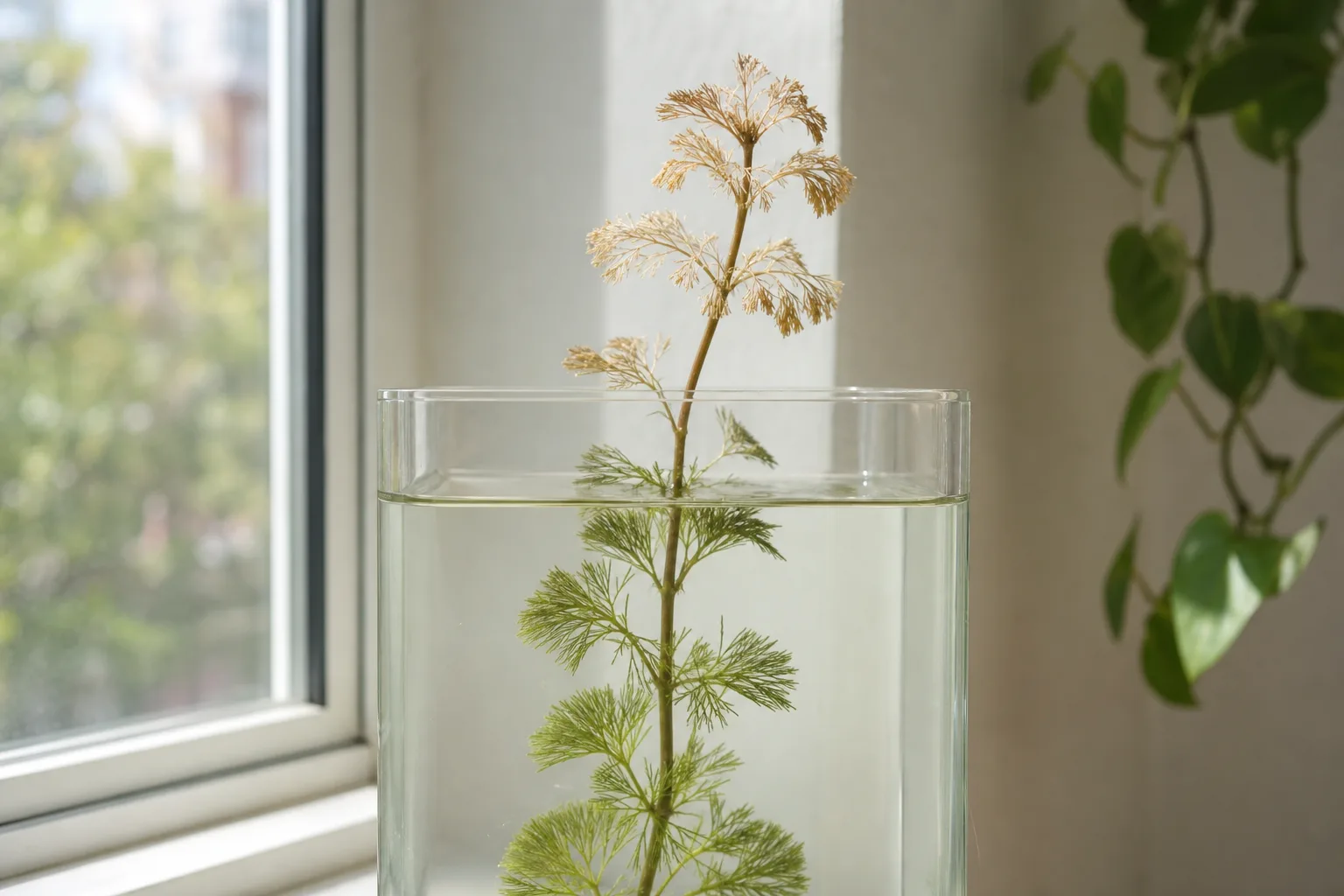
Low Humidity on Cabomba Above the Waterline: Emersed Causes & Fixes
This guide covers low humidity on Cabomba. See also the general Low Humidity guide, watering, and light pages for this plant.
Low Humidity on Cabomba Above the Waterline: Emersed Causes & Fixes
Quick answer
For a normal aquarium, this page is usually the wrong diagnosis. Cabomba is a submerged aquatic stem plant, so room humidity does not dry out leaves that never leave the water column (UF/IFAS plant directory). Low humidity only becomes relevant when some growth is above the waterline in an emersed tray, dry-start tank, or partially drained setup.
First step: check whether the damaged whorls are actually in air. If they are underwater, investigate transport melt, weak submerged light, poor water quality, or physical damage instead. If they are in air, raise enclosure humidity or re-submerge the exposed tips before you change anything else.
When this page applies
Use this page for:
- emersed Cabomba in propagation trays
- dry-start aquascapes before flooding
- bunches left partly exposed during acclimation
- tanks or tubs where the water level dropped below the top growth
Do not use it for:
- ordinary fully submerged display tanks
- lower leaves disappearing from shaded stems
- fresh-purchase melt after planting underwater
- dirty water or algae problems
Cabomba is commonly sold for submerged use. The low-humidity search intent exists mostly because emersed stems can dry quickly when they are handled like houseplants even though the species is not one.
Why submerged Cabomba is not a humidity problem
Cabomba caroliniana is a freshwater aquatic plant whose familiar fan-shaped leaves are meant to function underwater (USGS NAS fact sheet). When those leaves are submerged, the surrounding environment is already saturated. Room air at 25 percent or 40 percent RH is irrelevant to tissue under water.
If a submerged stand looks like it is “drying out,” the more likely causes are:
- emersed-to-submersed transition melt on a new bunch
- not enough light at stem depth
- dirty or unstable water
- heat, medication, or chemistry shock
- lower stems being shaded out
That is why a humidifier beside a normal tank does not solve most Cabomba decline.
When Cabomba really can dry out
Low humidity matters when Cabomba is grown emersed. Aquatic plants can produce different leaf forms in aerial versus submerged conditions, a phenomenon documented in aquatic-plant research on heterophylly (PMC review). Emersed culture works only when humidity stays high enough for those aerial leaves not to desiccate.
Real-world situations include:
- farm-grown bunches waiting to be planted
- stems held in a shallow emersed tray under a lid
- dry-start aquascapes with only damp substrate
- bunches with the top whorls above a falling waterline
In those cases, Cabomba can behave like any thin-leaved emersed aquatic plant: the exposed sections crisp or collapse first.
What low humidity looks like on emersed Cabomba
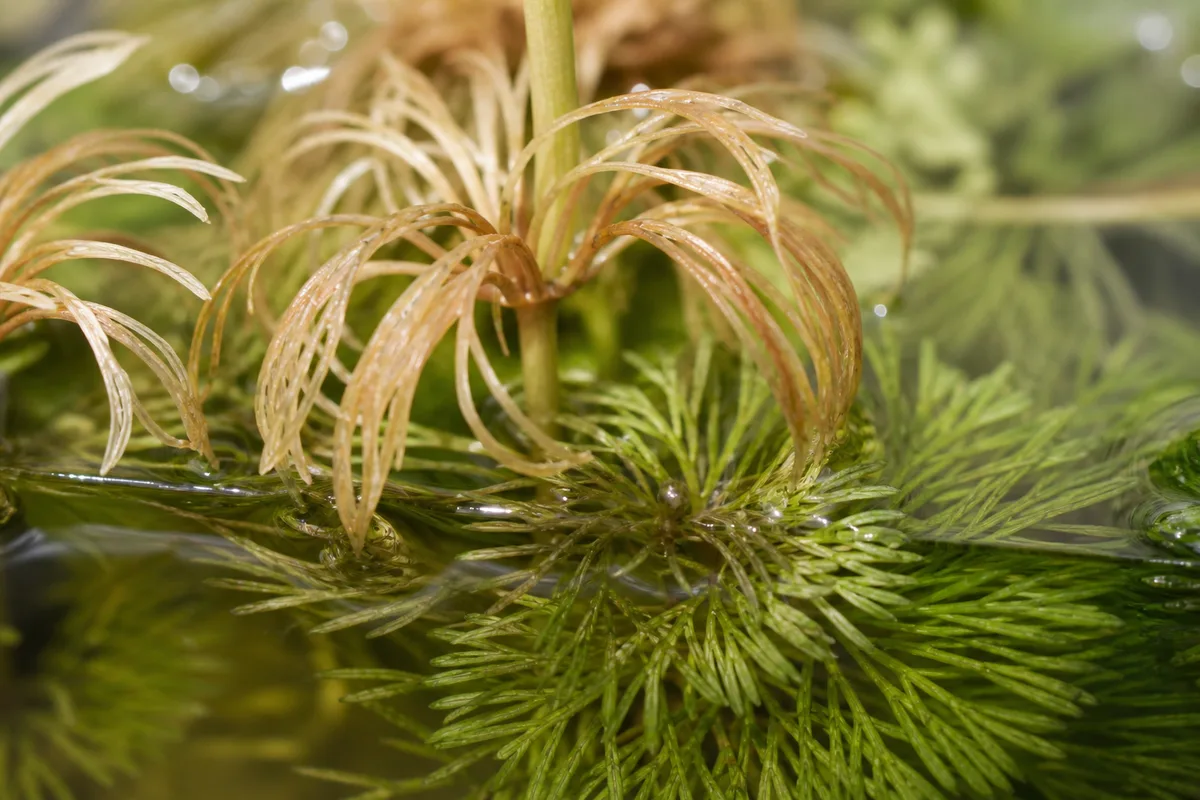
On Cabomba, true dry-air damage should stop at the aerial section instead of affecting the whole submerged stem evenly.
Typical low-humidity signs:
- papery, tan, or brown whorls above the waterline
- exposed tips becoming brittle instead of soft
- damage concentrated on aerial growth while submerged sections stay greener
- rapid decline after a lid was removed or a tray was left open
Typical non-humidity lookalikes:
| Pattern | More likely cause | First check |
|---|---|---|
| Transparent or mushy old leaves on new bunches underwater | Transition melt | Wait for fresh submerged tips |
| Bare lower stems and stretched tops | Weak light | Check not enough light |
| Whole stand yellowing in dirty water | Water-quality stress | Review watering guide |
| Only the exposed section is dry and brittle | True emersed dry-out | Raise humidity or re-submerge |
How to confirm the cause
- Waterline check. Does the damage stop where the water stops? If yes, low humidity is plausible.
- Texture check. Dry-air damage is papery and brittle. Transition melt underwater is usually translucent or mushy.
- History check. Did the setup recently move from covered to open air, or did water level drop below the top growth?
- Light check. Lower stems falling apart in a full tank point to weak light more often than humidity.
- New-growth check. If fresh submerged tips are forming while only exposed tips are failing, the issue is aerial stress, not whole-plant collapse.
If all damaged tissue is underwater, stop here and use a different diagnosis.
First fix
Either re-submerge the exposed growth or raise enclosure humidity around it immediately.
For emersed setups, that usually means:
- close the lid or cover
- mist the enclosure and hardscape, not just the leaves once
- keep a stable shallow water source around the stems
- avoid leaving the tray or tank open for long handling sessions
If the setup was not intended to be emersed, the fastest fix is often simply restoring the waterline so the exposed tips are submerged again.
What not to do
- Do not buy a room humidifier for a fully submerged tank problem.
- Do not diagnose bare lower stems as “dry air” when the top is stretching for light.
- Do not leave exposed Cabomba tips in open room air while you wait to rescape “later.”
- Do not treat brittle aerial tips with fertilizer first.
- Do not assume damaged aerial whorls will return to normal.
Recovery expectations
Damaged aerial whorls stay damaged. Recovery depends on whether healthy stem tissue remains below them.
Good signs:
- exposed decline stops after cover or re-submersion
- submerged sections stay firm and green
- new tip growth appears from healthy nodes
Bad signs:
- whole stems collapse below the waterline
- new submerged tips never appear
- water quality or light problems keep progressing after the humidity fix
In a healthy system, Cabomba can replace damaged tip growth quickly. In a weak-light or unstable tank, the same stems may continue to fail for reasons that have nothing to do with humidity.
When to use this page vs other Cabomba guides
- Cabomba overview - use for normal submerged culture and plant identity
- Cabomba watering guide - use for water quality, temperature, and maintenance
- Not Enough Light on Cabomba - use for stretched tops and bare lower stems
- Yellow Leaves on Cabomba - use for broad underwater decline
- Fungus Gnats Near Cabomba Tanks - use for flies around damp emersed media, not dry aerial tips