Low Humidity on Baby Rubber Plant: Causes, Checks & Fixes
Quick answer
Baby rubber plant (Peperomia obtusifolia) tolerates ordinary home humidity around 40–50% RH but crisps at leaf margins when forced-air heating drops air below roughly 30%. First step: move the pot off heating vents, radiators, and AC drafts, then scan for papery brown edges on leaves nearest the dry-air source.
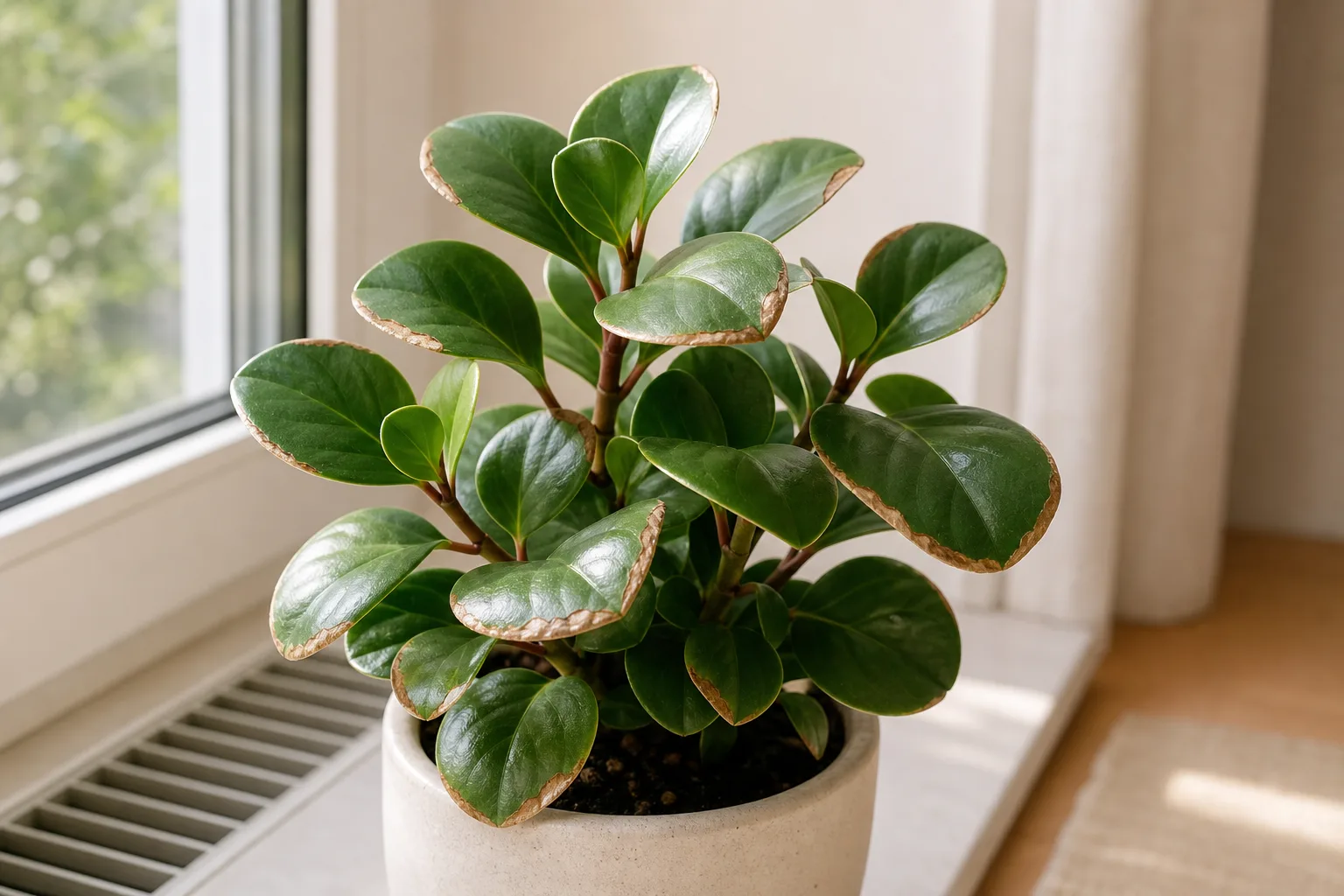
Low Humidity on Baby Rubber Plant: Causes, Checks & Fixes
This guide covers low humidity on Baby Rubber Plant. See also the general Low Humidity guide, watering, and light pages for this plant.
Low Humidity on Baby Rubber Plant: Causes, Checks & Fixes
Quick answer
Low humidity on baby rubber plant (Peperomia obtusifolia) shows up as crispy, papery brown leaf margins-often on the leaves closest to a heating vent, radiator, sunny window glass, or AC draft. Unlike true high-humidity tropicals, this species has thick, fleshy, succulent-like leaves that store moisture and tolerate ordinary indoor air around 40–50% relative humidity (RH). Stress usually appears when winter heating or air conditioning pulls room RH toward 30% or lower for weeks.
First step: move the pot off forced-air paths-at least several feet from heating vents, space heaters, fireplace blowers, and cold window glass. Hold the back of your hand near the plant at midday; if you feel a warm or cold air stream, that placement is the problem before you buy a humidifier.
Does Peperomia obtusifolia need high humidity?
No. Baby rubber plant is more forgiving than calatheas, ferns, or Norfolk pine, which struggle in dry winter rooms. Clemson HGIC describes Peperomia obtusifolia as easy to grow with low water needs. NC State Extension notes peperomias are adaptable to most home humidity levels and recommends a humidifier only when the home is very dry-not because obtusifolia needs greenhouse conditions.
Missouri Botanical Garden advises high humidity in summer and suggests a humidified room or wet pebbles for P. obtusifolia indoors, but that is seasonal comfort-not a steam-room requirement year-round. For baby rubber plant, think comfortable room humidity, not rainforest levels.
RHS peperomia guidance frames most species as adaptable to normal home atmosphere while preferring humid air when possible. Placement close to a radiator causes dehydration even when you water correctly.
Variegated cultivars such as ‘Variegata’ or ‘Golden Gate’ may show dry-air stress sooner than solid-green forms because variegated tissue runs closer to its light and moisture limits. If only the patterned leaves crisp while green neighbors stay firm, dry air plus bright window heat is a common combination-check not enough light if stems stretch or new leaves shrink, and review light placement when a south- or west-facing sill amplifies both heat and brightness.
What low humidity looks like on baby rubber plant
On Peperomia obtusifolia, dry-air damage is usually localized and marginal:
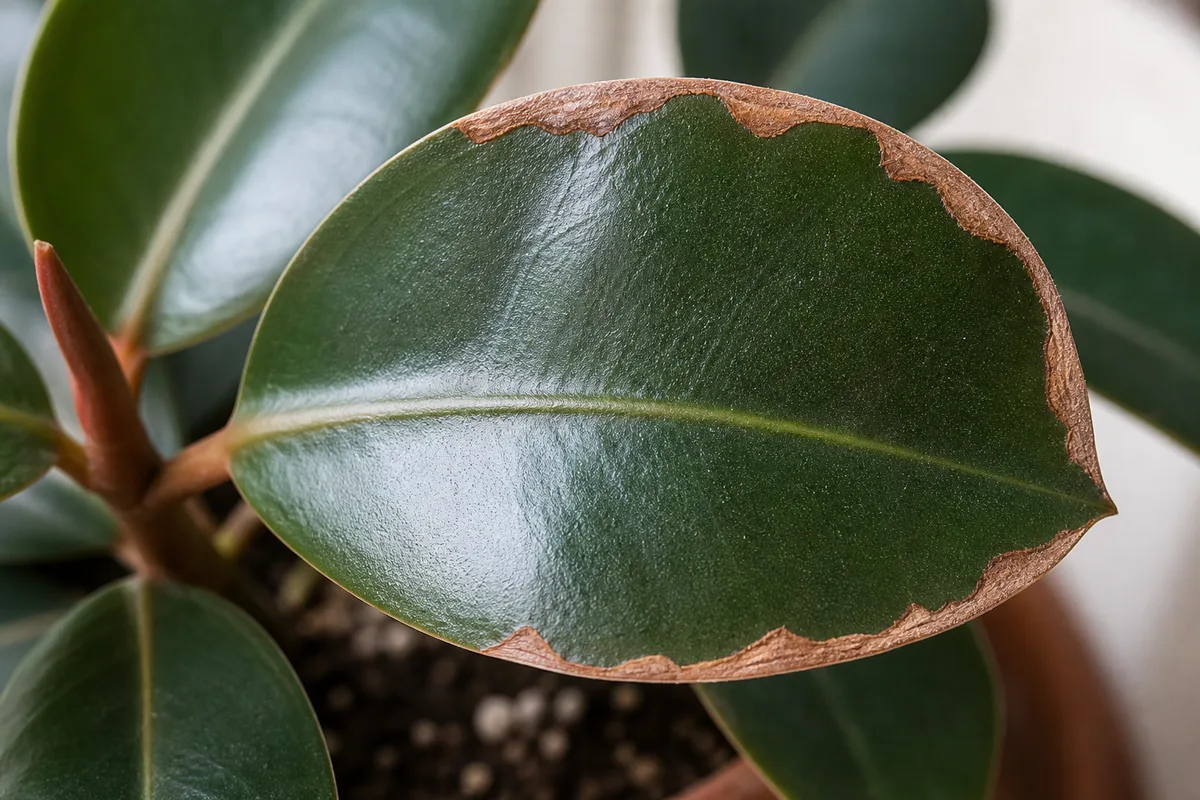
Low Humidity symptoms on Baby Rubber Plant - compare with healthy tissue on the same plant.
- Crispy brown edges that feel papery and crumble when pinched-often on one side of the plant or on outer leaves nearest a heat source
- Slight leaf cupping or dullness on affected foliage while stems stay firm and upright
- No fine stippling or webbing on leaf undersides (that pattern points to spider mites in dry heat)
- Soil moisture unchanged-the pot dries on its normal rhythm; you are not seeing the limp, thin leaves of chronic thirst
Because the leaves are waxy and semi-succulent, the plant does not wilt dramatically at first. Margin burn can creep for weeks before owners notice, especially on a desk beside a winter vent. Damage on newest leaves after a seasonal heating change is a strong dry-air signal when soil moisture has been stable.
Thin leaf margins lose water faster than the thick center of each obtusifolia leaf-so asymmetric edge burn on vent-facing foliage is a classic dry-air pattern before whole leaves wrinkle.
How to confirm dry air vs. other causes
Work through these checks in order:
- Vent and draft scan - Note heating vents, radiators, space heaters, AC returns, and cold window glass within three feet of the pot. NC State Extension advises protecting peperomias from cold drafts; the same logic applies to hot forced-air blasts that strip local moisture.
- Symmetry of damage - Dry air often affects leaves facing the heat source first. Uniform tip burn on every leaf after fertilizing suggests salt or fluoride, not humidity alone.
- Soil moisture check - Press a finger into the top inch. Dry soil with wrinkled, thinner leaves fits underwatering. Damp soil with yellow lower leaves fits overwatering or root stress-see yellow leaves. Firm leaves on appropriately dry soil with only margin burn fits dry air.
- New growth inspection - Brown only on oldest outer leaves may be minor seasonal dryness. Crisp edges on unfolding new leaves near a vent confirm active dry-air injury.
- Pest check - Tap a suspect leaf over white paper. Moving specks plus stippling mean mites in dry conditions, not humidity alone. Dry margins without stippling stay environmental.
- Season and hygrometer (optional) - Winter heating commonly drops indoor RH to the 20–30% range. A desktop hygrometer near the plant confirms whether RH sits below roughly 30% for long periods. Target 40–50% RH in the plant zone when margins keep crisping.
Symptom lookalike table
| What you see | Most likely cause | Key differentiator | Urgency | First check |
|---|---|---|---|---|
| Papery brown margins on vent-facing leaves; firm stems | Low humidity / dry-air placement | Damage asymmetric; soil moisture normal | Routine - relocate this week | Move off vent; measure local RH |
| Brown tips on newest leaves after watering; possible soil crust | Tap-water fluoride or fertilizer salts | Peperomias are sensitive to fluoride in tap water; follows feeding or hard water | Same week - flush and change water | Flush pot; use filtered or rainwater |
| Wrinkled, thinner leaves; very light pot; dry soil throughout | Underwatering | Whole leaf dulls; thirst rhythm, not one-sided burn | Same week - rehydrate once dry-down confirmed | Water thoroughly; adjust check method |
| Yellow lower leaves; wet soil; mushy base | Overwatering / root stress | Lower leaves first; sour smell possible | Urgent - inspect roots before raising RH | Stop watering; inspect roots per overwatering |
| Fine stippling, webbing, dusty undersides | Spider mites in dry heat | Pests confirmed on paper tap test | Same week - treat before humidity alone | Rinse; treat per spider mites |
Use the table to pick one primary cause before stacking fixes. Baby rubber plant responds best when you change placement or humidity first, then reassess after new growth.
First fix for baby rubber plant
Move the pot away from forced-air heating, AC drafts, and hot or cold window glass-ideally to a stable spot with bright indirect light and no direct air blast on the canopy.
Shift it at least 3–4 feet from floor vents and radiators, or elevate it on a stand if the only warm zone is low on the floor. RHS peperomia care recommends keeping plants out of cold draughts and away from radiators to prevent dehydration. After moving, wait 10–14 days before adding a humidifier or changing watering-let one variable prove itself.
If the room still measures below ~30% RH in winter and margins keep crisping on new leaves, add one secondary humidity step in this order:
- Small cool-mist humidifier near the plant zone (most reliable for steady RH)
- Group plants to raise local moisture from combined transpiration
- Pebble tray with the pot sitting above the waterline on stones or clay pebbles-UMN Extension notes trays help slightly; they are not a whole-room solution
Target roughly 40–50% RH in the plant area. You do not need 60–70% for this species-and saturating humid air while soil stays wet invites root rot on peperomias.
Recovery timeline
Existing brown margins do not turn green again. Judge recovery by whether new leaves emerge with clean edges and damage stops spreading to fresh growth.
After relocating off dry-air paths, margin burn usually stabilizes within one to two weeks. New growth with intact edges often appears within two to four weeks once RH stays in a comfortable band. If crisping continues on new leaves after placement and humidity fixes, re-run the lookalike table-especially tap-water burn and spider mites in persistent dry heat.
Trim fully brown, papery sections only for aesthetics; partial margin damage can wait until the plant is stable. Removing a few damaged outer leaves does not harm a bushy P. obtusifolia.
What not to do
Do not overwater when brown margins look like “thirst.” Dry air desiccates leaf edges while roots and soil may still be correct. In warm, dry air, transpiration speeds up; adding water to already-moist mix risks root rot on this species.
Do not rely on daily misting as your main humidity strategy. The effect is temporary, and wet waxy leaves in poor airflow can encourage fungal spotting. UMN Extension notes misting is not very effective for raising humidity compared with humidifiers or grouping.
Do not park the pot directly on a pebble tray submerged in water-roots need drainage above the waterline. Do not blast a humidifier into enclosed wet soil; pair moderate ambient RH with the normal water-when-dry rhythm.
Do not fertilize stressed plants to “green up” margins. Salt buildup also browns tips-see baby rubber plant fertilizer if burn followed feeding. Do not stack Baby Rubber Plant repotting guide, heavy pruning, and pesticide on the same day as a humidity move.
How to prevent dry-air stress next winter
Before heating season, scout placement: desks beside floor vents, kitchen counters under AC cabinets, and window sills above radiators are repeat trouble spots. A pot on a kitchen counter beneath an overhead AC return can sit in a micro-zone below 30% RH even when the living room reads comfortable-move pots in October or November before furnaces run continuously.
Run a humidifier in the driest room if winter RH regularly sits near 30% or lower. Grouping houseplants creates a modest microclimate without turning the home into a greenhouse.
Inspect leaf edges weekly during heating season. Spider mites thrive in warm, dry conditions on indoor plants-catch stippling early when air is dry.
Keep ordinary care stable: bright indirect light per the light guide, airy well-drained mix, and watering when the top inch dries-the full rhythm is in the baby rubber plant overview. Avoid misting as primary humidity; stable placement and ambient moisture beat spray bottles for P. obtusifolia.
When to worry
Escalate if new leaves keep crisping after two weeks off vents with a humidifier running, or if stippling and webbing spread-that is mite pressure in dry heat, not humidity math alone. Follow the spider mites treatment path before adding more humidity.
Act quickly if brown margins coincide with yellow lower leaves on wet soil or soft stems; that is root stress overlapping environmental burn. Unpot and inspect per overwatering before raising humidity further.
Routine winter margin tan on one outer leaf near a window is low urgency. Widespread margin burn on new growth in a vent path needs same-week relocation.
Escalation summary: asymmetric vent-side margin burn on firm stems → move off dry-air path (routine). Crisping on new leaves after two weeks with corrected placement → add humidifier or grouping (same week). Newest-leaf tip burn after feeding or hard water → flush and change water per brown tips (same week). Stippling and webbing → mite treatment before more humidity (same week). Yellow lower leaves on wet soil with soft stems → root inspection (urgent-do not humidify wet mix further).
Related baby rubber plant problems
- Brown tips - fluoride, salt, and watering chemistry when newest leaves brown after feeds, not vent-side asymmetric margins
- Spider mites - stippling and webbing in warm, dry air that margin burn alone does not explain
- Underwatering - wrinkled, thinner whole leaves when the pot is very light and soil is dry throughout
- Overwatering - yellow lower leaves and wet mix when brown margins overlap root stress
- Not enough light - stretched spacing and pale growth when variegated forms crisp in dim corners
- Yellow leaves - lower-leaf yellowing with wet soil, not dry-air margin burn alone
- Baby rubber plant overview - thick-leaf biology and baseline care hub
- Baby rubber plant light - bright-window heat plus variegated stress overlap
FAQs
Does baby rubber plant need a humidifier?
Usually not if your room stays around 40–50% relative humidity. Peperomia obtusifolia adapts to typical indoor air better than ferns or calatheas. Add a small humidifier or pebble tray when winter heating holds RH near or below 30% and you see recurring crispy margins on new growth-not as a default for every pot.
Can I mist Peperomia obtusifolia to raise humidity?
Misting gives only a brief humidity spike and wet waxy leaves in stagnant air can invite fungal spotting. For baby rubber plant, ambient fixes work better: humidifier, grouping plants, or a pebble tray with the pot above the waterline. Save misting for occasional leaf cleaning, not daily humidity.
Is low humidity or tap water causing brown tips on my baby rubber plant?
Dry air usually browns older leaf margins on the side facing a vent or radiator, with firm otherwise-green tissue. Tap-water or fertilizer salt burn often shows on newest leaves or after feeding, sometimes with white crust on soil. Check placement and RH first; if only new tips brown after watering, review water quality and feeding-or see the dedicated brown tips guide.
Will damaged baby rubber plant leaves recover from low humidity?
Crispy brown margins on existing leaves do not re-green. Recovery means the damage stops spreading and new leaves emerge with clean edges. That often takes two to four weeks after you move the plant off dry-air paths and stabilize room humidity.
How do I prevent low humidity stress on baby rubber plant next winter?
Keep pots off heating vents and cold window glass, run a humidifier in the driest room if RH stays under 30%, and group plants to raise local moisture. Inspect leaf edges weekly during heating season-very dry air also invites spider mites on Peperomia.
Is low humidity the same as brown tips on baby rubber plant?
Not always. This page covers dry-air margin burn from vents, radiators, and winter heating. The brown-tips guide covers fluoride, salt buildup, and watering chemistry when newest leaves brown after feeds or hard tap water-even when humidity is fine.
Conclusion
Choose your path by what the lookalike table confirms: vent-side asymmetric margin burn on firm stems → move off dry-air paths first and wait 10–14 days before adding gear. Crisping on new leaves with RH still below ~30% → add one humidifier or grouping step, not misting and extra water together. Newest-leaf tip burn after feeding → flush and change water per the brown-tips guide, not a humidity device. Stippling or webbing → treat mites before assuming humidity failed. Yellow lower leaves on wet soil → inspect roots urgently-do not raise ambient moisture around saturated mix. Baby rubber plant is a moderate-humidity peperomia, not a calathea; judge success by clean new growth, not old brown edges re-greening.
When to use this page vs other Baby Rubber Plant guides
- Baby Rubber Plant watering guide - Use for routine moisture checks before assuming low humidity is the main issue.
- Baby Rubber Plant problems hub - Browse all 16 common issues on this species.
- Brown Tips on Baby Rubber Plant - Different entry point when symptoms overlap with low humidity.