Slow Growth on Aglaonema Silver Bay: Causes, Checks & Fixes
Quick answer
Slow growth on Aglaonema Silver Bay is often normal: variegated Chinese evergreens survive dim corners but grow at a fraction of their speed in bright indirect light. Worry when silver variegation fades, new leaves shrink for months through a warm season, or wet soil sits beside a stalled crown. First step: measure light at the leaf and compare newest leaf size to last summer-not the calendar.
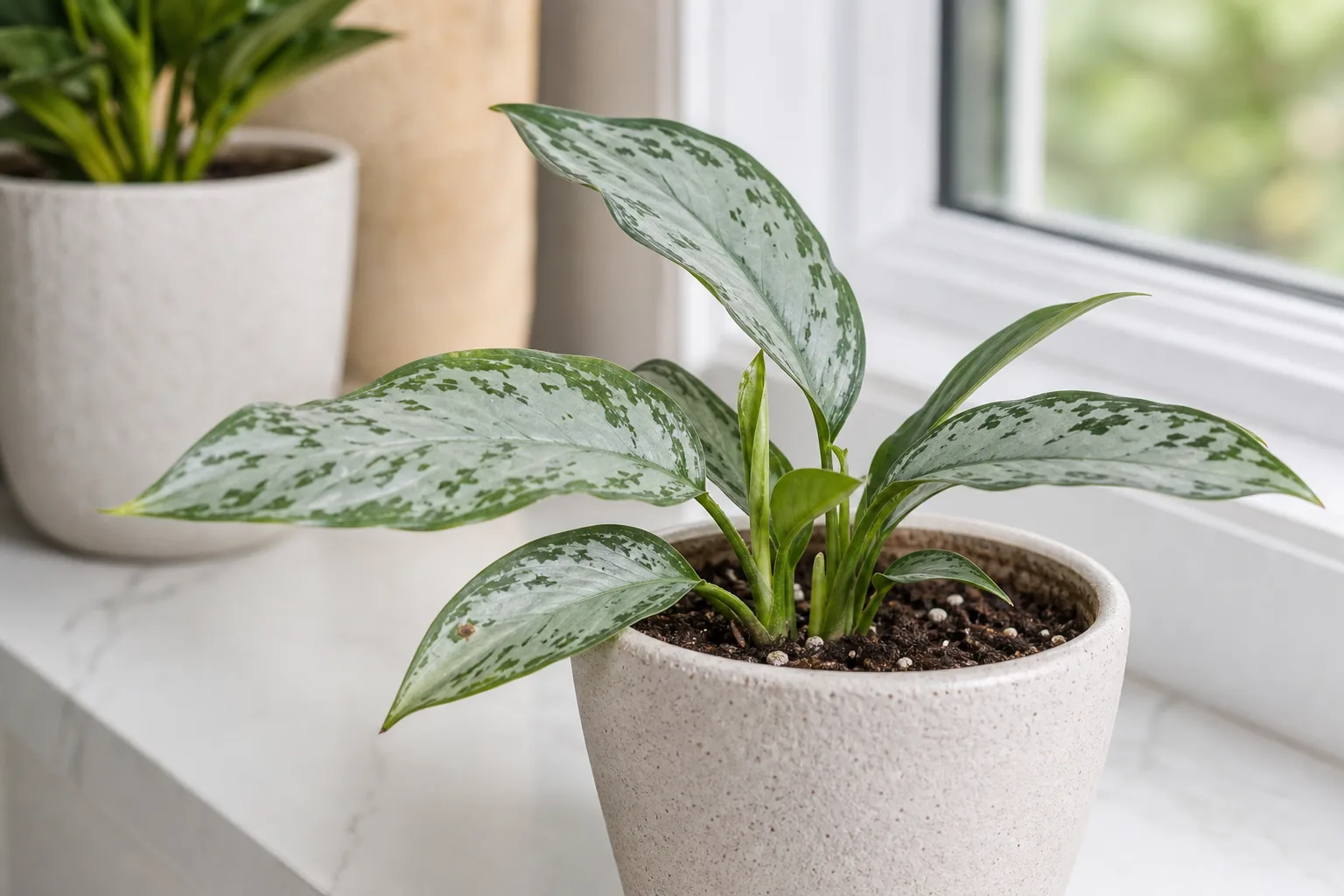
Slow Growth on Aglaonema Silver Bay: Causes, Checks & Fixes
This guide covers slow growth on Aglaonema Silver Bay. See also the general Slow Growth guide, watering, and light pages for this plant.
Slow Growth on Aglaonema Silver Bay: Causes, Checks & Fixes
Quick answer
Slow growth on Aglaonema Silver Bay splits into two situations owners confuse: normal low-light pace and abnormal stall. Silver Bay survives dim offices and north-window corners because it is one of the most durable houseplants in the genus-but “low light tolerant” does not mean “growing at full speed.” In bright indirect light, a healthy specimen pushes firm new leaves with crisp silver centres every couple of weeks during warm months. In a fluorescent-lit cubicle or a hallway three metres from a window, one or two leaves per year can still be a healthy plant holding variegation.
A true stall looks different: no new leaves through an entire warm season at a bright window, each new leaf smaller and greener than the last, wet soil for a week or more beside a silent crown, or silver pattern washing out while stems stay short. Those patterns point to fixable stress-usually light, roots, or watering-not the cultivar’s natural habit.
First step: measure light at the leaf and inspect the newest foliage-not the oldest leaves. Use a lux meter app at solar noon with the sensor pointed at the window. Compare the reading to last summer’s growth in the same spot. Light fixes more Silver Bay stalls than fertilizer ever will.
What normal slow growth looks like on Aglaonema Silver Bay
Silver Bay is a variegated cultivar of Aglaonema commutatum with a wide silver-grey centre and dark green margins. That silver is physiologically a chlorophyll gap-the pale tissue photosynthesises more slowly than the green margin, so the whole plant grows at a measured pace even in good conditions. Owners who expect pothos-like speed in a dim corner are usually misreading healthy survival as failure.
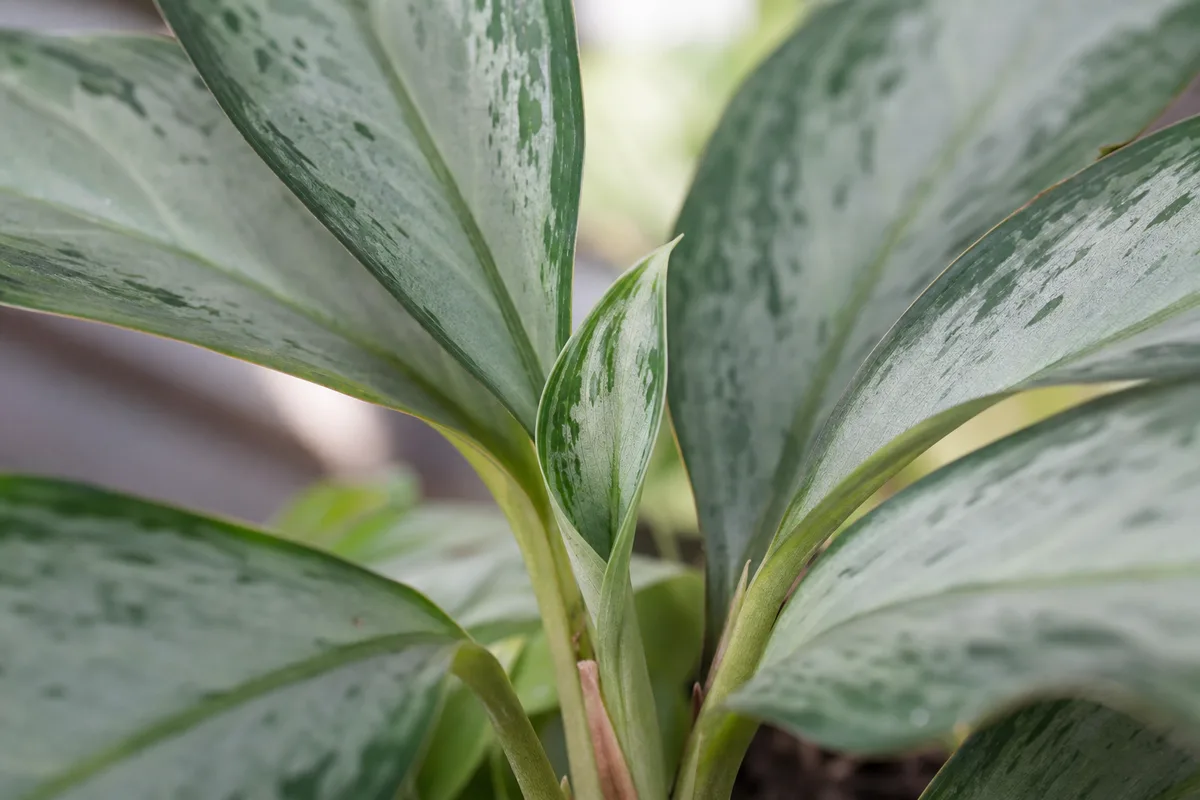
Slow Growth symptoms on Aglaonema Silver Bay - compare with healthy tissue on the same plant.
Expected pace indoors by light level
| Light at the leaf | What you should see on Silver Bay |
|---|---|
| Bright indirect (150–300 fc / 1,600–3,200 lux) | New leaf every 2–4 weeks in spring–summer; crisp silver variegation; full-size foliage |
| Moderate indirect (75–150 fc) | New leaf every 4–8 weeks; silver slightly less vivid; compact, upright habit |
| Low survival light (25–75 fc) | 1–3 leaves per warm season; silver may dull; very slow but firm crown |
| Below ~25 fc without grow light | Long-term survival only; fading silver and eventual decline |
These bands align with the light guide foot-candle targets and peer-reviewed work showing heavily variegated Aglaonema commutatum cultivars lose pigment and slow gas exchange below about 100–150 µmol/m²/s PPFD.
A corner Silver Bay that added three leaves in twelve months under office fluorescents is often on pace. The same plant producing zero leaves in a bright east window through June and July is not.
Seasonal winter slowdown
Chinese evergreens naturally slow when days shorten and indoor temperatures dip. Growth below about 55 °F (13 °C) nearly stops. From late fall through winter, no new leaves for four to eight weeks while you water less often is expected rest-not a crisis. Resume judging pace when days lengthen and the plant sits in its warm-season window again.
Signs Silver Bay is healthy despite slow pace
- Firm, upright petioles with no limp lower leaves on wet soil
- Crisp silver variegation relative to the light available (some dulling in dim spots is normal; total green wash is not)
- New leaves match or exceed the size of the previous two leaves
- Crown stays tight and firm at the stem base
- Soil dries on a rhythm that matches light-slower in dim rooms, faster in bright windows
When slow growth is actually a problem
Worry when pace drops below what your light level should support, or when secondary stress signs appear alongside stalled growth.
No new leaves across a warm, bright season. If spring and summer pass at an east or filtered south window and the crown never pushes a leaf while a pothos nearby grows freely, light may still be insufficient at the leaf, roots may be bound, or chronic overwatering in shade has damaged uptake.
Shrinking or pale new leaves with fading silver. Each new leaf smaller and greener than the last-while internodes stay short-signals the plant cannot build full foliage at current light. This is variegation loss from insufficient usable light, not a separate disease.
Wet soil plus stall in a dim corner. A Silver Bay in deep shade uses water slowly. Calendar watering keeps mix soggy; roots lose oxygen and growth stops even though leaves have not yellowed yet. Wet weight, cool pot, and zero crown activity for months is abnormal.
Cold or draft stress. Temperatures below about 55 °F can halt growth overnight. A plant beside an AC vent or cold windowpane may stall through an entire season without obvious wilt.
Why Aglaonema Silver Bay grows slowly
Naturally slow in low light (variegated cultivar biology)
The Clemson University Home & Garden Information Center notes that variegated Chinese evergreens need low to moderate indirect light and grow more slowly than solid-green types in the same dim spot. Silver Bay’s silver centre carries less chlorophyll; the green margin must supply energy for both zones. In dim light the plant prioritises staying alive over pushing new leaves-that is the trade-off that makes it a reliable office plant.
Light compensation floor and variegation fade
Below roughly 75 foot-candles at the leaf, Silver Bay survives but cannot maintain its signature silver pattern or vigorous pace. Research on variegated A. commutatum cultivars shows pigment loss and reduced photosynthetic efficiency when PPFD drops below about 100–150 µmol/m²/s. Fading silver is often the first warning before growth stalls entirely.
Low light beyond tolerance
“Low light tolerant” has a floor. A plant more than two to three metres from the nearest window on a cloudy day may receive under 25 foot-candles-enough to linger, not enough to grow. Interior hallways and windowless rooms need a grow light for any meaningful pace.
Root-bound and pot size
Silver Bay is a moderate grower and does not need frequent repotting, but a dense root ball circling drain holes for years eventually limits water and nutrient uptake. Stall on an otherwise well-lit plant with soil that dries in a day and roots visible at the pot edge often means root-bound, not light failure.
Overwatering in shade
The Missouri Botanical Garden and Clemson both flag overwatering as the leading killer of Aglaonema. Dim plants use less water; owners who water on the same schedule as a bright-window plant keep roots anaerobic. Growth stops before yellow leaves appear.
Cold and acclimation stress
Chinese evergreens prefer roughly 68–80 °F indoors. Chilling below 55 °F, sudden moves from greenhouse to drafty entryway, or repot shock can pause growth for weeks even when light and moisture look correct.
Lookalike symptoms to rule out
Leggy stretch vs. slow compact growth - Long bare stems with small leaves reaching toward a window is etiolation from low light, not the same as a short, dense plant growing one leaf every two months. See leggy growth if internodes are lengthening.
Winter dormancy vs. year-round stall - A four-to-eight-week winter pause with firm leaves and drier soil is normal. Zero growth from March through September at a bright window is not.
Root rot vs. slow pace - Root rot shows yellow lower leaves, sour smell, soft crown, and wet mix. Slow healthy growth keeps a firm crown and stable older foliage. See root rot if wet soil and decline accelerate.
Variegation fade vs. slow growth alone - Silver can dull while the plant still occasionally pushes a leaf. Fading without any crown activity for months means light is below the growth floor, not just below the colour floor. See not enough light.
How to confirm the cause
Work through these checks in order so you do not fertilize a light-starved plant or repot one that only needs brighter placement.
- Light at the leaf - Measure lux at midday with a phone app; aim for 1,600–3,200 lux (150–300 fc) for vigorous pace. Below 800 lux, expect slow survival pace only.
- Newest leaf quality - Compare the last three leaves for size and silver intensity. Shrinking, greener new foliage confirms light stress.
- Crown firmness - Press the stem cluster gently. Firm crown with no new leaves points to light or root-bound issues; soft crown on wet soil suggests rot.
- Soil moisture rhythm - Insert a finger to the second knuckle. Mix wet seven or more days after watering in a dim spot confirms overwatering habitat.
- Pot weight and roots - Light pot that dries in a day on a bright sill may be root-bound if growth stalled despite good light. Slide the plant out; circling white roots tight against the pot wall confirm binding.
- Season and temperature - Note if stall began in winter or after a cold draft. Growth often resumes with warmth without other intervention.
- Recent changes - Repotting, fertilizer surge, or a move to a darker room narrows cause quickly.
Confirmed normal slow pace: firm crown, stable variegation for the light level, occasional new leaves matching expectations for your lux reading, soil drying appropriately.
Confirmed abnormal stall: zero warm-season growth at adequate light, shrinking new leaves, wet soil in dim corners, or root-bound mass with dry-out-in-hours pattern.
First fix for Aglaonema Silver Bay
Measure light at the leaf and compare newest leaf size to last summer before changing water, fertilizer, or pot.
If the lux reading is below about 1,600 lux at the leaf and new leaves have been small or silver has dulled, move Silver Bay to brighter indirect light-an east window sill, one to two metres back from a sheer-curtained south or west window, or a full-spectrum LED grow light 30–45 cm above the canopy for 10–12 hours daily. Hold watering steady; do not compensate for dim rooms by watering more often. Full placement targets are on the light guide.
If light is adequate (1,600+ lux) but the pot dries within a day and roots circle the drain holes, plan a repot into a container one size larger with fresh well-drained mix-see the repotting guide. Do not repot and fertilize the same week.
If soil stays wet for a week or more in a dim corner while growth stopped, stop watering until the top two inches of mix dry, move to slightly brighter indirect light to speed evaporation, and inspect roots if the crown softens. See overwatering for the full wet-soil protocol.
Make one correction, then wait four to six weeks before stacking repotting, fertilizing, and heavy pruning.
Recovery timeline
Light-limited stall - After a brighter placement or grow light, the first new leaf often appears in three to six weeks during warm months. Silver variegation may take one to two additional leaves to sharpen. Winter moves can add a month.
Root-bound recovery - Repotting into fresh mix typically pauses growth for two to four weeks while roots settle, then pace increases over the next one to two months if light is adequate.
Overwatering stall - Once mix dries and roots are healthy, crown activity may resume in three to eight weeks. Yellow lower leaves rarely green up; judge by new upright growth.
Cold or repot shock - Firm crown with corrected warmth or settled roots often shows a new leaf in four to eight weeks without further intervention.
What not to do
Do not pour fertilizer onto a stalled Silver Bay in a dim corner-variegated cultivars in low light cannot use extra nitrogen to replace photons, and salts burn leaf tips. Do not repot on day one without confirming root-bound or failed mix. Do not remove healthy leaves because “nothing is happening”; a slow grower needs every photosynthesising leaf. Do not stack repotting, pruning, and feeding on the same day. Do not judge recovery by old foliage; Silver Bay rarely speeds up visibly until new crown leaves emerge.
How to prevent abnormal slow growth next time
Match watering to light-let the top 1–2 inches of mix dry before the next drink, and stretch intervals in dim rooms. Place Silver Bay where the leaf receives at least moderate indirect light for the pace you want; accept survival pace in true low light without expecting silver to stay vivid. Repot every two to three years or when roots circle heavily-not on a panic schedule after a slow month. Keep temperatures in the 68–80 °F range away from AC vents. Fertilize lightly during active growth only after light and moisture rhythm are correct-see the fertilizer guide. Rotate the pot a quarter turn every few weeks in asymmetric light so growth stays balanced.
When to worry
Act soon if the crown softens, soil stays wet while leaves yellow from the bottom up, or roots are brown and mushy on inspection-those signs mean rot, not slow pace. Zero growth through an entire warm season at a measured 2,000+ lux reading with firm roots may warrant a careful root inspection for hidden decay.
You can wait and observe if variegation is stable, the crown is firm, soil moisture matches light, and you are simply comparing Silver Bay to a faster houseplant on the same shelf.
Silver Bay care cross-check
| Check | Healthy slow pace | Abnormal stall |
|---|---|---|
| Light at leaf | Matches expected pace band for lux reading | Below 800 lux but owner expects bright-window speed |
| New leaves | Full size or larger; silver crisp for conditions | Each leaf smaller; silver washing to green |
| Crown | Firm | Soft on wet soil |
| Soil | Dries on rhythm matching light | Wet 7+ days in dim corner |
| Season | Winter pause normal | Zero growth March–September at bright window |
| Roots | White, firm when inspected | Mushy, sour, or densely circling with instant dry-out |
Related Silver Bay guides
- Silver Bay overview - full care hub; slow growth in low light is expected
- Light needs - foot-candle targets and variegation biology
- Fertilizer - when feeding helps vs. when light is the limiter
- Not enough light - fade, stretch, and stall from dim placement
- Leggy growth - differential from compact slow growth
- Repotting - root-bound diagnosis and timing
- Root rot - wet-soil stall with crown decline
- Overwatering - chronic wet mix in shade