Aglaonema Silver Bay Light Needs: Best Indoor Placement
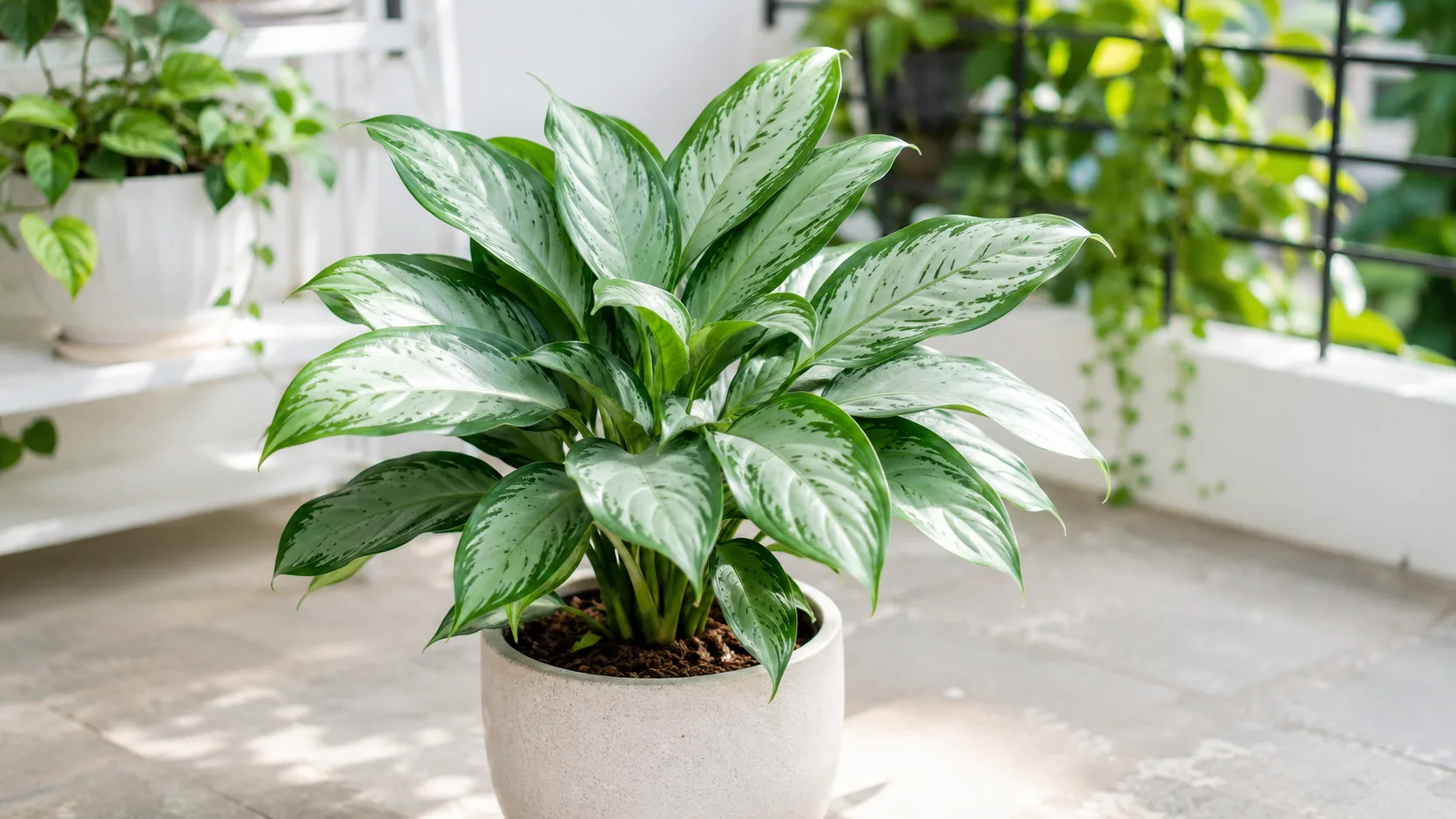
Aglaonema Silver Bay Light Needs: Best Indoor Placement, Windows, and Grow Light Guide
Aglaonema Silver Bay Light Needs: Best Indoor Placement, Windows, and Grow Light Guide
A Silver Bay Aglaonema will tolerate almost any spot you put it in. That is the trait that made the species famous as a houseplant in the first place. It is also the trait that quietly turns the plant into a slow, dim, leggy shadow of itself if you treat “tolerant” as a synonym for “fine.” Light is the lever that decides which version of Silver Bay you take home: a dense, silver-painted specimen pushing out a new leaf every couple of weeks, or a stretched plant with pale, fading variegation that has been “surviving” in a corner for two years. Almost everyone who searches for Aglaonema light guidance is really asking some version of one of three questions: Is the spot I picked too dark, too bright, or about right? The honest answer is that “about right” is a band, not a point, and the plant tells you which edge of the band you are on within a few weeks.
What “low light tolerant” really means in practice
The phrase “low light tolerant” comes from a long list of horticultural references - Missouri Botanical Garden, Clemson Home & Garden Information Center, North Carolina State Extension, and the Iowa State University Yard and Garden light guide all describe Chinese evergreen (the common name for the whole Aglaonema genus) as tolerant of low light. The Iowa State guide specifically groups Aglaonema with ZZ plants, snake plants, and cast iron plants in the low-light survivor category, while noting that for any of these species, brighter conditions usually mean fuller growth. What “tolerant” does not mean is that the plant is at its best in those dim conditions. A 2023 peer-reviewed study in Applied Sciences (MDPI) looked at four Aglaonema commutatum cultivars under different light levels and found that the most heavily variegated cultivars lost pigment and reduced photosynthetic efficiency when grown below about 100–150 µmol/m²/s of PPFD. Survival is one thing. Photosynthesis at full speed is another.
Silver Bay’s Native Light Conditions: Tropical Understorey in Southeast Asia
A houseplant light guide is a guess unless you anchor it in the conditions the species actually evolved under. Silver Bay is a hybrid of Aglaonema commutatum, a species that botanists and several peer-reviewed sources (including a 2024 chloroplast-genomics study in Scientific Reports and the North Carolina Extension Gardener Plant Toolbox) place in the tropical and subtropical forests from northeastern India through southern China, Malaysia, Indonesia, the Philippines, and New Guinea. A. commutatum is documented on Luzon in the Philippines and on Sulawesi in Indonesia, where it grows as an understorey perennial in shady, damp lowland rainforest, often below 500 metres elevation.
Where the plant comes from and why that matters
A rainforest understorey is a specific environment, not a vague “jungle.” It is warm (typically 21–32 °C year-round, with stable humidity), sheltered from wind, and lit by a canopy of taller trees that filters the tropical sun. Aglaonema species are commonly recorded as “dominant in the undergrowth” in their native habitat, with densities on the order of hundreds of plants per hectare. The light they receive is real - it has to be, or photosynthesis would not work - but it is heavily filtered, dappled, and changes throughout the day as the sun moves. Translated to your living room, this means Silver Bay wants bright ambient daylight, not direct sunbeams. A north or east window in the Northern Hemisphere, a south or east window in the Southern Hemisphere, and any room where you can read a book without switching on a light during the day will usually sit inside the plant’s native light range.
Dappled light, not deep shade: what the canopy actually delivers
One of the most common mistakes is to treat “understorey” as “dark.” It is not. Studies of tropical forest light profiles show that understorey plants often receive a meaningful fraction of full daylight during sunflecks - bright pulses that break through gaps in the canopy. Silver Bay leaves have evolved to capture those pulses efficiently, with high chloroplast densities per unit area, which is exactly why the species survives so well in low indoor light. But the pulses are still bright, and the leaves still expect that pattern of intensity changes. This is the practical reason Silver Bay does best near a window instead of in an interior hallway, even though the species can technically “live” in a hallway for a year or more.
The Exact Light Range Silver Bay Wants Indoors
“Low to bright indirect” is the most common description of Silver Bay’s light preferences, and it is not wrong - it is just incomplete. The reason the plant behaves differently in a low-light corner than it does in a bright window is that those two spots are about 10–20× apart in measurable light intensity. Putting a number on it makes the difference obvious.
Foot-candles, lux, PPFD, and DLI in one target window
The two most useful units for a home grower are foot-candles (fc) and lux, because they are easy to measure with a smartphone light meter app or a cheap lux meter. PPFD (photosynthetic photon flux density) and DLI (daily light integral) are the units a botanist or a serious grow-light user would use, and they are the units a Photone-style PAR app or a quantum sensor will report. All four are talking about the same thing in different language.
| Category | Foot-candles (fc) | Lux | PPFD | DLI |
|---|---|---|---|---|
| Survival minimum | 25–75 fc | 270–800 lux | 20–50 µmol/m²/s | 1–2 mol/m²/day |
| Healthy growth target for Silver Bay | 150–300 fc | 1,600–3,200 lux | 50–150 µmol/m²/s | 3–6 mol/m²/day |
| Upper limit before scorch risk | ~450 fc | ~4,800 lux | ~200 µmol/m²/s | ~8 mol/m²/day |
| Direct sun at a south window (noon) | 2,000–5,000+ fc | 21,000+ lux | 400–1,000+ µmol/m²/s | 30+ mol/m²/day |
Light range adapted from Iowa State University Extension (Yard and Garden), Smart Garden Guru’s indoor light reference, and the 2023 MDPI study on Aglaonema commutatum. Conversion: 1 fc ≈ 10.76 lux.
The Iowa State Yard and Garden light guide puts foliage plants like Aglaonema in the 3–6 mol/m²/day DLI category, which lines up with the practical “low light” group. The MDPI Aglaonema study found that photosynthesis at typical indoor PPFD levels of about 100–200 µmol/m²/s was already enough to support active growth, and that heavily variegated cultivars in particular held their pigment and their gas-exchange rates when PPFD stayed inside that band. The takeaway: aim for somewhere inside the middle row of the table. Survives in the first row, thrives in the second, scorches in the last.
Why variegated Aglaonema need more light than solid green cultivars
‘Silver Bay’ has a wide silver-grey centre surrounded by a dark green margin. That silver is, physiologically, a chlorophyll gap. The MDPI study and similar work on variegated foliage (such as the Aucuba japonica ‘Variegata’ pigment study cited in the Nanjing Forestry University paper) found that the pale sectors of a variegated leaf contain fewer chloroplasts, photosynthesise more slowly, and have lower chlorophyll fluorescence (Fv/Fm) than the green tissue. The plant is essentially carrying its silver centre as a passive reflector, and the rest of the leaf has to do the photosynthesis for both zones. This is why a ‘Silver Queen’ (a mostly green Aglaonema) will sit happily in a dim hallway while a ‘Silver Bay’ or a red Aglaonema in the same spot will slowly lose the colour it was bought for. Give Silver Bay the brighter end of the Aglaonema light range, and the silver stays bright; park it in deep shade, and the silver fades as the plant prioritises chlorophyll production to stay alive.
Best Indoor Placement and Window Direction for Aglaonema Silver Bay
Numbers in hand, placement becomes a geometry problem. The window direction sets a ceiling on how much light your plant can receive; the distance from the glass sets what the plant actually feels; and the seasons adjust both.
East-facing windows: the near-perfect default
For most of the Northern Hemisphere, an east-facing window is the textbook answer for Silver Bay, and the literature backs it up - the Missouri Botanical Garden Plant Finder entry for Aglaonema ‘Cutlass’ (a closely related cultivar) recommends an unobstructed north or east window, and Clemson HGIC’s general Chinese evergreen guide makes the same case. East windows deliver a few hours of gentle direct sun in the morning, when light intensity is at its daily low, and shift to bright indirect for the rest of the day. That pattern closely matches what the species gets from a rainforest canopy at sunrise. A practical rule: place Silver Bay 0 to 1.5 m (0 to 5 ft) from an unobstructed east window, on the sill if there is a sheer curtain, or on a stand 0.5 to 1.5 m (2 to 5 ft) back if the morning sun is unobstructed. In that position, the plant will usually sit in the 200–600 fc band at midday, which is right inside the healthy growth range.
North, south, and west windows: how to use each one
A north-facing window in the Northern Hemisphere (a south-facing one in the Southern Hemisphere) is the most consistent, lowest-intensity option. It almost never scorches a leaf, which makes it forgiving for beginners. The trade-off is that during the darker half of the year, a north window in a high-latitude city (say above 40° N) can drop below 50 fc at the sill on a cloudy day. The MDPI study on Aglaonema noted that even moderate variegated cultivars slow their growth measurably at those levels. North window is fine for Silver Bay in spring and summer, and acceptable in autumn, but plan on supplementing with a grow light between November and February if you are north of about 40° latitude.
A south or west window in the Northern Hemisphere is the high-energy option. These exposures can deliver 800–3,000+ fc at the glass around midday, which is 5–10× the upper limit for Silver Bay. The Missouri Botanical Garden and Clemson HGIC guides both explicitly say do not put Aglaonema in direct sun. The plant can use the intensity of a south or west window as long as the light is filtered. Two reliable workarounds: hang a single layer of standard sheer fabric, which cuts roughly 40–60% of incoming light and turns a 2,000 fc south window into an 800–1,200 fc bright-indirect spot; or move Silver Bay 1.5 to 2.5 m (5 to 8 ft) back from an unobstructed south or west window, and the intensity falls into the bright-indirect band without any curtain at all.
Distance from the glass and the inverse square problem
One of the most underappreciated facts about indoor light is how fast it falls off. A spot 1 m (3 ft) inside a room from a south window often receives less than half the light of the same plant on the sill, and 2.5 m (8 ft) into a room you are typically looking at 25 fc or less on a cloudy day. Practical translation: if your Silver Bay looks “fine” 3 m from the brightest window in your house, you have probably never seen what it looks like in good light. A quick measurement trick: take a lux reading at the leaf with a smartphone meter app (Photone is the most accurate on the market, and works on most iPhones and higher-end Androids). Read at the brightest part of the day, ideally around solar noon, with the sensor pointed at the window. If the reading is below 1,000 lux at the leaf, the plant is in low light by the numbers, even if the room looks “bright” to your eyes. If it is above 4,500 lux at the leaf in midday, you are in scorch territory without a curtain.
Signs Your Silver Bay Is Getting Too Little Light
The plant is honest about this. Low light does not kill a Silver Bay quickly, but it changes the way it grows, and the changes show up in the same order every time. The first visible symptom is etiolation: the stems stretch, the internodes (the gaps between leaves) get longer, and the leaves cluster at the top of bare stalks. This is phototropism in action - the plant is literally reaching for the window. If you find yourself rotating the pot every few days to keep the lean going in the same direction, that is also a low-light symptom, not a normal maintenance step.
The second symptom is colour loss. The dark green margin of Silver Bay’s leaves has plenty of chlorophyll and stays green in low light, but the silver centre has less chlorophyll to begin with. When light is insufficient, the plant responds by allocating more chlorophyll to the silver zone to compensate. New leaves come in with a duller, more greenish-grey centre; old leaves may shift slightly as the plant reabsorbs mobile nutrients. If your Silver Bay is coming out green, the most likely explanation is not a “reverting” cultivar - it is a low-light issue. Smaller new leaves tell the same story: the plant does not have enough energy to build full-size foliage, so each new leaf comes in a little shorter and a little narrower than the last.
There is also a hidden risk. A Silver Bay in a dim corner uses water much more slowly than a Silver Bay in a bright window. Watering on the same calendar schedule in both spots is a recipe for root rot on Aglaonema Silver Bay in the dim one. The Missouri Botanical Garden and Clemson HGIC guides both flag overwatering on Aglaonema Silver Bay as the number one killer of Aglaonema. If your light diagnosis points to “too dim,” the answer is not just to add a grow light - it is also to back off the watering frequency by about a third, and to let the top 2–3 cm (1 in) of soil dry out between waterings.
Signs Your Silver Bay Is Getting Too Much Light
Sun damage is more dramatic and more obvious than low-light damage, and it is also more permanent. A bleached leaf will not turn green again. Recognising the early signs lets you save the next leaf over. The classic Aglaonema sunburn starts as a pale, washed-out patch on the part of the leaf most exposed to the light source - usually the tip, the edge, or a central zone facing the window. Within hours to a few days, that patch turns papery, then yellow, then tan or brown and crispy. The progression is fast because once chlorophyll in an area is destroyed, the plant cannot rebuild it in that tissue. The American Horticultural Society and the Royal Horticultural Society both note that “low-light tolerant” plants are often the most sensitive to sudden increases in direct light, because their leaves are not built to dissipate the energy. Silver Bay is no exception.
Three secondary signs often appear alongside bleaching. The leaves may feel noticeably warm to the touch in direct sun (a leaf surface temperature of 35 °C / 95 °F or higher can damage photosystem II, the light-harvesting machinery inside chloroplasts). They may curl inward, which is a stress response to reduce light-absorbing surface area. And they may wilt even when the soil is moist, because transpiration is outrunning the roots’ ability to replace the water. In a documented case by the Aglaonema Tips site, a Silver Bay placed in direct afternoon sun showed warming leaves on day 3, washed-out colour on day 5, the first crisp brown edge on day 7, and serious necrotic patches by day 14. The lesson is not to wait for visible damage to act. If a heatwave, a tree falling, or a curtain coming down exposes your Silver Bay to a few hours of direct sun, move it back into bright indirect the moment you notice, even if the leaves still look fine.
Grow Lights for Silver Bay: Setup, Spectrum, and Timing
Grow lights are not a luxury add-on for Silver Bay; for many owners, they are the only realistic way to hit the 3–6 mol/m²/day DLI target during winter, or in any room without a usable window. Setting one up is a 15-minute project if you know what you are looking for.
Fixture type, Kelvin, distance, and photoperiod
The default choice is a full-spectrum white LED in the 4,000–6,500 K colour temperature range. The “K” stands for Kelvin and describes the colour of the light, not its intensity - 6,500 K is a cool, blue-leaning white that mimics midday daylight; 4,000 K is a neutral white that looks more natural in a living room. Both are fine for Silver Bay. The Aqualogi grow-light guide, the Ariumology PPFD/DLI guide, and the Iowa State Yard and Garden light guide all recommend 4,000–6,500 K for foliage houseplants, with 6,500 K being the closest to the natural daylight that drives chlorophyll synthesis. Avoid “blurple” purple-only LEDs for a foliage plant like Silver Bay - they are tuned for the red and blue peaks of flowering crops and tend to look harsh in living spaces.
Three variables control the light the plant actually receives: how bright the fixture is (wattage × efficacy), how close it is to the leaves (distance), and how long it stays on (photoperiod). The Iowa State Yard and Garden light guide, the Ariumology DLI guide, and several grow-light distance references converge on a sensible starting setup for a low-light foliage plant: 30 to 45 cm (12 to 18 in) above the canopy, 10 to 14 hours per day, and 24 to 40 W of LED wattage. Doubling the distance cuts the intensity to roughly a quarter, because of the inverse square law, so it is much more efficient to mount the light at the right height than to buy a brighter fixture and hang it from the ceiling. Plants need a dark period of at least 6 to 8 hours for healthy respiration, so do not run the light around the clock. A cheap mechanical or digital outlet timer costs a few dollars and removes the “did I leave the light on” question from your routine.
Measuring the actual light your plant receives
If you want to be precise, two tools are worth considering. A quantum sensor (sometimes called a PAR meter) measures PPFD directly in µmol/m²/s; they cost around $100 to $300 new, which is overkill for most home growers. A smartphone app like Photone uses the phone’s camera to estimate PPFD and DLI; it is not laboratory-accurate, but in head-to-head testing it is within about 10–15% of a real quantum sensor, and it is free or cheap. A basic lux meter is also fine, but remember that lux is weighted for human vision and does not line up perfectly with photosynthetic light, especially under LED spectra that lean blue. A simple sanity check that does not require any tool: the shadow test suggested in the Aglaonema Tips sun-stress guide. Hold your hand about 30 cm (12 in) above the leaves at midday. If the shadow on the foliage is sharp and clearly defined, the light is strong enough to grow Silver Bay actively. If the shadow is faint or barely visible, the spot is too dim. If there is no diffuse shadow and you can feel the leaves warming, you are in scorch territory.
Acclimating a Silver Bay to a New Light Position
Silver Bay does not respond well to a sudden light change. The Royal Horticultural Society and the American Horticultural Society both note that abrupt moves are a leading cause of leaf drop and scorch, and the Aglaonema Tips shade-stress guide documents a working 7-day acclimation protocol for moving a plant from low to higher light. A reliable schedule: on days 1–3, move the plant to a spot with slightly brighter ambient light, but no direct sun - east window 2 m (6 ft) back, or a north window 1 m (3 ft) from the glass. On days 4–7, inch it closer to its final position by about 30 to 60 cm (1 to 2 ft) per day, watching the leaves for any pale, warm, or curling signs. By days 8–14, settle into the permanent spot, and continue to watch the leaves for late-arriving scorch, which often shows up 5 to 10 days after the move. The reverse move (bright to dim) is much gentler on the plant. Drop it back into the dim spot in a single move; the risk is leaf yellowing and a brief slowdown in growth as the plant adjusts its chlorophyll mix.
Three checks matter in the first two weeks at a new spot. First, leaf temperature at midday - touch a few leaves at solar noon. They should be ambient temperature, not noticeably warm. Second, new growth at the centre of the plant - new leaves that come in pale, thin, or papery are a sign the light is too high; new leaves that come in small, dark, and widely spaced are a sign the light is too low. Third, soil moisture over a 7-day window - if the soil is still wet a full week after watering, the new spot is dimmer than the old one, and you can safely cut back watering frequency. Light, watering, humidity, and temperature all move together. Silver Bay is comfortable between about 18 and 27 °C (65–80 °F) and tolerates a brief dip to about 13 °C (55 °F). The combination of a hot, dry, bright window in winter is the most stressful environment, because the plant is losing water through the leaves faster than the cold air can hold humidity.
Light and Variegation: How to Keep the Silver Bright
The Silver Bay cultivar was bred for its silver centre. That is the entire point of the plant. The light you give it decides whether the silver stays crisp and bright or fades into a dull, greenish wash. The silver zone in Silver Bay leaves is not paint; it is a region where the leaf produces fewer chloroplasts. The MDPI study on Aglaonema commutatum cultivars and the related Aucuba japonica ‘Variegata’ pigment study both measured this directly: the pale sectors have lower chlorophyll a and b content, lower maximum quantum yield (Fv/Fm), and lower net photosynthetic rates than the green sectors. In one set of measurements on Aucuba, the net photosynthetic oxygen evolution in the yellow sector was effectively negative - the cells were respiring more than they were photosynthesising, and the green tissue was subsidising them. Translated to a houseplant: the silver centre is essentially parasitic on the green margin in terms of energy, and the plant is vulnerable to anything that reduces the green margin’s output - most importantly, low light.
There is a useful rule of thumb for the relationship between light and variegation in Silver Bay. Light too low (under about 75 fc / 800 lux at the leaf) makes the plant produce more chlorophyll in the silver zone to compensate, so the silver fades to grey-green, growth is slow, and stems may stretch. Light in the healthy band (150–300 fc / 1,600–3,200 lux at the leaf) keeps the silver crisp, the green margin deep, growth steady, and the contrast between zones at its best. Light too high (above about 450 fc / 4,800 lux direct) bleaches the silver first, because those cells are the most vulnerable, and you get a pale, washed-out look before any burning. The middle band is the goal. A light meter or smartphone app takes the guesswork out of staying in it, and it costs less than a new plant if you scorch the current one.
Conclusion
Silver Bay Aglaonema is one of the most forgiving foliage plants you can buy, and that is both its gift and its trap. It will live through being parked in a dim hallway or a hot west window. It just will not look like the plant you bought. The narrow band where it actually thrives - 150 to 300 foot-candles, 1,600 to 3,200 lux, 50 to 150 µmol/m²/s of PPFD, and 3 to 6 mol/m²/day of DLI - is a measurement problem, not a mystery. Pick a spot near an east or filtered south window, confirm the intensity with a lux meter or a smartphone PAR app, and add a 24 to 40 W full-spectrum white LED on a 10 to 14 hour timer if the room is dim or the season is dark. Watch for the early signals: leggy stems and fading silver mean “more light”; bleached patches, warm leaves, and midday curl mean “less light, or a curtain, or more distance from the glass.” Acclimate gradually over 10 to 14 days if you change spots. Back off the watering when the plant moves to a dimmer location. Use the rule of thumb that a Silver Bay in the right light pushes a new leaf every couple of weeks in the growing season, holds its silver centre, and stays compact to about 60 to 90 cm (2 to 3 ft) tall and wide. That outcome is not luck. It is a window, a number, and a timer.
When to use this page vs other Aglaonema Silver Bay guides
- Aglaonema Silver Bay overview - Start here for whole-plant context before deep-diving this topic.
- Aglaonema Silver Bay problems hub - Jump to symptom-specific fix guides when this care topic does not resolve the issue.
- Not Enough Light on Aglaonema Silver Bay - Escalate here when light adjustments are not enough.
- Leggy Growth on Aglaonema Silver Bay - Escalate here when light adjustments are not enough.
Related Aglaonema Silver Bay guides
- Aglaonema Silver Bay overview
- Aglaonema Silver Bay watering
- Aglaonema Silver Bay soil
- Aglaonema Silver Bay propagation
- Aglaonema Silver Bay fertilizer
- Aglaonema Silver Bay repotting
- Not Enough Light on Aglaonema Silver Bay
- Leggy Growth on Aglaonema Silver Bay
- Aglaonema Silver Bay problems
Related tool
Try the Plant Problem Diagnosis Tool with aglaonema-silver-bay pre-selected to estimate needs for your setup.