Aglaonema Silver Bay Fertilizer Guide: NPK, Schedule
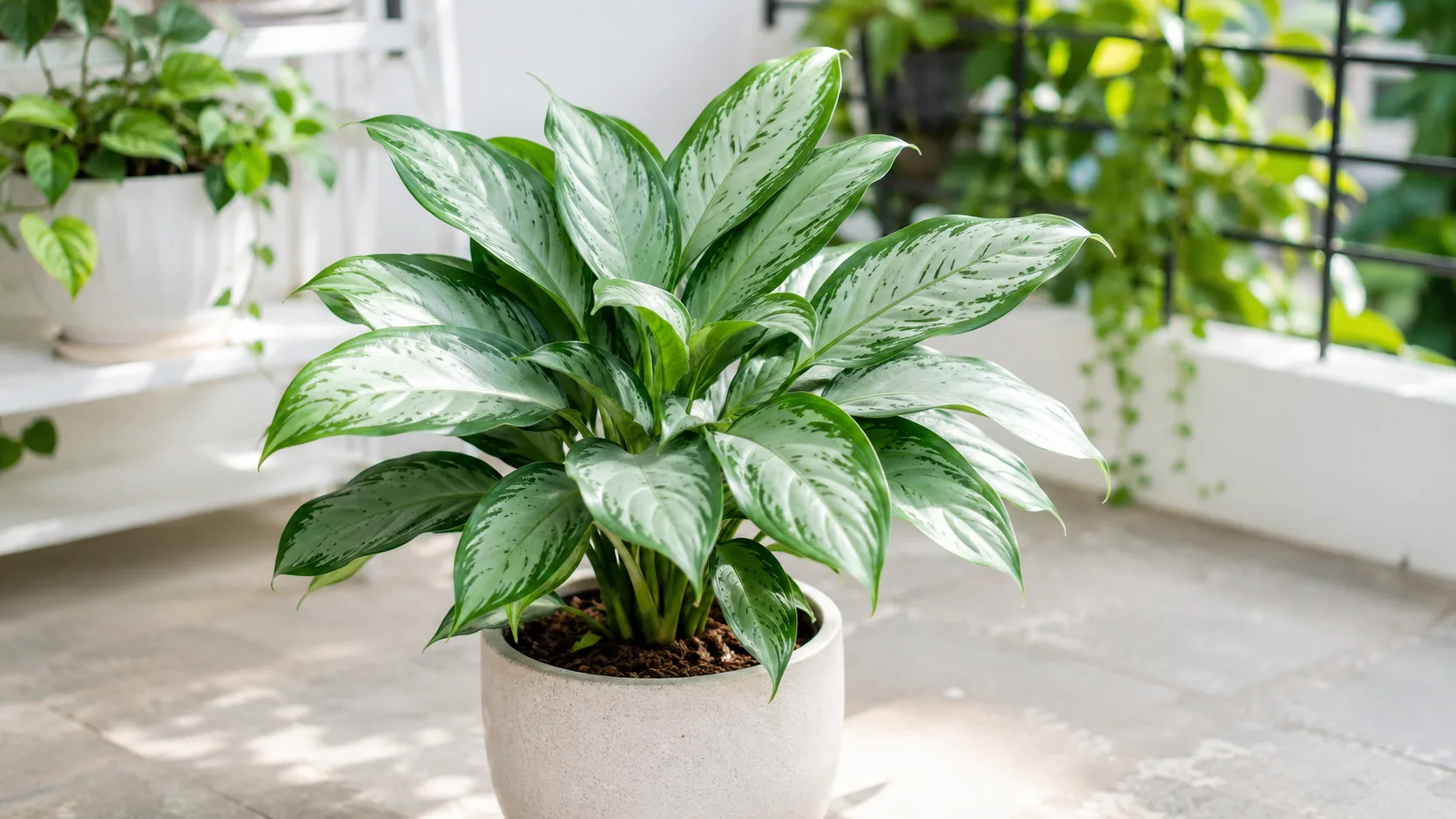
Aglaonema Silver Bay Fertilizer Guide: NPK, Schedule, and What to Avoid
Aglaonema Silver Bay Fertilizer Guide: NPK, Schedule, and What to Avoid
Aglaonema Silver Bay will live for years in a low corner with nothing more than a watering can and a window - but the difference between “surviving” and “pushing out a fresh silver-green leaf every few weeks” almost always comes down to a single, often-skipped habit: feeding it the right amount of the right fertilizer, in the right season, on the right day. Get fertilizer right and Silver Bay rewards you with dense, broad variegated leaves. Get it wrong and the same plant develops crispy brown tips, a white crust on the soil, and a slow retreat into itself that looks mysterious but is almost always salt damage.
This guide gives you the full picture: the NPK ratio that suits a foliage aroid like Silver Bay, the exact cadence for spring and summer, the rule for winter dormancy, the signs of over-fertilization specific to Aglaonema Silver Bay overview, and the recovery routine if you’ve already pushed too hard. The goal is to make the next fertilizer purchase the last one you have to think about.
What “fertilizer” actually means for an Aglaonema Silver Bay
Fertilizer is not food. A plant makes its own carbohydrates from light, water, and carbon dioxide. What fertilizer supplies is the mineral nutrition - nitrogen, phosphorus, potassium, and a long list of micronutrients like calcium, magnesium, iron, and manganese - that a confined pot of soil cannot keep supplying on its own forever. Every time you water, a little of that reserve is flushed out or used up. After a few months, the soil is genuinely running low, and new growth slows, gets paler, or stops altogether.
Aglaonema commutatum ‘Silver Bay’ evolved as an understory aroid in Southeast Asia, growing in leaf litter under taller trees. It is genetically wired to grow slowly and use resources conservatively. In a pot, that translates into a plant that does not need - and does not appreciate - heavy feeding. Most Aglaonema care guidance, including University of Florida IFAS Extension production guidelines, treats the genus as a low-to-moderate feeder that responds to balanced, modest nutrition rather than aggressive fertilizer programs. This is good news. It means the cost of “doing it right” is low, the risk of “doing too much” is high, and the entire feeding routine can be summed up in a few lines once you understand the why.
The best NPK ratio for Aglaonema Silver Bay
NPK is the three-number shorthand on a fertilizer bag that tells you the percentage of nitrogen (N), phosphorus (P), and potassium (K) by weight. The numbers do not need to be exact for Silver Bay. They need to be appropriate for a foliage aroid, and the labels on most general houseplant fertilizers are.
3-1-2 vs 10-10-10 vs 20-20-20: which to pick
For foliage aroids like Aglaonema, the University of Florida IFAS Extension recommends a 3:1:2 N-P-K ratio in production, meaning three parts nitrogen, one part phosphorus, and two parts potassium. That ratio mirrors how a leafy tropical plant actually uses nutrients: lots of nitrogen for new leaves, modest phosphorus for roots and energy transfer, and steady potassium for overall vigor and stress tolerance.
Two practical labels match that profile in stores: 3-1-2 foliage formulas (such as 9-3-6, 6-2-4, or 12-4-8), which are closest to the research-based ratio and the best fit if you want to fine-tune, and balanced 10-10-10 or 20-20-20, a perfectly safe default that ships in nearly every houseplant fertilizer on the shelf. The 1-1-1 ratio gives slightly more phosphorus than a true foliage plant technically needs, but at the diluted, infrequent rates used indoors, the difference is academic. For most home growers, a balanced 20-20-20 water-soluble powder or liquid is the easiest choice because it’s cheap, widely available, and forgiving when diluted. If you can find a 3-1-2 foliage formula, that’s a small upgrade - not a requirement.
A quick mental model helps you read any fertilizer label with confidence: Nitrogen (N) drives leaf and stem growth, so it matters most for Silver Bay, but more is not better - excess nitrogen produces soft, leggy growth and can mute crisp variegation on heavily patterned cultivars; Phosphorus (P) supports root development, energy transfer, and bloom production, a supporting player for a foliage plant that rarely flowers indoors; Potassium (K) regulates water use, disease resistance, and overall hardiness, and is what helps Silver Bay tolerate dry air and inconsistent watering. Micronutrients matter too. Silver Bay is known to develop iron, manganese, and copper deficiencies in soilless mixes over time, especially in long-lived container plants, so look for a fertilizer that includes a micronutrient package listing iron (Fe), manganese (Mn), and copper (Cu).
Liquid, slow-release, or organic: choosing the right format
Fertilizer format matters as much as NPK. Each option has a clear use case.
Why liquid feeds give the most control for indoor plants
Liquid and water-soluble fertilizers are the most popular choice for indoor aroids for three reasons: you control the dose, the plant absorbs them quickly, and any mistake can be flushed out within a few waterings. For Silver Bay, a single 20-20-20 water-soluble powder mixed at half strength into a watering can covers almost every feeding situation. Brands like Dyna-Gro Grow, Jack’s Classic 20-20-20, and most generic houseplant liquids work the same way.
When slow-release pellets make sense
Slow-release pellets (Osmocote and similar) are coated granules that release nutrients over 3–6 months as they are watered. They’re convenient, but they trade control for convenience. Once you’ve mixed them into the soil, you cannot easily reduce the dose if your Silver Bay starts showing leaf burn. They make sense for large containers in bright light where you want a “set and forget” routine, and for outdoor patio planters. For a typical 6- to 8-inch indoor Silver Bay, they tend to release more than the plant needs in the warmer months, and they keep releasing during the cool months when the plant has stopped growing. If you do use them, apply a single light top-dress in early spring - never in autumn or winter - and skip liquid feeding for the rest of the season.
Organic options: worm castings and compost tea
Worm castings (vermicompost) and compost tea are the two organic options most home growers can actually buy or make. Both are gentle, slow-release, and almost impossible to over-apply. Worm castings can be mixed into the potting medium at 10–20% of the total volume at Aglaonema Silver Bay repotting guide, or scratched into the top inch of soil once a month as a top dressing. Compost tea is brewed by steeping finished compost in dechlorinated water for 24 hours, then using the liquid to water the plant. A note on completeness: worm castings are not a complete fertilizer on their own. They are excellent for soil structure, microbial life, and micronutrient delivery, but their nitrogen-phosphorus-potassium content is too low to fully feed an actively growing aroid. Treat them as a supplement - a 10–20% soil amendment plus a monthly top dressing - and pair them with a balanced liquid feed during the main growing season. The same applies to compost tea.
How much fertilizer to use (and why “half strength” matters)
Aglaonema roots are sensitive to soluble salts. This is the single most important fact in this entire guide, and it is the reason every reputable care source for the genus repeats the same line: dilute to half the strength recommended on the label.
Salt sensitivity shows up fast on Silver Bay. The plant will not collapse dramatically - it will slowly crisp its leaf tips, develop a faint white crust on the soil surface, and produce smaller, paler new leaves. Many growers blame low humidity for tip burn that is actually fertilizer burn. Cutting the dose in half is the simplest fix.
A simple dilution example for a 20-20-20 powder
A typical 20-20-20 powder label says “1 teaspoon per gallon.” For Silver Bay, use ½ teaspoon per gallon. That single change covers most of the over-fertilization problems people encounter with this plant. If you prefer a 3-1-2 foliage formula at the label’s recommended dose, the math is the same: cut it in half. If you use a pre-diluted liquid like Espoma Organic Indoor Plant Food, follow the “indoor” or “gentle” rate on the back of the bottle rather than the “outdoor” rate, and ignore any urge to feed at every watering. Always apply fertilizer to moist soil. Watering the day before, or watering first and feeding an hour later, prevents the concentrated solution from burning dry root tips.
The Aglaonema Silver Bay feeding schedule by season
Silver Bay’s appetite is almost entirely seasonal. The plant is a light feeder for most of the year and stops feeding itself in winter. Match the schedule to the calendar - and to the new leaves you actually see.
Spring and summer: every 4–6 weeks
From the first signs of new growth in spring (usually a fresh leaf unfurling or a brighter center color) through the end of summer, feed every 4 to 6 weeks at half strength. In a bright, warm room, lean toward 4 weeks. In a lower-light room, lean toward 6 weeks. The “every 4–6 weeks” range is not a hard rule - it’s a band, and you’ll learn where your specific plant sits in it within a single growing season. UF/IFAS commercial production guidance for interiorscape Aglaonema uses a 20-20-20 water-soluble solution at roughly 50 ppm nitrogen once a month as the maintenance rate under interior conditions. That is a useful reference point: a monthly spring/summer dose of half-strength 20-20-20 sits right where the research says it should.
Autumn and winter: pause or sharply reduce
As days shorten and indoor light drops, Silver Bay enters a soft dormancy. New leaf production slows to a crawl or stops. Feeding a dormant plant is one of the most common Aglaonema mistakes, and one of the easiest to avoid. Stop fertilizing from late autumn through early spring. Resume only when you see active new growth - usually a fresh leaf center unfurling. If your Silver Bay sits under strong grow lights in a heated room through winter and continues to push new leaves, you can continue a reduced monthly feed at half strength. If it is just sitting there, leave it alone. The salt it does not use does not just disappear - it accumulates in the soil and burns roots in spring.
When NOT to fertilize your Aglaonema Silver Bay
Knowing when not to feed is as important as knowing when to feed. Four situations are clear no-feed moments, and the same logic applies across most indoor foliage plants. Recently repotted (within the last 4–6 weeks): fresh potting mix contains starter nutrients, and roots disturbed during repotting are vulnerable to salt burn, so wait at least a month, and ideally until you see new leaves, before resuming the regular feed. Stressed, dropping, or pest-infested: a Silver Bay with yellowing lower leaves, sudden leaf drop, root rot on Aglaonema Silver Bay, or active pests is telling you it cannot use the nutrients you would give it; fertilizer adds salt stress to an already over-loaded root system, so restore light, water, and pest control first and resume feeding when the plant is actively growing again. Soil is dry: never apply fertilizer to bone-dry soil because the concentrated solution runs straight past the roots or burns them on contact; water first, feed an hour later (or the next day) at half strength. Plant is dormant: no new growth in late autumn or winter means no feed, so resume in spring when active growth returns.
Signs of over-fertilization on Aglaonema Silver Bay
Over-fertilization is the most common Aglaonema problem that is blamed on something else. The classic “low humidity” tip burn on a Silver Bay that sits in a perfectly humid bathroom is, more often than not, fertilizer burn. Knowing what to look for lets you catch the problem in a single afternoon.
Reading the leaves: brown tips, slowed growth, sudden wilting
The earliest and most reliable leaf signal is brown, crispy leaf tips and margins on otherwise healthy-looking foliage. From there, the symptoms progress in roughly this order: smaller, paler new leaves (the plant has the salts but not the water balance to expand them fully); a general slowdown in growth during what should be the active season; sudden wilting even when the soil is moist (salts are reversing the osmotic gradient, drawing water out of roots); leaf drop, starting with the oldest leaves; and blackened, desiccated roots if the situation is severe and prolonged. None of these symptoms are unique to fertilizer burn, which is why the diagnostic step that follows matters as much as recognizing the leaf signal.
Reading the soil: white crust and salt rings
Lift the pot and look at the soil surface and the rim. A white or yellow crust on the soil is dried soluble salt. A white ring around the inside of the pot, just above the soil line, is the same thing concentrated by evaporation. Both are unambiguous evidence that salts have built up beyond what the plant can use, and the standard extension-service guidance - from Penn State, Nebraska, and UF/IFAS - is to leach the soil, reduce the dose, and recheck in a few weeks. The pour-through test is the more precise version of this check. If you have an inexpensive EC meter, water the pot until 50 mL of drainage comes out, then measure the conductivity of that drainage. 1 dS/m is depleted and the plant is showing deficiency; 2 dS/m is the target; 3 dS/m or higher is over-fed and requires leaching and a reduced schedule, the same pour-through thresholds that UF/IFAS EP160 sets for interiorscape Aglaonema production.
How to flush salts out of the pot (the recovery routine)
If you see salt crust, leaf-tip burn, or any of the over-fertilization symptoms above, the recovery routine is the same and it is simple. Step 1 - stop feeding immediately: no more fertilizer for at least 4–6 weeks, plain water only. Step 2 - scrape off the crust: if there is a visible white or yellow crust on the soil surface, gently remove the top 1–2 cm of soil and discard it, and do not remove more than a quarter of the total soil volume. Step 3 - leach slowly: take the plant to a sink or bathtub and pour room-temperature water through the pot slowly and steadily, roughly the volume of the pot two to three times - for an 8-inch pot, that’s about 4–6 liters total - and let it drain freely. Step 4 - repeat once: Penn State Extension’s guidance for salt-loaded container plants is to repeat the leaching 2–3 hours later, or the next day, until the drainage runs clear. Step 5 - hold off feeding for a month: resume at half strength only when you see a fresh leaf emerging, and if leaves were badly burned those leaves will not heal - the recovery signal is the next round of new growth. For a severe case - blackened roots, total leaf drop - unpot the plant, rinse the rootball under tepid water, trim any black or mushy roots, and repot into fresh, well-draining aroid mix, and do not fertilize the repotted plant for at least six weeks.
Connecting fertilizer to light, water, and pot size
Fertilizer is the smallest part of Silver Bay’s care routine. The bigger inputs are light and water, and the three are linked. A Silver Bay in bright, indirect light uses more nutrients and will reward a 4-week cadence. The same plant in a dim corner uses less and is better served by 6-week intervals or a slightly weaker dilution. A useful self-test: count the number of new leaves your plant produced during the previous growing season. Two to four new leaves from spring through early autumn is healthy, slow growth that lines up with a 5–6 week feed. Six or more new leaves usually means light and feed are both strong and you are on the right cadence. Zero or one new leaf points at a light problem first, a feed problem second.
Pot size matters too. A large container holds more soil, which means more nutrient reserve and more buffering against salt spikes. A small 4- or 5-inch pot holds very little soil, dries out fast, and concentrates salts quickly. If you keep your Silver Bay in a small pot, lean toward the longer end of the 4–6 week range, dilute slightly more aggressively, and flush once a month as a routine, not just as a rescue. Watering practice is the final link. If you water heavily and let excess drain, you are already leaching the soil a little with each irrigation. If you water lightly and frequently, salts concentrate. Either is fine, but adjust fertilizer to match. Heavy waterers can stay on the standard half-strength schedule. Light waterers should cut the dose further or extend the interval.
Soil pH is the last silent variable. Silver Bay prefers a slightly acidic to neutral mix in the 5.5–6.5 pH range, the same band most peat-based aroid mixes sit in and the band UF/IFAS EP160 recommends for quality Aglaonema production. If your tap water is very alkaline (above 7.5) and you have been watering for a year or more without flushing, the soil pH can drift up, which locks out iron and manganese even when fertilizer is present. That is one of the under-appreciated causes of interveinal yellowing on otherwise well-fed Silver Bay. The fix is the same as for salt buildup: leach thoroughly with room-temperature water, then resume the half-strength schedule. Long term, switching to filtered, distilled, or 24-hour-rested water in alkaline regions prevents the drift from coming back.
Conclusion
Aglaonema Silver Bay fertilizer is simple once the framework is clear: a balanced houseplant fertilizer at half strength, every 4 to 6 weeks during the active growing season, with a hard pause through winter and an automatic “no” whenever the plant is recently repotted, stressed, dry, or dormant. The plant evolved as a slow-growing understory aroid and it stays that way in a pot - it does not need much, and it will tell you, very clearly, when it has had too much. Read the leaves for brown tips and the soil for white crust, flush salts out the moment either appears, and use the recovery routine in this guide as your safety net.
The reward for getting fertilizer right is a plant that quietly pushes out a new silver-green leaf every few weeks through the growing season, with no leaf burn and no salt stress. That is the standard. Stick to it and you will not need to think about fertilizer again until next spring.
When to use this page vs other Aglaonema Silver Bay guides
- Aglaonema Silver Bay overview - Start here for whole-plant context before deep-diving this topic.
- Aglaonema Silver Bay problems hub - Jump to symptom-specific fix guides when this care topic does not resolve the issue.
Related Aglaonema Silver Bay guides
- Aglaonema Silver Bay overview
- Aglaonema Silver Bay watering
- Aglaonema Silver Bay light
- Aglaonema Silver Bay soil
- Aglaonema Silver Bay propagation
- Aglaonema Silver Bay repotting
- Aglaonema Silver Bay problems
Related tool
Try the Fertilizer Dilution Calculator with aglaonema-silver-bay pre-selected to estimate needs for your setup.