Monstera Not Splitting Leaves? 5-Minute Diagnosis and Fixes
Find out why Monstera leaves are not splitting and fix light, maturity, support, watering or nutrient issues.

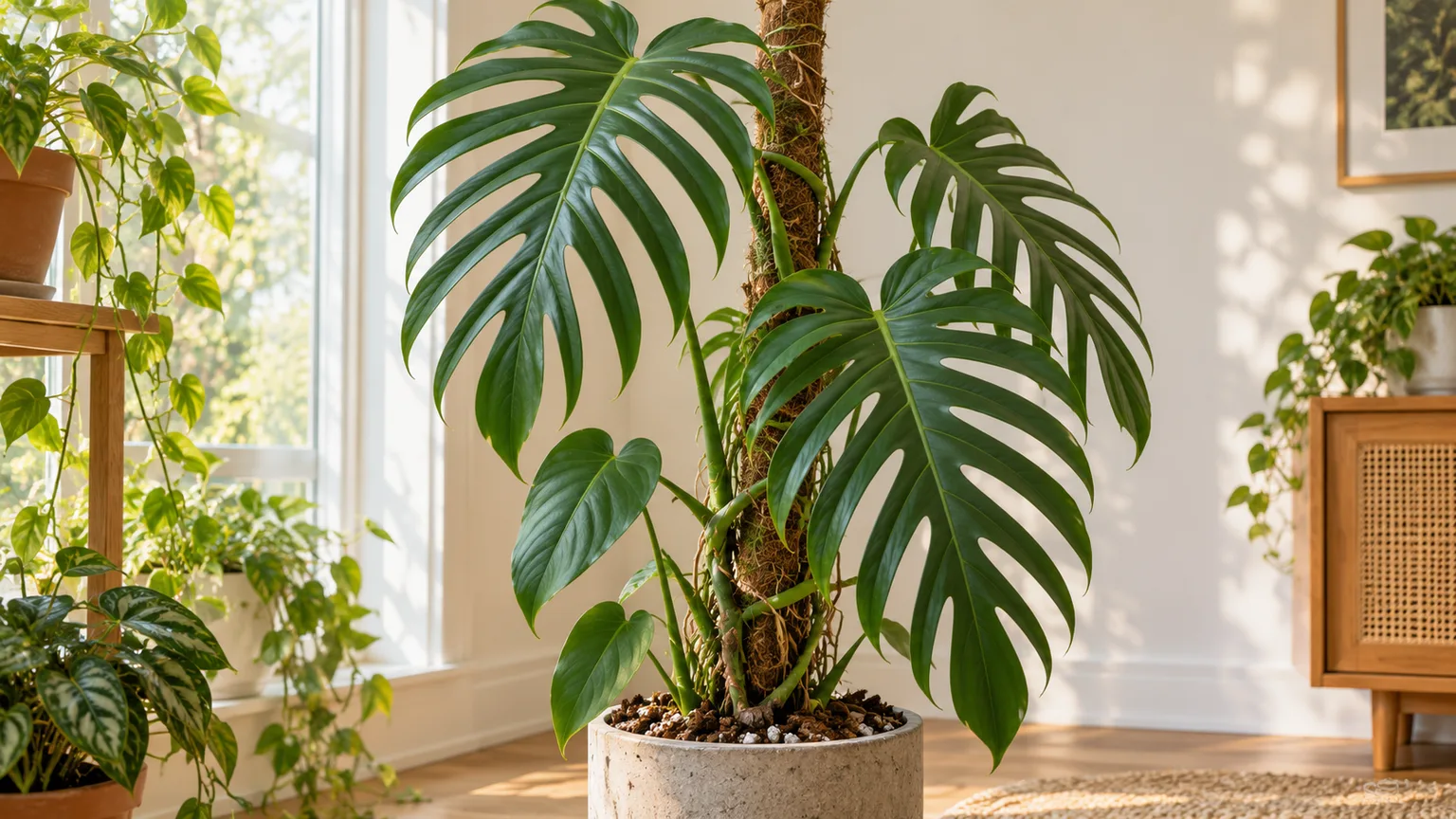
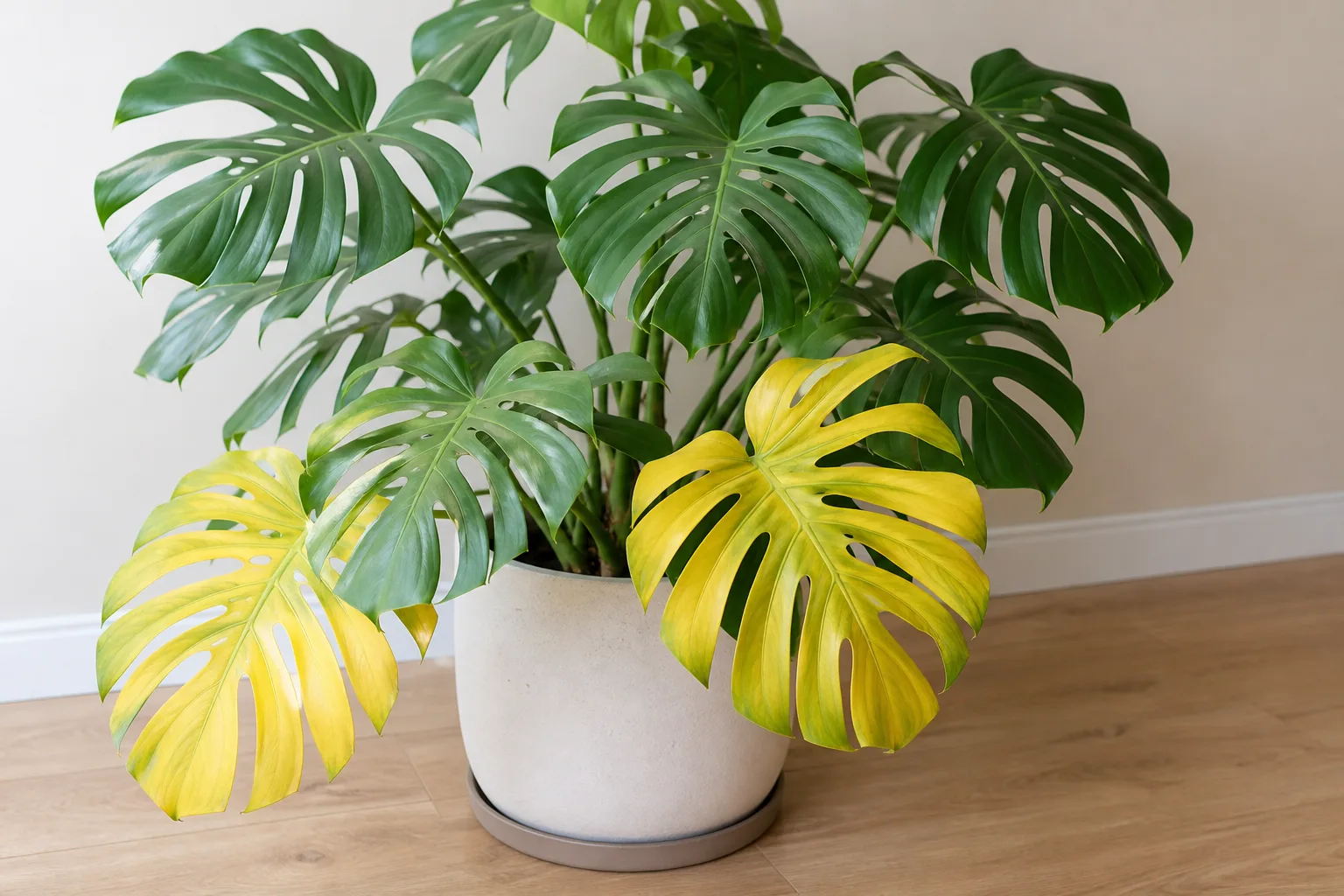
Your Monstera is putting out healthy, glossy, dark green leaves. They just will not split. That gap between what you are doing and what you expected is the most common frustration with this plant, and it almost always traces back to one of four bottlenecks: the plant is still juvenile, the light is too weak to support mature foliage, the vine has nothing to climb, or something in the care routine is quietly slowing growth. Run the diagnostic below before you change a thing. Each check is built to surface the biggest blocker first, because once you fix that, fenestration usually appears on the next few new leaves rather than on the ones you already have.
This page is a triage guide. For the science of why Monstera leaves fenestrate at all, the deep explainer on getting Monstera leaves to split is the longer read. For everyday watering, light, soil, and feeding routines, the Monstera deliciosa care hub is the canonical home. If your plant is a long, mature vine that recently started dropping fenestrations on new leaves, jump straight to the not-enough-light problem page instead.
Quick Answer: The Four Reasons Solid Leaves Stick Around
If your Monstera is healthy but not splitting, one of these four bottlenecks is usually blocking fenestration:
- The plant is still juvenile. A small nursery Monstera with three- to five-inch heart-shaped leaves is on a developmental timer; fenestrations appear once the plant reaches substantial size, usually by the time leaves are ten to thirteen inches wide and the plant is climbing.
- Light is too weak for mature foliage. “Surviving” indoor light is not the same as “mature growth” light. Monsteras can stay green in dim corners for years and still never produce fenestrated leaves.
- The vine has no support to climb. Monsteras are climbing hemiepiphytes. Without a moss pole or trellis, the plant stays more juvenile-looking, regardless of light.
- Care stress is stalling growth. Inconsistent watering, dense soil, root problems, and cold drafts keep growth slow enough that mature foliage never develops.
That list also tells you the order to work in. Fix the biggest bottleneck first, then judge the result on the next two to four leaves, not on the current one. Existing leaves do not normally gain new holes as they age (House Plant Journal), so progress shows up on new growth, not on the leaves you already have.
Where This Guide Fits in the Monstera Cluster
If you have searched Monstera care for more than five minutes, you have noticed the cluster is dense. Different pages cover the same plant from different angles, and the angle you need depends on what stage your plant is in. Here is how this page is positioned:
| Your situation | Use this page? | Better next stop |
|---|---|---|
| Leaves look healthy but no splits, you want a triage | Yes | Continue here |
| You want the botany of fenestration in depth | No | How to get Monstera leaves to split |
| You want a full Monstera deliciosa care encyclopedia | No | Monstera deliciosa hub |
| Mature vine, fenestrations disappearing on new leaves | Maybe briefly | Not-enough-light problem page |
| Light placement questions in general | No | Monstera light requirements |
| Quick checklist for beginners | No | Monstera care 101 |
| Advanced setup and momentum tips | No | Secrets to thriving Monstera plants |
The narrow job of this page is a 5-minute diagnostic and the fix sequence that follows it. Everything else is delegated.
Diagnose Your Plant in 5 Minutes
You do not need a moisture meter or a light meter to start. Three short checks, done in any order, will usually tell you which of the four bottlenecks is the biggest one. Look at the plant, not the calendar.
Check 1: Leaf Size, Spacing, and Vigor
Start with the leaves themselves. Are new leaves getting larger over time, or smaller? Are the spaces between leaves on the vine getting longer and leggier? Are petioles reaching hard toward one direction? Small, increasingly distant leaves usually point to insufficient light. Tiny but otherwise healthy leaves on a very young plant point to immaturity. A plant that is not enlarging leaf size over time is not on a strong path to fenestration yet.
Pay attention to recent growth, not the plant’s overall age alone. A two-year-old plant that has barely grown is not effectively “older” in the way that matters for splits. Maturity indoors is tightly linked to sustained vigorous growth, which is why one neglected plant can stay juvenile-looking for years while another in a better setup starts producing dramatic leaves much sooner.
Check 2: Light Quality and Window Placement
Now look at where the plant actually lives. “Near a window” is not enough detail. Is the plant right in front of bright filtered light, or is it across the room? Does it get bright light for much of the day, or just a brief glow? Penn State Extension describes Monstera as a tropical understory plant that prefers bright light but not direct sun indoors, and notes that it gets “leggy” in lower light (Penn State Extension). The RHS agrees: if mature leaves are not showing holes, the plant should be moved to a brighter spot (RHS).
For growers who want a measurable cue: target roughly 200 to 400 foot-candles at the leaf canopy for sustained fenestration on a mature vine. A soft defined shadow on your hand at midday near the leaves suggests usable light; almost no shadow means the spot is too dim for the Swiss cheese look most owners want.
Check 3: Roots, Soil, and Climbing Support
Finally, inspect the pot and structure. Is the soil dense and heavy, or airy and fast-draining? Does water sit in the saucer? Are roots circling badly or emerging from drainage holes? Is there any support for the vine to climb? UConn recommends a well-draining mix and notes that moss poles mimic natural climbing surfaces (UConn Home and Garden Education Center). Penn State Extension adds that upright support is consistently linked with larger, fenestrated leaves (Penn State Extension).
Growth bottlenecks stack. A plant in weak light, dense soil, and no support will rarely produce the leaf shape you want. A plant in good light with airy soil and a pole can accelerate quickly once the active growing season starts. Do not overcomplicate the diagnosis. Ask one blunt question: What is most obviously preventing strong upward growth? Then fix that before anything else.
The Four Reasons Monstera Leaves Stay Solid
The four-cause framework below is the structure the rest of the page hangs on. Use it together with the diagnostic above, not instead of it. If the diagnostic and the framework disagree, trust the diagnostic — your plant’s actual signals beat a generic checklist every time.
Reason 1: The Plant Is Still Juvenile
This is the most common reason, especially with small retail plants. Young Monstera deliciosa naturally produce smaller, solid, heart-shaped leaves before they transition into mature foliage. NC State Extension’s plant profile describes the species as a climbing evergreen with large, perforated leaves “only on mature plants,” and notes that leaves are gigantic (up to a foot or more) and only develop holes as the leaf grows (NC State Extension). That means a young plant can be perfectly healthy and still look disappointing if your only success metric is “does it have holes yet?” Think of juvenile leaves like training wheels. The plant is still building root mass, stem strength, leaf size, and climbing behavior. Pushing it harder will not skip the developmental stage. In many homes, the right move is not to “force” fenestration. It is to remove delays and let the plant mature faster.
Reason 2: Light Is Too Weak for Mature Foliage
If the plant is old enough but still pushing out small, solid leaves, weak light is the first suspect. Penn State Extension recommends a site near a sunny window where the plant can receive bright light but not direct sun, and warns that leggy growth is a sign the spot is too dim (Penn State Extension). House Plant Journal’s rule of thumb is one of the most useful here: bright indirect light means the plant can “see the sky and not necessarily the sun” (House Plant Journal). That is much brighter than the average dim corner.
This is where people get tripped up by the phrase “low light plant.” Monstera can survive in moderate indoor light, but survival is not the same thing as mature, dramatic foliage. A plant ten feet away from a window may stay alive for years and still never produce the leaves you expected. Bright indirect light near an east-facing window, three to five feet back from a south-facing window behind a sheer curtain, or directly under a full-spectrum grow light for ten to twelve hours a day are the realistic placements.
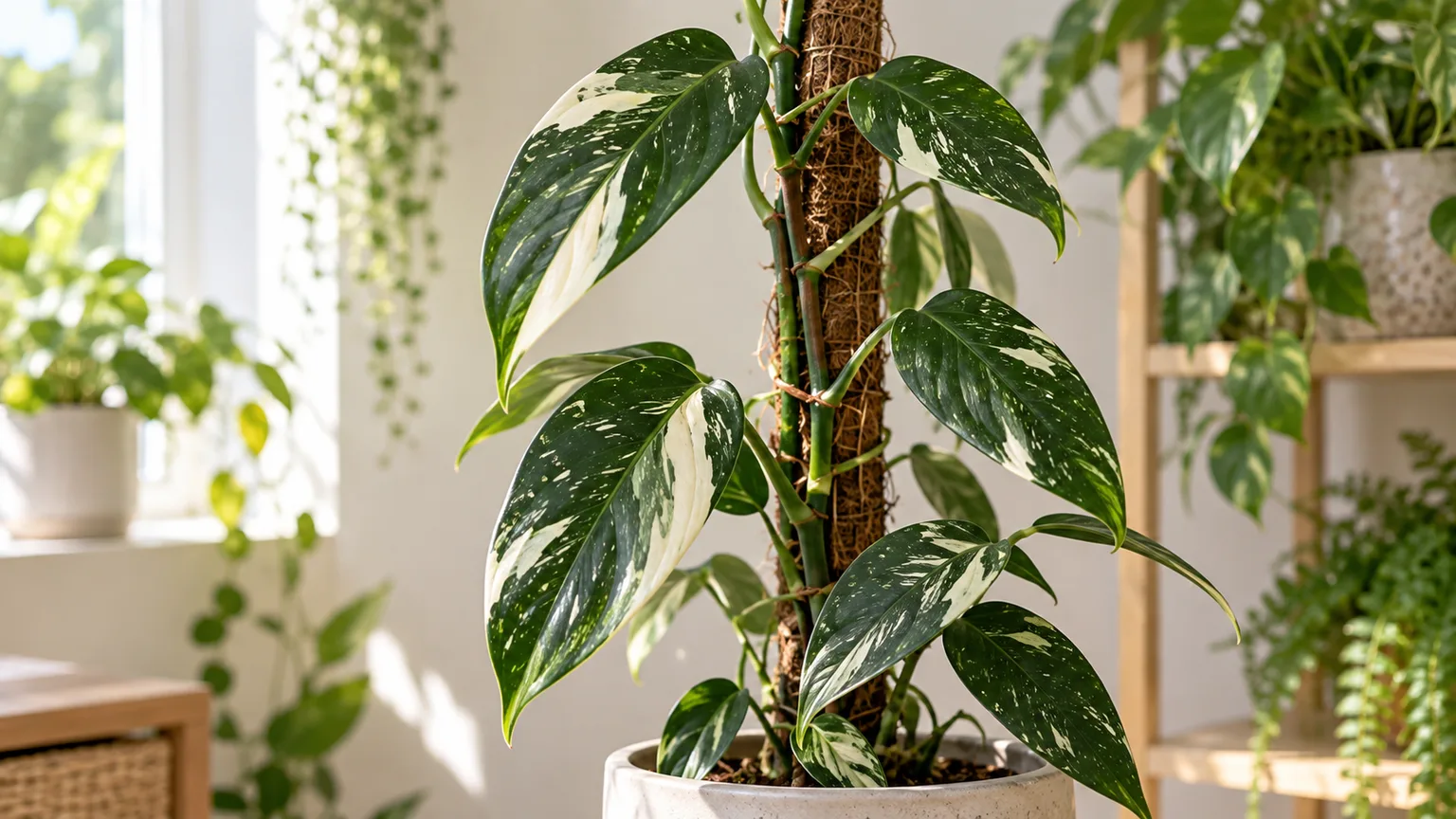
Variegated cultivars need more. NC State Extension notes that variegated forms such as ‘Albo Variegata’ and ‘Thai Constellation’ need more sunlight than darker green cultivars because the white sectors photosynthesize less efficiently (NC State Extension). Expect slower splits on variegated plants in the same window where a solid-green Monstera would fenestrate. If you own a speckled or sector-variegated plant, treat weak light as the first suspect even when the leaves look otherwise healthy.
Reason 3: Nothing to Climb
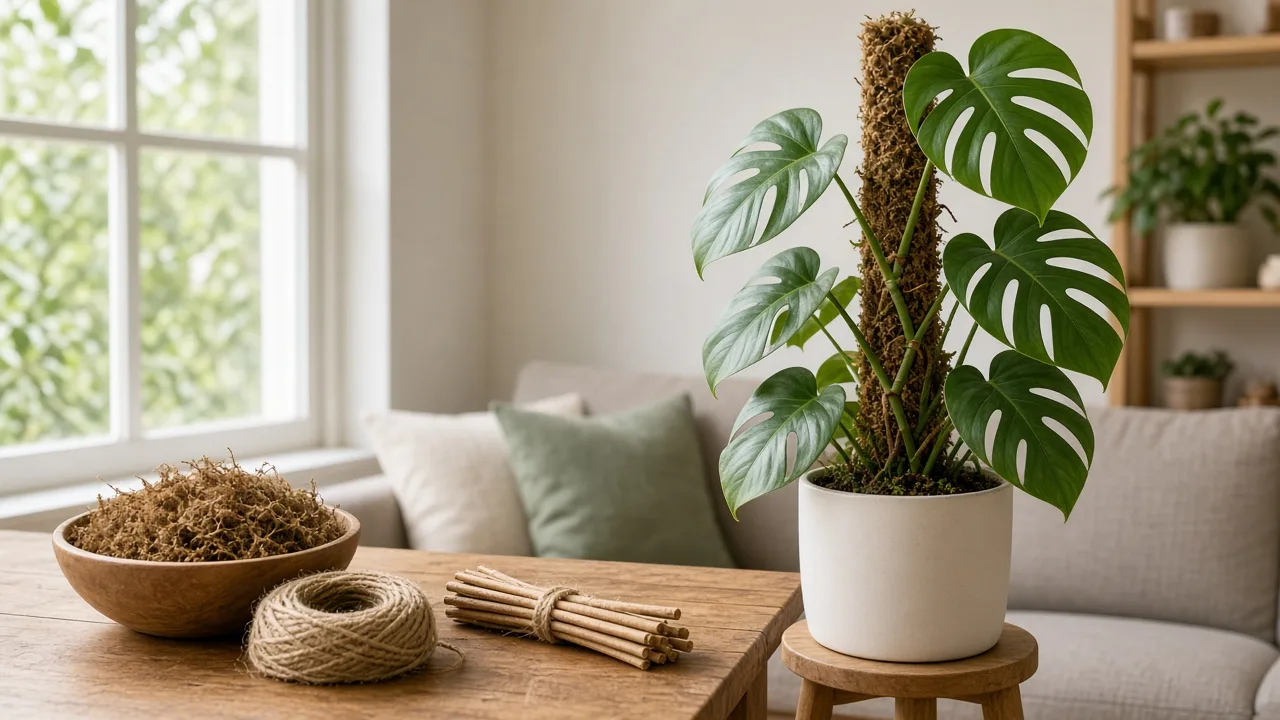
This is the most underrated factor. In nature, Monstera deliciosa is a climbing hemiepiphyte that begins life on the forest floor and shifts to an epiphytic climber on tree trunks once it contacts something to grip (NC State Extension). Indoors, when it sprawls horizontally or slumps without support, it often stays in a more juvenile-looking state. Penn State Extension states that when Monstera is trained upright on support, the leaves become larger and develop the typical mature fenestrations (Penn State Extension). UConn says much the same and notes that once vines successfully attach to a moss pole, leaf size typically increases (UConn Home and Garden Education Center).
That explains why two Monsteras in equally bright rooms can look completely different. The one climbing a pole can throw larger, more mature leaves. The unsupported one can stay floppy, smaller, and less fenestrated. Support does not “cause” fenestration on its own, but it helps the plant behave more like the climbing species it is. A moss pole is not decoration. It is a structural cue that can improve leaf size, aerial root engagement, and overall maturity pattern.
Reason 4: Care Stress Is Stalling Growth
Fenestration does not happen when growth is weak, stalled, or stressed. That stress can come from inconsistent watering, poor drainage, root problems, cold temperatures, underfeeding during active growth, or a potting setup that keeps the plant either bone dry or soggy. UConn recommends allowing the top two to three inches of soil to dry between waterings and warns that Monstera is prone to root diseases when conditions stay too wet (UConn Home and Garden Education Center). Missouri Botanical Garden similarly recommends a peaty soil-based mix and letting the soil dry somewhat between waterings (Missouri Botanical Garden).
Penn State Extension adds that Monstera prefers warm temperatures between 60° and 85°F and abhors cold drafts (Penn State Extension). Drafts below about 13 °C (55 °F) — common beside single-pane winter windows or exterior doors — can stall growth even when the room looks bright enough. If new leaves stay small and solid through winter, check whether cold air is hitting the pot at night before you blame light alone.
There is also a simple distinction that matters: true fenestration is planned growth; tearing is damage. If your Monstera is producing limp, thin, discolored, or misshapen leaves, the issue is not “how to get more holes.” The issue is how to restore strong growth first.
Fenestration Basics You Need First
A lot of frustration disappears once you understand what fenestration is and what it is not. It is not a cosmetic trick that appears on demand after one sunny week. It is a mature leaf trait produced when the plant has enough energy, enough developmental progress, and the right environment to build larger, more complex leaves. Field research summarized in the University of South Florida Digital Commons repository tested three adaptive hypotheses for Monstera leaf fenestration (water capture, wind damage, and herbivory deterrence) and found the strongest support for a water-capture advantage in the understory climbing habit, with wind reduction as a likely secondary benefit.
Do Existing Leaves Split Later?
Usually, no. House Plant Journal states this directly: a leaf does not develop more cuts or holes as it ages; instead, the next leaf may come out more complex if the plant is happy (House Plant Journal). So if you moved your plant into brighter light yesterday, do not expect the current unsplit leaf to transform next week. Watch the next leaf. Then the one after that. Improvement usually appears as a sequence: stronger petioles, larger leaf size, more consistent spacing, then deeper cuts or more holes. Fenestration is the lagging indicator of better care. It shows up after the plant has already been growing better for a while.
Fenestration vs Tearing: How to Tell the Difference
This table is worth memorizing, because a leaf with random ragged holes is not the same milestone as a leaf with clean splits.
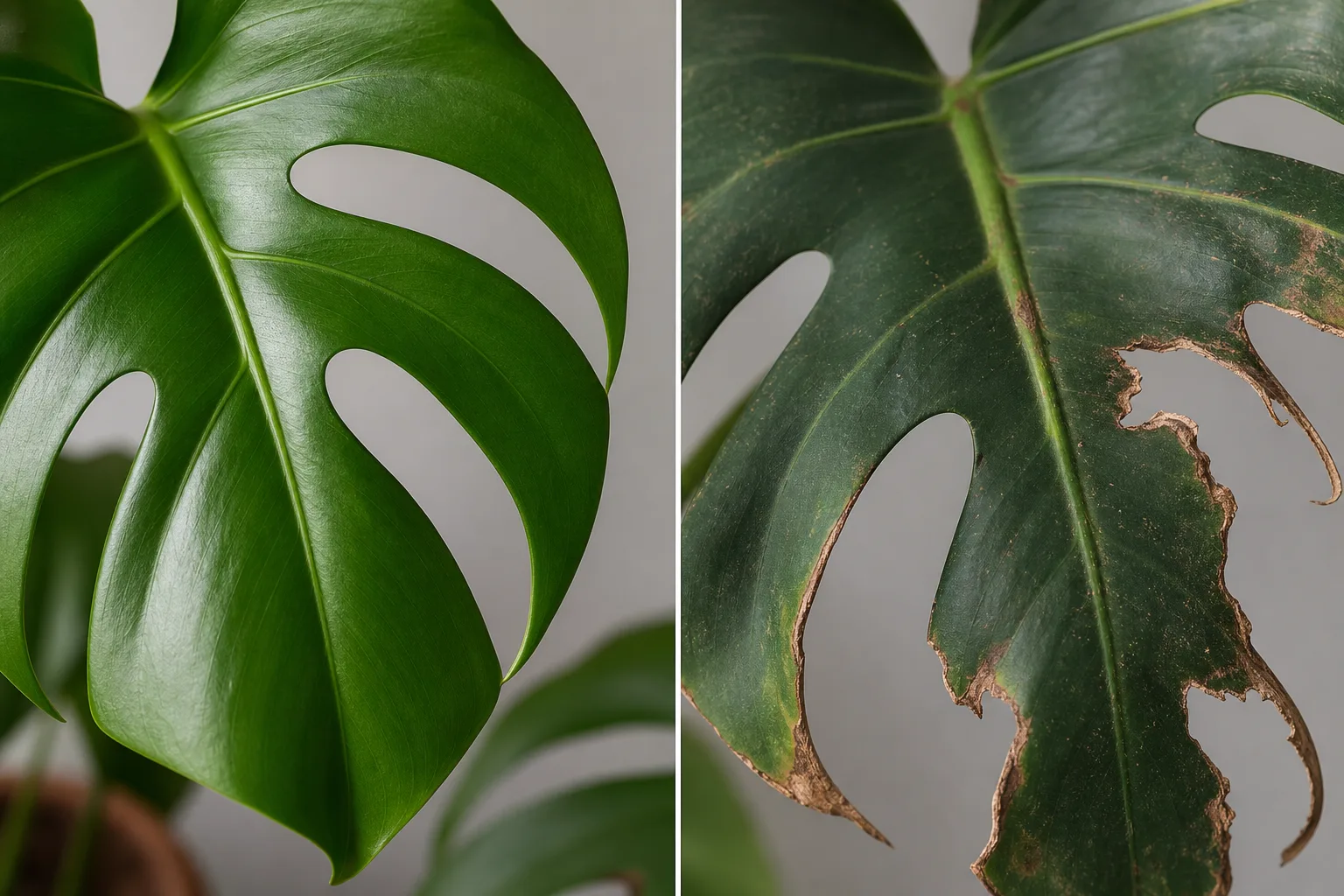
| Signal | True fenestration | Damage or tearing |
|---|---|---|
| Edge shape | Smooth, oval, or lobed | Jagged, irregular, brown-edged |
| Timing on the leaf | Visible as the leaf unfurls | Appears after the leaf hardens |
| Pattern | Mirrors other leaves on the vine | Random, often one leaf only |
| Petiole condition | Firm, healthy | Limp, thin, or discolored nearby |
| Likely cause | Maturity + light + support | Underwatering, low humidity, mechanical damage |
If the new holes look more like the right column than the left, fix watering and humidity before chasing fenestration. For ragged holes on otherwise mature vines, see the holes-in-leaves problem page.
The Fix Sequence That Works Indoors
The strategy is straightforward: increase usable light, give the plant something to climb, and remove the stressors slowing growth. That sequence shows up across extension care guidance, and it lines up with how Monstera naturally matures. Do these three steps in order. Step 1 is the highest-leverage move in most homes.
Step 1: Upgrade the Light (Without Scorching)
Move the plant closer to a bright window, but avoid harsh direct midday sun on leaves that are not acclimated. If your home is naturally dim, add a full-spectrum grow light and keep it consistent. Better light does more than encourage holes. It increases the plant’s energy budget, which supports stronger roots, larger leaves, sturdier stems, and the maturity threshold fenestration depends on.
One caution: do not swing from cave-dark to scorched. UConn notes that Monstera leaves can burn if light levels change too aggressively, and the plant should be acclimated carefully (UConn Home and Garden Education Center). The target is bright, usable, steady light, not punishment. A reasonable acclimation plan is to move the plant closer to the new light source by one to two feet per week, or to run a grow light for two to three hours a day for the first week and increase by an hour or two every few days until you reach ten to twelve hours.
Editorial grow log (March 2026): In a south-facing sixth-floor apartment in Chicago, a solid-green Monstera deliciosa that had produced only heart-shaped leaves for eighteen months was moved from eight feet to three feet from a sheer-curtained south window and given a coco coir pole in the same week. Leaf 1 (unfurled week 2) was slightly larger with shallow edge notches. Leaf 2 (week 8) showed deeper margin cuts and the first interior hole. The takeaway is not a guarantee for every home — it is that measurable progress usually appears on the second or third leaf after light and support change, not on the leaf already on the plant.
Step 2: Add a Real Climbing Support
If you only change one structural thing, make it this. Install a moss pole, coco coir pole, or sturdy trellis that the vine can actually grip. Penn State Extension lists moss sticks, trellises, bamboo stakes, and boards covered with sphagnum moss as workable options (Penn State Extension). UConn adds that moss poles mimic the porous surfaces Monsteras climb in the wild (UConn Home and Garden Education Center).
Why does this work? Because climbing changes the plant’s posture and growth behavior. Unsupported Monsteras often sprawl, twist, and produce less impressive foliage. A supported Monstera can orient upward, anchor aerial roots, and allocate growth more like it would on a tree trunk in nature. Secure the vine gently with soft plant ties. Position aerial roots toward the pole where possible. Keep the moss lightly moist so aerial roots engage.
Step 3: Remove the Growth Bottlenecks
Light and support do most of the heavy lifting, but they will not overcome a chronically stressed plant. If your Monstera is sitting in dense soil, overwatered, bone dry for long stretches, chilled by drafts, or badly root bound, it may never build the momentum needed for mature leaves. UConn recommends letting the top two to three inches of soil dry between waterings (UConn Home and Garden Education Center). Missouri Botanical Garden recommends regular growing-season watering while letting soil dry somewhat between waterings and reducing watering from fall to late winter (Missouri Botanical Garden).
Feeding matters too, but only in proportion. UConn notes Monstera can tolerate regular fertilization in active growth periods while being sensitive to high soil salts (UConn Home and Garden Education Center). In other words, feed a growing plant sensibly. Do not try to fertilizer-bomb a weak plant into adulthood.
Humidity plays a supporting role. Penn State Extension notes that Monstera prefers humidity above fifty percent and may benefit from a nearby humidifier if the indoor space is very dry (Penn State Extension). Humidity alone usually does not create fenestration, but very dry air can contribute to stress and slower growth. Think of humidity as a growth smoother, not the main engine.
What to Expect on the Next Leaves (Progression Table)
Improvement shows up on new leaves, not on the unsplit ones you already have. Use this four-leaf progression as a working benchmark once you have fixed the biggest bottleneck. Times are rough and depend on your active growing season; in dim winter conditions, expect them to stretch.
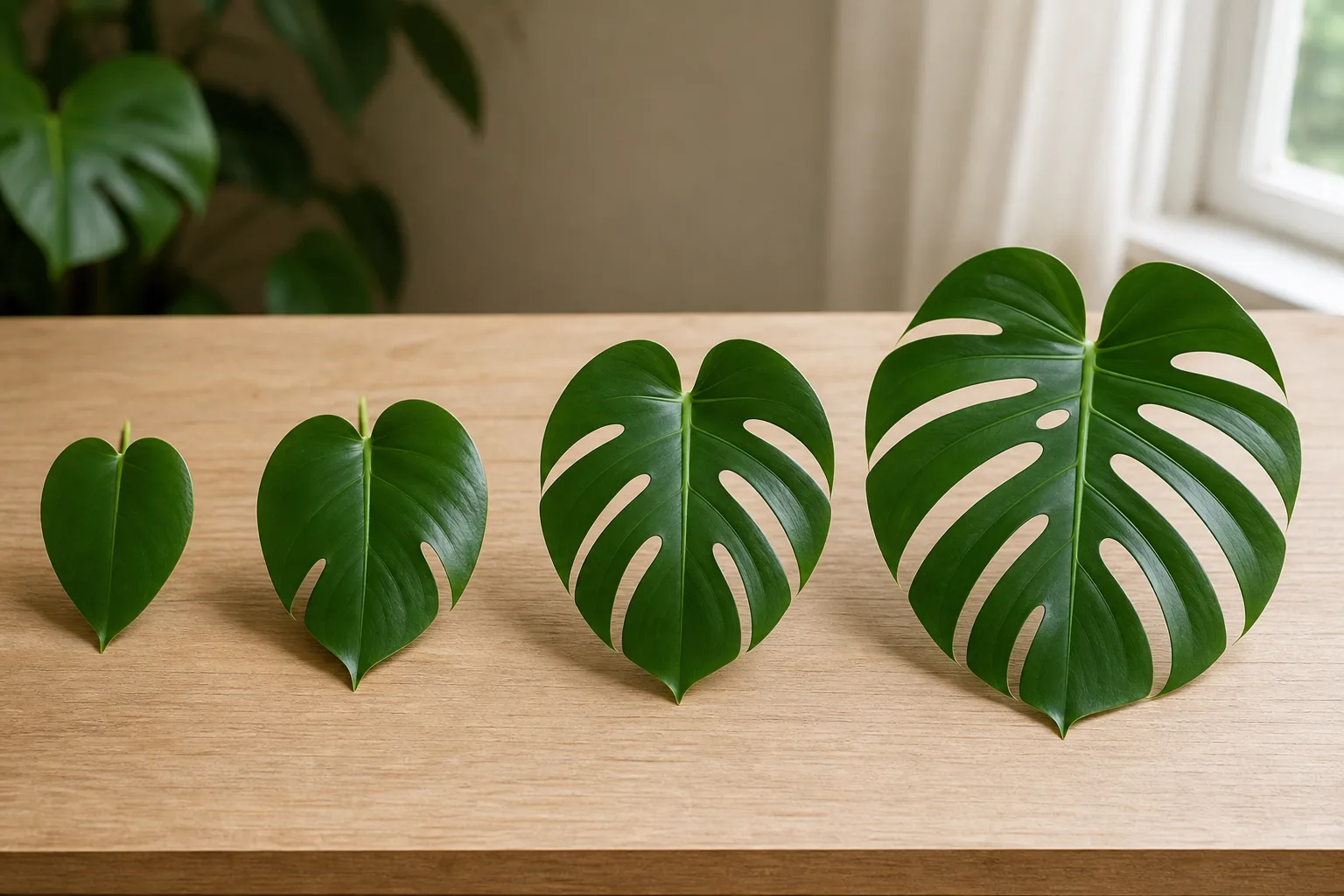
| Leaf stage | What you should see | What to do |
|---|---|---|
| Leaf 1 (next new leaf after fixes) | Slightly larger blade, shorter petiole, healthier green color; still mostly solid or with shallow edge notches | Keep conditions steady. Do not move, repot, or fertilize aggressively yet |
| Leaf 2 (about 4–8 weeks later) | Noticeably larger leaf, deeper edge notches, the first interior holes may appear on vigorous vines | If light has not improved, add or extend grow-light hours now |
| Leaf 3 (mid-season on a healthy vine) | Multiple interior holes plus deeper splits; petioles thicker; new aerial roots reaching for the pole | Begin light balanced fertilizer if you have not already; refresh moss if it has dried out |
| Leaf 4 (full growing season later) | Mature fenestrated form matching the species; new growth consistently producing splits | Maintain routine. The plant has crossed the maturity threshold |
If you reach leaf 2 and see no improvement at all, the bottleneck is somewhere you have not yet fixed. Re-check light intensity at the canopy, pole engagement, soil dryness between waterings, and root health at the next repot window. If splits still fail after two full growing seasons with corrected conditions, consider consulting your county extension office or a local master gardener program for a hands-on diagnosis.
Could It Be the Wrong Plant? Monstera vs Lookalikes
Not every plant sold under a Monstera-ish common name behaves the same way. NC State Extension’s Monstera entry notes that “split-leaf philodendron” is a common misnomer for M. deliciosa, which can confuse buyers who bring home a Philodendron bipinnatifidum expecting a Monstera (NC State Extension). If your expectations came from photos of giant Monstera deliciosa leaves, make sure that is the plant you actually own.
Quick identity check:
- Monstera deliciosa: round, heart-shaped leaves with both edge splits and interior holes when mature.
- Monstera adansonii: narrower, more oval leaves with interior holes; rarely produces edge splits.
- Rhaphidophora tetrasperma (“mini Monstera”): smaller, more delicate leaves with splits but no interior holes; vining habit.
- Philodendron bipinnatifidum (often called “split-leaf philodendron”): deeply lobed leaves but no interior holes; not a climber in the same way.
If you have one of the lookalikes, most of the same advice still applies, but the fenestration pattern will be different. A Rhaphidophora, for example, usually produces splits on a smaller plant than a Monstera does.
For Full Monstera Deliciosa Care, See
This page is a focused troubleshooting checklist. For everything beyond triage, use these:
- Monstera deliciosa hub — the canonical species home with watering, light, soil, fertilizer, repotting, propagation, and problem pages.
- Monstera care 101 — short onboarding checklist for beginners.
- Monstera care guide for beginners — longer beginner walkthrough.
- How to get Monstera leaves to split — the science explainer with deeper fenestration mechanics.
- Monstera light requirements — placement, window choice, and grow-light baselines.
- Not-enough-light problem page — when a mature vine has started dropping fenestrations on new leaves (mature-vine reversion).
- Holes-in-leaves problem page — when holes look ragged rather than smooth.
If you only click one of those, click the Monstera deliciosa hub. It is the canonical home for everything beyond the diagnostic you just ran.
Conclusion
If your Monstera is not splitting leaves, the answer is almost never mysterious. It is one of four bottlenecks: the plant is too young, the light is too weak, the vine has nothing to climb, or something in the care routine is quietly stalling growth. Run the 5-minute diagnostic to find the largest gap, fix that first, then judge the result on the next two to four leaves using the progression table. Healthy, unsplit leaves are not failure. They are information. Read them correctly, fix the bottleneck, and your Monstera has a very good chance of doing what it is built to do. Just not on your timeline. On a strong-growth timeline. And that is the one that actually matters.