Leggy Growth on Tradescantia Zebrina: Causes, Checks & Fixes
Quick answer
Leggy Tradescantia zebrina shows long bare internodes with colorful leaves clustered at vine tips-usually from chronic low light, skipped pinching, or crown shading in hanging baskets. First step: remove the longest leafless middle section on each vine and pinch remaining tips just above a node.
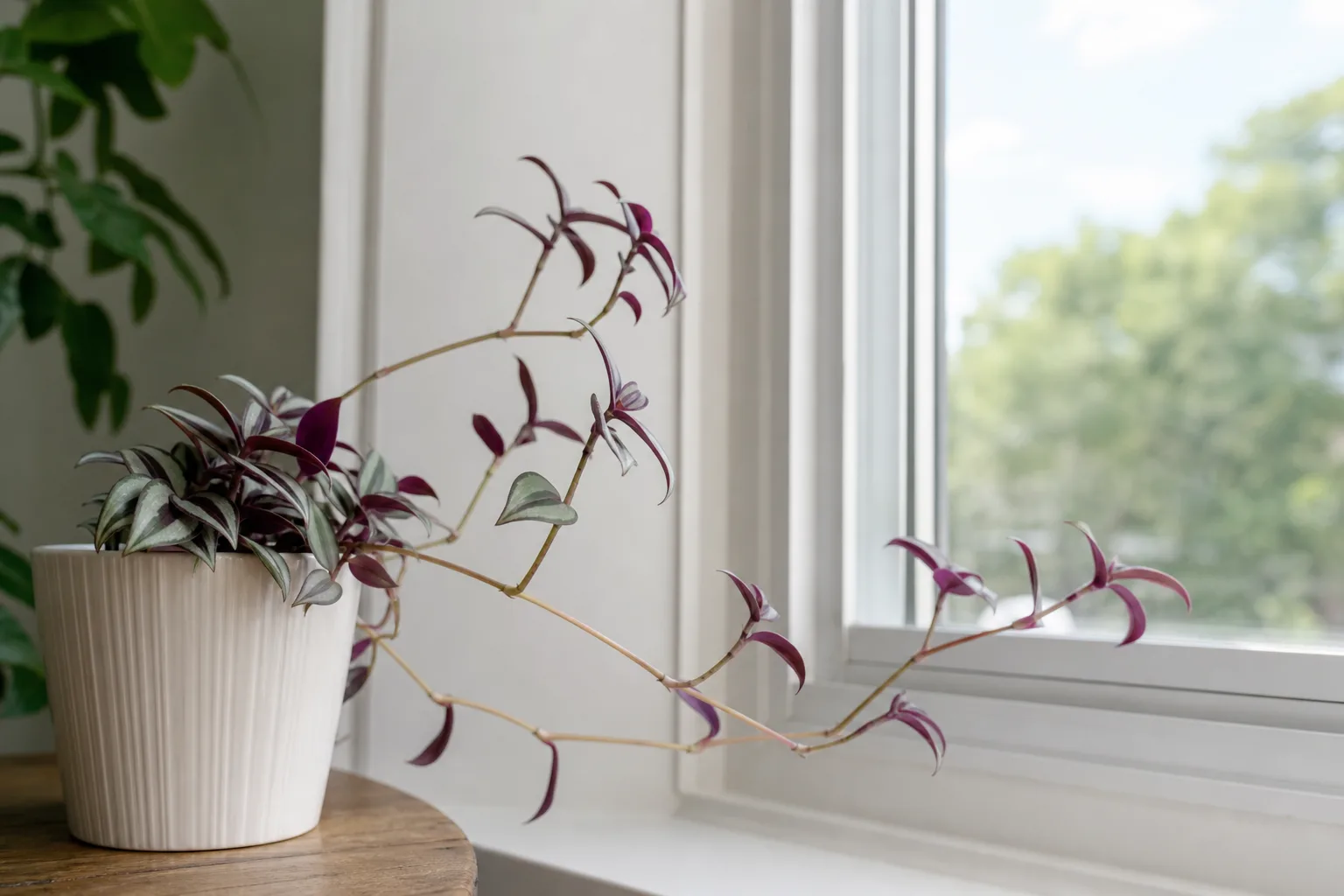
Leggy Growth on Tradescantia Zebrina: Causes, Checks & Fixes
This guide covers leggy growth on Tradescantia Zebrina. See also the general Leggy Growth guide, watering, and light pages for this plant.
Leggy Growth on Tradescantia Zebrina: Causes, Checks & Fixes
Quick answer
Leggy Tradescantia zebrina-inch plant, wandering dude, zebra plant-is a shape and stretch problem on a naturally fast trailing vine. Healthy zebrina should read as stacked purple-and-silver foliage along multiple stems. When light is weak, pinching stops, or a hanging basket shades its own crown, vines become ladder-like: long naked internodes below, vivid striped leaves only at the tips.
This page covers rejuvenation rescue-removing bare middles, pinching above nodes, and rooting cuttings back into the same pot. If your main question is which window, how far from glass, or how to acclimate after a move, start with the not-enough-light guide and the Tradescantia zebrina light guide. Cut placement, tool hygiene, and hard-refresh timing live on the pruning guide.
First step: remove the longest leafless middle section on each vine and pinch every remaining growing tip just above a node. That single structural correction redirects growth to buds below the cut and stops bare skeletons from lengthening further. If new leaves are dull grey-green with wide gaps and the plant leans hard toward glass, pair the pinch with a brighter filtered spot-shape fixes and light fixes work together on zebrina, not as either-or choices.
What leggy growth looks like on Tradescantia Zebrina
Leggy zebrina is recognizable once you trace vines from crown to tip instead of judging only the colorful ends.
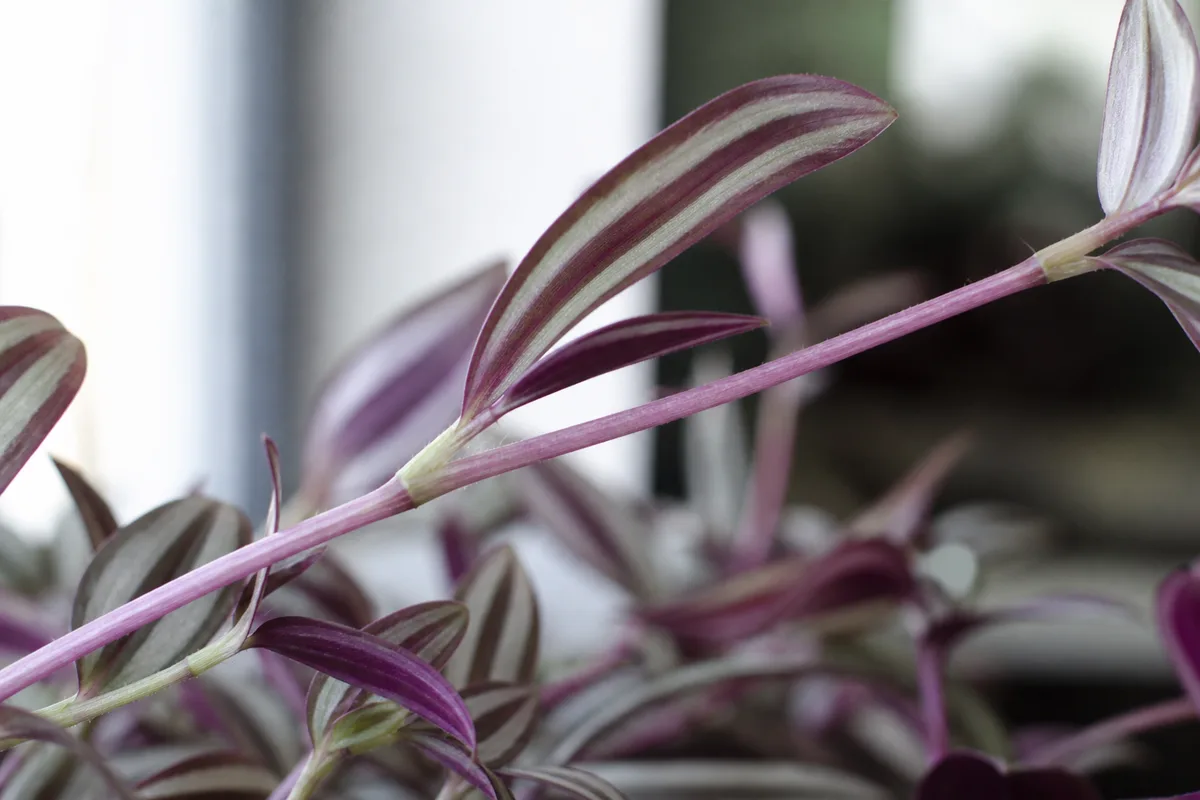
Leggy Growth symptoms on Tradescantia Zebrina - compare with healthy tissue on the same plant.
Typical leggy-growth signs:
- Long bare internodes-gaps between leaf pairs visibly wider than growth from a bright window; measure the newest section against older compact nodes lower on the same stem
- Tip-heavy silhouette in hanging baskets-healthy striped foliage clustered at vine ends while the crown and middle stems are leafless
- Ladder-like trailing form rather than a stacked, bushy cascade
- Faded silver-purple striping on new leaves when low light is driving the stretch-not required for pure maintenance legginess, but common when both causes stack
- One-sided lean toward the brightest window or lamp while the shaded back side stays paler
- Crown thinning while tips keep growing-NC State Extension notes that in low lighting, stems lose lower leaves and remaining foliage loses much of its coloring
- Thin, pliable stems that snap easily at nodes when weight concentrates at the ends
Zebrina grows fast, so stretch can advance within a few weeks after pinching stops or light drops. That is different from normal trailing age on an otherwise vivid plant: if only the oldest nodes elongate while new growth stays tightly striped and purple-flushed, you may need light maintenance, not a full basket rescue.
Why Tradescantia Zebrina gets leggy
Low light and etiolation (most common driver)
Zebrina evolved at bright forest edges and wants open-sky brightness indoors without baking in hot midday sun. In dim corners the plant does not pause-it stretches toward photons. Internodes elongate, a process called etiolation-elongated, spindly stems with paler leaves from insufficient light.
Wisconsin Horticulture Extension notes that in low light conditions, stems lose lower leaves and leaves lose much of their coloring. NC State Extension adds that greatest color intensity appears with stronger light, while low lighting thins the crown. When fade and lean dominate, read the not-enough-light guide first-then return here for shape rescue once brighter placement is set.
Skipped pinching on a fast trailer
Zebrina is a rapid grower that adds length continuously unless you intervene. NC State Extension on tradescantia notes that pinching back stems encourages new growth and prevents leggy stems, and that these plants root easily at stem nodes from cuttings.
Without routine tip pinches, one vine races outward-especially in warm bright conditions where the plant has energy to grow but no reason to branch at lower nodes. Indoor baskets bought full and never trimmed often look acceptable for a month, then reveal bare middles by week six.
Crown-vs-tips shading in hanging baskets
Room brightness misleads on baskets. The floor beside a window can look lit while the canopy hangs below the sill in shade. Trailing stems also shade lower leaves on themselves, so the crown thins even when tips near glass still look striped. “Near a window” should mean the top of the plant sees window sky, not that the basket hangs in a corner while glass is meters away.
Nodes do not refoliate bare internodes
This is the non-obvious zebrina mechanic owners miss: new leaves emerge at nodes, the small joints where leaves clasp the thin succulent stem. A long naked internode between two old leaf scars rarely sprouts foliage again. Missouri Botanical Garden describes zebrina as rooting easily at nodes-those same joints are where branching and refoliation happen after a cut.
Waiting for bare middle sections to “fill in” on their own wastes months. Remove bare middles, pinch above live nodes, or replant tip cuttings into the crown.
Leggy growth vs not enough light - which guide to read
| What you see most | Start here | Why |
|---|---|---|
| Long bare vines, tip-only foliage, neglected pinching | This page (leggy growth) | Shape rescue and rejuvenation |
| Faded striping, window lean, dim placement questions | Not enough light | Window distance and acclimation |
| Cut placement, hard refresh, tool hygiene | Pruning guide | Full shaping workflow |
| Almost no new growth for weeks | Slow growth | Stall, not just stretch |
Both guides often apply to the same basket. Upgrade light when color and lean scream “dim,” then prune once the plant has photons to branch-not pinching alone in a dark corner.
How to confirm the cause
Run this zebrina-specific checklist before you repot, fertilize, or spray:
- Internode measurement - Compare the newest stem section to growth from when the plant was compact. Gaps longer than older nodes confirm ongoing stretch.
- Pinch history - When did you last remove tips above a node or cut out bare middles? “Never since purchase” points to maintenance legginess even in decent light.
- Crown inspection - Lift vines and look at the soil surface. Black mush, sour smell, or stems soft at the base suggest overwatering layered on stretch-not pinching alone.
- Canopy height - Does the top of the basket sit at or above window sill height? Crown below the sill often explains bare lower stems while tips look fine.
- Color on new leaves - Consecutive dull grey-green pairs with weakening striping mean light is limiting; pair pruning with placement fixes from the light guide.
- Pest scan - Mealybug cotton at nodes and fine webbing on new tips can weaken branching. Inspect joints before assuming pure etiolation.
- Moisture rhythm - Wet mix for many days while stems stretch can mean low light is slowing water use. Firm roots and normal dry-down support a pruning-first approach.
Confirmation test: After removing one bare middle and pinching tips above nodes, you should see new shoots at nodes within 7 to 14 days in bright active-season conditions. If branching stays pale and sparse, upgrade light before the next pinch round.
First fix: remove bare middles and pinch above nodes
Cut out the longest leafless middle section on each vine, then pinch every remaining growing tip just above a healthy node-about 5 mm above the joint where leaves attach. Use clean scissors; wipe blades with alcohol if you removed rot or pests.
That paired action is the correct first response when vines are already ladder-like. It stops skeleton lengthening and wakes dormant buds below the cut. Do not hard-chop every stem to stubs on day one unless the pot is mostly bare wood; stage severe renewal over one to two sessions following the pruning guide one-third foliage rule.
After the first cut:
- Root the healthiest tip cuttings back into the same pot at the crown for instant fill-zebrina roots easily at nodes in moist mix or water. See the propagation guide for grouping cuttings at the soil line.
- Move to brighter filtered light if striping is faded or internodes widened after a recent pinch-pinching cannot substitute for photons in a dark room.
- Hold fertilizer for one week on a stressed basket; do not feed stretch hoping for bushiness.
- Rotate the basket weekly so all sides branch evenly toward the window.
Step-by-step recovery
Once bare middles are removed and tips pinched:
- Wait 7 to 14 days for lateral buds to break at nodes in bright warm conditions.
- Pinch again when new tips extend beyond the canopy-every few weeks during active growth keeps internodes short.
- Discard fully bare vines at the crown rather than coiling them back into the pot; they add length without foliage.
- Replant grouped cuttings into gaps at the soil surface when the crown looks empty-this is faster than waiting for old stems to branch.
- Upgrade light if two pinch rounds produce thin pale shoots with wide spacing-read not enough light before a third pinch.
- Hard refresh in early spring if more than half of each vine is leafless: cut remaining stems to a few inches with leaves on each stub, replant the best tips. Missouri Botanical Garden notes zebrina may be pruned hard in very early spring if needed.
Make one major stress at a time when diagnosing. Prune first when form is the issue; relocate first when color fade and window lean dominate-then prune once new growth proves the plant has energy.
Recovery timeline
In bright active-season conditions, new shoots often appear at nodes within 7 to 14 days after a pinch. Noticeable basket fill from one pruning round typically takes three to four weeks. A hard spring refresh with several replanted cuttings can look substantially fuller in four to six weeks.
Old bare internodes never shorten. Stretched stem sections stay long; success means new branches emerging lower on the plant, replanted cuttings rooting at the crown, and tighter internodes on fresh growth.
Winter cuts in low light may sit nearly unchanged until warmth and brightness return-postpone heavy renewal unless you can add a grow light. If no branching appears after three weeks in a clearly bright spot, revisit roots in wet soil or pests on nodes before another pinch cycle.
Lookalike symptoms to rule out
Not enough light - Faded striping, pronounced lean toward glass, and smaller paler new leaves across the plant. Fix placement and acclimate before repeated pinching. See not enough light on Tradescantia zebrina.
Slow growth - Little or no new tissue for weeks in warm weather. Different from vigorous tip growth on bare stems. See slow growth.
Overwatering at the crown - Yellow leaves, soggy mix, soft black stems at the base. Leggy stretch can coexist, but root trouble needs separate treatment. See overwatering.
Normal trailing on an otherwise vivid plant - A few elongated older nodes on a basket that still produces tightly striped new growth may need only routine pinching, not a hard refresh.
Pests on weak nodes - Mealybug clusters and spider mite stippling on new tips can stall branching. Treat pests before expecting pinching alone to restore shape.
What not to do
Do not wait for bare middle internodes to refoliate-they rarely do on zebrina.
Do not pinch repeatedly in a dark corner hoping for bushiness. Side shoots need light to thicken; Clemson HGIC notes insufficient light causes stretch on indoor plants.
Do not fertilize a stretched basket before correcting light and form-feed only after compact new growth returns.
Do not coil bare vines back into the pot for “fullness”; they add tangle without leaves and trap moisture at the crown.
Do not stack Tradescantia Zebrina repotting guide, hard pruning, and pesticide on the same day. Give the plant one stress at a time.
Do not relocate a shade-adapted zebrina to harsh direct south-window sun the same day you prune-acclimate over 7 to 14 days to avoid bleaching.
How to prevent leggy Tradescantia zebrina next time
Pinch on a schedule-every few weeks during active growth whenever internodes start to lengthen, not only when the basket already looks skeletal.
Remove bare middles early before they dominate the pot; Wisconsin Extension notes any leggy growth can be pruned off and used as cuttings for propagation.
Keep canopy at window height in bright filtered light-east windows within 1 to 3 feet are a reliable default per the light guide.
Rotate baskets weekly so all sides branch evenly and one face does not shade the rest.
Root fresh tips into the crown when gaps appear instead of nursing years of tired vine skeleton.
Reassess light each autumn when daylight shortens-neglected pinching and seasonal dimming often combine. Add grow lights before stems go fully bare.
Keep technique reference handy in the pruning guide for node placement and sanitizing tools after rot or pests.
When to worry
Pure legginess is a cosmetic and maintenance issue-your zebrina is not dying because it looks like a sparse mobile.
Escalate when:
- Soft black stems at the crown with sour soil smell suggest rot, not stretch alone
- Yellow mushy leaves and wet mix persist after light and pruning corrections
- Mealybug or mite populations explode on multiple nodes after prolonged neglect
- No branching after three to four weeks of pinching in a clearly bright location-reassess light, roots, or pests
Gradual tip-heavy growth over weeks is fixable with pruning and light checks-no panic, but do not wait until every stem is bare wood from crown to tip.
Conclusion
Leggy Tradescantia zebrina tells you the basket outgrew its light, its pinching schedule, or both. Remove bare middles, pinch above nodes, and root healthy cuttings back into the crown-old naked internodes will not refoliate on their own. Pair shape rescue with brighter filtered light when striping fades or internodes keep widening after a pinch. For window placement read not enough light; for cut mechanics use the pruning guide; for rooting trimmings see propagation.
Related zebrina problems: not enough light, slow growth, overwatering. Care guides: pruning, light, overview.
When to use this page vs other Tradescantia Zebrina guides
- Tradescantia Zebrina watering guide - Use for routine moisture checks before assuming leggy growth is the main issue.
- Tradescantia Zebrina problems hub - Browse all 2 common issues on this species.